This is a Regency romance. Regency romance is a super-popular genre, which is why I made it my business to find a lesser-known indie Regency romance with only a few reviews. Because that’s how we do things here at Ruined Chapel.
To be clear, this book is more in the Regency Historical sub-category, in that the characters use many modern expressions and tend to behave more in accordance with present-day attitudes, without much care for the mores of the actual Regency period.
In other words, this book has sex scenes. Don’t go in expecting Jane Austen. It’s raunchy and fast-paced. Maybe it’s more accurate to call it a Regency sex comedy.
And that’s not all. Penelope, the impulsive, stubborn heroine, moonlights as a highwayman when she’s not flirting with Lord Westfield, Duke of Burwick. There’s a subplot with smugglers and kidnappers that culminates in a violent showdown.
The book is fast-paced. Sometimes, it was so fast-paced I found It difficult to keep track of all the characters were and their motivations. It’s probably a good idea to keep notes on characters as they are introduced. Also, it has a trope that’s common in romance novels: two characters who are obviously going to end up together refusing to just admit they’re in love for no particular reason. This drives me nuts; but it’s so frequently used I guess romance readers don’t mind it. I wouldn’t want to marry somebody whose attitude towards me seemed to vary by the hour, but hey; that’s just me.
Despite this criticism, the book is enjoyable. I think I’m right in saying the author doesn’t mean for it to be taken too seriously; hence the “funny” in the subtitle. There are some over-the-top scenes of bawdy, farcical humor that are quite enjoyable. It may not be to everyone’s taste, but it’s still an entertaining tale with a bit of naughtiness to it.
On a technical note: there are a few typos throughout the book. It didn’t really bother me that much, but some readers are more sensitive to this sort of thing than others.
And it has to be said: I’m not normally one to read Regency romances. I’m nowhere near the target market for this book. And even I enjoyed it, despite its flaws. Regency romance fans who like their tales to err on the silly side are sure to find it a treat.
To understand the future, we must understand the past. I’ve used this strange, unwieldy phrase “techno-decadentism” in reference to an artistic movement; one that is, I will argue, an heir to the tradition of “just plain old” decadentism. But what was the original decadentism? Where did it come from? And can we learn anything from it?
Come with me, once again, to the 1890s. I talked in the previous post about fin de siècle. But now we have to experience it.
It’s 1897 and there’s a revival of The Yeomen of the Guard on at the Savoy. Check out that poster!
A black figure against a yellow background–how striking. Then again, we’ve seen this before–in 1896, The Grand Duke was playing at the Savoy, with a very similar poster–indeed, by the same artist:
Of course, Grand Duke depicts a broken-down critter, not an imposing figure. And yet, both, in their own way, symbolize the same thing. Do I even have to tell you what they symbolize? Decadence means decay, and the final stage of decay is of course death. A lone figure, symbolizing death… it evokes Poe’s Masque of the Red Death.
Ah, now, that’s a bit of a cheat. I have no business dragging a poem from 1842 into a conversation about the 1890s. Or do I? After all, Poe’s influence on the decadent movement was great, and if he was born a little too early, and a lot too west, we can’t blame him for it. Artistic movements usually take a while to bloom; like a plant. “A flower, planted on Poe’s grave,” as I once heard someone describe it.
You might think these posters are similar simply because they are by the same artist, Dudley Hardy. But this is more than just a single artist’s distinctive touch. It’s part of something bigger–hence, we call it an aesthetic. See again the example of Théophile Steinlen’s 1896 poster for Le Chat Noir:
Or, maybe the single most famous piece of artwork to come out of this epoch: The Scream, by Edvard Munch (1893). Again, an ominous background surrounding a surreal and nightmarish figure:
Everything about Fin de siècle is conveying a mood of pessimism, of decline and decay. In England, a venerable old monarch was growing grey. Victoria’s days were numbered, as her subjects must have known, but would not say. Maybe that’s why Sir James Frazer’s anthropological study of death and rebirth myths The Golden Bough (1890) made such a hit.
You ask: am I just cherry-picking here? Finding all the seemingly-related works from a certain period and leaving out ones that don’t fit? I’m sure there must have been good old-fashioned romantic art being produced in the 1890s. (Actually, fin de siecle art was centered in Europe–other parts of the world were in an altogether different phases of civilization at this point.)
Anyway, yes: I might indeed be cherry-picking facts. It’s easy to find themes that fit a narrative and discard those that don’t, since we know what happened next, and therefore are easily predisposed to see patterns that might not even exist.
To know if anything is really going on here in the 1890s, we have to try to look at the world through the eyes of its inhabitants. This is where my amateurish Gilbert and Sullivan studies come in handy: in their heyday of the 1870s and 1880s, Gilbert and Sullivan made their names with comic operas known for their light humor, bubbly dialogue, and romance. They are optimistic and fun–even when they talk about darker subjects like execution.
And then we come to the 1890s, and things change. Their next-to-last work, Utopia, Limited doesn’t just mock the foibles of particular public figures, but is a broad satire on the British Empire itself. And their last, the aforementioned Grand Duke is cynical mockery of almost everything–love, death and the medium of theatrical entertainment itself. It’s funny (actually, in my opinion one of their funniest) but it doesn’t have heart like their most famous operas do.
The opera is a decadent work, as Professor Jones has suggested–perhaps a deliberate parody of literary trends near the time of Wilde’s Salome, when perverse attitudes (necrophilia, for one) and violence were being seriously depicted on the European stage. Certainly The Grand Duke is decadent in the literal sense of representing physical and mental, moral and political decay.
He explicitly makes the comparison with fertility myths:
The decrepit Rudolph has the role of the Old King whose death signifies the end of the year, the defeat of Winter in the ceremonial contest with Spring. “Broken-down critter” that he is, he makes a perfect monarch for a comic wasteland… Rudolph undergoes legal death in the mock duel–”the moment of ritual sacrifice”–and the plump, sausage-devouring comedian takes over as duke for a day and Lord of Misrule.
I can’t prove an entire shift in the zeitgeist based on the work of a curmudgeonly old librettist and his alienated and sickly composer. But, something is going on here, wouldn’t you say? Things that would have never been tolerated at the height of Victorian prudishness are now becoming mainstream.
There is a sense of a cycle, a cycle that is coming to an end. The cynicism, boredom, and restless neuroticism that characterize a declining empire who knows its best days are behind it.
I’ve always liked The Grand Duke. It was the least popular Gilbert and Sullivan opera, but its atmosphere is strangely compelling to me. But I never bothered to see it in its proper context until I began to study the 1890s for another reason: Robert W. Chambers’ collection of stories, The King in Yellow, and in particular the first story, “The Repairer of Reputations.”
I’ve talked about it before. A lot. Hell, I’ve actually posted the story with my annotations on this blog. So a lot of this will be old hat to longtime readers. But we just can’t understand this strange world of fin de siècle without understanding The King in Yellow. Sorry if this is repetitious for some of you.
Despite my enthusiasm for it, I’ve never actually reviewed The King in Yellow, however, because something in it defies reviewing. The key part of the book is the fictional play described within it, also called The King in Yellow, which connects the first four stories. Chambers only quotes bits and pieces of the play, and, notably, only from Act I. Act II–the really juicy bit that drives people mad–is left a mystery to the reader. Personally, I’ve always imagined it as something to do with an all-consuming plague, like the aforementioned Masque of the Red Death. And I think it’s not too much of a stretch to say there is an echo of Poe’s story in these mysterious lines quoted from the play:
CAMILLA: You, sir, should unmask. STRANGER: Indeed? CASSILDA: Indeed it’s time. We all have laid aside disguise but you. STRANGER: I wear no mask. CAMILLA: (Terrified, aside to Cassilda.) No mask? No mask!
But that’s just me. The beauty of Chambers’ technique is that he knows that what the reader imagines will be scarier than anything he himself could create.
If The King in Yellow has a flaw, it’s that its tales are arranged in the wrong order, proceeding from most bizarre to most mundane. M.R. James would have known that the way to truly mess with the reader is to lull them at first, before springing the trap. But, probably some editor told Chambers that one of the ten rules of writing was to lead with the exciting bit, or some such conventional wisdom. Times change; but people who don’t appreciate art remain the same, and also remain in charge of deciding what shall be published.
Recall that, as I said above, it is hard to evaluate an era honestly, because we know what happened. It’s interesting to get a view of the people of the era, who don’t know where it’s all going. It’s even more interesting to read their predictions for where they think it will go. Chambers provides us with just such a prediction, albeit wrapped in a curious package.
The Repairer of Reputations begins:
Toward the end of the year 1920 the Government of the United States had practically completed the programme, adopted during the last months of President W———‘s administration. The country was apparently tranquil. Everybody knows how the Tariff and Labour questions were settled. The war with Germany, incident on that country’s ————-, had left no visible scars upon the republic…
Okay, so I’m playing censor here and cutting stuff out. Did your mind automatically fill in those blanks? The natural thing is to assume the first is filled with “Wilson” and the second with “invasion of France.”
If you do that, you have a totally nondescript history of someone talking about actual 1920. Admittedly, it’s a decidedly vague description, but still, it works.
But of course, this story was written in 1895. And it’s President Winthrop and Germany seized the Samoan islands. Which actually happened a few years after Chambers wrote the book, although it was not the cause of the major war.
What’s even weirder is that, as the story develops, we learn that Hildred Castaigne, the narrator telling us all this, is, um, not exactly reliable. In fact, he’s so unreliable that it might not even be set in 1920 at all, and yet his doubly-imaginary 1920 seems plausible to us, as readers who, unlike Chambers, know what happened in real 1920.
Does this creep you out just a little? There’s more: the future that our narrator reports (envisions?) includes such things as government lethal chambers, where people who find existence unendurable may find relief. Was that prescient? I dunno, let’s check with the American Eugenics Society, founded in 1922.
So what the heck? Was Robert W. Chambers some sort of prophet or time-traveler gifted with uncanny insight into the future? And if he was, we must ask: why did he use his powers only to write one cool story, and not for something more epic?
A more plausible explanation, and much more agreeable to my skeptical, materialist mind, is that there is such a thing a zeitgeist where all trends are pointing towards something happening. For example, could you find some literary work from the early 2000s that involved a highly-contagious pandemic? Why yes, you could! But really, in retrospect, isn’t that one of those things that any intelligent person who was paying attention could have foreseen?
And this is why fin de siècle literature is so interesting. If it was all just a coincidence that around 1890 everybody started to feel cynical, bored, and generally like the old order is about to go up in some sort of apocalyptic catastrophe, and it did, then it’s a mere historical curiosity.
But if, on the other hand, there is some sort of predictive value in this–if perhaps people feeling this pervasive sense of decay had something to do with the ultimate fate of Europe, either because it was a self-fulfilling prophecy or simply because anyone attuned to the spirit of the age could see where it was going, then this is very interesting indeed.
And it would be especially interesting if we had some reason to believe that it was happening again… but that’s for another time. 😉
I have to start this review with some context: I started reading this book shortly after doing some beta reading for a friend of mine. The book I was beta reading was an extremely dark, harrowing story about terrorism. While it’s a great story, it was nice to be able to turn from that world (not to mention real life news) into this book, which is a sweet, uplifting romance.
Not that there aren’t serious moments in Second Chance Romance. The female lead, Melanie Harper, has a major tragedy in her past. Trying to forget it, she’s immersed herself in her work as a divorce attorney in Washington D.C., but has come to the small town of Sweet Gum, Virginia to convince her Aunt Phoebe to abandon her little diner and move to D.C.
While there, Melanie has a car accident and is rescued by Jackson Daughtry, a single father raising his young daughter, Rebecca, after his wife left him.
After Melanie recovers from her accident, Phoebe suffers a stroke, rendering her unable to run her business, and forcing Melanie and Jackson to work together to keep the diner running. At first, the big-city lawyer and the small-town paramedic clash, but soon–it’s a romance, after all–they begin to develop feelings for each other.
Not that it’s smooth sailing even then. Jackson and Melanie still disagree over her plan to close the diner and move her aunt to D.C. And to make matters even more difficult, Jackson’s ex-wife shows up again.
I should mention that this is a Love Inspired book, which is an imprint that publishes Christian fiction. So there are a few references to characters praying and facing struggles with their faith throughout the book. It never comes across as strident or preachy, however; and largely seemed right for the characters.
All in all, it’s a very sweet story. There are no big surprises or shocking twists, and there shouldn’t be in a book like this. It’s a feel-good book. And while it’s not the sort of thing I often read, it’s quite enjoyable. There is a place in every art form for both the Rockwell-esque and the Goya-esque. Though my own tastes skew towards the latter, I can still respect the former.
This is a perfect book for anyone who wants to enjoy a light and uplifting romance in a pleasant small-town atmosphere.
Jane Got a Gun premiered on January 29, 2016. I had been looking forward to it since I learned of its existence, and with the film finally, finally hitting the big screen, of course I had to see it on opening day. It was a bright, unseasonably warm day for winter in Ohio, and I went to the nearby AMC for an afternoon show in a nearly-deserted theater.
I enjoyed the film from the start. It was not just good, it was surprisingly good. Then, at a certain point, about halfway through the film, the drama reached a critical point, and I can distinctly remember thinking, “Oh, no–I certainly hope they’re not going to…”
But hold up a minute. I’m getting ahead of myself, diving right in to the memories and not putting things in the right order. Like the film’s heroine Jane Ballard (Natalie Portman) says at one point, “It’s hard to remember how things seemed… when you know how they actually turned out.”
***
The behind-the-scenes story of Jane Got a Gun begins in 2012, with a script by Brian Duffield, to be distributed by Relativity Media, directed by Lynne Ramsay and starring Natalie Portman. Michael Fassbender was cast in the role of Dan Frost, Jane’s former fiancé. However, Fassbender soon left the part, and was replaced by Joel Edgerton, who had originally been cast as the villain, John Bishop. Jude Law and Bradley Cooper were both briefly on board, before finally Ewan McGregor was cast as Bishop. In the middle of all this, Ramsay left the production less than amicably, causing more turmoil that was resolved in part thanks to the timely intercession of lawyer David Boies.
Ramsay was replaced by Gavin O’Connor. O’Connor, Edgerton and screenwriter Anthony Tambakis then re-wrote Duffield’s script, and filming finally took place in 2013. The filming itself seems to have gone smoothly–in the words of Edgerton, “We’re winning out there.”
Relativity Media had initially scheduled the film for a February 2015 release. But it was delayed, and Relativity filed for bankruptcy in mid-2015. Fortunately, there was another studio that had agreed to distribute the film, and the rights to Jane Got a Gun were released from Relativity and secured by the Weinstein Company, which scheduled the film for distribution.
The Paris premiere was scheduled for November 15, 2015, but was canceled due to the November 13 terrorist attacks. The film finally premiered in Germany in late December 2015, and in France and the United States in January 2016.
Of course, I can’t talk about a Weinstein Company film without also talking about the infamous film producer, who was then about a year away from being publicly disgraced. One of the many unsavory aspects of Harvey Weinstein’s personality that came to light after his downfall was that he would occasionally sabotage his own company’s films. I have no idea if anything like that happened with Jane Got a Gun, but the decision not to screen the film for critics can’t have helped its chances, and undoubtedly contributed to its poor showing at the box office.
It was a film dogged at every step by negativity, with only cursory promotional efforts, in a relatively unpopular genre, and hamstrung by a misleading title that makes it sound more like a fast-paced action picture than what it really is.
And after all that, it was gone as soon as it had come. It was only in theaters for about three weeks and grossed about $3 million against a $25 million budget.
As anyone who followed my blog at the time knows, I loved the movie. I wrote a glowing review. Two glowing reviews, actually, because I wrote about it again in more detail when it came out on home media. And owing, I suspect, to the scarcity of other reviews, these were some of my most-viewed posts ever.
Which speaks to the fact that a major reason it wasn’t more successful is that not many movie-goers ever knew it existed. And I’d argue that the reasons not many movie-goers knew it existed can tell us a lot about the movie business, the entertainment industry as a whole, and American culture generally.
That sounds like quite a leap, I know. (Or, as Dan Frost would say, a “very big jump, my friend.”) To begin with, let’s talk about why Jane Got a Gun is significant to me.
***
Jane Ballard (Natalie Portman)
Natalie Portman is probably my favorite actress, and part of the reason for that, as I’ve discussed before, is her willingness to experiment. She doesn’t let herself be typecast, but is willing to play all sorts of different roles in different kinds of movies. I respect this risk-taking. Portman films aren’t always good, but they are almost always interesting.
I also like movies that take place in remote, bleak desert settings, and the New Mexico landscapes of Jane Got a Gun are just gorgeous to my eye. While I could do without the washed-out lens filter, the sweeping vistas and extraordinary rock formations make the setting instantly compelling.
I went into Jane Got a Gun hoping to see Natalie Portman in a good old-fashioned western adventure, and as a bonus, see the always-entertaining Ewan McGregor as a villain I loved to hate. And I got all that–but the movie surprised me at the same time, even while delivering on all fronts. How is that possible?
Time for one of my Socratic movie quizzes: what’s Jane Got a Gun about?
Okay, since many of you haven’t seen it, I’ll give you the cliffs-notes summary answer. It’s not the real answer, of course, but you know what I’m like. And anyway, a little plot synopsis will be handy to have as you read this.
Jane Got a Gun is about Jane Ballard, a woman who was kidnapped by a gang of criminals, escaped with the help of a man whom she married and built a new life with, only to find herself once again pursued by the gang, and forced to seek help from her ex-fiancé, Dan Frost, whom she had until recently believed died in the Civil War.
Dan Frost (Joel Edgerton) gazes forlornly down from a ridge.
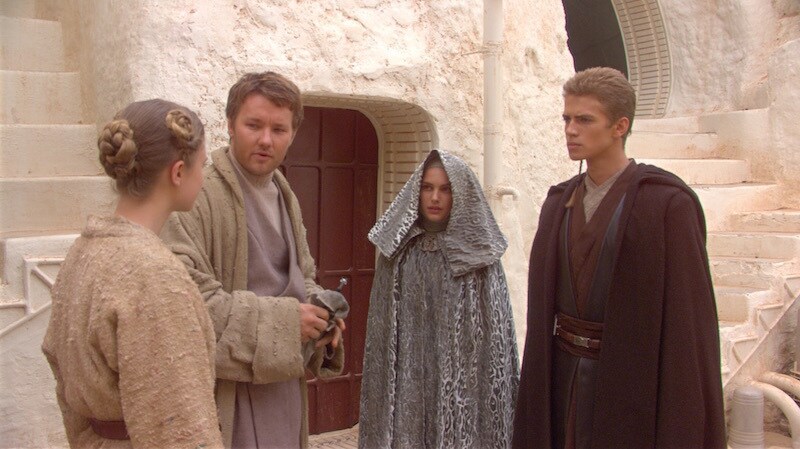
Ah, Dan Frost. He’s as good a place as any to start with where this movie surprised me. Previously, I knew Joel Edgerton as young Uncle Owen in the Star Wars prequels, where he has about two minutes of screen time and does nothing but stand around and hold a dirty rag.
After you watch Jane Got a Gun, it’s impossible to watch the scenes with Owen in Attack of the Clones the same way. In the scene from Star Wars, Portman and Edgerton are both unremarkable, standing vacantly with no lines or “stage business” to do. In Jane Got a Gun, every scene between the two is filled with tension–Edgerton can convey so much emotion with simply an expression, or a grunt, or a small gesture. And as Edgerton said of his co-star’s talents, “We’ve actually coined the phrase ‘The Portman’ to describe how she can say a line without saying a word, just with a look.”
This illustrates one way in which Jane Got a Gun runs contrary to modern sensibilities. Characters–especially the good characters–do not wear their hearts on their sleeves, but for the most part behave with reserve and restraint. We only see Jane and Dan kiss in flashbacks–circumstances dictate they must keep their feelings controlled, and the few glimpses we see of their emotions bubbling close to the surface are moments of intense drama. Even as they prepare to fight for their lives, the couple is reminded constantly of their past.
One good example of this is the transition from Jane’s memory of a carefree afternoon with her fiancé back in Missouri to the grim present, as the sweaty, tired figure of her former lover takes a break from digging a defensive trench to check the vast desolation for any sign of the Bishop gang. Without a word being spoken, Portman’s face and the soundtrack convey the bittersweetness of remembering happier times.
Jane and Dan, in a flashback
***
I’ve lent my copy of Jane Got a Gun to a great many friends, at first just out of a sense of wanting to share something I enjoyed, and over time out of an interest in the different reactions they would have to it. Some of them have loved it as much as I do. Others thought it was just middling, still others have called it boring and bad. One friend told me he thought it was dull, but that perhaps that was an intentional choice, to capture the slower pace of life in the 1870s. Another friend of mine, who generally hates any movie made after 1965, complained about the lens filter but said his wife called the character of Jane Ballard “just about perfect.”
I’ve seen the movie enough times that it gallops by, but at the same time I guess I can understand how some would find it slow… sort of. Well, maybe. No, not really.
Here’s the thing: if you’re used to loud, fast, big, action-packed spectacles of movies, then I guess this would seem slow. And yeah, the title does imply that’s what this film is going to be. A pulse-pounding Wild West shoot-’em-up with a female gunslinger, kind of like the 2006 film Bandidas. Maybe that’s the kind of movie Duffield’s script originally called for. And there’s nothing wrong with that kind of movie. I like Bandidas.
But Jane Got a Gun isn’t that kind of movie. It’s mostly quiet, punctuated by a few moments of intense action. There are no over-the-top special effects or stunt-work. Because it’s not about the action scenes; not really. That’s why the title is so misleading. To say nothing of some of the posters…
(If you’ve ever wondered if people who make movie posters have to watch the movie beforehand, the answer is pretty clearly “no.”)
Jane Got a Gun is not about guns, even though there are guns in it. It’s not about Jane avenging the wrong that was done to her, although that does happen. It’s not about a frontierswoman proving herself just as adept a sharpshooter as the men, although that also happens.
Jane Got a Gun is actually about listening to other people.
***
I think 2016 will be remembered as a very significant year in history. I mean, every year is significant to a historian, since they are all part of a linked causal chain of events, but 2016 is going to be one of those dates that everyone will know, like 1776, 1865, 1939, and 1968.
2016 was the year when the American political system and the unending noise machine of modern communication combined to produce systemic shocks right to the heart of our centuries-old system of government. In 2016, all the fissures and divides across the nation were laid bare, and the repercussions are still being felt, and will be for decades; perhaps centuries to come.
2016 was the year that people shouting at each other through mass media finally, irrevocably, unforgettably, changed the landscape of American politics.
What does this have to do with Jane Got a Gun?
You know how sometimes you’ll hear about how a movie perfectly evokes the “mood” of a certain time? What pretentious critics, like me, call the “zeitgeist?” For example, how Taxi Driver supposedly captured the rebellious alienation of the 1970s.
Jane Got a Gun does the opposite of that. Jane Got a Gun is like if you captured the essential spirit of 2016, and then made something that was in every way the antithesis of it.
Jane and Dan’s relationship changes when they stop arguing and start listening. Dan’s relationship with Jane’s husband, Bill Hammond, changes when he stops making assumptions and listens to what Jane says about him. Even at the climax of the film, when Jane finally confronts John Bishop, she waits to hear what he says before bringing him to justice–and is rewarded for doing so.
It’s a quiet, old-fashioned movie, about the importance of understanding and reconciling with other people. There are villains, yes; but the real drama of Jane Got a Gun is in the relationship between Jane and Dan. It’s more of a romance than an action film, but a romance set against the backdrop of bleak and desolate frontier; a society being built in the shadow of a nation ravaged by war.
John Bishop (Ewan McGregor)
It’s not a Civil War movie, but the recent war has clearly left its mark on the characters, in all sorts of ways, as when the aristocratic John Bishop (who clearly avoided serving on either side) jovially shows off his war souvenirs to Frost. He casually tells the former soldier, while regarding an officer’s pistol used at the battle of Shiloh: “Shiloh means ‘place of peace’ in Hebrew.” Frost, having become all too familiar with the horrors of war, grimly replies, “Ain’t nothin’ peaceful about Shiloh.”
Much of the film is about coming to terms with the after-effects of something horrible, whether it’s Jane overcoming what Bishop and his gang did to her, or Dan overcoming his suffering in a prison camp. And that’s why it’s set in the post-war West, when the country was struggling to build anew, after enduring trauma.
Jane Got a Gun is a film about healing. It’s hard to imagine a film more out of sync with the atmosphere of 2016.
***
In an interview promoting the film, Portman described it as “very American.” Indeed, I’d argue that Jane Got a Gun is possibly one of the most quintessentially American movies made since the turn of the century. It’s a Western, which is the stereotypically American genre. It’s about a pivotal period in the nation’s history–essentially, a re-founding period when the modern United States was being created.
Jane Got a Gun was created by an international grouping of cast and filmmakers including Australians Joel Edgerton and director of photography Mandy Walker, Scottish actor Ewan McGregor, Brazilian actor Rodrigo Santoro, and Irish dialect coach Gerry Grinnell-all bringing new perspectives to the classic American Western.
Portman offers, “It’s always wonderful when people make art in unfamiliar surroundings. Tolstoy’s theory is about how art is about making things strange, and with an Australian and a Brazilian on board it’s already strange and so it’s immediately art. That’s why Sergio Leone made such great Westerns – to have that completely different, non-American vision of the West.”
Put all this together with the production difficulties, and you have a behind-the-scenes narrative that’s nearly as much of a romanticized vision of America as the classic Western genre itself. In my second blog post about the film, I wrote:
Jane Got a Gun evokes the best of the American frontier mythology: hope and triumph in the face of harsh and unforgiving circumstances. That it has such a diverse international cast and crew only adds to this feeling, as people of different nations coming together is very much the story of America itself.
There have been times when I think about these kinds of assertions and wonder, “Am I overstating this? Reading too much into it; seeing things that aren’t there?” I’ve been known to do that sometimes, so it’s certainly possible.
But then there’s this behind-the-scenes photo:
Left to right: Edgerton, Portman and Tambakis. Source
***
Does Jane Got a Gun still matter? Maybe that’s the wrong question. With the exceptions of the people who made it and me, it’s not clear that Jane Got a Gun mattered much to anybody in January 2016.
Does it matter to anyone else now, five years later?
This is the part where I’m supposed to say something like, ‘I’d argue that it does, because…’ or something of the sort. Certainly, it would be pretty rotten of me to lead you all the way down this particularly winding memory lane only to tell you no, it doesn’t matter.
But I can’t answer the question. It’s your call to make, dear reader; not mine. Pretentious critics–again, like me–think we can persuade people, that we can shape tastes, that we can, in some sense, tell people what to think of a film, or a book, or a painting. But we can’t. All we can really do is describe the complex, personal reactions that we have to art.
***
The really key scene in Jane Got a Gun; the one that I think is the emotional heart of it, is the one I mentioned at the start of this post, where for a moment, I was concerned the plot would go in a really stupid direction. It’s the scene where Jane walks out to Dan as he’s digging a defensive trench. Seeing him again has brought back a lot of memories for Jane, and she wants to try to smooth things over with him, on what could be their last day alive. So she says, “Why’d you change your mind to help me?”
Jane knows the answer, of course; and so does Dan: he loves her, even though he thinks she left him for another man, even though he’s probably going to die because of her–he loves her. But Dan is still furious at her, and besides which, she’s married. So he can’t say it, instead grumbling, “I dunno.”
This escalates to a tense discussion in which the two former lovers rehash their past, and all the choices that led them here, each one increasingly blaming the other, until finally Jane says, “You know what, Dan…”
I thought she was going to tell him to leave. I foresaw the most hackneyed Hollywood story imaginable: Jane tells him to get lost, Dan rides off in a huff, only to ride back in at the 11th hour and save the day.
But that didn’t happen. What happened instead is what sets Jane Got a Gun apart.
***
In an interview with Elle magazine in 2013–shortly after filming wrapped on Jane Got a Gun—Portman said:
The fallacy in Hollywood is that if you’re making a “feminist” story, the woman kicks ass and wins. That’s not feminist, that’s macho. A movie about a weak, vulnerable woman can be feminist if it shows a real person that we can empathize with.
One of the contemporary criticisms of Jane Got a Gun was exactly this–that Jane doesn’t single-handedly go in guns-blazing and wipe out Bishop and his gang. Jane Ballard isn’t a one-woman army, and if she were, the film would be worse for it. She fights back, but she does so in a way that makes her relatable.
She is, in other words, “a real person that we can empathize with.”
The film works, or doesn’t, to the extent that the audience is prepared to empathize with the characters. That might be true of most films, although I’d hesitate to say “all films”–there are some that pretty clearly rely solely on spectacle or nostalgia or fan service to sell themselves. That’s one reason Hollywood loves their sequels and franchises so much: it’s easier to expect audiences to continue following characters they already know.
Jane Got a Gun is a throwback to another era of filmmaking. That much is obvious just by virtue of it being a Western. Westerns used to be a staple of Hollywood in the 1950s and ’60s, but have since become increasingly rare. It’s also a throwback in its self-contained nature. Even if it had been a financial success, it’s hard to imagine it spawning a “Jane Ballard” franchise.
It’s a good match for me, because I am a throwback to a different era of filmgoer. I follow movie stars more than franchises, much as audiences did at the height of classic cinema. I saw Jane Got a Gun because it had Natalie Portman and Ewan McGregor in it. (And after seeing it, I watched a bunch of Joel Edgerton films.)
I love the film for the cast’s expressive performances, that communicate so much in so few words. I love the haunting, melancholy soundtrack. I love the vast, sprawling desert setting that is both harsh and beautiful. I love the tight, spare script, that takes us on a journey that is at times very dark, but ultimately uplifting. I’m not ashamed to say I think I could recite the entire film from memory, but I’ll end this retrospective by quoting just two more lines.
The first is the one that I’ve been teasing you with throughout this review. The one that encapsulates the film’s theme–the empathetic optimism that enables Jane to triumph over all the darkness in her life. The line she says after, “You know what, Dan…” The script might have gone any number of directions just then, and maybe in previous iterations, it did.
But what Jane says next is the insight that makes me come back to it again and again, that makes it a film so blatantly out of step with the cultural mood of its epoch, and so wonderfully timeless. After everything she’s suffered, all the misery she’s had to endure, Jane takes a deep breath to collect herself and says to her former lover:
You might want to see a day where the sun don’t just shine on your story. Because there is a whole world out there of other people’s tales, if you just care and listen.
To which, dear reader, I will append only these words, that Dan says to Bill Hammond at a particularly tense moment:
…and I want you to think about that with the shank of time that you’ve got left.
Who doesn’t love a good dystopia? To read about, I mean.
The country (maybe more of a city-state) of Deres-Thorm is a bizarre, surreal nightmare, evocative of North Korea, East Berlin, and every other totalitarian dystopia. The unsuspecting narrator, Horus Blassingame, is thrown from one bizarre obstacle to another, whether it’s from the constantly changing street and building names, the two distinct dialects, or the constant paranoia of the security forces.
The book is darkly comic, with an emphasis on the dark. There are some scenes that are not too far off of Room 101 from Nineteen Eighty-Four. Still, the narrator remains relatively upbeat, despite the torturous conditions he often finds himself in.
It’s a very funny satire on the kinds of horrors that can occur in a Stalinist bureaucracy. I’d call it Kafkaesque, although I’ve never read Kafka, so I may be wrong. But it certainly sounds like the sort of thing I’ve heard people call “Kafkaesque.” (And, well, it says so on the cover.) It also called to mind G.K. Chesterton’s The Man Who Was Thursday, with its surreal and simultaneously funny and disturbing takes on political theory.
I like the book a lot, so I don’t want the following complaints to be misconstrued as reasons not to read it. But I have to put them out there all the same.
First, the only named female character (not counting the genderless Th’pugga) is a prostitute. This is a pet peeve of mine, but I swear, so much modern fiction gives you the idea that prostitution is always and everywhere running rampant. Yes, yes, I know; “world’s oldest profession” and all that; but really.
The second point isn’t even really a criticism, but more of an observation. The most significant exchange in the book, which sums up the entire philosophy governing Deres-Thorm, is when the main antagonist, Pokska, explains that citizens are bound by the laws of their own countries while in Deres-Thorm, just as all citizens of Deres-Thorm are bound by their laws no matter where they are in the world. The logic behind this, he elaborates, is that “the citizen is the property of the State.”
This is pretty horrifying, right? It’s close to a re-formulation of Mussolini’s “Everything within the state, nothing outside the state.” It’s basically the central concept of totalitarianism, and the reader is not slow in seeing how it can lead to exactly the kinds of horrors depicted in this book–not to mention in real life.
But, wait. What is the state? The state is legalized violence, because the state has a monopoly on the legal use of force. (Don’t take my word for it, take Max Weber’s, one of the founders of modern sociology.) In governments structured as liberal democracies and constitutional republics, the people consent to authorize the state to use violence. We issue them a badge, as it were. In other, more brutal forms of government, the state doesn’t need to show the people any stinkin’ badges.
This is an important difference, and I don’t want to minimize it. But… even in liberal democracies… the state still has the authority to deprive us of our freedoms, if it has some reason to do so. Theoretically, at least, the people can hold the state accountable so that it will use its terrible powers only for good. Theoretically. But it has terrible powers, all the same…
My point is, the state kind of does own the citizen, by definition. It can pretend it doesn’t; it can put all sorts of accountability measures and checks and balances in place–and it should, and it does. But still.
And yet, not every state is a hellish Orwellian nightmare. So the state owns the people. So what? Just because you own something doesn’t mean you’ll destroy or mistreat it. Generally the opposite, actually. The problem is when the machinery of the state is controlled by psychopaths. Which, admittedly, happens alarmingly often. And even once is too often. Obviously, the power of the state is alluring to psychopaths, with results like those seen in A True Map of the City.
What I’m driving at here, in my usual roundabout way, is that the book seems to be trying to determine what it is that makes a government go insane and stop serving its people, and instead become a simple exercise in power for power’s sake; to preserve by any means necessary the status of the ruling class.
What we’re really trying to figure out is, “what is the root of tyrannical government?” To determine exactly how creeps like Pokska and Th’pugga came to be running the show in Deres-Thorm.
In an early draft of this review, I had a much longer section on this question, referencing Lord Acton and Plato’s Republic and lots of other stuff like that on the origins of tyranny. But I cut that, because it was wandering too far from the topic at hand. I didn’t want to do that to you. (Again.) But I hope I’ve at least convinced you that there are lots of big ideas in this little book. Maybe some powerful mind will do a truly cogent interpretation of it, like Christopher Hitchens on Nineteen Eighty-Four. But as of right now it only has one review on Amazon, (5 stars, of course) so I think I can safely say it needs more readers.
I’m not sure where to begin with this book. Perhaps a good way to start would be to define what kind of book it is, but you see, there are layers to it. You could approach it in a number of different ways.
One avenue would be to say it’s a romance. The protagonist, Dr. Alasandr Say, is in love with a fellow physicist named Penny. Only that’s not the romance. That’s backstory. Dr. Say goes to a remote village in Scotland as his first post-doctoral research assignment. He has been hired by the foul-tempered Lord Learmonte to transcribe notes taken by an ancestor of the latter, a mysterious scientist whose own research produced a number of bizarre results.
You see though, already I’m getting off-track, because I haven’t gotten to the romance part. Dr. Say strikes up a friendship with Nesta, Lord Learmonte’s daughter, who is being pressured by her father into an arranged marriage with an old family friend.
It’s a classic Victorian romance, or comedy of manners–a drama about engagements made for reasons of family business competing with the desires of the heart. It’s full of well-mannered upper-class society folks holding gatherings, with ladies in dresses and men in suits, all set against the backdrop of a dreamy glen in Scotland. Dr. Say even gallantly assists Nesta after she falls into a river, in a scene straight out of Victorian literature that is charming in its modesty.
Except… it’s not set in the 1800s. Rather, it takes place in a future where much of modern technology has been rendered useless by sun-storms–bursts of energy from the sun that wrought catastrophic damage on the modern world, which is still recovering. The reason for the revival of the old-time fashions is to cover people’s skin against the powerful solar rays. This is retro-futuristic world-building at its finest.
And what is Dr. Say researching, exactly, while on his romantic summer retreat into a dreamy wilderness? It has something to do with the powerful electrical storms that well up nightly, originating from the site of Lord Learmonte’s ancestor’s laboratory. Storms which may be somehow connected to the solar anomalies of decades past, and which local superstition maintains are connected with supernatural forces–such as the glowing will-o’-the-wisps that appear late at night, known as the “Riders” from the “Otherworld.”
You see? I told you this book had layers. Sometimes I felt like I was reading Austen or even Wodehouse; other times it felt closer to something by Jeff Vandermeer. The closest analogue I can think of is Sheila Hurst’s Ocean Echoes, a book that combined interpersonal drama with scientific research and a dash of pure magical fantasy. Not many books give you romance, magic, mystery, and glimpses into the politics of scientific research funding, but Ocean Echoes does, and A Summer in Amber does too.
I could go on more about how much I enjoyed this book, but it seems better to let you discover the mysteries and bewitching atmosphere of Glen Lonon and Maig Glen for yourself. It’s a marvelous place. Be sure to check out some of the supplemental material, such as maps etc., on the author’s blog.
Writers Supporting Writers is a new blog run by Mark Paxson, Audrey Driscoll, Susan Nicholls, Trent Lewin, and yours truly. You can find posts and video chats about all sorts of indie writing matters there. Go check it out, and please feel free to comment.
One of the greatest things about the indie writing community is how indie authors continually support one another. We occasionally say it feels like the only people who read our books are other authors–but by my lights, that’s a good thing. It’s better to get feedback from people who actually have a handle on how tough writing is.
My hope is that this site will be a place where indie authors can gather to discuss our experiences. I’ve already met one indie author thanks to this site–C. Litka. I’ll be reviewing one of his books later this week.
So visit Writers Supporting Writers; read some posts, make some comments, and maybe discover some new indie authors!
This is a cover for a 1980 edition. There are many like it–and many un-like it–but this one is my favorite.
Starship Troopers is a famous book, with a profound influence on modern science fiction. It’s one of the earliest known appearances of powered armor in fiction, elements of its setting can be seen in countless other science-fiction works about humans battling alien insects, and it was the basis for a cult-classic movie franchise.
The book is told in first person by Juan “Johnny” Rico, a soldier in the Mobile Infantry. It begins with Rico and his platoon attacking an enemy planet, then flashes back to when Rico joined the military, over the objections of his father.
Rico details all the details of basic training, as the drill sergeants mold the recruits into a fighting force. Occasionally, he flashes further back to his high school class in “History and Moral Philosophy,” taught by a retired officer, Lt. Colonel Dubois.
Throughout the book, Rico reflects on Dubois’ lectures. And why is that? Well, we’ll talk about that later.
Eventually, Rico graduates and joins the war against the bugs. His mother is killed by a bug attack on Buenos Aires, a devastating attack which mobilizes Terran forces against the bugs, and Rico soon ships out to attack Klendathu as part of the formidable unit “Rasczak’s Roughnecks.”
Ultimately, Rico becomes an officer and, after another daring raid to capture a “brain bug,” becomes an officer and commander of “Rico’s Roughnecks.”
There really isn’t that much sci-fi stuff in the book. Apart from a few episodes of high-tech infantry attacks against the bugs at the beginning and the end, you’d barely notice the book is set in the future. It’s mostly about military basic training. My father was in the army and trained at West Point, and the descriptions don’t seem much different from the stories he’s told me.
So why did Heinlein even bother setting it in the future, if we’re only going to get a few pages of power-armored spacemen fighting overgrown bugs and lots and lots of “history and moral philosophy”?
Heinlein was a fervent anti-communist, and it is widely believed that he chose insects for the antagonists because they represented a collectivist society taken to an extreme. The bugs care nothing for individuals; indeed, they frequently are willing to sacrifice hundreds of “workers” in order to kill just a few humans. The centrally-coordinated, anti-individualist bug society is meant to represent communism in its most extreme form.
Here is where things get strange. Much of the book is dedicated to showing Rico and his comrades being molded into a cohesive fighting unit–a hierarchical structure where soldiers follow orders from their superiors unquestioningly, the chain of command is respected, and if necessary, soldiers sacrifice themselves to defend society.
Doesn’t that sound awfully… I don’t know… collectivist to you? It does to me. But now I’m confused. Rico and his men are the good guys, and the bugs are the bad guys, and both are collectivist. I’m not saying they’re the same, but it’s a difference in degree rather than a difference in kind as far as I can see. What’s going on here, Heinlein? Make up your mind if we’re supposed to be for collectivism or against it!
Well, there’s more to this story. But first, it occurs to me I’d better apologize to new readers coming to this as part of Little Red Reviewer’s Vintage Science Fiction Month. You probably are used to normal, sane people who review a book by talking about the plot, the characters, and saying what they did and didn’t like. (For a long list of VSFM posts, written by competent and focused reviewers unlike yours truly, see here.) I have a tendency to write long, rambling reviews that go off on tangents, and I daresay this particular book only encourages me. If you want the TL;DR version, it’s this: I didn’t especially like the book as a novel–I found it too didactic, with not enough actual plot to liven it up. That said, it is interesting, and worth reading nevertheless. But to find out why I think it’s interesting, I’m afraid you’ll have to be subjected to more of my idiosyncratic review style…
Check out the Wikipedia page on Starship Troopers. You’ll see in the contents a section called “Allegations of fascism.” You can read the section if you want, although it really tells you nothing beyond what the title conveys–the fact that some people alleged the book was promoting fascism.
That’s a serious allegation! And maybe it’s the answer to our question. After all, 20th-century fascism was another totalitarian ideology that competed with communism. And when I say “competed” I mean “fought bloody wars against.” Between them, these two ideologies are responsible for death and destruction on a mind-numbing scale.
But you’ll notice I specifically mentioned 20th-century fascism, as formulated by Mussolini. But that was more of a darker take on the nationalism of Garibaldi, wedded to some concepts borrowed from 20th century socialism. We must dig deeper still.
The name “fascism” comes from the fasces, a symbol of wooden rods bound together, which shows up in all sorts of surprising places across the globe. The fasces symbolized power in Ancient Rome, and if there’s one tradition Heinlein seems to be modeling his futuristic society on, it’s the values of the Roman Republic.
It’s time to talk about Lt. Col. Dubois, as promised. Here he is replying to a student who has just said that “violence never solves anything”:
“I’m sure the city fathers of Carthage would be glad to know that… Violence, naked force, has settled more issues in history than has any other factor, and the contrary opinion is wishful thinking at its worst. Breeds that forget this basic truth have always paid for it with their lives and their freedoms.”
Wow! Whatever they’re teaching in that Moral Philosophy class, it probably ain’t pacifism, is it? No wonder it got Rico so excited to join up, even over his father’s objections.
Well, that and another reason. Sorry if I buried the lede here, but in the society of Starship Troopers, you only become a full citizen by serving in the military. In other words, you have to complete basic training and fulfill a term of service in order to be able to vote. And why is this? Dubois explains:
“There is an old song which asserts that ‘the best things in life are free’… This was the tragic fallacy which brought on the decadence and collapse of the democracies of the twentieth century; those noble experiments failed because the people had been led to believe that they could simply vote for whatever they wanted… and get it, without toil, without sweat, without tears…
The best things in life are beyond money; their price is agony and sweat and devotion . . . and the price demanded for the most precious of all things in life is life itself — ultimate cost for perfect value.”
The goal of Heinlein’s society is cultivating civic virtue. (Much like the fasces, the words “civic” and “virtue” both come from Latin.) The idea is that people who have paid a heavy price to wield authority will use it judiciously and wisely. Thus, restricting citizenship only to those willing to fight and die in the defense of society.
Is this fascism, as we understand it today?
Not quite, I don’t think. I don’t believe a society governed by the votes of military veterans is inherently fascist. That said, you can see the potential for it to turn into something a lot like fascism. The Freikorps weren’t all Nazis, by any means, but you can see how easily the former can produce the latter.
Of course, a society in which only military veterans can vote will be much more militaristic than one where everyone can vote. That goes without saying. And militarism, while possibly not the most collectivist society imaginable, is certainly not friendly to ultra-individualism either.
To an ultra-individualist, anything that’s less individualistic than their own ideals looks like some form of creeping collectivism, whether fascist or communist or whatever. Judged by the standards of 2020s America, 1930s America looks pretty collectivist. For example: a huge national service program in which people perform manual labor sounds pretty weird to us, but FDR pulled it off with some good results.
There are some problems–such as alien bug attacks and highly contagious viruses–which require collective action to solve. A certain amount of civic virtue is needed to meet such emergencies, which is why the society Heinlein envisioned is so militaristic.
That is, what we see of it, which admittedly isn’t much. Actually, one of my problems with the book is the lack of description of the wider world outside the Mobile Infantry. Rico’s father does some sort of business, but other than that, details about the economy are vague. Even the government itself is unclear. Veterans vote, but what do they vote on? Do they vote directly for policies, or for representative candidates? Who, in short, is driving this bus?
Starship Troopers isn’t the sort of pulse-pounding action-adventure novel its name suggests. Actually, it’s a philosophical novel about society and government. Given that, it would have been nice to see a bit more of both. But it’s also intended as a tribute to, as Heinlein puts it, “the bloody infantry, the doughboy, the duckfoot, the foot soldier who goes where the enemy is and takes them on in person.”
And certainly, anyone who does a job requiring discipline and sacrifice is deserving of praise. DuBois’ speech above relates to something I’ve been musing about lately: in wealthy societies, where options for entertainment and leisure abound, people easily can forget about the dignity and respect afforded to those who do the hard jobs that keep society running. But it is, and always will be, noble to forgo pleasure to do something good. And the more opportunities for pleasure there are, the nobler forgoing them will be.
In that regard, Starship Troopers certainly offers plenty of food for thought, and it’s easy to see why Heinlein chose to put such an austere message in the form of a science-fiction story, at a time when the United States, as a prosperous superpower, was beginning to focus on the possibility of traveling into space. As President Kennedy said in 1962, three years after the publication of Starship Troopers:
“There is no strife, no prejudice, no national conflict in outer space as yet. Its hazards are hostile to us all. Its conquest deserves the best of all mankind, and its opportunity for peaceful cooperation may never come again. But why, some say, the moon? Why choose this as our goal? And they may well ask why climb the highest mountain? Why, 35 years ago, fly the Atlantic?
…We choose to go to the moon. We choose to go to the moon in this decade and do the other things, not because they are easy, but because they are hard, because that goal will serve to organize and measure the best of our energies and skills, because that challenge is one that we are willing to accept, one we are unwilling to postpone, and one which we intend to win.”
“Not because they are easy, but because they are hard.” There’s a political rallying cry for you! Sadly, there is always the danger that “Can’t Someone Else Do It?” will be competing with it…
Anyway, Starship Troopers is definitely a worthwhile book, not only for its status as a hugely influential work of science-fiction, but also as an insight into the mindset of the Cold War.
“Aamrgan?” you say. “What kind of title is that?” Well, it’s an anagram of anagram. Nifty concept, isn’t it? It’s a good brain-teaser that sets the stage for what’s to come.
Aamrgan is a short book, but it contains huge ideas. It was originally going to be a novel, until the author began contemplating the backward time travel paradox, and so instead wrote this short but fascinating work of metaphysical puzzles.
When I was in college I took a class in logic offered by the Philosophy department. I did okay in the class, but I always felt like there was something about it that I just couldn’t wrap my head around. Maybe my mind isn’t great at grasping abstract concepts. I got the same vibe reading this–like I was stretching my mental muscles in a way they weren’t used to moving.
Don’t be fooled; while the book is 34 pages long, it’ll keep you thinking about it for way longer than it takes to read it. It’s different; it makes you think about things you may have taken for granted in entirely new ways. It’s a good book to start off the year, too; what better way to start a new year than with a new perspective?
Merry Christmas and Happy Holidays to all! I started this year with the goal of posting a book review every Friday, and as this is the last Friday of the year, I’m going to recap them all. Since many of these are available as e-books that can be instantly delivered, you might find a truly last-minute gift on here! The covers are in the slideshow above.
I can’t tell you how much fun I’ve had reading all these books, and even more reading your comments on my reviews. I’ve even been lucky enough to hear from some readers who checked them out on my recommendation. It always makes me happy to hear that someone enjoyed a book they learned about through this site.
Most of these are indie books, which I find are the most fun to review, because they are different, and because fewer people have heard of them. And after all, how can I reasonably expect anyone to try my books, if I’m not willing to try indie books myself?
Looking back over this list, I realized that I do tend to lean towards sci-fi more than I had really been aware. I’ll try to be more balanced in the future.
Although… January is Vintage Sci-Fi Month… so no promises. 🙂
But for now–Merry Christmas, Happy Holidays, and here’s to a Happy New Year!

 This is a Regency romance. Regency romance is a super-popular genre, which is why I made it my business to find a lesser-known indie Regency romance with only a few reviews. Because that’s how we do things here at Ruined Chapel.


 Well, there’s more to this story. But first, it occurs to me I’d better apologize to new readers coming to this as part of