Let me start by making something very clear: I have nothing but respect and admiration for Paul Graham. I’ve read most of his essays multiple times. A few of them have completely changed the way I look at the world. He is, in my opinion, nothing short of a modern Renaissance man. So please don’t think I’m attacking him or trying to tear him down. Not that I could even if I wanted to, but I would never want to. Nevertheless, he has made a claim I disagree with, and I want to examine it.

Graham recently posted an essay entitled “Write Simply.” It’s a subject he’s written about before, especially in “Write Like You Talk.” You should read these essays before reading this post.

There’s always been something about “Write Like You Talk” that bothers me, and I got the same feeling from “Write Simply.” But it was hard for me to figure out what it was, because generally it seems like sound advice. There was nothing in them I could point at and say, “That’s wrong.”

But I think I’ve finally figured out what nags at me: it’s that most famous writers through history clearly didn’t write this way.

Let’s look at some examples. Here is the opening of Oscar Wilde’s 1891 essay “The Soul of Man Under Socialism”:

The chief advantage that would result from the establishment of Socialism is, undoubtedly, the fact that Socialism would relieve us from that sordid necessity of living for others which, in the present condition of things, presses so hardly upon almost everybody. In fact, scarcely any one at all escapes.

Now and then, in the course of the century, a great man of science, like Darwin; a great poet, like Keats; a fine critical spirit, like M. Renan; a supreme artist, like Flaubert, has been able to isolate himself, to keep himself out of reach of the clamorous claims of others, to stand “under the shelter of the wall,” as Plato puts it, and so to realise the perfection of what was in him, to his own incomparable gain, and to the incomparable and lasting gain of the whole world. These, however, are exceptions.

Is this simple? I don’t think so. Here is a rewritten version that contains basically the same ideas.

The best thing about Socialism is that it would allow everyone to have more independence. There have been a few gifted people who have had this independence in the past, and who have done great things that benefited society, but not many.

Does this mean I’m a better writer than Wilde? Seems unlikely. Nor is Wilde’s style unusual for his time. Read anything written in English during the Victorian period. I’ll bet that the language is more complex, the sentences more intricate, than an equivalent piece of writing today. Whether you compare Oscar Wilde to Paul Graham or Varney the Vampire to Twilight, you will see this pattern.

What explains this difference? I can think of a few possible explanations:

  • Writers today are smarter than those fussy Victorians, and use simplified language to make our point clear.
  • The Victorians were smarter than writers today, and could handle more complex language.
  • Victorian writers and modern writers are, in the aggregate, equally smart, but fashions have changed.

There are probably good arguments to be made for each, though I tend to favor the last one. In particular, Victorian writers were writing because they knew they had to justify publishing their writing in some physical form, which meant a higher word count. With some exceptions, writers today face no such requirement. Maybe that is sufficient to explain it.

But let’s look at another famous writer, from a more recent period:

I have before me a bibliography of P. G. Wodehouse’s works. It names round about fifty books, but is certainly incomplete. It is as well to be honest, and I ought to start by admitting that there are many books by Wodehouse – perhaps a quarter or a third of the total – which I have not read. It is not, indeed, easy to read the whole output of a popular writer who is normally published in cheap editions. But I have followed his work fairly closely since 1911, when I was eight years old, and am well acquainted with its peculiar mental atmosphere – an atmosphere which has not, of course, remained completely unchanged, but shows little alteration since about 1925. 

This is from George Orwell’s 1945 essay “In Defence of P.G. Wodehouse.” I can make a lot of cuts to this:

I have not read all of Wodehouse’s books, but am familiar enough with them to say that his style has changed little since 1925.

Doesn’t this communicate the same point? And might not Orwell himself approve, since he also once wrote in another essay, “If it is possible to cut a word out, always cut it out.” I think Graham and Orwell would agree on this rule.

On the other hand, Orwell also wrote the novel Nineteen Eighty-Four, in which a totalitarian government systematically eliminates words from the language in order to make certain thoughts unthinkable. In the appendix to the novel, there is an example of how this works:

Pre-revolutionary literature could only be subjected to ideological translation — that is, alteration in sense as well as language. Take for example the well-known passage from the Declaration of Independence:

We hold these truths to be self-evident, that all men are created equal, that they are endowed by their creator with certain inalienable rights, that among these are life, liberty, and the pursuit of happiness. That to secure these rights, Governments are instituted among men, deriving their powers from the consent of the governed. That whenever any form of Government becomes destructive of those ends, it is the right of the People to alter or abolish it, and to institute new Government. . .

It would have been quite impossible to render this into Newspeak while keeping to the sense of the original. The nearest one could come to doing so would be to swallow the whole passage up in the single word crimethink.

And this is what I find scary about writing simply: there is a fine line between writing so simply that you get your ideas across, as Graham advises, and writing so simply that your ideas become too simplified.

Einstein is famously quoted as saying, “Everything should be made as simple as possible, but no simpler.” In fact, he didn’t say this. What he said was, “It can scarcely be denied that the supreme goal of all theory is to make the irreducible basic elements as simple and as few as possible without having to surrender the adequate representation of a single datum of experience.” But, amusingly, someone decided it was better if it was made simpler. And they were right, in this case–but it’s still worth knowing the real quote.

If there’s one point in all of Graham’s essays where I just don’t see things his way at all, it’s this from “Write Like You Talk”:

But just imagine calling Picasso “the mercurial Spaniard” when talking to a friend. Even one sentence of this would raise eyebrows in conversation. 

I love the phrase “mercurial Spaniard.” It’s been stuck in my mind ever since reading that essay. (I haven’t read the book Graham references.) It just has a nice feel to it. I admit I’m unusual in this regard–both my mother and her father loved unusual turns of phrases like this, and that’s probably where I picked it up. Would I say that in conversation with just anyone? No. Would I say it in conversation with a friend who loved it as much as I do? Absolutely.

Graham asserts that, “The gap between most writing and pure ideas is not filled with poetry.” I think that it used to be. Or, if not poetry, then clever and original prose. Of course, this doesn’t mean the ideas were good. But if they were bad, at least you still had some poetry. What do we have now?

Graham’s method is to convey his ideas as cleanly and precisely as possible. The old method was to communicate ideas with some ornament, some extravagance, in order to make them not only interesting, but aesthetically pleasing.

It’s true that bad ideas can be disguised with clever language. It’s one of the oldest tricks in the history of communication. But my fear is that good ideas can also be eroded through oversimplified language. The great writers of past eras were distinguished by their love for language, and their ability to use it in its most complex and most basic forms.

Graham says, “Write simply.” If I’m going to dispute this, I’d better offer some kind of counter-advice. Here’s my suggestion: write memorably. But understand that nine times out of ten, writing memorably is writing simply. Complexity is usually ugly, except when it’s necessary. But when it is necessary, be sure you can do it.

This is a hard science-fiction novel about an expedition to settle on Mars in the year 2075. The novel begins on a dystopian Earth, where society is collapsing and the super-rich leaders of large corporations live sheltered lives, away from the rest of the desperate populations.

David Gill is head of a food production company, and is enlisted by his business partner, Robbie Newall, to join the mission to Mars. Gill and Newall are incredibly badly-suited to working together, however–Gill is an honest engineer, while Newall is more of a businessman. And not an ethical one, either. He’s always hatching increasingly complicated schemes to enrich himself through morally-dubious means. This is a constant source of tension between the two.

Because the venture includes multiple corporations, as well as the military leadership, there are all sorts of factions jockeying for power on the newly-settled planet. Gill, who has something of the Heinlein hero about him, constantly finds himself getting involved in these power struggles, even as though he really cares about is getting his settlement up and running. It reminded me a little of Pat Prescott’s Fan Plan books, where industry power struggles don’t stop just because of extremely harsh environmental threats.

I have to admit, at times I struggled to follow all the different schemes and corporate machinations. That’s not to say they were poorly written–in fact, I suspect the author gave them a great deal of thought–but dammit, Jim, I’m a writer, not a businessman! If I understood how to make a killing by floating junk bonds… well, I dunno what I’d do. But the point is, I don’t.

There are definitely some moments when I got a strong feeling that I was just not smart enough to understand this book. In addition to the business wheeling-and-dealing, there are long passages of heavy science, as one might expect in a novel about settling Mars. These are, again, well-written, but a lot of it was over my head.

Even with all that said, I enjoyed this book. There are still plenty of action scenes and interesting plot twists to keep an uninformed reader like me interested. If I have a criticism, it’s that the characters tolerated Newall’s increasingly outrageous behavior way too long. In an environment like this, I find it hard to imagine people would put up with the things he does.

Actually, that’s an overarching issue: characters would feud, apologize, then feud again. It seemed sometimes like they just… didn’t remember things. It wasn’t a lack of continuity, exactly–the plot is actually pretty tight–but it was odd. People didn’t have the emotions that one would expect them to. But they weren’t bad characters; don’t think I’m saying that. Besides Gill, I especially liked the expedition’s commander Adrienne Shepherd, the clueless empty corporate suit Graeme Cherrington, and the plucky anti-corporation pilot Jacqui.

Part of it is, it’s a long book, with a ton of world-building and huge scientific concepts throughout. At times I found it hard to picture what was going on, but that’s understandable given the sheer scope of the setting and the amount of technical description involved.

This review sounds more negative than it should. Because despite all the ways I struggled with it, I really liked this book. It reminded me of some of the cult-classic video games of the late ’90s, where the ambition of the designers exceeded the technical capabilities of game machines. The result is sometimes a bit clunky, but that shouldn’t detract from the sheer scope of the story that is being told.

I was hooked on the story and couldn’t wait to find out how it would all end. There’s so much information here, it can be a little bit overwhelming at times, but it’s also an incredibly daring attempt at a thriller set in a plausible, carefully thought-out Martian colony. It’s a big time investment, but it’s worth it.

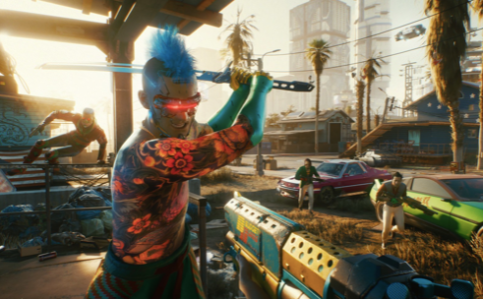
I’ve been binge-watching Cyberpunk 2077 reviews and playthroughs. The game looks amazing, and also amazingly glitchy. I have an older generation console, which means I’d either be getting a buggy mess or have to install massive updates, which with my internet connection would take forever. But what can one make of a game that gives us this:

And also this:

I’m sure I wouldn’t mind the bugs, though. My favorite game of all time is KotOR II. Fallout: New Vegas and Mass Effect: Andromeda are not far behind. Kids these days are spoiled; expecting their immersive sandbox RPGs to work perfectly. Why, in my day, we played KotOR on a backwards compatible Xbox 360 and the frame rate would slow down to, like, three frames per second during combat and the sound would randomly cut out. And we were grateful!

No, my real issue with this game is the same thing that makes me so interested in it: it’s too big. The time that I could spend in the neon dystopia of Night City, fighting street gangs and cyborgs, driving futuristic cars and customizing my avatar’s weaponry, abilities and appearance, is daunting

But of course, that’s the whole selling point of the thing! We want to distract ourselves from daily life by escaping into an anarchic world polluted by drugs and depravity, and where the only law is made by ruthless mega-corporations. [Editor’s note: something about that sentence seems off–consider revising.] Who wouldn’t want that? But then I look at these skill trees and shake my head. There’s no way I’d have time for all this. 

An aesthetic, at least to someone who appreciates it, is like a drug. The more of it you get, the more you need to get that same feeling it gave you on the first hit. The thrill of a bizarre techno-city that filmgoers of 1927 could get from Metropolis now requires 100GB of a high saturation battlefield with police chases and cyborgs. And Keanu Reeves–although somehow I feel if he were transported to 1927, he could have fit in to Fritz Lang’s world, too. Maybe he’s a time-traveling cyber-wizard.

There are a couple ways this trend of accelerating aesthetic experience can go: one is total immersion in VR worlds. The technology is almost there. I wouldn’t be one myself, but I can believe there are people who are so obsessed with aesthetic experiences, they would submerge their physical bodies in some type of suspended animation and don the headgear to live 24/7 in a simulation. If this sounds creepy–and/or reminds you of another film starring Mr. Reeves–it should. But not surprising. The hallmark of the classic decadent is, frankly, a weird obsession with aesthetic authenticity. As the crazed protagonist of Lovecraft’s 1922 short story The Hound put it:

Wearied with the commonplaces of a prosaic world; where even the joys of romance and adventure soon grow stale, St John and I had followed enthusiastically every aesthetic and intellectual movement which promised respite from our devastating ennui. The enigmas of the symbolists and the ecstasies of the pre-Raphaelites all were ours in their time, but each new mood was drained too soon, of its diverting novelty and appeal. 

Only the somber philosophy of the decadents could help us, and this we found potent only by increasing gradually the depth and diabolism… till finally there remained for us only the more direct stimuli of unnatural personal experiences and adventures. 

If you’re a horror fan who has never read The Hound, do yourself a favor and check it out–it’s one of HPL’s best. If, on the other hand, just reading that has skeeved you out so much you don’t even want to know what the narrator and St John got up to next, well, I can’t blame you. Let’s just say it ends badly for them.

While researching this post–yes, believe it or not, I actually do research on these things before I vomit them forth into the blogosphere–I found this fascinating US ad for Metropolis:

This looks like a poster for a musical comedy. Maybe even a parody of a musical comedy, as written by P.G. Wodehouse: “What ho! It seems young Freder has fallen into the soup once more…”

Can you imagine going to see the movie you think you’re getting based on that ad and actually seeing Metropolis? I’m not sure I can, although I’d sure like to. The dissonance is so strong that it’s actually beautiful. I don’t care if you’re running it on the best gaming PC with the best monitor in existence, I’ll bet you anything that Cyberpunk 2077 can’t hold a candle to the pure, unexpected, unadulterated shock of techno-decadentism you would get from that experience.

Which brings me to the other path I could see this aesthetic going: a future where cyber-aesthetes learn discipline, focus, and restraint. Values which are, admittedly, fundamentally not the values of a decadent… but hear me out on this.

I’ve used this analogy before, but think of entertainment media as a sort of expansion pack for your imagination. A book gives you raw words that you have to imagine. A black-and-white silent film like Metropolis gives you some images to work with, but it’s still not a whole visual world. A color film gives you more, a video game still more, and VR games are basically taking the place of your imagination. 

The more you’re relying on media, the less you’re using your imagination. Which I totally understand, by the way. Using your imagination is hard. It’s awfully tempting to just sit back and let the computer do the work. And we’re right back to option one, where we lose ourselves in VR world.

Except, as we have seen, we’re already at the limits of how much of this we can take. At least, I am. I admit that your mileage may vary. But for me, the prospect is overwhelming. Immersion is supposed to be a feature, not a bug, and yet it’s also my principle reason for not buying this game.

But all that is really needed to experience an aesthetic–whether techno-decadentism or anything else–is imagination. Like Arthur Conan Doyle’s famous fictional detective said, “From a drop of water… a logician could infer the possibility of an Atlantic or a Niagara without having seen or heard of one or the other.” Likewise, a cyberpunk future can be inferred simply from reading a single sentence describing it. All that’s left is the imagining. The hard part is sharing it. But since the entire thesis of decadents is that art is personal, does that even matter that much? Surely anyone like-minded enough to care will be able to understand it well enough to share it.

Either we will learn enough self-discipline and mental concentration that we can satisfy our desire to create whole worlds made purely of imagination, without the need to manifest them through technology, or we will create simulation technology so powerful that our own most human qualities become obsolete. 

As Paul Graham once wrote, “we’ll increasingly be defined by what we say no to.” Aesthetics, which are really just the crystallization of moods that we imagine, are wonderful and strange. But saying “no” to the ability to have such things created for us in simulations is increasingly our only hope of retaining the ability to imagine at all. And after all, saying “no” to what is normal and routine is the essence of counter-culture, punk, and decadence.

They say not to judge a book by its cover. In general, this is probably good advice. But when the author of the book is also a gifted painter who creates his own covers, I believe it is necessary to make an exception to this rule. For in this case, the cover is not just some bit of packaging a publisher slapped on the text; it is the product of the same imagination that created the world of the story.

Look at this cover! What does it evoke to you? A fantastic rock formation, perhaps? I encourage you to think for a moment about this before you read on.

It is a “Martian castle,” which is a term for the abandoned grain elevators of a terraformed Mars in the distant future Litka imagines. Most interesting to me is Litka’s description, where he says he envisions his futuristic Mars as being like Nebraska. I love this idea. 

Don’t you feel a little as if you’re gazing at it across some open plain, where the chilly breeze whips against you and the weak light of the sun–paler than on our own planet–throws blue shadows down across the barren desolation? You can almost hear the echoing horn of the train at the elevator’s base as it rolls along.

At least, I can. Maybe I’m biased, because I grew up in a rural midwestern town where the biggest landmark was a grain elevator with a railway beside it. The Mars of this book is a Mars that I can easily relate to.

On to the text itself: the book’s protagonist, Gy Mons, has awakened after some 700 years of stasis in a Martian facility. While he and his wife, Keiree Tulla, had slumbered in their pods, a plague devastated the solar system, more or less wiping out colonies on Earth and the Jovian moons.

Gy soon learns that Keiree’s pod was stored elsewhere, and so she was not awakened along with his group. So he–and his genetically modified silka cat, Molly–set off to find her, at every step discovering how Mars has changed while he was in stasis.

There’s a fascinating temporal parallax that occurs for Gy as he searches his and Keiree’s old neighborhoods on Mars. For him, it feels as though it’s only been a few weeks since he’s been in these places, though in fact centuries have elapsed. If you’ve ever come back to your old hometown after being away for years, imagine that, only multiplied by 700.

This book is, obviously from the setting, sci-fi. And yet, I’d say it’s really what is often called “literary fiction.” As I read it, I kept thinking of Mark Paxson’s novella The Irrepairable Past, which is not at all sci-fi, but which also deals with someone reflecting on bittersweet memories. Both books are about something deep in the human psyche, and Keiree feels every bit as emotionally relevant and powerful as if it were set on present-day Earth.

This is why I dislike the distinction between literary and genre fiction. We write books to make people feel a certain way. Whether they are set in the distant past, the present-day, or an imagined future, is secondary to their true purpose of evoking a feeling in the reader. And Keiree does evoke many feelings. So what if these characters are living on Mars, many centuries from now? They are still people, and Litka treats them as such.

Well, except of course Molly, who is a cat. A genetically-modified one, but in ways that if anything only accentuate her fundamental “cat-ness.” Anyone who ever owned a cat will know instantly what I mean.

Keiree is a wonderful novella, and I recommend it highly. Everyone, whether they like sci-fi or not, should go visit Litka’s gorgeous vision of Mars.

This is a post-apocalyptic zombie book. I should state up front: I’ve never really cared for the whole zombie genre. I saw Night of the Living Dead as a teenager and it didn’t seem remotely scary. I’ve played many video games with zombie-like enemies, but I never relish the levels that involve fighting hordes of the undead. They just seem gross to me, not scary.

“Okay, Berthold; then why did you read this book?”

Well, I’ll tell you. But, as usual, in my own time. First, let’s meet some of the characters.

As you might surmise, one of the major characters is named Zach. Zach is a former marine who lost his wife early in the outbreak of the zombie apocalypse. Shortly after that, he rescued a young girl named Abby from a zombie attack, and took her under his protection. Zach and Abby make a decent home for themselves in a cabin, but it soon comes under attack, forcing them to flee.

This leads to an episode that was rather tough for me. I don’t want to spoil it, even though it only occurs about a quarter of the way into the book, but it involved a trope that drives me nuts. Let’s just say it’s a hallmark of the post-apocalyptic zombie genre. Which, I guess, is probably one reason why I don’t read more post-apocalyptic zombie books. I don’t want to knock the book too much for this, since it may be a genre convention as much as anything.

Another reason I don’t read many post-apocalyptic zombie books is the intense violence. That’s not a criticism of the book, to be clear–I knew what I was letting myself in for by picking up a zombie apocalypse book–but some of the scenes were still pretty hard to take. I particularly don’t enjoy violence involving female characters, and there were some very brutal scenes of exactly that.

The first quarter of the book was tough going for me, but I stuck with it, and I’m glad I did, because I enjoyed what followed: first comes an extremely tense and well-paced episode at a military base, followed by Zach, Abby, and some new comrades they’ve met along the way discovering a town called “Little America,” which is seemingly a safe haven from the zombies and the gangs roving the wilderness.

Life is almost normal in Little America, and Zach and Abby find themselves living in near-peace. Abby starts going to school and making friends her own age, Zach makes a living as leader of the town militia. And both of them even find time for a little bit of romance–a boy from school for Abby, and for Zach, a woman named Amber, one of the people they met while trekking across the zombie-haunted wilds.

Up until Little America, His Name Was Zach is mostly a straightforward zombie story, but then there are three moments that stick out as unusual. 

The first is a scene where Zach sees a statue of George Washington and finds himself imagining a whole Revolutionary War battle going on around him. Some readers might find this passage a bit odd, but personally I loved it. First, because it’s offbeat and unexpected, which automatically makes it interesting, and second because I think it gives us a window into both Zach’s deep immersion in a timeless warrior ethos and his PTSD. It’s like it triggers a flashback to a war he wasn’t even in, but he feels a bond with those who fought in it all the same.

Actually, that’s something worth noting about this book: there’s a strange dissonance produced by the episodes of horrific violence–some of which is committed by Zach himself–and the serene, almost Andy Griffith-like wholesomeness of Little America, and Zach and Abby’s father-daughter relationship. It’s downright uncanny to conceive of a world that can contain sweet, beautiful things as well as disturbing, monstrous things. Yet, we know that the world–the actual, real-world, I mean–does in fact contain both, but our minds can’t really reconcile the two.

There have been books that I have abandoned because they are too relentlessly violent, too consistently bleak. Yet, in a strange way, unified bleakness is almost easier to think about than the jarring switch from soul-crushing horror to a world where things are, basically, all right. There were moments while reading His Name Was Zach that the letters “DNF” flashed across my mind, but it would always revert back to a more normal, almost pleasant tone–I say “almost” because the gnawing feeling of the horror lurking on the fringe would never quite go away.

This mirrors the personality of Zach himself. He describes it as a demon chained up within him, and when he is angered, that demon yanks at its chains and is capable of pushing him to terrifying extremes–but the rest of the time, he seems like any other normal guy, just trying to protect his loved ones and do his duty.

Speaking of which: eventually, Zach is sent outside of town on a mission, along with a group of the militia, in which they encounter one of the gangs, led by one of the most fascinating characters in the book–a drug-addled psychopath named Edmund, who is something of a cross between the Joker and Anton Chigurh.

And now, I’ll tell you why I read this book despite it being outside my reading comfort zone.

I’ve been very impressed by posts I’ve read on Martuneac’s blog. Like this one, where he argues that the reason Bilbo Baggins has such excellent luck in The Hobbit is because that’s how Tolkien saw life. Tolkien had survived World War I thanks to sheer luck, and so he had no problem having his characters survive due to the same.

I generally dislike plot contrivances that hinge on miraculous luck for the hero. But, Martuneac makes a strong case for them in that post. So much of life really is determined by chance, so why not have it be so in fiction as well? Fatalism born of seeing the random violence of war.

Edmund essentially embodies this concept. His encounter with Zach piles one strange coincidence on top of another. And I’ll admit, it’s the sort of thing I would complain about in fiction, but together with Martuneac’s reading of Tolkien, it takes on a nearly allegorical quality. It’s a statement about the bizarre, weird, freakish stuff that happens in life.

And that’s why I picked up this book: I’ve enjoyed reading the author’s blog, because of insights like this one. When I find a writing blog I like, it’s generally only a matter of time before I try one of the author’s books, even if they are outside my usual genres.

The third moment that stood out to me comes about three-quarters in, when the authorial tone briefly changes to directly address the reader. The entire story is in third-person, but only once does it actually turn into the voice of someone conscious that they are telling a story. The omniscient narrator tells us not only that this is a story, but, broadly, what’s going to happen next.

I found this interesting, because it’s a call-back to a much older, and currently unfashionable, form of storytelling. Readers may love or hate it. I wouldn’t say I loved it, but it was different, and I like that.

There is one more section after that which I want to discuss: a part where Zach is forced to make a very difficult choice, It’s the sort of thing that veterans of Role-Playing Games will recognize, where one has to make a snap decision and either way will be forced to sacrifice something.

The amount of “time” spent on this was a little excessive. By “time,” I mean the way the scene was “paused” to allow the reader to read Zach’s internal monologue thinking through the implications of each choice.

Now, of course, as authors it’s our prerogative to mess with time in our stories however we like. We can make years go by in a single sentence, or spend a whole chapter on one single minute of existence.

My problem with this scene was that the consequences were already quite clear without needing to have spelled them out. I was sufficiently invested in the characters that I knew how serious the problem was without being told. And it happens in the middle of an action sequence, so it felt a bit jarring.

Finally, the end of the book. Again, I’m trying not to spoil anything, so I’ll just say this: I guessed where it was going before it got there, but despite this, it still produced the effect the author was going for. Now, I am perhaps the most easily-manipulated reader in the world, so maybe that’s not saying that much. But, for what it’s worth, it worked on me even though I saw it coming.

This is the first book in a series, and the ending does a good job at simultaneously being a satisfying ending point while also setting up the next book. 

One technical note: the dialogue was at times a bit clunky–characters would say things that sounded more like speeches than spoken dialogue. I found myself wondering if the story could have been told with less dialogue, in keeping with the older style of omniscient storytelling that I alluded to above. (H.P. Lovecraft’s stories, for example, contain very little dialogue, often summarizing conversations instead of quoting them.) On the other hand, that might be just too weird for most modern readers.

And now, a word about zombies. 

I was actually pleased by how little the zombies featured in the story–they are mostly a “background menace,” used sparingly and for maximum effect. I liked this, but then since I am not a zombie fan, I would. People who just can’t get enough zombies may be disappointed. 

Also, for the record, they are the fast-moving, predatory zombies; not the the slow, shambling kind. They also have one curious trait I’ve not seen in other zombie stories, in that they are somewhat capable of responding to Pavlovian conditioning. 

I mention these things only because I know there are people out there who care deeply about the quality of their literary zombies, and connoisseurs will be upset if they find themselves reading a zombie book that features the wrong kind of walking corpses.

Wow, I really am going on, aren’t I? Normally when I write a post this long, it’s to complain about a Star Wars movie. But I have to say one more thing in closing, which is that His Name Was Zach isn’t really about the plot, or even the setting. This is a character-driven book, plain and simple, and it really all hinges on how the reader feels about Zach and Abby. The dynamic between them is what “makes” the story.

It’s probably not a book for everyone, in particular not the squeamish. Then again, it may be that there are no readers more squeamish than I am, and even I made it through. But if you can handle the violence, it’s worth a look, and Martuneac is a promising author. I’ll definitely be reading more of his work.

I picked this book up because it is set during the Boer War. How many books do you hear about set during the Boer War? I mean, of course, this isn’t the only one, but compared to the seemingly-endless army of books set during, say, World War II, it’s a relatively exclusive club. Come to that, how many people today even know what the Boer War was? It’s not something that gets a lot of attention. Maybe people find it, as one of my history teachers never tired of saying, “Boer-ing”?

Well, it was anything but! People lived and died and enjoyed triumphs and tragedies even before 1939, you know. Forgiven is concerned with telling the story of a young man’s experiences of all these. Richard Wilson is his name, a New Zealander who falls in love with the lovely Rachel Purdue. Rachel is a lovely girl who has had her reputation unfairly tarnished by gossip, which has left her without suitors in her hometown. She and Richard soon become engaged, but are forbidden by her family to marry immediately.

While waiting, Richard gets the not-so-bright idea to join up in the British Empire’s fight against the Boers in South Africa. Rachel, who is a bit sensitive and fearful of betrayal, is furious with him, as well she should be, for making this huge decision without consulting her. But, Richard has given his word, and has no choice but to keep it. And so he ships off to the Cape Colony.

In addition to fighting the Boers, he encounters a ruthless Prussian spy and a haughty English aristocrat, Lady Sarah. Initially, he and she despise one another–he sees her as a stuck-up noblewoman, she sees him as an uncouth commoner–but over the course of their time together, they come to have a mutual respect. I really enjoyed the way their relationship evolves.

That said, one aspect of it that did surprise me was the anachronistic language. I just can’t believe that a man of the 19th century, even one as admittedly rough-around-the-edges as Richard is, would refer to a woman the way he does. Oh, he might not like her, to be sure; he might very well resent being ordered about by such a pampered princess; but he wouldn’t express it the way modern folks do. At least, everything I’ve ever read of 19th century literature indicates to me he wouldn’t.

Now, using modern dialogue in historical fiction is a common stylistic choice, and it can work. But at times, the language did seem to be period-correct. And then something modern-sounding would pop-up. It was a bit jarring.

That said, much of the history feels authentic. The author is an expert on the firearms of the era, and gives the lengthy descriptions of the weaponry, which was quite interesting. Numerous historical figures of the period, including Walter Kitchener, Koos de la Rey, and a young Winston Churchill are all referenced throughout the tale.

Overall, it’s a very well-paced story of adventure and romance, and while the author keeps the pace moving briskly, he stops to indulge every now and again in some very evocative imagery. What I like best of all was how well fleshed-out even minor characters are; it made the whole thing feel very immediate and real.

A couple other minor things that didn’t quite work for me: there’s a sub-plot involving Rachel’s ne’er-do-well brother, which not only seemed unnecessary, but was especially jarring because it was told in the third person, when the majority of the book is in the first-person, from Richard’s perspective.

Also, there was at least one thing that seemed to be a stone-cold anachronism: at one point, there is a reference to a Zane Grey novel. As near as I can tell, the earliest of Zane Grey’s work was published in 1903, and the action in Forgiven ends in 1900. It’s hardly a central plot point, but it I noticed it all the same. Given how accurate the novel is in other respects, this was very strange, and made me wonder if I was missing something. If there are any experts on the period–or Zane Grey, for that matter–who can explain what’s going on here, I’d be very grateful.

Despite these minor reservations, I definitely recommend this book to anyone who enjoys a good adventure/romance, and wants something in an uncommon setting. Give it a try.

This book begins with a clever hook: the protagonist, Cassie Black, is shocked when the corpses at the funeral home where she works start coming back to life. She quickly learns the reason for this sudden re-animation is that they have “unfinished business.” At first, she’s able to help put them to rest, but when the eponymous Mr. Tenpenny returns to life, putting him at peace proves to be a daunting task that sucks Cassie into a whole parallel world of magic and mystery.

The book is very much in the tradition of fantasy novels like Alice in WonderlandHarry Potter, etc. (There are a few references to the latter throughout.) It’s the classic setup of a seemingly ordinary person who finds themselves in another society where they are of immense importance. From there it’s Joseph Campbell’s Hero’s Quest, through and through, but Cassie narrates her adventures with a smart-aleck, macabre sense of humor. The book is suffused with dark humor, of the sort at which Painter excels. 

Cassie can be a little difficult; I won’t lie. There are times when her anti-social personality and paranoia make her tough to relate to. Although, as is explained in her backstory, she’s had a hard life, shuffled among various foster families that treated her quite badly, so it makes sense she would be this way. And eventually, her instincts do point her in the right direction. (Sort of.)

I actually enjoyed the “real” world of everyday Portland most of all; it felt very vivid and interesting. I especially liked the officious government inspector who is investigating the funeral home where Cassie works, suspecting, (quite correctly) that something is amiss.

That reminds me: this is book one in a series, and it ends on a cliffhanger. So, there are a lot of threads that remain to be tied up in future volumes, and I look forward to seeing where it all goes. It’s a fun read for anyone who enjoys fast-paced, somewhat snarky, somewhat twisted fantasy adventures.

[This review is based on an ARC. The Undead Mr. Tenpenny releases today, February 23, 2021.]

Okay, I cheated a little on my plan to broaden my reading horizons this month. This is a science fiction book, which is very much my standard fare. But it’s also a romance; trust me! And it’s something of a milestone because it’s the first book I’ve ever bought because of an ad. For years I’ve seen a link to it on the Amazon page for one of my books. So when I needed to find another romance book, I decided to give this one a try. And I’m glad I did.

The setting is Union Station, a sort of hub space station where races from all across the universe meet. (I kept picturing the Citadel presidium from the Mass Effect series.) The station is run by super-intelligent artificial intelligence beings known as the Stryx, who monitor everything and generally keep order.

The Stryx also run a dating service, which purports to be able to find the perfect match for someone due to the telepathic abilities of the intelligence. Kelly Frank, the EarthCent ambassador, who receives a gift subscription to the Stryx’s matchmaking service.

Unfortunately, it doesn’t work as well as she hopes–Kelly ends up having a series of bad dates, some of which lead to bizarre adventures, but none of which result in her finding a good partner.

Much the same story holds for Joe McAllister, a former mercenary spacer turned junk dealer who has also decided to take advantage of the dating service. He too has quite a range of experiences–but he just can’t seem to find that special someone.

You can probably guess where this is going, but it’s still an enjoyable ride, thanks largely to Foner’s first-rate world-building. Kelly and Joe’s bad dates show us glimpses of the wider universe–and what a rich universe it is, populated by all kinds of interesting characters. There’s a royal house in need of a champion, a criminal kidnapping ring, and robot trying to pass itself off as human. Then there are the subplots involving cheating at competitive gaming, a couple of flower girls profiting off of the dating scene, and a bazaar teeming with counterfeit goods.

All of it feels so organic and interesting–not to mention really funny. It’s a lighthearted book, and each vignette ends on an amusing note. There’s plenty of conflict, but of the purely PG-rated variety. There’s nothing too dark here; it’s a romp.

Sci-fi fans should absolutely check this book out. Even if you’re not into romance, don’t worry–there’s a lot more going on here. I have only one complaint about this book, which is that the last chapter felt a bit rushed. I would have liked to see it come to a more leisurely conclusion. But hey, if your biggest complaint is that the ride ended too soon, you know it’s good.

Admittedly, I’m late to the party on this one. This book has over a thousand reviews, so it’s fairly well known, as such an enjoyable book deserves to be. Perhaps it’s proving me wrong about ads after all.

What I like best about Geoffrey Cooper’s thrillers are how they provide a window into the politics of research institutions. I’ve noted this about his earlier Brad and Karen novels, Nondisclosure and Forever, and if you enjoyed those novels as much as I did, you’ll be glad to know that Bad Medicine is more of the same.

Brad is requested–more like ordered–by the university president to chair a tenure committee at a medical research Institute in Maine. There are two candidates up for tenure: one is Mark Heller, a superstar researcher who appears to have made huge strides in cancer research, the other is Carolyn Gelman, whose work, while strong, lags behind her colleague and is unpopular with the faculty to boot.

The politics of tenure committees are bad enough, but soon, Brad finds evidence that something far more serious is going on: someone is sabotaging Gelman’s research. Beginning with the destruction of test drugs and escalating to far more serious crimes, Brad and Karen once again are drawn into a criminal conspiracy.

As usual, the pace is fast and the twists are numerous, but there are still moments for the characters to stop and catch their breath, and to sample some delicious New England cuisine, the descriptions of which are highly enjoyable.

The core of the book is the relationship between Brad and Karen, which ends up being tested in a surprising way. I liked the way this was handled, too–it makes sense that what happens would put some stress on them, but it doesn’t create needless drama or tension. Sometimes authors go too far in creating fissures in a relationship, in a way that feels forced. But that didn’t happen here.

If you enjoyed the other Brad and Karen books, you’re going to like this one. Besides being a good thriller, it’s another fascinating glimpse behind the curtain at the highest levels of medical research.  As soon as I finished it, I found myself hoping to read another one soon.

[Note: this review is based on an ARC. Bad Medicine releases today, February 17, 2021.]

I love poetry–especially rhyming, metrical poetry. I’ve learned over time to appreciate blank verse and the like, but in my heart, I’m always going to be a sucker for a good old rhyming couplet. To illustrate: while most people would probably say T.S. Eliot’s greatest work is The Waste Land, give me Old Possum’s Book of Practical Cats any day.

That’s why it was such a delight to read this amusing collection of poems, about the mis-adventures of the author’s dog, Ani. All the poems are light, bubbly and amusing, and sure to make any dog lover smile as they read Ani’s antics with tennis balls, vacuum cleaners and–the pup’s ultimate nemesis–baths.

Ani’s human, Sue Vincent, has a great knack for sparkling, crisp verse and a delightful wit. In a few poems based off of Shakespeare’s works, she does a fine job in the style of the Bard. And most of all, she has a wonderfully endearing love for her dog, and one that Ani clearly reciprocates as only canines can.

Doggerel is a charming book that anyone who loves poetry and/or dogs is sure to enjoy. It’s also illustrated with pictures of the four-legged protagonist, who looks like every bit the lovable scamp portrayed in the poems.

(P.S. I am very grateful to my friend A.C. Flory for bringing this author’s work to my attention.)