[The other day I came across this unfinished humor novel I wrote when I was sixteen. I hadn’t looked at it for over a decade. Parts of it are funny. Most of it is stupid.  What follows are a few of the highlights–I left out the really lame bits. For background: it was intended as a satire of spy/thriller  stories, as well as poking fun at my favorite target, government bureaucracies. Teen-aged me was an ardent libertarian, so take all of it with a generous helping of salt. Also don’t miss my juvenile attempt at Gilbertian wordplay at the end. Enjoy!–BG]

NOTICE FROM THE FEDERAL BUREAU OF STORIES

The following story is true.

(Note: This story is not actually true. That was a literary device.)

The following story is in compliance with section V, article xii of the drama treaty of English-speaking nations. By reading this story, you certify that you are (a) literate and (b) not visually impaired in any way that would prevent reading. If you are found to be in violation of either or both of these conditions you may or may not be penalized. Before reading the story that follows, you must take out all your identification and read it aloud. If any or all of your identification papers are expired, you must renew them before reading this story. Reading of this story without proper and up to date identification is punishable by fine or imprisonment under article xii, section V of the California—Maine Fiction Code. No person or persons under the age of 21 may take away a moral from this story without filling out a moral-requisition form in compliance with article xvii of the Alaska state constitution. If multiple morals are taken away, a requisition form must be filled out for each moral. Any and all themes, motifs, etc. in this story are in compliance with article cvvxxi, section C of the American Motif Code. The character(s) in this story is/are certified and in compliance with all regulations regarding character(s) in English fiction. (English fiction referring to all fiction written in English by persons of any nationality.)

Reading of this story out loud is strictly prohibited.

(more…)

allworkandnoplay

Most days, it’s a real struggle for me to get started on writing even a paragraph in one of my stories. Once in a great while, I’ll be struck by some inspiration and then it’s just a matter of getting the words down as fast as I can, but that’s rare. The more normal case is something like this:

 I need to write something where X happens.

 [Write a word or two]

Huh, I wonder what’s going on in the news.

 [Half hour later, force myself to write another sentence or two]

Are there any good videos on YouTube?

I have to consciously force myself to stay on task and write something down. If I manage to do that, most of the time I hate what I’m writing up until I finish, at which point it starts to seem possibly decent. But the whole time I’m doing it, I feel like I’m doing lousy work, and moreover, it takes all my willpower to even do that.

Why is this? Writing is supposed to be what I like doing. No one is forcing me to do it—it’s what I want to do.  But then why am I strongly tempted to avoid doing it, like it’s a job or something?

At first, I thought maybe I was just a lazy bum. But I follow lots of hard-working writers on Twitter, and they frequently report this same problem. I even did a poll of my followers, and while the sample was small, 100% reported they procrastinated:

So, it’s not just me being lazy. Other writers face this problem too.

The simple and obvious explanation is that writing is active. You have to consciously do something to make it happen. Whereas reading the news or watching cat videos is passive—you just find your way to the site and put your mind on cruise control.

But this doesn’t totally explain it. One of the ways I procrastinate is by playing video games. And that’s not passive; I still have to press buttons and make decisions to get the outcome I want in the game.  Yet it’s far easier for me to play a game of FTL or computer chess than it is to write. I don’t have to will myself to play a game.

My next-door neighbor has had all kinds of hobbies over the years I’ve known him, from shooting guns to building model airplanes to mixing drinks to, yes, playing video games. And he doesn’t seem to need a huge amount of willpower to make himself work at any of his hobbies. Why is my hobby different?

Part of the problem is that I’ll write something down and then think, “Well, that’s not any good”. This feels unsatisfying. And at some level, I think procrastination is a defense mechanism. Skimming the sports headlines may not yield much satisfaction, but at least it won’t be as disappointing as writing something imperfect.

But why should that be disappointing? After all, no one else is going to judge me by the first draft. No one else will even know it existed unless I show it to them. So why am I bothered if it’s not right the first time? I don’t get discouraged if I don’t win a video game right away. On the contrary, losing a game just makes me want to try again.

Writing, unlike other activities, is more closely associated with having an audience. After all, if you’re just writing for yourself, why bother writing? You know the story already—the only reason to write it down is to communicate it to others.

That’s the heart of the difference: When I play a video game or exercise or any of the other things I do for fun, my only audience is myself. If I’m satisfied with my performance, that’s all I need.

We are trained very early on that writing is different. Writing is what you do when you want to tell other people something. As a result, when you write, you are subconsciously trying to please other people.

Ta-da! This explains the mystery of why writers procrastinate. Procrastination is something you do when you are assigned a task by other people, and writing feels like that because that’s how we’re trained to regard it. It’s the same reason we all procrastinated when our teachers assigned us to write a paper on such-and-such-thing-no-one-cares-about.

Some of the most common advice I’ve seen from successful authors is stuff like “Write for yourself,” “Ignore your inner critic on the first draft” and perhaps the most common, “Lose your fear of writing”.*

This advice always puzzled me. Of course I was writing for myself! Who the hell else would I be writing these weird stories for? And my inner critic? Who’s that? As far as I knew, I didn’t have one. The fear thing seemed the most sensible, although for me, the fear wasn’t so much of writing as it was of publishing.

But now I see what all those famous writers were saying: you think you’re writing for yourself, but you aren’t really. In your unconscious mind, you are still trying to figure out what the readers are going to think of what you wrote. It’s a deeply-rooted habit, probably one that evolution instilled in us—the societies where people could clearly communicate their ideas to one another were the ones that flourished.

I’m not saying you shouldn’t write so that other people can understand you. But the point is, that has to come later. First, you have to treat writing as a personal challenge between you and the part of your mind that wants to stop you from doing it. It’s like working out: you know it’s good for you, and you know you will feel great afterward, but you have to overcome the natural instinct that tells you it’s easier not to do it.

The precise way to do this can vary from person to person. You’ll discover the method that works best for you as you go along.

One exercise that I think can help teach how not to write for an audience is to just try writing stream-of-consciousness. For this post, I deliberately tried an experiment where I turned off my sense-making filter and just spewed forth whatever came to mind. This is what resulted:

Grey window skies empty noises and duahgter nothing al dhpauiw hope thjat move listen coffee  righ fjor wdesk need time hope sk

Sitting on a cold day that is grey and deporessing why am I doing this write exercise imagine plains vision skies weird black nebulous

This seems like incoherent babble, but it’s really not all that random. For context: I was sitting at my desk by a window on a cold grey day, drinking coffee. I could hear people outside talking and someone said something about a daughter.

For the second paragraph, the other people shut up, and I started to let my imagination roam, which led to visions of Lovecraftian weird cosmic horror, because that’s my favorite genre, or at least the one I’m most familiar with.

As sloppy and gibberish-filled as that is, you can see my thought process even through all the errors and downright nonsense. Which brings me to my point: as in many other fields, “true randomness” is actually pretty hard to achieve in writing. Your brain will work very hard to force you to make sense. Which is helpful in many other ways, but the problem is that our brains have become so good that they will try to prevent us writing anything less than the perfect sentence on the first try. That part of the brain would much rather procrastinate than risk writing something nonsensical.

This is what all those famous writers mean when they say “Write for yourself” or “Don’t worry about the audience” or “Ignore the inner-critic.” It’s all true, but it’s not specific enough, because when you are tempted to put off writing and procrastinate instead, you don’t realize you’re writing for someone else, or that it’s your inner-critic, or your fear of the audience. It feels like you’re just trying to write something that makes sense, and for some horrible reason, you can’t.

That’s because it doesn’t make perfect sense, and your brain hates that. But it’s okay. You can fix it later. Editors and beta readers will make sure of that.

So my advice is: don’t worry about making sense. In fact, I’ll go even further: actively try to avoid making sense on the first draft. Just put down the most basic, sub-literate version of what you want to convey. You’d be surprised how hard it is to not make sense—your unconscious mind will keep you at least within saluting distance of it most of the time. After that, you can just iterate until your visceral idea has been refined into something your readers can understand.

FOOTNOTE

* As Phillip McCollum has observed, fear can also be extremely useful for writers. But that’s fear of other things, not writing itself.


“They don’t blame you — so long as you’re funny!” –Jack Point, in The Yeomen of the Guard, by W.S. Gilbert.

One of the most interesting beta reader comments on my new novel was “Why don’t you make it funnier?”

This one stuck with me, because I already had a sneaking suspicion that the book was too humorless. Paul Graham’s point about good design sticks in my head: “Good design may not have to be funny, but it’s hard to imagine something that could be called humorless also being good design.”

I’ve struggled with this quite a bit. The book isn’t a comedy by any means—it deals with some very dark subjects. And yet… that doesn’t seem like a valid excuse. For example, racism, murder, and rape are all major elements in the plot of To Kill a Mockingbird, and yet it still has plenty of extremely humorous moments as well.

I read somewhere that a novel is supposed to capture “the totality of life”. If so, then it makes sense that it needs to have both the dark and the light moments—after all, real life has both.

But how do you put humor into a serious story? You can’t just put in a slapstick comedy routine for characters who are struggling with matters of life and death. It would seem out of place.

This is the problem that so-called “comic relief” characters were created to solve. And sometimes, that can work. But it’s easy for it to go wrong, and then you get something like Jar Jar Binks—a character whose antics clash with the main narrative and annoy the audience.

A better route is to have characters who are well-rounded enough to be both funny and serious. And actually, having funny characters is probably helpful in terms of the larger goal of making the reader care about them. Funny characters are more likeable.

One of the complaints I got about The Start of the Majestic World was the lack of banter between the two protagonists. This was because I just generally don’t like banter—it comes across as too forced to me. But I wonder now if this was really about an overall lack of humor in the book. (I did try to make some of the supporting characters entertaining, if not exactly comic.)

It’s tricky to find the right point to insert humor in a non-humor book.  At any given moment, the characters are dealing with serious problems, and so there never seems to be any specific point where it makes sense to insert comedy, even though the overall vibe is that the book needs more of it.

Another way is to put humor in the descriptions. The difficulty here is that my book is set in the distant future, and as such requires a fair amount of world-building and information about how the futuristic society works. And it’s tough to give the reader that information, much of which will ultimately be relevant to the plot, and be funny at the same time.

Even more importantly, humor relies on a shared frame of reference, so it’s hard to come up with really funny things to say in a futuristic society. Humor also involves playing with social norms, and when dealing with unfamiliar social norms, it doesn’t seem funny when they get violated. It just seems confusing.

This still doesn’t justify a lack of humor, though. Robert Heinlein and Arthur C. Clarke infused their science fiction stories with wit. What it comes down to is being able to write plausibly human and relatable characters in a futuristic and/or alien setting.  That’s what I’m trying to do, anyway—write characters with both serious and silly sides to them, and then put them in situations where the different aspects of their personalities can appear.

14 year-old me
14 year-old me (R, w/fangs)

For the last month, I’ve been looking through a lot of old family pictures to get good Halloween stuff to post on Twitter. I got plenty of that, but I also found lots of pictures of myself as a teenager that set me thinking about some things.

What struck me was how, in certain ways, I’m a lot like that younger version of me. He wanted to be a writer, he was interested in politics, he loved Halloween and ghost stories… If someone met 14-year-old me, and then was transported instantly through time to meet present-day me, they would recognize a lot of commonalities.

At least, in terms of raw interests, there are a lot similarities. The differences come in terms of things like skill-level. (I’m a much better poet now than when I was 14, for example.) And, I now have a lot more first-hand knowledge about how the world actually works, as opposed to teen-aged me, who just had a theoretical model based on stuff he’d read or seen on TV.

What bothers me, looking back, is all the stuff teenage me should have taken advantage of, if he had only been willing to. But he didn’t know what would happen, and so just sort of kept his head down, reading books and writing stuff that only he read.

Basically, he wasted a lot of time. And it occurs to me that somewhere out there, there are probably lots of other teenagers and young adults now in the same boat as I was, who vaguely know they want to be writers, but don’t know how to go about doing it.

My hope is that they’ll read this, and maybe it will help them avoid wasting time like I did.

If you’re interested in writing, do lots of it.

Teenage me thought the key to being a great writer was to read a lot of books, and then the idea for a great novel/essay/poem would eventually come to him. Not really. Reading is great and important, but if you want to be a writer, you have to write what you want, not what you think you should write based on some books you read.

The easiest way to do this is figure out what kind of book you’d like to read, and then go write it. (That’s a cliche, I know.)

Bottom line: if you have read enough to decide you’d like to be a writer (and let’s face it, few people who don’t like to read want to be writers), then it’s time to start writing.

Don’t be afraid to publish.

In the old days, before the internet, it was hard to get anything published. But now, anyone can do it. And it’s been that way since I was a teenager. But for a long time, I still was hesitant to publish anything for other people to read.

Why? I was scared. Of what? I’m not even sure. That people would sue me, or make fun of me, or that my ideas or stories would seem stupid.

Basically, I was afraid people would laugh at me. Looking back, this was a hugely irrational fear. The big problem I face is not ridicule or lack of privacy, but getting people to read anything I write. Getting an audience is the hard part–it takes years of publishing your work before it starts to happen. So the sooner you start, the better.

When you’re a kid, you assume that the world is full of bullies who will mock your work, like the ones in school. And sure, the internet has lots of that, although good publishing platforms provide safeguards against it. But the point is, unless you publish it, no one will see your work. And who is hurt by that? Well, you, for starters. But also the people all across the world who have similar interests to yours, for whom you have written the perfect thing, but who don’t get to read it because you didn’t publish it.

It doesn’t matter if what you write is bad

In the beginning, I was worried that my blogs on politics were facile, that my poems were awkward and pretentious, that my stories were incoherent and vague. In short, I worried that my work was bad.

I don’t worry about that any more. I know when I’m doing good work or not.

How do I know? Well, simply put, I wrote a lot of stuff that was in fact awful. I wince when I read some of my old blog posts from 2009 or ’10. What was I thinking?, I ask myself.

What’s funny is that at the time, I was so concerned with not writing bad stuff, and yet I managed to do it anyway.

Writing is like anything; you get better at it by doing more of it. What I know now is that I’ve written a lot of stuff that’s pretty bad–but I’ve also written a few things I’m very proud of. And I couldn’t have done the latter without doing a lot of the former. As such, I’m not even really ashamed of lousy poems or blog posts from my past–I look at them as a cost of doing business.

Remember: if you manage to write one really great essay, or novel, or poem, it will more than offset however many failed drafts and ill-advised scribblings you had to generate in order to do it. And there will be a lot of those.

It’s a very interesting spot. I’ve gotten a lot of ideas for my writing here, including this poem and one of the stories in this book.

These pictures don’t do it justice. Even video wouldn’t do it justice. It’s very peaceful, standing here and feeling the wind rustling the leaves and listening to the creaking of the trees.

This slideshow requires JavaScript.

lorem ipsum
Need extra words? Here are some random ones!

If you follow me on Twitter, you probably know that I’ve been working on a new novel for the last two months. My goal at the outset was 100,000 words, and I’ve been keeping a running update of my progress. Here’s my latest:

I re-read it, and I think the story has a pretty decent pace overall. It may be a little too brisk (it turns out these things seem much faster when you’re reading them than when you’re writing them), but I think I have the central plot arc in place. And there’s just no way to pad it out to 100,000 words, which is bad, because it’s a sci-fi novel, and those are generally “supposed” to be at least 80,000 words.

I can and probably will throw in some additional world-building detail and “local flavor”, tie up a few minor loose ends in the plot, and add some more description of scenes and characters. (Description, as long-time readers know, has always been my weak point.) But even all that will probably bring it to around 60,000 words, at the maximum.

Personally, I have never been a fan of arbitrary word counts for a genre. A story should be told in the number of words that make it most powerful for the reader–no more, no less. Too many words, and they get bored. Too few, and they won’t get drawn into it.

But of course, the publishers don’t see it that way. They have certain rules for word count by genre. In my opinion, this “quantity over quality” approach encourages overly-long books, but then again, when you have to review thousands of manuscripts, it helps to have some rules that let you automatically eliminate some of them. (This article summarizes it well.)

The key question here is; what do readers like? Assuming the two books are equal in price, does the typical reader prefer to have a longer one to a shorter one? Do they want to maximize the number of words they get for their money? Or do other considerations take precedence?

For myself, I generally make decisions based on other factors. I read the synopsis to see if it sounds like an interesting premise, then I flip through the book a little and see if I like the author’s style. Cover art also makes a difference to me, even though we all know we shouldn’t judge a book by its cover.

What about you? What factors most heavily influence your book-buying decisions? How much do you care about the length of a book?

[You can make a case for any of these characters being “Mary Sues”. From left: Robert Pattinson as Edward from Twilight, Miranda Lawson from Mass Effect 2, Sean Connery as James Bond, and Daisy Ridley as Rey in Star Wars: The Force Awakens. All images via respective Wiki pages and re-used under ‘fair use”]

First, let me begin by defining terms. Or more accurately, letting Wikipedia do it for me:

A Mary Sue (if female) or Marty Stu (if male) is an idealized and seemingly perfect fictional character…

The term “Mary Sue” comes from the name of a character created by Paula Smith in 1973… The story starred Lieutenant Mary Sue (“the youngest Lieutenant in the fleet — only fifteen and a half years old”), and satirized unrealistic characters in Star Trek fan fiction.

“Mary Sue” is now a shorthand for an unrealistically capable character, with no flaws or foibles. It’s the mark of an amateurish writer, too lazy to flesh out their characters.

Naturally, there’s a discussion to be had here about the use of the term’s sexist connotations, and whether the pejorative “Mary Sue” is now used by lazy critics to put down any female protagonist. It’s a very interesting issue, but it’s not the thing about Mary Sues I want to discuss here.

What I want to address is the motivation for creating such characters in the first place. Often, critics assume that the reason is wish-fulfillment; that authors imagine themselves to be these characters, and make them perfect as a result. (Critics usually assume that everyone is as conceited as they are.)

But perfect–or at least, incredibly highly-skilled–characters are actually very tempting for reasons of plot, especially in a science-fiction or fantasy setting. Simply put; when your plot takes place in a big, complicated universe, you want your character to be able to participate in every aspect of that universe.

If I’m writing a sprawling epic with, say, a league of heroic knights who go around fighting dragons, it’s a bit of a letdown if I say “But sadly, Bob the protagonist was an archer who knew nothing about horsemanship or swordsmanship, and so could never be a knight.” By the same token, if Bob is a knight, then it’s a real shame if he can’t be in any archery attacks.

When you’re writing a story, you generally want your protagonist to be able to participate in most of the action. Having them figure out and solve the central conflict makes a better story than: “Bob found out a lot of interesting information about dragons. So he gave it to the experts who handle that sort of thing. 8 months later, he read in the newspaper about how the dragon issue had been solved. ‘Huh,’ he said. ‘So that’s how that all played out.’ The End.”

Now sure, you can have lots of characters with different skill sets, and still have the protagonist be involved in every step. This is relatively easy to do if your setting is the present day or recent past. For example, in a mystery novel, Ted the Brooding Detective With The Dark Past can take the evidence to Jill the Wisecracking Forensics Expert With The Rebellious Streak. (And if they fall in love, then you’ve almost got all the characterization you need.)

But this gets harder to do the more exotic your setting is, because then you have to make up a bunch of skill sets for people This is especially true in science fiction. So, there’s the girl who flies the ships, there’s the guy who fixes the ships, there’s the other guy who fixes the robots, there’s some alien who mines the raw materials for building both the ships and the robots…

It can be done, don’t get me wrong. But it’s tough to do it, and very, very tempting to the novice writer to just say, “We need to get this plot moving! We haven’t got time to meet the guy who waxes the floors. It’s faster to just make the protagonist do it.”

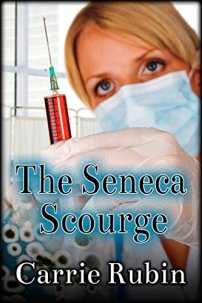
51lvbVGJfzLThe Seneca Scourge is a medical thriller with science-fiction elements.  It follows Dr. Sydney McKnight as she finds herself in the midst of a seemingly incurable influenza pandemic. Aiding the staff at her hospital is the mysterious Dr. Casper Jones. As the pandemic spreads, Dr. McKnight notices Dr. Jones behaving oddly.

As she investigates in between treating the ever-growing patient population, Dr. McKnight gradually uncovers the shocking truth about Dr. Jones.

That’s the spoiler-free synopsis. If you don’t want to know the plot twist, don’t read after the asterisks below. My spoiler-free review is that it is a very well-paced thriller that successfully combines fairly plausible depictions of medicine and viruses in the first half with science-fiction elements in the second half. If you like either medical thrillers or science-fiction (and especially if you like both) I recommend it highly.

Now, if you want to know more detail, with spoilers, read on.

****

(more…)