Adaptations fail in the majority of cases because a story is usually engineered specifically for its original medium. As mediocre as Half-Life the game is, it would be way worse as a movie. So, they really can’t do an adaptation. It would have to be some other story in the Half-Life universe. But the Half-Life universe is, honestly, pretty mediocre itself.
I frankly don’t see any way this could turn out well, unless they get Ross Scott to play Gordon Freeman. I’m sorry, but Freeman’s Mind is the best thing to come out of that franchise, and hopefully at some point the contractual imbroglio will be resolved and Scott can resume making it.
As for Valve’s Portal series, which Abrams might also adapt, it is a much better game, but again it seems like a waste of time to adapt it. This is precisely because it is so well-suited to game form. The gameplay is an integral part of what makes it fun. It would still be amusing, I guess, to hear the humorous lines, but the game lets you do that and enjoy the gameplay. You can have your cake and eat it too.
Now, there are cases where the original medium is not the best, and there are some games that might have been better as something else. Metal Gear Solid is probably better as a movie, at least from Sons of Liberty onward. Neverwinter Nights 2 probably would be better as a book. Duke Nukem would have been better if it had never existed at all. But in general, stories are designed for the medium they were originally created in.
Via Freddie DeBoer, a good article in the NYT by Christy Wampole about irony in our culture. It’s a good article, but it kind of misuses the word “irony”. Not that it’s much of a misuse, as most everyone nowadays uses “irony” in the same way. But the truth is that irony doesn’t have to mean lack of feeling or sincerity. Greek tragedy is replete with irony, but it does not detract its emotional power. In Greek tragedies, irony means simply that the audience knows the inevitable doom that awaits the characters. But just because you know what will happen doesn’t automatically mean you lose the emotional connection to the characters.
No, what people mean when they speak of those who do things “ironically” is that they have an air of superiority. In his post, DeBoer concerns himself mainly with this attitude in the political arena. I myself fall prey to this attitude, largely because I simultaneously am interested in politics and yet very cynical about most the public relations gimmicks that pass for statesmanship. I can’t help but be a little cynical and jaded about how we go about selecting our leaders, even if it is a very important issue.
The thing about politics is that almost everyone assumes the politicians are disingenuous, and yet they still have to listen to what they say, so consequently you end up being interested and detached at the same time.
As for irony in culture and art, long-time readers know, I rail against over-explaining or predictability in books, movies, etc. I like stories that leave things to the reader to imagine. I realized recently that many people do not have the same tastes in entertainment. I think some people get a kick out of watching predictable movies, for example, because it makes them feel like they are clever because they know what’s going to happen. Personally, I am usually not a big fan of that because it is boring, but to each his or her own.
To reconcile that with what I said above about Greek tragedy, I don’t think that means knowing the story’s ending ahead of time alone means the story is designed to make the audience say to themselves “I called it!” For example, I knew how Revenge of the Sith would end, but I still found it to be a very powerful film. Everyone knew how it would end; but the point of the movie was more about the psychological drama and philosophical underpinnings than it was just watching the plot develop. But there are other films and books, etc. that use the audience knowing the outcome ahead of time simply by using old trope after old trope. And I realize now that some people find this, at some level, reassuring rather than boring.
So, irony is sometimes a means of distancing oneself, but it seems like just as often, it’s a technique used for heightening the emotional power of a story. So, for the phenomenon Wampole describes, I think that “meta” is a better word than “irony”. It’s clever, but it’s also distancing.
What’s interesting is the idea that people are so insecure that they would need this kind of distancing technique to feel better, not just in art, but in everything. Still, I think it’s dangerous to over-generalize these sorts of things, and I think the Wampole article does some of that. “Irony” is certainly a trend in internet culture, but I don’t think it’s as all-pervading as the article would have you believe.
I was too busy to address this when the news broke; but let me just say that I think the Star Wars/Disney thing is terrific news. I am an avid, if somewhat unorthodox, Star Wars fan. I like the prequels more than the originals. I think most of the “Special Edition” changes were good. I think the end of KotOR II is perfect, and that the game as a whole is the best thing ever set in the Star Wars universe.
Many fans are worried about it; they’re scared it will “ruin” Star Wars. Star Wars fans are, I have come to realize, about the most fragile bunch of pessimistic nervous Nellies I’ve ever seen. Honestly, they’re worse than Democrats when it comes to having no confidence in their own side.
I’m not saying it’s a sure thing that the new movie will be good. Maybe it will be worse than the “Holiday Special”. But Star Wars isn’t going to continue at all unless somebody is willing to take some risks. It all goes back to what I said here, during the most recent existential threat to Star Wars.
Sure, it won’t be exactly like A New Hope all over again, but so what? As a melancholy Vrook remarks to Zez-Kai Ell in KotOR II when they return to the destroyed Jedi Enclave: “It is not as it was…” And as Zez-Kai Ell thoughtfully responds: “But, perhaps, that is for the best.”
I happened to see some of the 1979 movie The Amityville Horror on TV the other night, which was convenient coming on the heels of talking about The Haunting. I liked it pretty well, although several scenes bore a close resemblance to some in the earlier film The Exorcist. I’ve already noted one similarity here, and there was also a scene where a police detective talks to a priest that resembled a scene from that famous horror film. Even so, I thought Amityville seemed to be a vastly superior film. I want to see the whole thing some time.
It’s not as subtle as The Haunting, but it still moves slower and more insidiously than the “shock” horror movies of today. And I like that. I was a little disappointed in the ending where they escape from the house. In the allegedly “true story” on which the film is based, the family did not explain what had finally caused them to leave the house, saying it was “too frightening”. Now, whatever you think of their motivations, you can’t deny that this “leave it to the reader/viewer” technique is way scarier. The movie should have done that, too.
They can’t make them as good as they are in our memories, but they go on doing them and each time it’s a disaster. Why don’t we remake some of our bad pictures – I’d love another shot at ‘Roots of Heaven’ – and make them good?
Huston said it–they should do remakes of lousy movies, books and games. Not necessarily the worst of the worst, but the ones that had potential and fell flat. The gameDaikatana was actually a good concept, it just didn’t work out. They should take another try at it. Alfred Hitchcock remade his own film The Man Who Knew Too Much. And I think many of H.P. Lovecraft’s stories could have benefited from a reworking, especially The Shadow Out of Time.
Oh, well. I guess it makes economic sense that only popular things get remade, but it makes no artistic sense.
The first time I saw Robert Wise’s 1963 movie The Haunting, I was pretty young and I didn’t like it much. Too boring, I thought. But upon subsequent viewings I have come to think it’s actually a pretty effective horror film, because it does not rely on the grotesque and horrible to instill fear, but rather on subtle psychological manipulation.
In brief, the story concerns a paranormal researcher’s study of a reputedly haunted house. The film focuses on one participant, Eleanor Lance, who is apparently sensitive to the supernatural. Gradually, it begins to seem that the unexplainable phenomena of the “haunting” is directed at her.
What makes the movie interesting is that it’s hard to tell whether Eleanor is truly being haunted by anything or if she is just going insane. The ambiguity makes for a good “let the viewer decide” puzzle, which I like very much. I suppose the closing narration does tip the balance somewhat in favor of a supernatural explanation, but still, it’s very good.
One weakness in the movie is that Eleanor herself is not very sympathetic. I think the viewer is supposed to pity her, and I guess I kind of did, but to an extent it made her seem so vulnerable that it doesn’t seem that surprising that the house would cause her such distress.
The other problem I have isn’t so much with this movie in particular as it is with the whole “Haunted House” genre, which is that haunted houses aren’t especially scary unless you go inside them. Apparently, as the opening narration makes clear, “Hill House has stood for 90 years”, and hasn’t hurt anybody except those who decided to live in it during that time. This isn’t really that scary, because you know that as long as you don’t go in the place, you will be okay. It may pose a threat to sensitive souls like Eleanor, but not to the world at large.
To me, that isn’t frightening in the way that Lovecraftian monsters or even creatures like the Wolf Man and such are, because those things are autonomous and can go all around spreading terror. While haunted houses just sit there, being haunted.
However, with that said, it’s still very effective; the House itself looks very sinister, and the cinematography does a great job conveying unseen threat. If the “Haunted House” concept isn’t all that frightening upon reflection, it certainly is easy to forget that while watching the movie.
I know they remade the movie in 1999. I haven’t seen the remake, but I have heard it was much less subtle than the original, and made the supernatural much more explicit. I won’t judge without seeing it, but seems plausible. Horror movies have declined a great deal since the ’60s.
In general, I have never been a huge fan of the “average guy who is secretly a super crime-fighter” trope. As a general rule, stories where characters have to lead secret double-lives a la Batman and Superman strike me as illogical. But there was one such character who I always thought was pretty awesome: Doctor Syn, or more properly, his alter-ego, the Scarecrow.
There are lots of stories about him, beginning with the series of pulpy novels by Russell Thorndike. I’ve never read those; they look to be on the along the lines of the Zorro stories. I’ve only watched the Disney movie version of the story with Patrick McGoohan, one of my favorite actors, playing the lead. That was enough for me to decide he was a pretty cool character.
By day, he is Doctor Christopher Syn, a humble vicar in a small, 18th-Century English village. But at night, Doctor Syn dons this awesome mask–more on that later–and becomes “the Scarecrow”. He’s tough to describe–what he does is basically the standard Robin Hood, steal-from-rich, give-to-poor act, but the character himself is more of a Batman-like figure. He has no supernatural powers; he is just a very skilled fighter and horseback rider. He is also quite sinister looking, even though he is the hero. His costume puts every other super-hero outfit I’ve seen to shame. And McGoohan does a great job with the role.
What really makes the series so eerie is the setting. The evocative cinematography is surprisingly good. The splendid England coast atmosphere is wonderfully spooky. It is especially fun to watch around Halloween. I think what I like most about the series is the historical setting.
I should mention that the Scarecrow is, for a Disney movie anyway, a pretty edgy hero. He’s not an anti-hero, but he does some pretty devious stuff nonetheless. (I get the impression that he’s an even darker, more outright anti-hero kind of character in the books.)
Back to the Scarecrow’s mask: the thing is brilliantly designed, part of it is mask and part of it is painted, and it really looks convincing. It has to be one of the coolest props made in that era. On the 2008 edition DVD release, there’s a little feature on how they made it. Even to fairly critical eyes, it holds up pretty well against the best C.G.I. tricks of modern film-making. I’d post a picture, but stills don’t do it justice. You have to see it in motion.
I touched on this with my last post about the movie Rudy: it can be fun to come up with alternative interpretations of movies that the directors and writers didn’t think of. With Rudy, I was saying that I found the hero character’s fixation on football to be an unhealthy obsession, rather than the inspirational determination it is presented as being.
Some movies have much more elaborate alternative interpretations. Take the Star Wars movies for example: most people assumed that the Empire is evil just because the opening crawl said so. But, in Phantom Menace, it’s pretty clear that what Palpatine says about the Old Republic being “mired” by “bureaucrats” is true. They can’t even get it together to go do something when one of their planets gets invaded and occupied. If nothing else, the Empire runs a more efficient operation.
If I know politics, a few years after ROTJ, there would be a massive campaign to rehabilitate Palpatine’s image.
This does not even take into account the Jedi, who claim to be good–although the only people who really seem to feel this way are the Jedi themselves–but who are shown to brainwash people from a young age to indoctrinate them into their cult. They say the Sith are evil, but in the movies, at least, the Sith wait until you’re an adult before asking you to join. Count Dooku was a former Jedi and an aristocrat of some sort before he opted to try his hand at Sith Lording in his retirement.
Also, of course, there’s the fact that everything the Jedi do turns out to be an abysmal failure. The Sith are clearly the only ones capable of creating a plan and seeing it through to the end in that galaxy. Even at the end, in Return of the Jedi, all the Jedi stuff Luke had been taught goes by the boards, and the Emperor is overthrown not by him, but by the actions of a renegade Sith.
George Lucas probably didn’t intend any of these interpretations (and the “Expanded Universe” contradicts a lot of them), but I think the movies can definitely be viewed that way. Personally, I think it makes more sense in some ways.
Or take Oliver Stone’s movie JFK. It was controversial for its promotion of conspiracy theories. I have a different take on it: I think Kevin Costner’s character is an unreliable narrator (he’s not really the narrator, but the film is very much from his perspective) who has this weird obsession with conspiracies. Donald Sutherland’s character “X” is a figment of his imagination, whom he created to fulfill his dreams of uncovering a massive plot. Try watching JFK and then A Beautiful Mind and see if you don’t agree.
Saw the movie Rudy on TV the other day. It was about what I always expect sports movies to be. Totally predictable, and thus somewhat dull, even though the acting, cinematography and music were all pretty good. It’s based on a true story, and to its credit remained relatively true to the actual events. You can see film of the actual play by Daniel Ruettiger here.
What surprised me a little about the movie was the extent to which it is a giant ad for the University of Notre Dame. That, and the fact that Rudy, as depicted in the film, seemed a little unhinged in his obsession with playing football for them. I don’t know if the real guy was like that–probably not–but the character as shown in the movie seems overly fixated on it to me.
I’m not saying a person shouldn’t want to play football for their favorite team, and I am totally behind the “don’t give up on your dreams” message, but still, there’s a difference between “never giving up” and “obsessing to the point of madness”. It made it difficult for me to relate to the character.
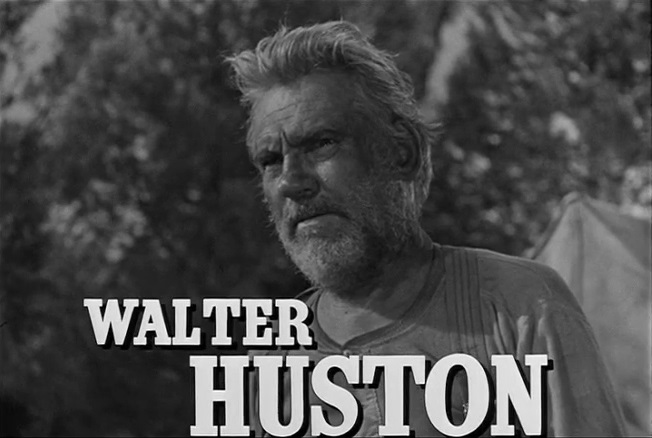
In the trailer for “The Treasure of the Sierra Madre”.
This movie really surprised me. It was made in 1948, around the time of what is called the “Second Red Scare“, when concern about communist infiltration was very high. Given that, the content of the movie is astounding.
Fred Dobbs (Bogart) and Bob Curtin (Tim Holt) are unemployed guys looking for work. They convince an old prospector named Howard (Walter Huston) to help them on an expedition for gold in the Sierra Madre mountains. The first remarkable thing about the movie is a speech given by Howard in his first scene:
Howard: Say, answer me this one, will you? Why is gold worth some twenty bucks an ounce?
Flophouse Bum: I don’t know. Because it’s scarce.
Howard: A thousand men, say, go searchin’ for gold. After six months, one of them’s lucky: one out of a thousand. His find represents not only his own labor, but that of nine hundred and ninety-nine others to boot. That’s six thousand months, five hundred years, scramblin’ over a mountain, goin’ hungry and thirsty. An ounce of gold, mister, is worth what it is because of the human labor that went into the findin’ and the gettin’ of it.
Flophouse Bum: I never thought of it just like that.
Howard: Well, there’s no other explanation, mister. Gold itself ain’t good for nothing except making jewelry with and gold teeth.
What’s so remarkable about that, you wonder? Well, what Howard is describing there is what is known as a Labor Theory of Value–the value of something is determined by the labor put forth to get it. This is an economic idea that is commonly associated with a fellow named Karl Marx. And it’s a response to the claim that gold’s value derives from its scarcity–a major component of non-Marxian, liberal economics.
Also in the trailer for “The Treasure of the Sierra Madre”
So, about twenty minutes into the movie, we have gotten a lecture on Marxian economics. This is all the more interesting because the rest of the movie is devoted to proving over and over that greed for wealth corrupts people–specifically, Dobbs. Howard repeatedly predicts that the gold will drive men to madness, and does it ever.
Dobbs’s inevitable corruption is fun to watch–that Bogart guy was a pretty good actor, you know that?–and Walter Huston is excellent, even though his role is fairly predictable. He is, essentially, an infallible sage, and normally those characters are pretty dull, but Huston imbues him with personality. What is not clear to me is why he bothered to come along, since he believes almost from the outset that the expedition will be a disaster, and it proves to be exactly that.
It was odd to me that the movie’s most famous, yet often mis-quoted, line: “Badges? We ain’t got no badges. We don’t need no badges. I don’t have to show you any stinking badges” was spoken by a rather poorly-acted, bandit character. I thought his character was pretty weak. In fact, I felt that the bandits had too big a role in the film, when all they really needed to do was show up at the end when Dobbs’s luck runs out.
I keep coming back to the economic “moral” of the movie, though. It’s a very socialist message, what with the capitalist who desires to earn for himself being depicted as either a monster or a buffoon, and the character who opens up describing the labor theory of value depicted as a wise and thoughtful figure.
Now, I know what you’re thinking. You’re thinking: “Well, this is it– Mysterious Man has finally gone completely crazy and is now seeing communist conspiracies everywhere. He must have been listening to Glenn Beck too much, and he just lost his tenuous grip on reality.”
1950s anti-communist pamphlet
To be clear, I’m not saying I think this movie was some kind of evil communist-Hollywood indoctrination plot. It was based on a book by a mysterious German called “B. Traven“, who was apparently a socialist. Well, when your movie is based on a book by a German socialist, you can’t be surprised if some German socialism creeps in. I doubt John Huston wanted to make Marxist propaganda; he just wanted to make a Western, and the book he adapted it from had some Marxist propaganda in it.
What surprises me is that, despite how popular accusing people in Hollywood of communism was at the time, the film wasn’t banned or censored, and John Huston wasn’t hauled up before the H.U.A.C. to explain himself. I’m not saying any of that should have happened, I’m just saying it’s weird that the film apparently got released without any censorship or controversy, which is kind of amazing given the zeitgeist.