This is a steampunk adventure-comedy about a group of geniuses, The Hogalum Society. When their founder and namesake, Dr. Yngve Hogalum, dies suddenly, one of the society’s members, Phineas Magnetron, takes it upon himself to make a daring, perhaps even mad, effort to restore Dr. Hogalum to life.

The book is written in a verbose, overly-ornate style that is a deliberate parody of Victorian prose. It takes place in 1877, albeit an alternate 1877 with many counterfactual technologies.

A few times, the author succeeded a little too well at mimicking the wordy style of the day, to the extent that I sort of wishes he’d get to the point more quickly. I got used to this eventually, and by the end found the narrator’s sesquipedalian tendencies rather entertaining.

The book is a quick 30 minute read that serves as an intro to the world of the Hogalums. I happened to stumble across it while searching for retrofuturistic books, and while it’s really an alternate history as opposed to actually retrofuturistic, I nevertheless enjoyed it very much.

Even more than the book itself, I liked the afterword where the author explains all the historical references and deliberate anachronisms. Things that sounded like impossibilities as I read them (a 20-chamber revolver???) turned out to be based in fact. I always learn something from these “stories behind the story.”

All in all, this is a very entertaining story for anyone who likes humorous steampunk adventures.

In this, the year of our Ford 115, limitless entertainment can be summoned for us at the push of a button. We live in an era where shows, films, games, and musical performances surround us constantly. If that’s still not enough, advanced computer technology will soon allow us to create our own customized artistic experiences on a whim. Want to see photos of Star Wars as a Spaghetti Western? It’s not quite ready to produce the full film version yet, but that day will come…

Yet, for everything we have in entertainment, we lack in imagination. Indeed, there is a very clear trade-off of imaginary power being made here. When you ask the A.I. to show you a new interpretation of Star Wars, you are literally outsourcing your imagination to a machine. Isn’t that a little scary?

‘Twas not always thus. It used to be that people relied on these things called “books” for entertainment. With a book, your task is to use your imagination to complete the ideas suggested by the author’s words. It’s similar to a computer program compiling, actually. In a sense, every book is a collaboration; the author gives us the basic furnishings, but it’s up to us as readers to finish it.

Which is not to minimize the importance of the author. Quite the contrary. Whereas, say, the director of a film has the power to manage every frame, every line, every sound, to inspire a specific reaction in the audience, (and we all know the stereotype of the tyrannical micromanaging film director) an author’s job is much tougher. What is not written is as important as what is. An author has to know what to state baldly, and what to only imply. An author has to know exactly what to tell the reader.

Which brings me at last to the subject of today’s review: Gold of the Jaguar, the third installment in Peter Martuneac’s Ethan Chase series.

Gold of the Jaguar takes us on an adventure in the jungles of South America, far away from the ease of modern life. It invites us to imagine lost treasure, ancient temples, and mysterious islands guarded by eerie predators that keep watch from the trees.

And Martuneac, a U.S. Marine Corps veteran, knows what details to give to immerse you in the adventure. The combat scenes feel vivid and immediate, the equipment, ancient and modern, is so real you feel like you can touch it, and the occasional flashbacks to earlier epochs give the setting a sense of history.

Beyond that, though, this book also deals with themes of recovering from addiction, abuse, reconciliation and healing. In that respect, it feels closer to Martuneac’s zombie apocalypse series, His Name Was Zach. While this is still a light adventure compared with the ultra-dark tone of those books, this one has some emotional weight to it.

Bringing all this back around to the point I made at the beginning: why, in 2023, should you read the Ethan Chase series, out of all the various forms of fiction competing for your attention? Well, I say the answer is because it’s sincere. I don’t care if it makes me sound like Linus in the pumpkin patch; there’s nothing but sincerity as far as the eye can see. It’s an adventure story, with heroes and villains and a lot of heart.

It is not the product of a focus group at some multinational entertainment megacorp, or a famous brand-name author who long since farmed the actual writing out to nameless drudges, or an A.I. piecing together bland assemblages of words to produce simulacra of stories.

No, it’s just a tale that one man wanted to tell, and he did it, and reading it is like coming along with him on a great adventure. Let his imagination team up with yours, and be swept away in a rollicking yarn of lost treasure, danger, and exploration.

A friend recommended this to me, and though it’s not the sort of book I normally read, I gave it a shot.
Dead Cert is told from the perspective of Alan York, an amateur jockey who is horrified when his friend Bill Davidson falls during a race, and dies from his injuries. York, who was right behind him when he fell, is convinced he saw a wire used to trip his friend’s horse, but on returning to the scene finds nothing.

But York isn’t the sort to give up, and keeps digging, trying to bring Davidson’s killers to justice. In so doing, he uncovers a taxi company acting as a front for a protection racket, a systematic scheme to rig races, and a beautiful young woman for whose affections he competes with one of his fellow riders.

It’s a classic mystery book, and York is a likable protagonist. His guts, determination, and stoicism make him easy to root for, even when he does run some pretty crazy risks. The writing is snappy and clever, and moves things along briskly and wittily.

All in all, it’s a really good book. Now, as it happens, I was able to guess who the ultimate “baddie” was the minute they were introduced.  Which is fairly early in the book, but there were plenty of tell-tale signs. And yet, this diminished my enjoyment of the story not at all. Even being pretty sure what would happen, seeing it unfold was still a treat, thanks to how well-written the story was.

More than the plot itself, what I really enjoyed was the portrayal of everyday life in early 1960s Britain. The social customs feel quaint and alien to a modern reader. That’s a compliment. Francis captured the setting beautifully,

While reading about this book, I came across this gem of a quote from The Guardian‘s obituary for Francis, describing his writing:

It was an American style that many clever people in England had attempted to reproduce without much success, and it was a wonder how a barely educated former jump jockey was able to do the trick with such effortless ease.

Yeah, pretty crazy that a former jockey would be able to write a book about being a jockey, isn’t it?

This is a short YA romance story that… no, wait, don’t run away! I mean, I don’t normally read YA romance either, but hear me out. This is by Adam Bertocci, the author of such favorites as The Hundred Other Rileys and Samantha, 25, on October 31. So let’s give him a chance and see where he takes this.

Iris, our protagonist, is a high school student with a strong contrarian streak. She just doesn’t like to follow the crowd. So when everyone at school insists she needs to wear green for St. Patrick’s Day, she refuses. (Pro tip from a veteran contrarian: to be really contrary, wear orange.)

However, when she’s forced to dress up as a leprechaun to hawk cookies for her father’s coffee shop, her stubborn independence is tested when she encounters the cute boy from school whom she’s had her eye on.

I really liked Iris. She reminds me of me, when I was that age. And maybe still. If you read this blog regularly, you know I tend to march to a different drummer.

I think a lot of kids are this way, and they feel kind of like misfits in school. And really, they shouldn’t. As much as anything, I think that’s what the real point of this book is. It’s okay to be different. But it’s also important not to let your commitment to being different override your own happiness.

This isn’t as complex a book as Samantha or Riley, but it’s not meant to be. It’s a fun YA short story, told with Bertocci’s typical wit and clever phrasing. It’s a good introduction to his style, and a nice read for St. Patrick’s Day.

Oh and one last thing: I loved Iris and her friend’s school assignment on debating the American Revolution. Naturally, Iris is taking the side of the British. I just want to note that if Iris actually existed, I’d encourage her to read A True History of the American Revolution by Sydney George Fisher to build her case for rebelling against the rebels.

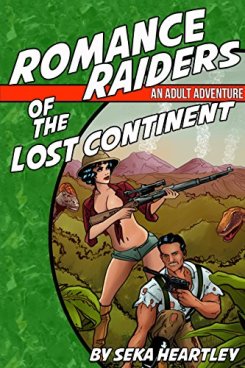
I reviewed the first book in this series last year, and this one is more of the same. Well, except the first one was sci-fi, and this is a classic 1930s pulp adventure. If the first one was Star Trek as a sex comedy, this is Indiana Jones as a sex comedy. Last time I said that the protagonist’s name, which is once again Dirk Moorcock, told you everything you needed to know. Well, I’ll add that this book has a spy named “Mata Hottie,” in case there’s any lingering confusion.

This time, around Dirk is hired by a beautiful Russian countess to guide her to, as you may have surmised, a lost continent discovered by her father. Naturally, an assortment of evil villains and monsters stand in their way, as does Dirk’s overactive sex drive.

I think the sex scenes in this book were somewhat more explicit than in the last one, which may be a good thing or a bad thing depending on your own personal preferences. They are easy enough to skim past if you don’t want to hear all the details. Though, if that’s the case, you may not want to bother with reading this in the first place. Still, if you liked the first book, you’re sure to enjoy this one as well.

I have to say, this is a great example of how you do a sequel. In general, my opinion is that it’s really difficult to keep telling good stories with the same characters again and again. Eventually, a writer starts reusing ideas, or making the characters behave in odd ways. I like this way of handling it, as a spiritual sequel (if the word “spiritual” can be used in regard to this bawdy tale) in a new setting. It allows the author freedom to keep what works from previous tales without being too closely bound by events of previous books. Hollywood should take note.

This is a science-fiction novel primarily set in the 25th century. It is framed as the memoir of Sir Robert Mayfair Bruce, a soldier in the inner circle of Isaac Prophet Fitzpatrick, a charismatic and ambitious man with designs on becoming a modern Alexander.

A great deal has changed by the 2400s, including the dissolution of the United States we know today. In its stead is the rigidly theocratic and highly disciplined Yukon Confederacy, which has its origins in the 2040s, when the Brain Lords were destroyed. (The Brain Lords being, in Bruce’s words, “a small sect of self-proclaimed superior humans who controlled the large corporations and the government through the use of thinking machines called computers.” Little else is remembered about them by Bruce’s time.)

This led to a period called “the Storm Times,” when an organization of engineers and scientists founded at Purdue University known as “The Timermen” used great “storm machines” (powerful satellites) to disrupt electrical equipment, and brought an end to the Age of Electricity.

(Aside: living as I do in the heart of Big Ten country, I’ve met many Boilermakers in my time, and it would not shock me if there really is a secret society of Purdue grads running the world. Every one that I’ve ever met is exceptional in some way.)

All this world-building is done efficiently and elegantly. The way the info is passed to the reader is really clever, and I actually feel bad for telling it to you in my clumsy way, but I had to in order to go on with explaining the plot, wherein the Yukon Civilization is a rising power looking to assert itself. And Isaac Prophet Fitzpatrick, who early on befriends the narrator and shepherds him high into the military ranks, seems just the man to lead them.

Fitzpatrick is an archetypal Carlylean “Great Man” of history. He wields authority through his bewitching personality and his brilliant ability to understand and manipulate the psychology of those around him. He evokes not just Alexander, but also Caesar and Napoleon, right down to his ability to carefully manage seemingly spontaneous incidents to bend people to his will.

Bruce is one such person and, at least as a young man, is easily convinced to do all sorts of things for the aspiring emperor, despite the reservations of Bruce’s wife, Charlotte, one of the few people who distrusts the Confederacy’s benevolent ruler.

Bruce is sent to India to build airbases in preparation for Fitzpatrick’s planned conquest of China, and later serves in the Great War that results. Bit by bit, as Bruce witnesses firsthand the horror of war and the machinations of his own government, he begins to question his child-like faith in the wisdom of Fitzpatrick.

Remember I said at the outset that the book is “framed” as Bruce’s memoir? Part of that framing device is that it’s presented as a discovered manuscript prepared for academic purposes by Doctor Professor Roland Modesty Van Buren, a scholar writing in 2591. Throughout the text by Bruce, there are annotations from Dr. Prof. Van Buren. And these notes mostly say that Bruce is lying.

You know that the unreliable narrator is one of my favorite tropes in fiction. Naturally, I fell in love with this framing device at once. Throughout the book, the Bruce text will say something about his experience, only to have an annotation by Van Buren state that this is categorically impossible, and cite some academic source as proof.

The great fun of the book is in figuring out who the unreliable narrator is at any given time. There are certainly some facts that the Bruce character misstates and the Van Buren character corrects, like when Bruce speaks of a long-gone statue on the Eastern coast of America as “The Mother of Liberty,” and Van Buren gives the proper historical name. There are other cases where it is not so clear who is right and who is wrong.

This book is many things, but above all, it’s a love letter to Clio, the muse of history. It is not just a fictional future-history; it is an instruction manual for how to read all histories, of any period. Again and again, the book reminds us that we can’t trust those who write either the first-hand accounts or those historians who follow them, eager to present a record that suits their own agendas. Hence why all histories must be subjected to meticulous analysis.

A couple months ago, over at Writers Supporting Writers, I wrote that my dream is to write a book with layers and depth to it. My example of the kind of book I meant was Dune, by Frank Herbert. Fitzpatrick’s War is another such book. Many times, I found myself comparing Fitzpatrick’s War to Dune. There are some similar plot elements, including:

  • A messianic nobleman consumed by visions of empire. (Paul in Dune, Fitzpatrick here.)
  • A secret society manipulating world-historical events. (The Bene Gesserit in Dune, The Timermen here.)
  • A purposeful destruction and limitation of artificial computing technology. (The Butlerian Jihad in Dune, the aforementioned defeat of the Brain Lords here.)

But the last thing I want you to think is that Fitzpatrick’s War is a Dune knock-off. It’s not that at all. I enjoyed it more than Dune, in fact. I attribute this partially to it being told from the perspective of Bruce, who, by his own admission, is just a common, unexceptional, stolid soldier-type, instead of Herbert’s focus on the hallucinating demigod at the center of a personality cult.

This is Judson’s special genius in constructing Fitzpatrick’s War: although the book deals with the grand sweep of history and the place of humanity in the universe, the author never loses sight of his characters. Bruce, Fitzpatrick, Charlotte, and others (especially Bruce’s friend Pularski, my personal favorite) never become mere puppets for the author’s philosophizing. They are well-defined, believable people, swept up in momentous and often horrifying events, and you feel like you’re experiencing all of it right there with them.

I could go on, and on, and on. There are so many things I adore about this book. But no amount of my praise can convey it properly. I’ll just say it’s the sort of book I wish I could write, and it deserves to be widely read.

But that, I’m afraid, is where we come to the sticky wicket.

Unlike nearly all books I review, this one’s not on Kindle. You used to be able to get a paperback on Amazon for twelve bucks. I say “used to” because apparently I bought the last one. As I write these words, the hardcover is going for about $25.

On the one hand, I’d gladly pay that price for this book, if I could experience it all over again for the first time. But I recognize that it’s a steep price to pay for a book, and not everyone will react to it the same way I did.

My suggestion: see if you can get it from the library. Also unlike most books I review, this one isn’t indie, at least not in the sense we normally use the term. It was published in 2004 by DAW Books, which is a reasonably well-known publisher of science-fiction. As a result, there may be more physical copies in existence than of most books I review, and a greater chance that libraries might possess some of them.

About those copies… being the nosy little sneak that I am, I tried to find some way to contact Judson. I failed, but I did find his blog, which hasn’t been updated since 2007. There, I found a post of his where he says that Fitzpatrick’s War:

…may be the least read book ever printed by a major house. I think in hard-cover and paperback editions put together it sold less than two hundred copies world-wide.

I recommend reading Judson’s entire post, and bookmarking it to refer to whenever someone asserts that traditional publishers help with marketing.

No, the fact is, book publishers and reviewers would much rather focus their efforts on promoting reliably salable titles by internationally famous writers. So, if we non-famous people want books promoted, we’ve just got to do the job ourselves. Judson may have written off Fitzpatrick’s War as having “died an ignoble death,” but I think he’s a bit of a crapehanger. (Which is understandable in anyone who has studied history as extensively as he obviously has.) Many now-classic works of literature were lost and forgotten for decades or even centuries before they took their place in the Canons of Literary Art.

If you can somehow get yourself a copy, you must read Fitzpatrick’s War. It’s weird, I know, to have to go to some trouble to enjoy a piece of media in this era of instant content delivery, but perhaps this is fitting given some of the book’s themes.

As for me, I plan to read it again to check for subtleties I may have missed. Then I’ll probably lend it to one or two family members who I think would like it. After that’s done, I’ll certainly consider sending my copy to friends of the blog who may wish to read it and can’t get hold of it otherwise. This book is too good, and people need to read it, and decide for themselves if Robert Mayfair Bruce is a hero or a traitor.

Update 11/23/2025: A Kindle re-release of Fitzpatrick’s War is slated for August 11, 2026, coinciding with the release of a new novel from Judson set in the same universe, The Timerman.

There’s simply nothing like a Zachary Shatzer book to make you laugh. This one is no exception. The sequel to Sorcerers Wanted gets going early with a hilarious recap of the events of the first book, and never lets up from there.

I can’t summarize the plot; it’s simply too wild. You have a demonic talking hamster, inter-dimensional travel, an evil overlord who turns everything into candy, and a sweet Canadian hockey mom who practices occult magic on the side. And that’s just the tip of the iceberg.

It is wacky and zany and bizarre and hilarious. I’m sure it won’t be to everyone’s taste, but if you couldn’t already tell from my reviews of all his other books, Shatzer’s style is very much to mine. I laugh out loud reading his books, which is something I almost never do, even when I am genuinely amused by a piece of writing.

Go pick this book up. If you struggle to envision the scenes in a way that strikes you as funny, try the following experiment: imagine how the book would play as a movie performed by Monty Python. As the Pythons were no strangers to playing multiple roles, you can assign them to as many characters as you like.

It’s just an idea. If you’re like me, you won’t need any additional mental tricks to enjoy this book. It will be a non-stop laugh-fest from start to finish.

This is a textbook example of what I’d call magical realism. On the one hand, it’s a story about the mining of uranium in the Southwest, and the health effects it had on the miners.

But there’s more to this story, and Bruce weaves it together with the myths and legends of the native peoples. The meat of the tale is about people, beaten down by the materialistic and greedy society around them, learning to let go of their linear conceptions of time and to embrace a cosmic, cyclical view of life.

This all sounds a bit esoteric, I’m sure. And it is, but Bruce makes it understandable and relatable. With just a few sentences, I could empathize with his characters, and it was a pleasure to join them on what ultimately becomes a story of healing.

This book is definitely in the same mold as Bruce’s novel Oblivion, about a sort of commune built in the desert, around motifs of nature and healing. Like Tolkien and so many of the greats, Bruce loves his native landscape and deplores its destruction by modernity.

It’s funny; I think everyone knows, deep down, that there’s something wrong with the annihilation of nature to make way for more technology, more artificial and unwholesome modes of life. And yet no one can stop it. Like Leonard Cohen sang: “Everybody knows the war is over. / Everybody knows the good guys lost.”

Still, it’s never too late to heal, and the best time to start is always now. Quite apart from being a commentary on society, or an exploration of ancient legends, the book is about people coming to terms with their own mortality, and making peace with it.

This is a small book; but it contains massive ideas. I highly recommend it.

Last year, Lydia Schoch and I made an agreement that January 31 would be “Second Halloween.” Accordingly, I’m observing the day by reviewing a book appropriate for that spooky season.

And look at that cover. How, I ask you, could I possibly not read a book with that cover? Even though it is the sixth book in Boyack’s “Hat” series, and I have not read any of the others, I simply could not resist.

Fortunately, Boyack writes such that you don’t have to read the others to understand it. Maybe a few references went over my head, but I could follow it well enough. It tells the story of a musician named Lizzie, her magical talking hat, and a friend of theirs who has been revivified Frankenstein-style and needs to find medicine to stay alive.

But, finding the medicine means finding the doctor who restored him, and he has fallen into the clutches of the titular monster, the sinister-looking entity pictured above.

The book is fast-paced and action-packed. Lizzie and her friends must mow down waves of pumpkinheaded zombies to reach the Rambler in time. There are also moments of downtime when they gather clues by listening to a paranormal late-night radio show along the lines of Coast-to-Coast AM. As you can imagine, I loved these parts of the story.

This is a fun and enjoyable read for Halloween. Or, in this case, Second Halloween. Which is going to be a thing, by golly! What better way to liven up this dreary time of year?

Robert E. Howard was a popular pulp author in the 1920s and ’30s. Mostly, he is remembered today for Conan the Barbarian, but he wrote a great deal of adventure and sword-and-sorcery stories, many of which appeared in the pages of Weird Tales.

As the subtitle suggests, this book aims to tell the story of Howard’s life through a close analysis of his literary output, using quotes from Howard and his contemporaries.

Literature is a business to me–a business at which I was making an ample living when the Depression knocked the guts out of the markets. My sole desire in writing is to make a reasonable living.

So Howard himself wrote, in the early 1930s. Smith argues that in fact, Howard did have literary ambitions, but that he cloaked them with this sort of practicality.

Howard was a hard-nosed, hard-boiled kind of guy. An amateur boxer and weightlifter, he’d seen more than a little nastiness growing up and, Smith argues, his dark and violent stories reflect his upbringing.

I confess, prior to reading this book, I’d only ever read one thing by Howard: a short story called Ye College Days. It’s a dark comedy, in the vein of Ambrose Bierce, that seems to be satirizing college sports rivalries. Funny, in a macabre sort of way.

Howard, Smith repeatedly tells us, was fixated on physicality and violence in his fiction. His stories tell of fighters and warriors, struggling in mortal combat, either against one another or sometimes against otherworldly demonic entities.

This is in contrast to Howard’s friend and fellow pulp author, H.P. Lovecraft. Howard and Lovecraft corresponded frequently, and Lovecraft’s brand of weird fiction influenced some of Howard’s works.

HPL and REH had their share of disagreements, too, including one over a fairly abstract philosophical point about whether it is better to live in the comfortable regulation of civilization, or the liberated wilds of barbarism.

My favorite parts of the book are the ones about Lovecraft and Howard’s relationship, as they debate and discuss ideas while critiquing each other’s fiction. Unlike Howard, Lovecraft was a quiet, scholarly, would-be aristocrat who had probably never even been in a fistfight, and his characters are much the same; as bookish as Howard’s were barbaric.

The entire Weird Tales community strikes me as a forerunner of internet fandoms and forums. Fans could and did write to Weird Tales, seemingly usually to complain about something. Today, we know Robert Bloch as the author of Psycho, but once upon a time he was a teenaged kid writing angry letters to Farnsworth Wright, the editor.

Speaking of Farnsworth Wright, here’s his take on the readership of his magazine:

While we have many quick-witted and intelligent readers, we also have many whose intelligence is rudimentary.

This is the problem with having a wide readership. Not that Weird Tales was necessarily a blockbuster success, since financial difficulties seem to have been a recurring theme.  On the other hand, at one point we are told that in 1928, Howard:

…earned $186 from his writing, sufficient for him to no longer require other means to support himself and to help with his family’s expenses.

I looked up estimates of the purchasing power of $186 in 1928. Seems it’s equivalent to about $3,000 in today’s dollars, so I’m guessing this was monthly income.

A dream come true, to most of us self-published authors! Imagine if we all made $3K a month. Howard was clearly making a decent living, at least before the depression.

But let’s try to zero in on the specifics of the pulp publishing business. Weird Tales pays Howard $186 a month for his stories. Why? Presumably because they think his stories sell magazines. Of course, since each issue contains stories by multiple authors, there’s no way to precisely know how many sales are due to the presence of a Howard story. But he did have a tendency to be favored with having his story illustrated on the cover. (A fact that annoyed Bloch.)

About those cover illustrations… most of Howard’s tales were illustrated for WT by a woman named Margaret Brundage.  A quick sample of her oeuvre on Wikipedia left me thinking, “More like Margaret Bondage, am I right?” Ms. Brundage’s covers frequently depicted naked women in various sorts of peril, which many Weird Tales contributors were keenly aware of when writing their stories.

Smith writes that Howard “wrote from experience and with a deep respect for history, and the best Conan stories are melancholy with the sharp memories of greater days gone before.” Perhaps, and yet I can’t help wondering if the reason his stories sold was because of the titillating covers that usually accompanied them.

This is a pretty bleak conclusion for anyone looking to draw writerly insights from Howard’s career. Whatever qualities his fiction may have had, was it popular because it provided a basis for many a teenager’s fantasy? If so, what hope is there for authors in a world that also contains DeviantArt?

However, I take a more optimistic view. We still read the Weird Tales authors today, and enjoy the worlds they were able to conjure. The quality of their writing does matter after all!

Imagine if you could tell Howard, or Lovecraft, or any of the others, that in the year 2023, we’d be using a global communications network to discuss their works. I would imagine they’d be delighted.

As I see it, the ironic thing about the pulp community of the 1930s was that they were not thinking big enough. If they had known the future, would they have been grousing over whose story got the cover illustration? No! These trivial concerns melt away when you consider the influence their ideas would one day have in popular culture.

Part of the reason that the words of these authors live on is the community they created. I’ve written before about how Lovecraft’s correspondence with Bloch helped shape one of his best stories. One wonders what they might have done if they’d had the internet at their disposal.

Comes the cynic’s reply: probably waste it by arguing over petty nonsense. A forum is only as good as its members. While I obviously have a great deal of respect for some of their work, there’s no denying most of the major figures at Weird Tales were, well, weird. (Especially Lovecraft. His eccentricities, both the harmlessly amusing ones and the kind of appalling ones, come through clearly in this book.)

As for Howard himself, his own story ended in a rather sad way, the details of which I won’t discuss because they have little bearing on his literary work. All I’ll say is that it would have been interesting to see what he might have produced had he lived to write for a full natural lifetime. Stephen King called much of Howard’s work “puerile.” Smith contests this accusation vigorously, and rightly so, but he never brings up what I consider the most obvious objection: Howard died at the age of 30, and so never could produce more mature works.

After reading this book, I decided to give another of Howard’s stories a try. I read Wolfshead, because Smith seemed to think it’s one of his best early stories.

It’s not bad, I have to say. Of course, for multiple reasons, it is shocking to the sensibilities of modern readers. But it’s got a good atmosphere; a creepy castle in some remote jungle, a cast of interesting characters, and a memorable narrative voice.

Looking through Howard’s works on Wikisource led me to The Battle That Ended The Century, which is a humorous in-joke story, allegedly by Lovecraft, packed with references to various members of the Weird Tales crowd, including Howard, or as he is called in the story, “Two-Gun Bob.”. My favorite line:

[T]he eminent magazine-cover anatomist Mrs. M. Blunderage portrayed the battlers as a pair of spirited nudes behind a thin veil of conveniently curling tobacco-smoke.

Can’t you just picture the sort of scene that’s being described? I bet when you started reading this review, you had no idea who Margaret Brundage was, and now you are able to appreciate inside jokes about her art style that were originally intended for a specific group of writers in the 1930s.

Such is the power of a writing community! Here we are, nearly a century later, and still reading their words. Would anyone in 1936 have dared imagine that the contributors of this strange little pulp would still be remembered? And what will people in 2110 remember about 2023, I wonder? An interesting question to ponder, indeed. But for today, I have gone on too long already.