Despite the fact that I like history and I like movies,  I don’t think a lot about about the history of the movie industry.  But I was reading the other day about the 1964 movie The Fall of the Roman Empire, which I’d never even heard of, but sounds very interesting, as it has a very strong cast.  (Too bad Edward Gibbon didn’t get screenwriting credit.)

The film was a fairly bad box office failure, reminding me of another epic historical film that famously lost money: Cleopatra, which I blogged about here.  It wasn’t that people didn’t want to see Cleopatra; it was just that it was so expensive it couldn’t make back its massive cost.

It seems like “epic” movies were big in the 1960s, until they ran into bombs like Cleopatra, at which point the industry turned towards smaller, more “personal” movies, until George Lucas and Steven Spielberg came along and turned things back toward the epic scale.

I think “epic” movies–think movies with ornate sets and large crowds–became prohibitively expensive to make, so they turned away from them in the ’70s.  Then the advent of CGI made it possible for the genre to be resurrected.  Look at the Wikipedia article on historical epic films, and take note of the dates:

Examples of historical epics include Intolerance (1916), Gone with the Wind (1939), The Ten Commandments (1956), Ben-Hur (1959), Spartacus (1960), Lawrence of Arabia (1962), Cleopatra (1963), Doctor Zhivago (1965), Barry Lyndon (1975), Gandhi (1982), Braveheart (1995), Titanic (1997), Joan of Arc (1999), Gladiator (2000), Troy (2004), Alexander (2004), Kingdom of Heaven (2005), and Les Misérables (2012).

Now, the “new” epics are not as really the same as the “old” epics–it’s hard to put your finger on exactly how, but there is a feeling of unreality about the new CGI based movies.  They lack “grittiness”–a term normally associated with the non-epics made in the 1970s, but which applies to the macro scale as well.

“Capriccio Romano”, by Bernardo Bellotto. 1740s. Image via Wikipedia.

It can be done–one reason I think the Star Wars prequels are better than people give them credit for is that they do a better job emulating the “feel” of the bygone epic films than most other modern epics do.  George Lucas may be over-reliant on CGI, and he may have done more than anyone else to usher in the era of cheap epics, but he himself knows what he’s doing when it comes to CGI effects.   This could just be because Lucas (and Spielberg) are old enough to remember the era of the original epic movie era, and so can understand them enough to imitate them expertly.

But now that CGI is so prevalent, and makes epics so easy (relatively speaking) it makes all epics too overdone, too focused upon spectacle, and loses the deeper meaning.  I believe that some historians feel the same thing happened to cause the decline of Rome.   “Bread and circuses” indeed…

Last week, I watched an episode of the old TV series Sherlock Holmes, starring Jeremy Brett.  It was “The Adventure of the Naval Treaty“, in which Holmes’s client is a secretary who was copying a top-secret treaty, which gets stolen from his desk when he leaves his office for a moment.

I started thinking about the new “Sherlock” series and wondering how they could adapt the story to the modern day if they wanted to. In the age of word processing software and copiers, there’s no need for clerks to sit around copying lengthy documents for hours.  Conan Doyle’s story simply could not occur in the present day.

Then, a few nights later, I saw an episode of the show Bewitched.  In it, the witch puts a spell on household objects to make them respond to voice commands, e.g. windows opening and closing by simply saying a command.  When they made that show in the ’60s, that must have seemed fantastic; now it’s eminently doable.

I’ve often seen Cold War spy thrillers where a big problem is finding a phone quickly, before something serious happens.  Again, nowadays that’s obsolete–cell phones eliminate that problem.

It’s funny to think of how people in those days wrote these stories, probably never thinking that there would be technology that would one day make the whole scenario they had constructed obsolete.  It doesn’t make the story any less enjoyable, of course, but it just gives you an idea of how much technology has changed.  Makes you wonder what people will look at in our modern films and television programs  and think “if they just had…”

eurobrat posted an interesting observation about electronic communication and how the experience of using it must differ for introverts and extroverts.  It’s interesting because I also consider myself an introvert, but I don’t really like electronic communication via email, instant messaging or even blog comments that much.  Mostly because I always worry when I’m not communicating face to face that what I say might be misinterpreted and accidentally cause offense.

In my experience, it seems like blogging is largely done by introverts and Facebook is used by extroverts. But eurobrat points out that even Facebook  must not be adequate for those who really like getting out and interacting with people.  I guess that’s true, now that I think about it. Probably all the people on Facebook are just using it as a stopgap measure between interactions with their friends.  It’s a complement, not a substitute.

P.M. Prescott’s comment on this post reminded me of an issue I’ve wanted to write about on here for a while: TV commercials.  Are they worth it?

I almost always mute commercials when they come on, unless they’re for something I am already interested in.  I can’t think of any time in my life when I’ve decided to buy something just because I saw a commercial for it.  I generally research any major purchases first.

And then there are the commercials for small things, like soft drinks.  Maybe other people are different, but I don’t see those commercials and go “well, I’ve just got to go buy a [X soft drink] right now.”  My soft drink purchase decisions are made purely on the basis of what’s most convenient; I don’t care about brands enough to spend extra time hunting down a particular drink.

Some say that commercials work subliminally.  Well, maybe.  But how effective can the ads be when they produce no noticeable change in my behavior?  Even if it’s subliminal, I would notice that I suddenly had a desire to go out and buy particular things.

Especially interesting to me are political ads. (With which we are about to be deluged, incidentally)  Is anybody really going to vote based on what a TV ad said?  I just assume that all political ads are telling half-truths at best, and so I tune them out automatically.

Given all that, I have to think that companies are overpaying for ads.  The return on it can’t be that much, can it?   I think a company gets more benefit from announcing at the beginning of a program that they are sponsoring the whole thing without commercial interruption than they do from advertising during it.  Because, in general, commercials annoy the viewer who is just trying to watch something.

Turns out, these people had it right: tablets are the way to go. Image via Wikipedia

I don’t see what’s so great about this Microsoft Surface thing.  Then again, I said the same thing about the iPad when it came out.  But I got one for Christmas this past year, and I now love it.  But for the most part, I can’t see what new features this brings to the tablet.

The only advantage I can see for the Surface is that it has the touch-type keyboard.  That isn’t important to me, as I don’t touch-type, but I can see how that would be a big feature to people who can.  But any small advantage that may offer over the iPad seems negated by the cheesy-looking user interface of the Surface, plus the problem of it being rather late to the tablet party.

As if on cue, a guy named Rob Flickenger has invented a Tesla energy gun:

Cool. I like electricity. But notice that the thing’s range is apparently 12 inches. And it took only took a little over a hundred years to do it! To me, this somewhat long development time does explain why the armies of the world weren’t lining up to pay Tesla when he first talked about his energy weapon.

By the way, people keep calling it a “Tesla coil gun”. I believe there is also a “coil gun” that is a different thing altogether, invented by Carl Gauss–sometimes called a “Gauss gun”. And yes, I only know about this stuff from playing Fallout. With Science!

But, we can sleep soundly in our beds knowing that our best and brightest are devising new and better weapons. Hey, wait…

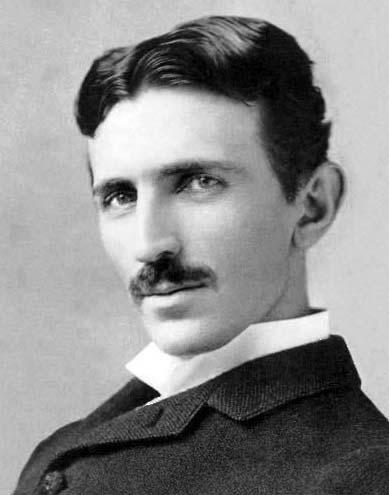
Nikola Tesla, via Wikipedia.

Have you heard the news? Abraham Lincoln invented a fore-runner of Facebook. No, really! It must be true because it said so on the internet.

Well, the hoax was exposed within a day, but not before a lot of major news sources fell for it. Here’s an excerpt from the hoax article:

The whole Springfield Gazette was one sheet of paper, and it was all about Lincoln. Only him. Other people only came into the document in conjunction with how he experienced life at that moment. If you look at the Gazette picture above, you can see his portrait in the upper left-hand corner… But just to the left of his picture, and above that column of text, is a little box. And in that box you see three things: his name, his address, and his profession (attorney).

The first column underneath his picture contains a bunch of short blurbs about what’s going on in his life at the moment – work he recently did, some books the family bought, and the new games his boys made up. In the next three columns he shares a quote he likes, two poems, and a short story about the Pilgrim Fathers…

Put all that together on one page and tell me what it looks like to you. Profile picture. Personal information. Status updates. Copied and shared material. A few longer posts. Looks like something we see every day, doesn’t it?

And it goes on:

Lincoln was requesting a patent for “The Gazette,” a system to “keep People aware of Others in the Town.” He laid out a plan where every town would have its own Gazette, named after the town itself… Lincoln was proposing that each town build a centrally located collection of documents where “every Man may have his own page, where he might discuss his Family, his Work, and his Various Endeavors.”

This right here should have tipped anyone who read this off that this was a hoax, by the way: the use of the word “page” sounds very odd here, not at all like someone from the 1800s would use it, and exactly like someone familiar with the internet would use it.

And surely it must have struck the people reading this that the concept is on its face absurd. People would have no need for such a tool back in the 1800s. They already had town newspapers. The faux-proposal sounds just stupid when you put it like this. This, again, should have given the whole thing away.

What this hoax exposed–perhaps unwittingly–is that Facebook is not a lot more useful than a town newspaper. It gives you some ability to stay in touch with your friends, but for the most part it’s just a time-waster. It’s addictive, sure, but not all that useful. It is barely more than a glorified bulletin board. or newspaper.

Lincoln invent Facebook! The idea is laughable at first sight!

He was much too smart for that.

Too bad about the Borders Bookstores bankruptcy and all the closings. I’ve always loved those stores.

I understand of course why technology made this more or less inevitable. Physical books are clearly on their last legs, and it’s hard to argue against electronic reading. It is more convenient, on the whole.

Really, though, what made Borders so great wasn’t the books at all, it was the ambiance they created in their stores. It would be very difficult to create an online store that could replicate that.

So, the Internet’s all full, eh? Oh, well, it was fun while it lasted.

Seriously, though, so they’re changing over to a new IP address system which, according to the CNN article above, has “340 undecillion IP addresses.”

I was never too good at math, so it kind of freaks me out to hear that there are even more numbers out there than I knew about already.