Maybe there’s something about the name “Sinclair”.  Last year, I blogged about Sinclair Lewis’s novel It Can’t Happen Here, and mentioned how terribly unsubtle its political commentary is.  I just finished reading The Jungle by Upton Sinclair, and it has much the same problem.

Upton Sinclair did not like the meat-packing industry. And so he wrote this book to explain why it–and ultimately the entire capitalist system–was corrupt and evil.  The book tells the story of a Lithuanian family who comes to America and finds work in the Chicago meat-packing industry.  Every single horrible thing that you can imagine happening then proceeds to happen, and so, through soul-crushing poverty, crime and death, the family breaks up.

The main character is the family patriarch, Jurgis Rudkus, who goes from being an honest working man beaten down by the cruel meat industry to a cynical and selfish criminal to finding the light of socialism, which he then espouses with religious zeal.

I have to admit, though it is about as heavy-handed as it could have been, it nevertheless succeeds somewhat in making you feel sorry for the characters by sheer force of repetition.  Sinclair had this irritating habit of writing something along the lines of: “Jurgis went home that night, little knowing that something unbelievably horrible was about to happen.”  This kind of kills the suspense, and is dramatically a dreadful device, but it beats you over the head with it so much it sometimes works anyway.

The irony is that though the book is famous for its depiction of the disgusting practices of the meat-packing industry, that was really just a bit of extra detail Sinclair included. His real point was much broader; it was that the workers were oppressed by the bosses.  So, he actually accomplished the extremely rare feat of writing a novel that accomplished social change, but it was not the change he wanted. (It wouldn’t shock me if the reason the book is famous for the parts about the food production processes is because those bits are closer to the beginning, and most people quit reading after that.)

Sinclair wrote this novel for a socialist magazine, and this is where it comes to its central problem: the conflict between being a work of propaganda and a work of art.  There can be propaganda that is also art, but when a person is writing to make a political point, there is a dilemma between portraying things as they are versus how the ideology requires them to be.  So, almost all of the characters in The Jungle are just puppets with which Sinclair makes his political points.

There are vast swaths of the book that don’t really qualify as being part of the story, they are merely long lists itemizing everything that is wrong with meat-packing, or the city of Chicago, or the factories, or whatever.  The last chapter of the book is just a huge lecture on the evils of Capitalism and the virtues of Socialism:

“How is the price of an article determined?”

“The price is the labor it has cost to make and deliver it, and it is determined by the first principles of arithmetic. The million workers in the nation’s wheat fields have worked a hundred days each, and the total product of the labor is a billion bushels, so the value of a bushel of wheat is the tenth part of a farm labor-day. If we employ an arbitrary symbol, and pay, say, five dollars a day for farm work, then the cost of a bushel of wheat is fifty cents.”

“You say ‘for farm work,'” said Mr. Maynard. “Then labor is not to be paid alike?”

“Manifestly not, since some work is easy and some hard, and we should have millions of rural mail carriers, and no coal miners. Of course the wages may be left the same, and the hours varied; one or the other will have to be varied continually, according as a greater or less number of workers is needed in any particular industry. That is precisely what is done at present, except that the transfer of the workers is accomplished blindly and imperfectly, by rumors and advertisements, instead of instantly and completely, by a universal government bulletin.”

That’s just a bit of it–to give you the flavor.  It reminded me of Ayn Rand’s writing, and almost made me wonder if her books are better once you are familiar with clumsily-written socialist propaganda.  Perhaps her sledgehammer approach to philosophical writing was intended as a parody.

There are a ton of obvious questions Sinclair fails to answer in the concluding chapters.  Given the benefit of hindsight, the “Socialism is Our Salvation” message of the book is truly ironic.  Just in the above passage, you may ask “how exactly will this ‘universal government bulletin’ work?” Or perhaps, if you’re after the big game, you might wonder “if price is determined by labor, wouldn’t that mean something produced with more labor–that is, less efficiently–be more valuable than the same good produced with less labor?”

Ok, that second one is unfair.  I’m criticizing Sinclair for repeating Marx’s mistake.  But if we just stick to the problems with this as a novel, it’s still pretty bad to end your book with a series of “Marty Stu” characters giving speeches.  This Socialist F.A.Q. in the last chapter made me think of a quote from Marx–Groucho, that is.  In one of their movies, there’s a bit where Chico is asking and answering his own rhetorical questions and then asks Groucho, “Now so far I’m right?”.  Groucho responds: “It’s pretty hard to be wrong  when you keep answering yourself.”

Now, don’t misunderstand me–I’m sure a lot of the criticisms Sinclair made of the meat industry were quite valid.  It was just the solutions where he went wrong, I think.  According to Wikipedia, an employee at the publishing company for The Jungle wrote:

One feels that what is at the bottom of his fierceness is not nearly so much desire to help the poor as hatred of the rich.

Doubtless, Sinclair would say that this employee was just slandering him on behalf of the capitalists in order to crush the glorious proletariat uprising. “Now we see the violence inherent in the system!”

Seriously, though, that person was right that Sinclair hated the rich.  He seems to have surprisingly little actual interest in the poor, and besides that, he seems to have had odd little prejudices of his own.  (Especially against the Irish–I think nearly all of the bad characters in the book are explicitly noted to be Irish.)

As a novel, it is pretty poor.  As a work of propaganda, it is also fairly weak, though it did actually set people thinking and inspire them to take action to make changes in society, even if it wasn’t what the author himself had in mind.  It caught the attention of  President Theodore Roosevelt–clearly, it was an effective vehicle for getting a message across.

And if nothing else, it made me glad I’m a vegetarian, even though I’m quite certain the meat industry’s practices have improved over the last century.

I did something new yesterday.  I watched almost all of an episode of a “reality TV” show.  I’ve really never watched any in the past–save for a few minutes of a “Wipeout” course that looked kind of neat–because “reality TV” shows strike me as stupid, which is a little unfair to think given that I’ve never seen one, but I have seen commercials for them during football games and they don’t look very interesting.

But it transpired I had some time to waste, and there was nothing on PBS that I hadn’t seen, and so I flipped over to the show “Stars Earn Stripes” on NBC.  If you haven’t seen it, it’s a show in which various celebrities run missions “based on” military training exercises.  The only celebrity on it who I had heard of before was Sarah Palin’s husband, so I’m not sure they’re actually “stars”.

I think the words “based on” are highly significant here.  I have never served in the military, but I am highly skeptical of whether they would have a training exercise like the one on last night’s episode, where the contestants had to shoot (with a pistol) at stationary, dinner-plate sized targets on the ground from a parked humvee. Seems pointless, unless they are expecting to fight a ground war against an army of dinner plates. If any veterans read this and have seen the show, I’d love to hear from them about it.

Their was also some sort of “elimination round” between two of the contestants.  It seemed more realistic, in that it was some kind of competition to clear a confined area of targets.  It looked like shows I’ve seen on S.W.A.T. training where they practice fighting through a building that has been taken over by criminals.

A lot of people, including Nobel Peace Prize Winners, say the show glorifies war.  I guess it does, but it mostly glorifies training for war, which may or may not be the same thing.  It’s not as egregious about it as, for example, the super-popular Call of Duty games or many popular action movies,  but at the same time it definitely plays like a military recruiting commercial, especially with the awkward presence of General Wesley Clark as co-host.

Is that bad?  I don’t know; the military has been trying to figure out ways of recruiting more people through P.R. stunts ever since the draft ended.  Maybe it was because of my expectations, but it struck me as no different than those ads you see during football games for the various branches of the service.  And those, I feel, are about as likely to succeed as other commercials.

It’s the Act of Valor issue all over again: sure, it’s recruiting film, but that still doesn’t answer whether it’s a bad thing or a good thing.  Personally, I think it’s kind of weird to show the celebrities doing stuff “based on” military training.  Seeing them try to get through an exact re-creation of Army Ranger training would probably be more exciting viewing, but then, I don’t think many celebrities would sign on for that.  And I doubt many viewers would say “looks like fun.”

Like I said, I haven’t seen much reality TV, but I get the impression the big draw is seeing the emotional disputes and inter-personal drama between the contestants.  There was none of that here.  I’m guessing that NBC wanted an emotionally stable cast, since they are giving them access to real weapons and live ammunition.  (Shades of “You can’t fight in here, this is the war room!”)  It makes practical and ethical sense, but probably makes for worse TV.

Lastly, I did feel a little weird watching the show.  Maybe I am cynical but it–along with most reality shows and sporting events–remind me a little too much of the Ancient Roman Gladiator Games.  While it’s obviously much safer for the contestants, there’s still something a bit unsettling about it as a viewer.

“Pollice Verso” by Jean-Léon Gérôme. 1872 artist’s conception of gladiatorial games.

P.M. Prescott’s comment on this post reminded me of an issue I’ve wanted to write about on here for a while: TV commercials.  Are they worth it?

I almost always mute commercials when they come on, unless they’re for something I am already interested in.  I can’t think of any time in my life when I’ve decided to buy something just because I saw a commercial for it.  I generally research any major purchases first.

And then there are the commercials for small things, like soft drinks.  Maybe other people are different, but I don’t see those commercials and go “well, I’ve just got to go buy a [X soft drink] right now.”  My soft drink purchase decisions are made purely on the basis of what’s most convenient; I don’t care about brands enough to spend extra time hunting down a particular drink.

Some say that commercials work subliminally.  Well, maybe.  But how effective can the ads be when they produce no noticeable change in my behavior?  Even if it’s subliminal, I would notice that I suddenly had a desire to go out and buy particular things.

Especially interesting to me are political ads. (With which we are about to be deluged, incidentally)  Is anybody really going to vote based on what a TV ad said?  I just assume that all political ads are telling half-truths at best, and so I tune them out automatically.

Given all that, I have to think that companies are overpaying for ads.  The return on it can’t be that much, can it?   I think a company gets more benefit from announcing at the beginning of a program that they are sponsoring the whole thing without commercial interruption than they do from advertising during it.  Because, in general, commercials annoy the viewer who is just trying to watch something.

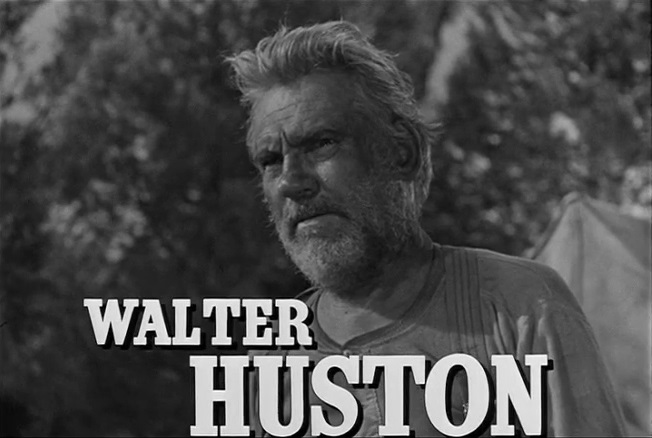
In the trailer for “The Treasure of the Sierra Madre”.

This movie really surprised me.  It was made in 1948, around the time of what is called the “Second Red Scare“, when concern about communist infiltration was very high.  Given that, the content of the movie is astounding.

Fred Dobbs (Bogart) and Bob Curtin (Tim Holt) are unemployed guys looking for work.  They convince an old prospector named Howard (Walter Huston) to help them on an expedition for gold in the Sierra Madre mountains.  The first remarkable thing about the movie is a speech given by Howard in his first scene:

Howard: Say, answer me this one, will you? Why is gold worth some twenty bucks an ounce?
Flophouse Bum: I don’t know. Because it’s scarce.
Howard: A thousand men, say, go searchin’ for gold. After six months, one of them’s lucky: one out of a thousand. His find represents not only his own labor, but that of nine hundred and ninety-nine others to boot. That’s six thousand months, five hundred years, scramblin’ over a mountain, goin’ hungry and thirsty. An ounce of gold, mister, is worth what it is because of the human labor that went into the findin’ and the gettin’ of it.
Flophouse Bum: I never thought of it just like that.
Howard: Well, there’s no other explanation, mister. Gold itself ain’t good for nothing except making jewelry with and gold teeth.

What’s so remarkable about that, you wonder?  Well, what Howard is describing there is what is known as a Labor Theory of Value–the value of something is determined by the labor put forth to get it.  This is an economic idea that is commonly associated with a fellow named Karl Marx.  And it’s a response to the claim that gold’s value derives from its scarcity–a major component of non-Marxian, liberal economics.

Also in the trailer for “The Treasure of the Sierra Madre”

So, about twenty minutes into the movie, we have gotten a lecture on Marxian economics.  This is all the more interesting because the rest of the movie is devoted to proving over and over that greed for wealth corrupts people–specifically, Dobbs.  Howard repeatedly predicts that the gold will drive men to madness, and does it ever.

Dobbs’s inevitable corruption is fun to watch–that Bogart guy was a pretty good actor, you know that?–and Walter Huston  is excellent, even though his role is fairly predictable.  He is, essentially, an infallible sage, and normally those characters are pretty dull, but Huston imbues him with personality.  What is not clear to me is why he bothered to come along, since he believes almost from the outset that the expedition will be a disaster, and it proves to be exactly that.

It was odd to me that the movie’s most famous, yet often mis-quoted, line: “Badges? We ain’t got no badges. We don’t need no badges. I don’t have to show you any stinking badges” was spoken by a rather poorly-acted, bandit character.  I thought his character was pretty weak.  In fact, I felt that the bandits had too big a role in the film, when all they really needed to do was show up at the end when Dobbs’s luck runs out.

I keep coming back to the economic “moral” of the movie, though.  It’s a very socialist message, what with the capitalist who desires to earn for himself being depicted as either a monster or a buffoon, and the character who opens up describing the labor theory of value depicted as a wise and thoughtful figure.

Now, I know what you’re thinking.  You’re thinking: “Well, this is it– Mysterious Man has finally gone completely crazy and is now seeing communist conspiracies everywhere.  He must have been listening to Glenn Beck too much, and he just lost his tenuous grip on reality.”

1950s anti-communist pamphlet

To be clear, I’m not saying I think this movie was some kind of evil communist-Hollywood indoctrination plot.  It was based on a book by a mysterious German called “B. Traven“, who was apparently a socialist.  Well, when your movie is based on a book by a German socialist, you can’t be surprised if some German socialism creeps in.  I doubt John Huston wanted to make Marxist propaganda; he just wanted to make a Western, and the book he adapted it from had some Marxist propaganda in it.

What surprises me is that, despite how popular accusing people in Hollywood of communism was at the time, the film wasn’t banned or censored, and John Huston wasn’t hauled up before the H.U.A.C. to explain himself.  I’m not saying any of that should have happened, I’m just saying it’s weird that the film apparently got released without any censorship or controversy, which is kind of amazing given the zeitgeist.


I tried to read the first book of the Hunger Games series awhile back, and although I thought it was well-written and had a good setting, it was hard for me to get into it because it was fairly predictable.  I’m sure that’s partially because it was written for a younger audience, but I think it also is a just a little too cliche filled.  I’m not saying it’s bad.  It’s a decent book, but I pretty much knew where it was going from a very early point.  This is a problem I have with a lot of dystopian fiction–it all seems cut from the same cloth.

You know, I had an idea for a dystopian movie once.  It would be set at an undefined place and time, in a country where a totalitarian, fascist government had taken over.  The main character would be some kind of violent goon for the government who went around suppressing all dissenters.  And the whole film would present him as the hero–he’d be played by a “leading man”, the camera angles would present him heroically–the whole film would seemingly approve of the dystopian society.  Then, at the end, there would be some kind of title card or something telling the audience that this was a propaganda film approved by the fictional government, perhaps even detailing some of the techniques involved.

The point of this would be to pull the rug out from under the audience; see how many of them would have found themselves being subtly seduced into rooting for the main character–and the society he represents–by the film’s technique.  The “plot twist” would actually be a test to see how much people would start to buy into something awful because of good cinematography. Then they would have to re-evaluate what they had just watched.

The trouble is, this is more of a science experiment than an entertainment movie.  The trick of the movie is that usually, in dystopian stories, the protagonist begins to question his society, and through him, the audience is told about the society’s problems. (e.g. Winston Smith in 1984, Guy Montag in Fahrenheit 451)  There would be none of that in this movie.  He’d be 100% behind the society, and looking to maintain it.  It would be kind of like 1984 from O’Brien’s perspective.

The thing about my idea–and I’m not saying it’s a good idea–is that it plays with the tropes of the dystopian genre.  Dystopian stories give the audience some character they can turn to to see the dystopia’s flaws; or at least the “tone” of the piece, or the “voice” of the narrative give it away.  Here, there are no societal outcasts or anything like that for people to turn to. (The main character takes care of that.)  I thought this up largely from noticing that every dystopian story seems to rely on the same devices, and that makes them pretty predictable.

A new poll has come out showing that only 49% of Americans think President Obama is Christian.  17% think he’s Muslim.  James Rainey writes:

The lingering questions about Obama’s faith likely come from people of two mind-sets. One is those who have an intense dislike of the president and find confirmation of all their fears in a fever swamp of conspiracy websites. Where a birth certificate is not accepted as proof of someone’s place of birth, forget about verifying something as intangible as a statement of faith.

The second factor driving up Obama’s “Muslim number” is doubtless the urge of some respondents to stick it in the pollsters’ ear — to commit a small act of defiance by giving an answer the voter knows is untrue. When the interloper in the Oval Office is deeply loathed, why credit him with anything, least that he is a Christian?

Rainey focuses his attention largely on 17% who think he is Muslim.  Probably this is because it really is incredible that anyone could honestly believe he is a devout Muslim, as so many of his actions are inconsistent with that faith.

What I wonder about is the people who answered “don’t know” or “other” in the poll.  Is there also a conspiracy theory that Obama is secretly Buddhist?  Actually, most of the people I’ve talked to who doubt Obama on this suspect that he’s an atheist, not a Muslim.  Not sure why those people would answer “don’t know”, though.

As for the results on Romney’s religion, I was surprised how many didn’t know it.  It’s one of the most notable facts about an otherwise fairly dull politician.

My favorite part was the bit where the multitude of Mary Poppinses banished Voldemort and all the other villains.  (Incidentally, I thought some of the monster costumes looked a lot like the Ghost People from the Fallout add-on Dead Money.) The James Bond bit was also amusing, but sort of weird.

In general, though, I don’t like all that pageantry.  It makes the whole thing seems less about sport and more like a grand theater production, or a massive circus act.  I mean, theoretically, this is the big moment for sports; the opportunity to see who is really the best in all the world, but it all feels more like a show than a real competition.

This article says the ceremony cost $42 million to make.  I don’t know too much about London’s economic situation, but I can’t help wondering if that is a wise use of money.  Might be better to spend it on infrastructure or something.  Still, there should be a Keynesian stimulus effect from it, but probably nothing too major.

Romney may have gotten one good line in, but as I mentioned, his answer to NBC’s Brian Williams’ question on gun control was awful.  The only place I was able to find a full transcript was a Conservative website, but here it is:

Williams: As governor you signed an assault weapons ban in Massachusetts. And you said at the time, quote, ‘These guns are not made for recreation or self-defense. They are instruments of destruction with the sole purpose of hunting down and killing people.’ Do you still believe that?

Romney: Well, I actually signed a piece of legislation, as you described, that banned assault weapons in our state. It was a continuation of prior legislation. And it was backed both by the Second Amendment advocates like myself, and those that wanted to restrict gun rights, because it was a compromise. Both sides got some things improved in the laws as they existed. And I happen to think that with regards to the Aurora, Colorado disaster, we’re wise to continue the time of memorial and think of comforting the people affected. And political implications, legal implications are something which will be sorted out down the road. But I don’t happen to believe America needs new gun laws. A lot of what this young man did was clearly against the law. But the fact that it was against the law did not prevent it from happening.

Let’s break this down bit by evasive, mealy-mouthed bit, with my comments in red.

  1. “I actually signed a piece of legislation, as you described, that banned assault weapons in our state. It was a continuation of prior legislation.”  [He is basically trying to say: “it’s not my fault, it was like that when I got there.”]
  2. “And it was backed both by the Second Amendment advocates like myself, and those that wanted to restrict gun rights, because it was a compromise. Both sides got some things improved in the laws as they existed.” [It was an assault weapons ban–that means it restricted guns, period.  Don’t try to retcon everything so that you were more radically conservative.  He’s trying to appeal to the hardcore NRA members by lying to them, and what’s worse is that it’s not even a very good lie, as it makes him look like an incompetent governor.]
  3. “And I happen to think that with regards to the Aurora, Colorado disaster, we’re wise to continue the time of memorial and think of comforting the people affected. And political implications, legal implications are something which will be sorted out down the road.” [I said something similar on the day of the atrocity; I thought we should wait until more facts were known before talking about what to do to prevent it.  But now, more facts are known.  Romney is trying to dodge the question so that he doesn’t have to alienate any voters.]
  4. “But I don’t happen to believe America needs new gun laws.” [What happened to what you said in the previous sentence?  Do you want to talk about the political angle or not?  If America doesn’t need new gun laws, then tell us: what does it need?  Surely something can be done to prevent this kind of tragedy.]
  5. ” A lot of what this young man did was clearly against the law. But the fact that it was against the law did not prevent it from happening.”  [What? Yes, everyone knows mass murder is illegal, and yet it still occurs.  That’s true.  But the point is, you can make it harder for the crime to be committed.  What Romney said is a trivial generality; an attempt to dodge the question again.  And it succeeded, because Williams then moved on to another topic.] 

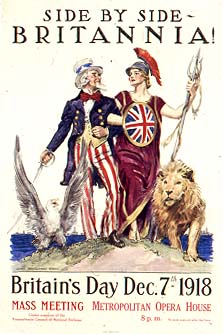
World War I propaganda poster depicting Britannia and Uncle Sam. Image via Wikipedia.

An anonymous Romney adviser has allegedly told the Daily Telegraph that Romney would improve relations with Britain because:

“We are part of an Anglo-Saxon heritage, and he feels that the special relationship is special,” the adviser said of Mr Romney, adding: “The White House didn’t fully appreciate the shared history we have”.

What a lot of people are talking about is the racial angle (pardon the pun) of this alleged quote.  One thing to keep in mind is that Obama is in fact partly English on the side of his mother, Ann Dunham.  (Dunham is an English name, for one thing.) But people are thinking this is a not-too-veiled racial attack.  I’d have to say I don’t what else the point of such quote could be, although it should be noted that the Romney campaign is saying this quote is inaccurate.  Well, if so, they should sue the Telegraph for libel.  If they don’t, it might seem like their guy actually said that, and they’re lying to cover it up.

What I really want to talk about, though, is this “special relationship” stuff.  I remember there was a big dust-up back in 2009 about the “special  relationship”, when Obama gave then-Prime Minister Gordon Brown a set of DVDs as a gift.  The Prime Minister had given him a pen-holder made from the HMS Gannet.  This upset a lot of people, but from what I can tell, Brown was treated like this by virtually everyone.  He had that anti-charismatic thing (a lot like Al Gore) that made people dislike him instinctively.  So I don’t think this means Obama doesn’t like Britain.

In practice, the “special relationship” seems to work like this: the British give us their culture–actors and actresses, authors, musicians–and we give them help whenever there’s a world war.  It’s not a bad system, all told.

Seriously, though: the “special relationship” seems to have been heavily emphasized by Winston Churchill, presumably for the purpose of convincing the U.S. to intervene in World War II.  And certainly, since America was founded people who had been British, there’s no doubt the two countries have a lot in common.  However, I don’t know that it is really that “special”.  Diplomatic relationships are usually forged and dismantled based on financial or military interests, not sentimentality.  If–Heaven forbid!–the United States’ relationship with Britain deteriorated, we would no doubt start saying “well, the whole country was founded because of a war with them, after all.”

That’s really the point: a lot of this is contrived stuff for people to argue about that ultimately doesn’t mean very much.  Example:  Romney says he’ll put a bust of Winston Churchill back in the Oval Office if elected.  Big deal.  I admire Churchill, but that really doesn’t matter very much in the scheme of things.  This is all a lot of pointless fighting over symbolism, as far as I’m concerned.

I see Michael Moore is going on Piers Morgan’s show tonight to talk about the awful shooting in Colorado and gun control.

I’ve seen three of Moore’s films: Roger & Me, Fahrenheit 9/11 and Bowling for Columbine.  Bowling is technically speaking the worst one, but it’s also by far the most interesting.  Because unlike the other two, which are amusing but kind of simplistic propaganda pieces, Bowling is really more of an open-minded exploration of the issues.

It starts out as a propaganda, dark comedy sort of movie, but it actually turns into more of a examination of American culture.  At one point in the film, Moore says that people also own lots of guns in Canada , but they don’t have the same crime problems we do. Surely, this point contradicts any gun control agenda he may have.  The middle of the movie is very interesting; Moore seems to admit he doesn’t have all the answers, and is actually revising his opinions as he learns more.

Now, towards the end, Moore remembers that he is making a movie, and he reverts to his ambush/ask awkward questions style and it totally doesn’t work and it makes him look like a jerk.  It makes for a really uneven movie, but it’s still thought-provoking to watch.

That said, I think Moore is unfair in singling out America for violence.  His new line is to portray Americans as singularly bloodthirsty, but I think we know that’s not the case.  There are mad men and evildoers in every nation.