What I like best about Geoffrey Cooper’s thrillers are how they provide a window into the politics of research institutions. I’ve noted this about his earlier Brad and Karen novels, Nondisclosure and Forever, and if you enjoyed those novels as much as I did, you’ll be glad to know that Bad Medicine is more of the same.
Brad is requested–more like ordered–by the university president to chair a tenure committee at a medical research Institute in Maine. There are two candidates up for tenure: one is Mark Heller, a superstar researcher who appears to have made huge strides in cancer research, the other is Carolyn Gelman, whose work, while strong, lags behind her colleague and is unpopular with the faculty to boot.
The politics of tenure committees are bad enough, but soon, Brad finds evidence that something far more serious is going on: someone is sabotaging Gelman’s research. Beginning with the destruction of test drugs and escalating to far more serious crimes, Brad and Karen once again are drawn into a criminal conspiracy.
As usual, the pace is fast and the twists are numerous, but there are still moments for the characters to stop and catch their breath, and to sample some delicious New England cuisine, the descriptions of which are highly enjoyable.
The core of the book is the relationship between Brad and Karen, which ends up being tested in a surprising way. I liked the way this was handled, too–it makes sense that what happens would put some stress on them, but it doesn’t create needless drama or tension. Sometimes authors go too far in creating fissures in a relationship, in a way that feels forced. But that didn’t happen here.
If you enjoyed the other Brad and Karen books, you’re going to like this one. Besides being a good thriller, it’s another fascinating glimpse behind the curtain at the highest levels of medical research. As soon as I finished it, I found myself hoping to read another one soon.
[Note: this review is based on an ARC. Bad Medicine releases today, February 17, 2021.]
I love poetry–especially rhyming, metrical poetry. I’ve learned over time to appreciate blank verse and the like, but in my heart, I’m always going to be a sucker for a good old rhyming couplet. To illustrate: while most people would probably say T.S. Eliot’s greatest work is The Waste Land, give me Old Possum’s Book of Practical Cats any day.
That’s why it was such a delight to read this amusing collection of poems, about the mis-adventures of the author’s dog, Ani. All the poems are light, bubbly and amusing, and sure to make any dog lover smile as they read Ani’s antics with tennis balls, vacuum cleaners and–the pup’s ultimate nemesis–baths.
Ani’s human, Sue Vincent, has a great knack for sparkling, crisp verse and a delightful wit. In a few poems based off of Shakespeare’s works, she does a fine job in the style of the Bard. And most of all, she has a wonderfully endearing love for her dog, and one that Ani clearly reciprocates as only canines can.
Doggerel is a charming book that anyone who loves poetry and/or dogs is sure to enjoy. It’s also illustrated with pictures of the four-legged protagonist, who looks like every bit the lovable scamp portrayed in the poems.
(P.S. I am very grateful to my friend A.C. Flory for bringing this author’s work to my attention.)
This is a Regency romance. Regency romance is a super-popular genre, which is why I made it my business to find a lesser-known indie Regency romance with only a few reviews. Because that’s how we do things here at Ruined Chapel.
To be clear, this book is more in the Regency Historical sub-category, in that the characters use many modern expressions and tend to behave more in accordance with present-day attitudes, without much care for the mores of the actual Regency period.
In other words, this book has sex scenes. Don’t go in expecting Jane Austen. It’s raunchy and fast-paced. Maybe it’s more accurate to call it a Regency sex comedy.
And that’s not all. Penelope, the impulsive, stubborn heroine, moonlights as a highwayman when she’s not flirting with Lord Westfield, Duke of Burwick. There’s a subplot with smugglers and kidnappers that culminates in a violent showdown.
The book is fast-paced. Sometimes, it was so fast-paced I found It difficult to keep track of all the characters were and their motivations. It’s probably a good idea to keep notes on characters as they are introduced. Also, it has a trope that’s common in romance novels: two characters who are obviously going to end up together refusing to just admit they’re in love for no particular reason. This drives me nuts; but it’s so frequently used I guess romance readers don’t mind it. I wouldn’t want to marry somebody whose attitude towards me seemed to vary by the hour, but hey; that’s just me.
Despite this criticism, the book is enjoyable. I think I’m right in saying the author doesn’t mean for it to be taken too seriously; hence the “funny” in the subtitle. There are some over-the-top scenes of bawdy, farcical humor that are quite enjoyable. It may not be to everyone’s taste, but it’s still an entertaining tale with a bit of naughtiness to it.
On a technical note: there are a few typos throughout the book. It didn’t really bother me that much, but some readers are more sensitive to this sort of thing than others.
And it has to be said: I’m not normally one to read Regency romances. I’m nowhere near the target market for this book. And even I enjoyed it, despite its flaws. Regency romance fans who like their tales to err on the silly side are sure to find it a treat.
I have to start this review with some context: I started reading this book shortly after doing some beta reading for a friend of mine. The book I was beta reading was an extremely dark, harrowing story about terrorism. While it’s a great story, it was nice to be able to turn from that world (not to mention real life news) into this book, which is a sweet, uplifting romance.
Not that there aren’t serious moments in Second Chance Romance. The female lead, Melanie Harper, has a major tragedy in her past. Trying to forget it, she’s immersed herself in her work as a divorce attorney in Washington D.C., but has come to the small town of Sweet Gum, Virginia to convince her Aunt Phoebe to abandon her little diner and move to D.C.
While there, Melanie has a car accident and is rescued by Jackson Daughtry, a single father raising his young daughter, Rebecca, after his wife left him.
After Melanie recovers from her accident, Phoebe suffers a stroke, rendering her unable to run her business, and forcing Melanie and Jackson to work together to keep the diner running. At first, the big-city lawyer and the small-town paramedic clash, but soon–it’s a romance, after all–they begin to develop feelings for each other.
Not that it’s smooth sailing even then. Jackson and Melanie still disagree over her plan to close the diner and move her aunt to D.C. And to make matters even more difficult, Jackson’s ex-wife shows up again.
I should mention that this is a Love Inspired book, which is an imprint that publishes Christian fiction. So there are a few references to characters praying and facing struggles with their faith throughout the book. It never comes across as strident or preachy, however; and largely seemed right for the characters.
All in all, it’s a very sweet story. There are no big surprises or shocking twists, and there shouldn’t be in a book like this. It’s a feel-good book. And while it’s not the sort of thing I often read, it’s quite enjoyable. There is a place in every art form for both the Rockwell-esque and the Goya-esque. Though my own tastes skew towards the latter, I can still respect the former.
This is a perfect book for anyone who wants to enjoy a light and uplifting romance in a pleasant small-town atmosphere.
Jane Got a Gun premiered on January 29, 2016. I had been looking forward to it since I learned of its existence, and with the film finally, finally hitting the big screen, of course I had to see it on opening day. It was a bright, unseasonably warm day for winter in Ohio, and I went to the nearby AMC for an afternoon show in a nearly-deserted theater.
I enjoyed the film from the start. It was not just good, it was surprisingly good. Then, at a certain point, about halfway through the film, the drama reached a critical point, and I can distinctly remember thinking, “Oh, no–I certainly hope they’re not going to…”
But hold up a minute. I’m getting ahead of myself, diving right in to the memories and not putting things in the right order. Like the film’s heroine Jane Ballard (Natalie Portman) says at one point, “It’s hard to remember how things seemed… when you know how they actually turned out.”
***
The behind-the-scenes story of Jane Got a Gun begins in 2012, with a script by Brian Duffield, to be distributed by Relativity Media, directed by Lynne Ramsay and starring Natalie Portman. Michael Fassbender was cast in the role of Dan Frost, Jane’s former fiancé. However, Fassbender soon left the part, and was replaced by Joel Edgerton, who had originally been cast as the villain, John Bishop. Jude Law and Bradley Cooper were both briefly on board, before finally Ewan McGregor was cast as Bishop. In the middle of all this, Ramsay left the production less than amicably, causing more turmoil that was resolved in part thanks to the timely intercession of lawyer David Boies.
Ramsay was replaced by Gavin O’Connor. O’Connor, Edgerton and screenwriter Anthony Tambakis then re-wrote Duffield’s script, and filming finally took place in 2013. The filming itself seems to have gone smoothly–in the words of Edgerton, “We’re winning out there.”
Relativity Media had initially scheduled the film for a February 2015 release. But it was delayed, and Relativity filed for bankruptcy in mid-2015. Fortunately, there was another studio that had agreed to distribute the film, and the rights to Jane Got a Gun were released from Relativity and secured by the Weinstein Company, which scheduled the film for distribution.
The Paris premiere was scheduled for November 15, 2015, but was canceled due to the November 13 terrorist attacks. The film finally premiered in Germany in late December 2015, and in France and the United States in January 2016.
Of course, I can’t talk about a Weinstein Company film without also talking about the infamous film producer, who was then about a year away from being publicly disgraced. One of the many unsavory aspects of Harvey Weinstein’s personality that came to light after his downfall was that he would occasionally sabotage his own company’s films. I have no idea if anything like that happened with Jane Got a Gun, but the decision not to screen the film for critics can’t have helped its chances, and undoubtedly contributed to its poor showing at the box office.
It was a film dogged at every step by negativity, with only cursory promotional efforts, in a relatively unpopular genre, and hamstrung by a misleading title that makes it sound more like a fast-paced action picture than what it really is.
And after all that, it was gone as soon as it had come. It was only in theaters for about three weeks and grossed about $3 million against a $25 million budget.
As anyone who followed my blog at the time knows, I loved the movie. I wrote a glowing review. Two glowing reviews, actually, because I wrote about it again in more detail when it came out on home media. And owing, I suspect, to the scarcity of other reviews, these were some of my most-viewed posts ever.
Which speaks to the fact that a major reason it wasn’t more successful is that not many movie-goers ever knew it existed. And I’d argue that the reasons not many movie-goers knew it existed can tell us a lot about the movie business, the entertainment industry as a whole, and American culture generally.
That sounds like quite a leap, I know. (Or, as Dan Frost would say, a “very big jump, my friend.”) To begin with, let’s talk about why Jane Got a Gun is significant to me.
***
Jane Ballard (Natalie Portman)
Natalie Portman is probably my favorite actress, and part of the reason for that, as I’ve discussed before, is her willingness to experiment. She doesn’t let herself be typecast, but is willing to play all sorts of different roles in different kinds of movies. I respect this risk-taking. Portman films aren’t always good, but they are almost always interesting.
I also like movies that take place in remote, bleak desert settings, and the New Mexico landscapes of Jane Got a Gun are just gorgeous to my eye. While I could do without the washed-out lens filter, the sweeping vistas and extraordinary rock formations make the setting instantly compelling.
I went into Jane Got a Gun hoping to see Natalie Portman in a good old-fashioned western adventure, and as a bonus, see the always-entertaining Ewan McGregor as a villain I loved to hate. And I got all that–but the movie surprised me at the same time, even while delivering on all fronts. How is that possible?
Time for one of my Socratic movie quizzes: what’s Jane Got a Gun about?
Okay, since many of you haven’t seen it, I’ll give you the cliffs-notes summary answer. It’s not the real answer, of course, but you know what I’m like. And anyway, a little plot synopsis will be handy to have as you read this.
Jane Got a Gun is about Jane Ballard, a woman who was kidnapped by a gang of criminals, escaped with the help of a man whom she married and built a new life with, only to find herself once again pursued by the gang, and forced to seek help from her ex-fiancé, Dan Frost, whom she had until recently believed died in the Civil War.
Dan Frost (Joel Edgerton) gazes forlornly down from a ridge.
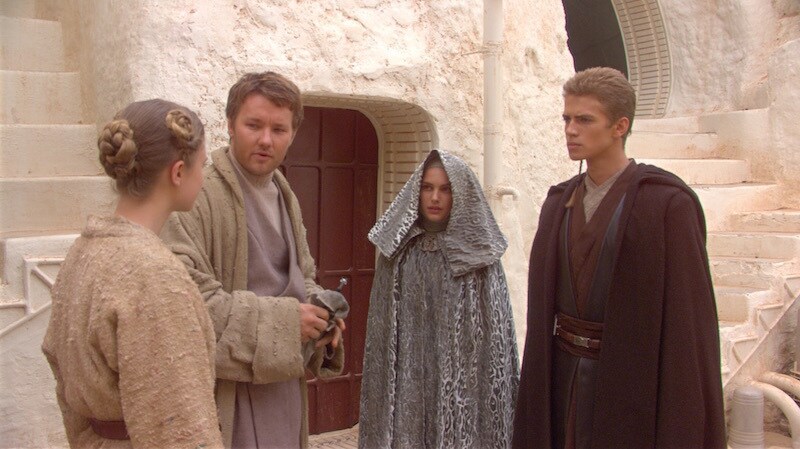
Ah, Dan Frost. He’s as good a place as any to start with where this movie surprised me. Previously, I knew Joel Edgerton as young Uncle Owen in the Star Wars prequels, where he has about two minutes of screen time and does nothing but stand around and hold a dirty rag.
After you watch Jane Got a Gun, it’s impossible to watch the scenes with Owen in Attack of the Clones the same way. In the scene from Star Wars, Portman and Edgerton are both unremarkable, standing vacantly with no lines or “stage business” to do. In Jane Got a Gun, every scene between the two is filled with tension–Edgerton can convey so much emotion with simply an expression, or a grunt, or a small gesture. And as Edgerton said of his co-star’s talents, “We’ve actually coined the phrase ‘The Portman’ to describe how she can say a line without saying a word, just with a look.”
This illustrates one way in which Jane Got a Gun runs contrary to modern sensibilities. Characters–especially the good characters–do not wear their hearts on their sleeves, but for the most part behave with reserve and restraint. We only see Jane and Dan kiss in flashbacks–circumstances dictate they must keep their feelings controlled, and the few glimpses we see of their emotions bubbling close to the surface are moments of intense drama. Even as they prepare to fight for their lives, the couple is reminded constantly of their past.
One good example of this is the transition from Jane’s memory of a carefree afternoon with her fiancé back in Missouri to the grim present, as the sweaty, tired figure of her former lover takes a break from digging a defensive trench to check the vast desolation for any sign of the Bishop gang. Without a word being spoken, Portman’s face and the soundtrack convey the bittersweetness of remembering happier times.
Jane and Dan, in a flashback
***
I’ve lent my copy of Jane Got a Gun to a great many friends, at first just out of a sense of wanting to share something I enjoyed, and over time out of an interest in the different reactions they would have to it. Some of them have loved it as much as I do. Others thought it was just middling, still others have called it boring and bad. One friend told me he thought it was dull, but that perhaps that was an intentional choice, to capture the slower pace of life in the 1870s. Another friend of mine, who generally hates any movie made after 1965, complained about the lens filter but said his wife called the character of Jane Ballard “just about perfect.”
I’ve seen the movie enough times that it gallops by, but at the same time I guess I can understand how some would find it slow… sort of. Well, maybe. No, not really.
Here’s the thing: if you’re used to loud, fast, big, action-packed spectacles of movies, then I guess this would seem slow. And yeah, the title does imply that’s what this film is going to be. A pulse-pounding Wild West shoot-’em-up with a female gunslinger, kind of like the 2006 film Bandidas. Maybe that’s the kind of movie Duffield’s script originally called for. And there’s nothing wrong with that kind of movie. I like Bandidas.
But Jane Got a Gun isn’t that kind of movie. It’s mostly quiet, punctuated by a few moments of intense action. There are no over-the-top special effects or stunt-work. Because it’s not about the action scenes; not really. That’s why the title is so misleading. To say nothing of some of the posters…
(If you’ve ever wondered if people who make movie posters have to watch the movie beforehand, the answer is pretty clearly “no.”)
Jane Got a Gun is not about guns, even though there are guns in it. It’s not about Jane avenging the wrong that was done to her, although that does happen. It’s not about a frontierswoman proving herself just as adept a sharpshooter as the men, although that also happens.
Jane Got a Gun is actually about listening to other people.
***
I think 2016 will be remembered as a very significant year in history. I mean, every year is significant to a historian, since they are all part of a linked causal chain of events, but 2016 is going to be one of those dates that everyone will know, like 1776, 1865, 1939, and 1968.
2016 was the year when the American political system and the unending noise machine of modern communication combined to produce systemic shocks right to the heart of our centuries-old system of government. In 2016, all the fissures and divides across the nation were laid bare, and the repercussions are still being felt, and will be for decades; perhaps centuries to come.
2016 was the year that people shouting at each other through mass media finally, irrevocably, unforgettably, changed the landscape of American politics.
What does this have to do with Jane Got a Gun?
You know how sometimes you’ll hear about how a movie perfectly evokes the “mood” of a certain time? What pretentious critics, like me, call the “zeitgeist?” For example, how Taxi Driver supposedly captured the rebellious alienation of the 1970s.
Jane Got a Gun does the opposite of that. Jane Got a Gun is like if you captured the essential spirit of 2016, and then made something that was in every way the antithesis of it.
Jane and Dan’s relationship changes when they stop arguing and start listening. Dan’s relationship with Jane’s husband, Bill Hammond, changes when he stops making assumptions and listens to what Jane says about him. Even at the climax of the film, when Jane finally confronts John Bishop, she waits to hear what he says before bringing him to justice–and is rewarded for doing so.
It’s a quiet, old-fashioned movie, about the importance of understanding and reconciling with other people. There are villains, yes; but the real drama of Jane Got a Gun is in the relationship between Jane and Dan. It’s more of a romance than an action film, but a romance set against the backdrop of bleak and desolate frontier; a society being built in the shadow of a nation ravaged by war.
John Bishop (Ewan McGregor)
It’s not a Civil War movie, but the recent war has clearly left its mark on the characters, in all sorts of ways, as when the aristocratic John Bishop (who clearly avoided serving on either side) jovially shows off his war souvenirs to Frost. He casually tells the former soldier, while regarding an officer’s pistol used at the battle of Shiloh: “Shiloh means ‘place of peace’ in Hebrew.” Frost, having become all too familiar with the horrors of war, grimly replies, “Ain’t nothin’ peaceful about Shiloh.”
Much of the film is about coming to terms with the after-effects of something horrible, whether it’s Jane overcoming what Bishop and his gang did to her, or Dan overcoming his suffering in a prison camp. And that’s why it’s set in the post-war West, when the country was struggling to build anew, after enduring trauma.
Jane Got a Gun is a film about healing. It’s hard to imagine a film more out of sync with the atmosphere of 2016.
***
In an interview promoting the film, Portman described it as “very American.” Indeed, I’d argue that Jane Got a Gun is possibly one of the most quintessentially American movies made since the turn of the century. It’s a Western, which is the stereotypically American genre. It’s about a pivotal period in the nation’s history–essentially, a re-founding period when the modern United States was being created.
Jane Got a Gun was created by an international grouping of cast and filmmakers including Australians Joel Edgerton and director of photography Mandy Walker, Scottish actor Ewan McGregor, Brazilian actor Rodrigo Santoro, and Irish dialect coach Gerry Grinnell-all bringing new perspectives to the classic American Western.
Portman offers, “It’s always wonderful when people make art in unfamiliar surroundings. Tolstoy’s theory is about how art is about making things strange, and with an Australian and a Brazilian on board it’s already strange and so it’s immediately art. That’s why Sergio Leone made such great Westerns – to have that completely different, non-American vision of the West.”
Put all this together with the production difficulties, and you have a behind-the-scenes narrative that’s nearly as much of a romanticized vision of America as the classic Western genre itself. In my second blog post about the film, I wrote:
Jane Got a Gun evokes the best of the American frontier mythology: hope and triumph in the face of harsh and unforgiving circumstances. That it has such a diverse international cast and crew only adds to this feeling, as people of different nations coming together is very much the story of America itself.
There have been times when I think about these kinds of assertions and wonder, “Am I overstating this? Reading too much into it; seeing things that aren’t there?” I’ve been known to do that sometimes, so it’s certainly possible.
But then there’s this behind-the-scenes photo:
Left to right: Edgerton, Portman and Tambakis. Source
***
Does Jane Got a Gun still matter? Maybe that’s the wrong question. With the exceptions of the people who made it and me, it’s not clear that Jane Got a Gun mattered much to anybody in January 2016.
Does it matter to anyone else now, five years later?
This is the part where I’m supposed to say something like, ‘I’d argue that it does, because…’ or something of the sort. Certainly, it would be pretty rotten of me to lead you all the way down this particularly winding memory lane only to tell you no, it doesn’t matter.
But I can’t answer the question. It’s your call to make, dear reader; not mine. Pretentious critics–again, like me–think we can persuade people, that we can shape tastes, that we can, in some sense, tell people what to think of a film, or a book, or a painting. But we can’t. All we can really do is describe the complex, personal reactions that we have to art.
***
The really key scene in Jane Got a Gun; the one that I think is the emotional heart of it, is the one I mentioned at the start of this post, where for a moment, I was concerned the plot would go in a really stupid direction. It’s the scene where Jane walks out to Dan as he’s digging a defensive trench. Seeing him again has brought back a lot of memories for Jane, and she wants to try to smooth things over with him, on what could be their last day alive. So she says, “Why’d you change your mind to help me?”
Jane knows the answer, of course; and so does Dan: he loves her, even though he thinks she left him for another man, even though he’s probably going to die because of her–he loves her. But Dan is still furious at her, and besides which, she’s married. So he can’t say it, instead grumbling, “I dunno.”
This escalates to a tense discussion in which the two former lovers rehash their past, and all the choices that led them here, each one increasingly blaming the other, until finally Jane says, “You know what, Dan…”
I thought she was going to tell him to leave. I foresaw the most hackneyed Hollywood story imaginable: Jane tells him to get lost, Dan rides off in a huff, only to ride back in at the 11th hour and save the day.
But that didn’t happen. What happened instead is what sets Jane Got a Gun apart.
***
In an interview with Elle magazine in 2013–shortly after filming wrapped on Jane Got a Gun—Portman said:
The fallacy in Hollywood is that if you’re making a “feminist” story, the woman kicks ass and wins. That’s not feminist, that’s macho. A movie about a weak, vulnerable woman can be feminist if it shows a real person that we can empathize with.
One of the contemporary criticisms of Jane Got a Gun was exactly this–that Jane doesn’t single-handedly go in guns-blazing and wipe out Bishop and his gang. Jane Ballard isn’t a one-woman army, and if she were, the film would be worse for it. She fights back, but she does so in a way that makes her relatable.
She is, in other words, “a real person that we can empathize with.”
The film works, or doesn’t, to the extent that the audience is prepared to empathize with the characters. That might be true of most films, although I’d hesitate to say “all films”–there are some that pretty clearly rely solely on spectacle or nostalgia or fan service to sell themselves. That’s one reason Hollywood loves their sequels and franchises so much: it’s easier to expect audiences to continue following characters they already know.
Jane Got a Gun is a throwback to another era of filmmaking. That much is obvious just by virtue of it being a Western. Westerns used to be a staple of Hollywood in the 1950s and ’60s, but have since become increasingly rare. It’s also a throwback in its self-contained nature. Even if it had been a financial success, it’s hard to imagine it spawning a “Jane Ballard” franchise.
It’s a good match for me, because I am a throwback to a different era of filmgoer. I follow movie stars more than franchises, much as audiences did at the height of classic cinema. I saw Jane Got a Gun because it had Natalie Portman and Ewan McGregor in it. (And after seeing it, I watched a bunch of Joel Edgerton films.)
I love the film for the cast’s expressive performances, that communicate so much in so few words. I love the haunting, melancholy soundtrack. I love the vast, sprawling desert setting that is both harsh and beautiful. I love the tight, spare script, that takes us on a journey that is at times very dark, but ultimately uplifting. I’m not ashamed to say I think I could recite the entire film from memory, but I’ll end this retrospective by quoting just two more lines.
The first is the one that I’ve been teasing you with throughout this review. The one that encapsulates the film’s theme–the empathetic optimism that enables Jane to triumph over all the darkness in her life. The line she says after, “You know what, Dan…” The script might have gone any number of directions just then, and maybe in previous iterations, it did.
But what Jane says next is the insight that makes me come back to it again and again, that makes it a film so blatantly out of step with the cultural mood of its epoch, and so wonderfully timeless. After everything she’s suffered, all the misery she’s had to endure, Jane takes a deep breath to collect herself and says to her former lover:
You might want to see a day where the sun don’t just shine on your story. Because there is a whole world out there of other people’s tales, if you just care and listen.
To which, dear reader, I will append only these words, that Dan says to Bill Hammond at a particularly tense moment:
…and I want you to think about that with the shank of time that you’ve got left.
Who doesn’t love a good dystopia? To read about, I mean.
The country (maybe more of a city-state) of Deres-Thorm is a bizarre, surreal nightmare, evocative of North Korea, East Berlin, and every other totalitarian dystopia. The unsuspecting narrator, Horus Blassingame, is thrown from one bizarre obstacle to another, whether it’s from the constantly changing street and building names, the two distinct dialects, or the constant paranoia of the security forces.
The book is darkly comic, with an emphasis on the dark. There are some scenes that are not too far off of Room 101 from Nineteen Eighty-Four. Still, the narrator remains relatively upbeat, despite the torturous conditions he often finds himself in.
It’s a very funny satire on the kinds of horrors that can occur in a Stalinist bureaucracy. I’d call it Kafkaesque, although I’ve never read Kafka, so I may be wrong. But it certainly sounds like the sort of thing I’ve heard people call “Kafkaesque.” (And, well, it says so on the cover.) It also called to mind G.K. Chesterton’s The Man Who Was Thursday, with its surreal and simultaneously funny and disturbing takes on political theory.
I like the book a lot, so I don’t want the following complaints to be misconstrued as reasons not to read it. But I have to put them out there all the same.
First, the only named female character (not counting the genderless Th’pugga) is a prostitute. This is a pet peeve of mine, but I swear, so much modern fiction gives you the idea that prostitution is always and everywhere running rampant. Yes, yes, I know; “world’s oldest profession” and all that; but really.
The second point isn’t even really a criticism, but more of an observation. The most significant exchange in the book, which sums up the entire philosophy governing Deres-Thorm, is when the main antagonist, Pokska, explains that citizens are bound by the laws of their own countries while in Deres-Thorm, just as all citizens of Deres-Thorm are bound by their laws no matter where they are in the world. The logic behind this, he elaborates, is that “the citizen is the property of the State.”
This is pretty horrifying, right? It’s close to a re-formulation of Mussolini’s “Everything within the state, nothing outside the state.” It’s basically the central concept of totalitarianism, and the reader is not slow in seeing how it can lead to exactly the kinds of horrors depicted in this book–not to mention in real life.
But, wait. What is the state? The state is legalized violence, because the state has a monopoly on the legal use of force. (Don’t take my word for it, take Max Weber’s, one of the founders of modern sociology.) In governments structured as liberal democracies and constitutional republics, the people consent to authorize the state to use violence. We issue them a badge, as it were. In other, more brutal forms of government, the state doesn’t need to show the people any stinkin’ badges.
This is an important difference, and I don’t want to minimize it. But… even in liberal democracies… the state still has the authority to deprive us of our freedoms, if it has some reason to do so. Theoretically, at least, the people can hold the state accountable so that it will use its terrible powers only for good. Theoretically. But it has terrible powers, all the same…
My point is, the state kind of does own the citizen, by definition. It can pretend it doesn’t; it can put all sorts of accountability measures and checks and balances in place–and it should, and it does. But still.
And yet, not every state is a hellish Orwellian nightmare. So the state owns the people. So what? Just because you own something doesn’t mean you’ll destroy or mistreat it. Generally the opposite, actually. The problem is when the machinery of the state is controlled by psychopaths. Which, admittedly, happens alarmingly often. And even once is too often. Obviously, the power of the state is alluring to psychopaths, with results like those seen in A True Map of the City.
What I’m driving at here, in my usual roundabout way, is that the book seems to be trying to determine what it is that makes a government go insane and stop serving its people, and instead become a simple exercise in power for power’s sake; to preserve by any means necessary the status of the ruling class.
What we’re really trying to figure out is, “what is the root of tyrannical government?” To determine exactly how creeps like Pokska and Th’pugga came to be running the show in Deres-Thorm.
In an early draft of this review, I had a much longer section on this question, referencing Lord Acton and Plato’s Republic and lots of other stuff like that on the origins of tyranny. But I cut that, because it was wandering too far from the topic at hand. I didn’t want to do that to you. (Again.) But I hope I’ve at least convinced you that there are lots of big ideas in this little book. Maybe some powerful mind will do a truly cogent interpretation of it, like Christopher Hitchens on Nineteen Eighty-Four. But as of right now it only has one review on Amazon, (5 stars, of course) so I think I can safely say it needs more readers.
This is one of those made-for-TV Christmas movies. It’s not a Hallmark or Lifetime movie, but it’s the same kind of thing. There’s an over-the-air channel that shows nothing but these kind of films during December. I can’t stand most of them; they tend to all hew closely to a formula that goes like this: the prince of some non-existent country meets a woman with a regular job, they fall in love, they have some sort of absurdly contrived misunderstanding and break up, and then they reconcile in the last five minutes.
Also, the writing tends to be dull, the acting usually isn’t anything special (sometimes the “villains,” like jealous sisters or whatnot, are good) and it’s just generally unmemorable.
Christmas Crush is different. The premise is that the protagonist, a young woman named Addie (Cindy Sampson), makes a wish after a friend tells her wishes can come true at Christmas. Addie wishes for her next-door neighbor to fall in love with her.
She’s thinking of the shy but charming Sam. (Robin Dunne.) But she doesn’t know that an old acquaintance of hers from school, Pete Larson, (Chris Violette) has just moved into the other apartment next to hers. And when her wish comes true, it’s Pete who falls in love with her, becoming obsessed, following her around, bringing her unwanted gifts, and even breaking up with his actual fiancée to propose to Addie. Naturally, all this ruins her attempts to go out with Sam, since from his perspective, Addie appears to have been simultaneously dating an engaged man.
Now, it’s true: a supernatural magical Christmas wish is an even more outlandish premise than the prince-traveling-incognito plot I complained about above. Princes at least actually do exist. But it’s the details that matter. This is a modern version of Victorian dramatist W.S. Gilbert’s classic “lozenge plot,” in which a magical device causes some sort of upheaval to the social order. He used this most famously in The Sorcerer, a comic opera in which a magical love potion causes everyone to fall in love with the wrong person.
Gilbert got his start writing pantomimes. These were entertainment staples of Victorian Christmas, and featured similar outlandish plot conceits. They featured stock characters and generally relied more on spectacle than writing to wow an audience, but there’s a clear line of descent from the craziness of Christmas pantomimes to Gilbert’s signature topsy-turvy satires. (And to be honest, it goes all the way back to Saturnalia, a Roman winter festival during which traditional social norms were temporarily suspended.)
What made Gilbert’s impossible supernatural devices work so well is that they were the only impossible element. Gilbert would create one bizarre, fantastic concept, and then have everything else proceed with perfect logic and consistency from there.
The same thing is going on here. Addie, Sam and Pete all behave logically and consistently given the one absurd premise. The characters’ personalities don’t change on a dime for the sake of the plot. The entire story is based on watching the hilarious consequences of Addie’s non-specific wish play out.
That’s the other thing about this movie: it’s funny. The script is snappy and clever. There’s an extended scene with Addie trying to talk to Pete’s ex-fiancée in a Christmas store that makes me laugh out loud. I’d be remiss if I didn’t mention the performances of the supporting cast: Konstantina Mantelos as Pete’s jilted fiancée is great, as is Erica Deutschman as Addie’s friend Drea. It was nice to see the two female leads working together as friends, instead of being rivals for the same guy.
There is also the character of Mr. Donner (I couldn’t find the actor’s name.) He is an important client of the firm Addie and Drea work for, and there is a subplot with them planning a Christmas event for him. There’s a running joke where someone will call it “the Donner party” and someone will quickly correct it to “the Donner event.”
Donner never speaks throughout the film. His performance is purely in his expressions. I loved this touch. Screenwriters take note: less can be more.
The film culminates with the Donner event, which includes an impromptu song by Pete in another over-the-top effort to woo Addie. Addie then gives a speech about the power of Christmas wishes. I won’t say more, even though it’s not really the kind of movie you can spoil. I mean, we all know what the ending will be.
And yes, I guess there is a last-five-minutes reconciliation with Addie and Sam, too. But again, it’s how it’s done that matters. Addie’s wish wasn’t to marry a prince, or a millionaire, or even to get married at all. She just wants to go on a date with a guy she likes.
This movie is fun. Everything about it is a cut above the usual Christmas TV movie fare. The writing is wittier, the acting is better, even the set design is more believable. Normally, people in these movies live in fabulous winter estates. But these characters just live in apartments, albeit very decorated ones.
It’s easy to make fun of feel-good holiday movies because most of them are bad. But you could say the same of most big budget Hollywood movies, actually. Most instances of every form of entertainment are fairly forgettable, to be honest. The fun is in finding the ones where the people who worked on it went the extra mile to make it good. Christmas Crush is one of those.
Note this should not be confused with the 2005 film of the same name starring Matthew McConaughey, or the 1943 film starring Humphrey Bogart, or the 1995 remake of the same, or either of two Bollywood films.
Whew! That’s a lot of films named after the desert. But we are presently concerned with the one that stars Brooke Shields as a young heiress named Dale Gordon whose dying father asks her to race his custom sports car in the 1927 Trans-African Auto Race, composed of racers representing all the major European stereotypes–snooty French, goofy Brits, and of course, evil Germans.
But Dale has another problem: the stuffy upper-class twits who run the race won’t allow a woman to participate. So she disguises herself as a man right up to the starting gun. Not until she is safely off on the race does she remove her disguise.
Unfortunately, the desert which Dale has to cross is also the battlefield in a war between two Bedouin tribes. She and her two crewmen are kidnapped by a member of one tribe as she tries to take a shortcut, and dragged to his tent. She escapes from his clutches and wanders out into the desert, but is shortly recaptured.
One of the tribe leaders intends to force himself upon her, but he is stopped by his nephew, Sheikh Jafar, who is the leader of the tribe, I guess. It’s sort of unclear whether he or his uncle is really in charge. I guess Jafar is technically the boss, but he’s a young guy, and obviously he defers to his uncle’s wisdom and experience.
Uh, except… all his uncle wants to do is assault their new captive. Jafar is not okay with that, and so outmaneuvers his uncle by marrying Dale. However, she doesn’t want to marry him, and soon they are interrupted when an enemy tribe attacks the camp, using an armored car provided to them by the German racer.
Dale has sticks of dynamite in her car for some reason, and runs out in the middle of a machine-gun battle to place the sticks in the path of the enemy vehicle. This is miraculous enough, but she then runs back behind friendly lines, picks up a rifle and shoots the sand-colored sticks of dynamite, causing them to explode just as the car drives past!
If a script wants us to believe something like that, they need to establish that a character is an expert sharpshooter first. Even then, it’s a bit hard to believe. But I find it impossible to accept that someone could pick up a rifle they’d never fired before and make those kinds of shots.
Anyway, after fending off the attack, Dale has won the respect of the tribe, and she marries Jafar after all. Then, after a night of passion, she remembers that she came here to fulfill her dying father’s wish and win the stupid race, so she sneaks off to her car and drives off into the desert, accompanied by Cambridge, an Englishman and former member of the faculty at the university of the same name, who is now living among the Bedouin for some reason.
Things seem to be looking up, but then unfortunately Dale is once again kidnapped, this time by the chief of the other tribe.
Seriously? This is the third time in this movie that she gets kidnapped. This is lazy scriptwriting if ever I saw it.
Naturally, Jafar leads a party of war to raid the enemy village and get her back. After initially refusing, his uncle agrees to take his faction of the tribe along. Dale meanwhile fights back against her captors–she’s getting to be an old pro at fighting kidnappers–and so, as Jafar’s men attack them, the tribe decides to dispose of her, and obviously the most efficient way of doing that is to FEED HER TO THE LEOPARDS.
Yes, they have an execution pit, dug inside of a cave, with leopards in it. And there’s even a central sacrificial pillar and everything. Clearly, these desert nomads have not been wandering far if they have time to make an investment like this.
But Jafar arrives and rescues Dale from the leopard pit. His uncle perishes in the fighting, and I guess we’re supposed to feel bad for him?
So, Dale gets back into her car and rejoins the race. As fortune would have it, her shortcut was so much faster that even with all the delays, she’s back on track at the same time as the other drivers are closing in on the homestretch.
Naturally, it comes down to her vs. the evil German racer in a final dash for the finish line. It’s neck-and-neck when the German’s wheel pops off, and Dale pulls ahead.
Having fulfilled her father’s dying wish, Dale goes back to Jafar and rides off to live as his wife, thus ensuring that her entire plot arc is defined by men, lest anyone get concerned that she might be independent or something.
All right; I’m sorry. That’s awfully snarky, isn’t it? Look, there’s nothing intrinsically wrong with these plot elements–either the fulfilling her father’s dream, or the romance. It’s just… Dale doesn’t seem like a character. She seems like a plot device. Everything she does is reactive. It’s a little thing, but it would have been much more satisfying if Jafar had come to be with her at the end, rather than her going back to him.
Part of the issue, admittedly, is the acting. Brooke Shields “won” two Razzie awards for worst actress for this movie. Frankly, I think that’s a bit harsh. She’s actually decent in the first few scenes; it’s only once she gets to the desert that her performance starts to fall flat.
Brooke Shields is a good actress, and for the most part, the other performances are equally weak. (The exception is Sir John Mills as Cambridge.) So to me, that suggests this is on the director, Andrew McLaglen, more than the cast. Originally, Guy Hamilton, the director of several Bond flicks including Goldfinger and Diamonds are Forever, had been hired to direct. I suspect he would have been better. Hamilton’s sometimes campy humor, while in my opinion too over-the-top in the world of 007, would have been perfect for this movie.
Sahara sometimes seems almost like it’s going to be a comic adventure, but it never quite gets there. It’s missing something–that wink to the audience that great adventure films like Raiders of the Lost Ark or the 1999 edition of The Mummy have.
So, how did I hear about this movie, and why am I talking about it?
I saw the poster on Henry Vogel’s Twitter page, and had to check it out. And while it was in many respects not nearly as good as it could have been, it did have some gorgeous desert scenes. I just cannot get enough of these barren landscapes. Brooke Shields is no Peter O’Toole, and Andrew McLaglen was definitely no David Lean, but even so there are are some shots in this movie that evoked the sweeping sandy expanse of Lawrence of Arabia. (There was one shot in particular that I’m pretty sure was a deliberate homage to that great desert epic.) And the music is by Ennio Morricone, so you know it’s good.
I’m normally against re-making films. (See my review of Tank Girl.) But this is a rare film that could use a remake. As John Huston–who would have been another good choice to direct this script–once said, the films that should really be remade are not the hits, but the ones that fail. There’s a lot of potential in this movie, but so much of it was wasted.
Of course, a remake should probably have a different title, since as we have seen, “Sahara” is overused. It needs to be something pulpy–how about Dale Gordon and the Great Trans-African Auto Race? Then get Rian Johnson to direct and Gal Gadot to star. You’re welcome, Hollywood. This one’s free, but any more ideas will cost you.
This is a collection of short speculative fiction stories that deal with complex concepts–the existence of God, the nature of reality, human relationships–as approached by everyday people. Goats has a knack for writing characters who are instantly relatable. Although this is in many ways a stylistic departure from his earlier books, which are primarily comic novels and crime thrillers, the thing they all have in common is the intelligent and humane voice of the narrator.
Even in “Snowlight,” which is one of my favorite short stories ever, and is probably the darkest one in the collection, the protagonist has a basic decency and pathos to him that makes the reader sympathetic, even when he does something that is objectively quite shocking. The characters always feel like humans–even when they’re not. There is a religious robot in one story, and a man who thinks everybody is a robot in another. Philosophy and humor are mixed frequently; as in the case of Zetoxis the philosopher, of whom it is said, “the wise man and the fool reside in the same body.”
Many of the stories suggest a moral or logical question for the reader to ponder. Some of them just let you look at the world in a different way through revolutionary technology, as in “Sentenced to Hard Empathy,” or “The Big Punch-Out,” the latter of which creates a dystopian world reminiscent of the imaginings of early 20th-century futurists. Sometimes this is blended with satire, most notably in “The Obscurators.”
The longest stories, “Alone” and “Fact of Existence” present concepts that could fill whole novels. “Alone” reminded me of John Brunner’s novel Total Eclipsewith its depiction of being stranded on a desolate alien world. “Fact of Existence” is a fascinating exploration of consciousness and religion, in the context of a science-fiction mystery. This is everything that science fiction should be–a great story that gives the reader something to ponder. The whole collection is like that, as Goats riffs on the same themes from a variety of different perspectives.
The only problem I have with this book is a purely technical one specific to the Kindle version. It has no table of contents. That’s not a big deal in a novel or novella, but in an ebook of short stories, it’s a hassle to have to scroll through it to find the one you want. As a workaround, I bookmarked the start of each story. Yes, I’m lazy. What can I say?
Still, it’s a small price for being able to read these stories. And we are lucky to be able to read them, for as Goats explains in his afterword, all but “The Big Punch-Out” were rejected for publication. This lack of taste on the part of literary website editors is to our advantage, as these tales might have ended up scattered behind a Balkanized array of paywalls. But you can get them all, now, for $0.99. (Or if you don’t want to deal with the ToC issue alluded to above, it’s worth it to spring for the paperback version.)
I highly recommend this book. I could go on about all the reasons why, but it’s really best if you just go check it out and lose yourself in a world of madmen, robots, wanderers and philosophers, all with different ways of looking at the universe and its mysteries.
My friend Patrick Prescott has recommended this movie many times. For further in-depth analysis of its themes, see his posts here and here.
Friendly Persuasion is about the Birdwells, a Quaker family living in Indiana in 1862. They are good people, though they each have their flaws. The father, Jess, (Gary Cooper) is a little too competitive when it comes to racing his friend to the meeting. The teenage daughter Mattie, (Phyllis Love) is a bit vain and boy-crazy. The youngest son, Little Jess, (Richard Eyer) is prone to anger as young boys often are, and the oldest son Joshua (Tony Perkins), too, can be tempted to fight.
And Eliza (Dorothy McGuire) the family matriarch, can if anything be a little too prim, as when she takes a hard line against her husband’s affinity for music. More about this in a moment.
In large part, it’s a family comedy-drama. The humor is not over-the-top, but in little things, as when Eliza denies to her children that she danced in her younger days–not really appropriate for a Quaker minister–but then unconsciously taps her hands and feet in time to the music when the family goes to a local fair. Or the way Jess tries to beat his friend in a race to meeting, while Eliza shoots disapproving looks at him. It makes the characters relatable. (I have friends who get much the same looks from their spouses when we get carried away talking about fantasy football.)
The film is based on a book, The Friendly Persuasion, by Jessamyn West, which is a series of vignettes from Quaker family life. It has the feel of being a loosely-connected series of episodes rather than a tightly-plotted tale. But that’s not a flaw. The Birdwells are a pleasant family to spend time with, and it’s always amusing when some element from an earlier episode comes back into play–as when some Quaker elders pay Jess and Eliza a visit while Mattie and her cavalry officer beau are playing music in the attic. (No, that’s not a euphemism!)
What I really like about this film is its portrayal of conflict, or more accurately conflict resolution. Even when it’s something as simple as Eliza and Jess’s dispute over his purchasing an organ–she says she won’t stay in the house as long as a musical instrument is there, and goes to sleep in the barn. Feeling abashed, Jess follows her out and spends the night with her, and they come to a compromise. Cooper and McGuire have great chemistry together–it’s an extremely romantic scene, and what’s more, it’s a very unusual kind of romantic. Most movie romances go for the easy stuff–the excitement of courtship and new love and so on. It’s much harder to portray a couple who have been married for a long time, been through thick and thin together, and still have an underlying affection. But that’s depicted very clearly here.
I really admire this. It would’ve been so easy to play it for cheap laughs by having Eliza seem like just a humorless goody-two-shoes, or Jess seem like just a sort of Quaker Ralph Kramden. But the script doesn’t take the easy path, and the actors play the roles with appropriate nuance.
The screenplay was written by Michael Wilson, who also co-wrote scripts for classics like The Bridge on the River Kwai and Lawrence of Arabia–two of my favorite films. However, he didn’t receive screenwriting credit for these, or Friendly Persuasion, because he was blacklisted after he was accused of being a communist before the House Un-American Activities Committee.
(After some digging, I found a transcript of Wilson’s testimony before HUAC. It’s here, and I strongly recommend reading it, because it helps put Friendly Persuasion in context. I also tried, without success, to find Wilson’s speech to the Writer’s Guild of America on receiving a lifetime achievement award in 1976. Based on the part quoted here, I suspect it’s interesting reading.)
At the end of the film, the civil war begins to impact the Quaker community, and the Birdwells eventually are forced to face challenges to their pacifist ideals. Joshua goes off to fight over the objections of his parents, and when a Confederate raiding party comes to their farm, each member of the family is confronted with a choice of whether to fight or hold to their beliefs.
And this is where the film becomes more than just a family drama and something else entirely. As Pat says in his review, the film implicitly makes the audience ask if they would be able to show the same restraint that the Birdwells do. The family is tempted, yes, and they stray from the path of perfect Quaker doctrine–but not nearly as much as most people would. Watching the film, thee can’t help but ask if thee could do what Eliza or Jess do–giving food to enemy soldiers ransacking thy land, or letting a man who had just killed thy friend go free.
Not many movies can make thee ask deep, uncomfortable questions about morality while also being highly entertaining. This film manages it, and all without ever being preachy or sanctimonious. It doesn’t tell thee what to think; it just introduces thee to some characters, and asks thee to put thyself in their shoes.
Now, there are a few technical gripes I can’t resist making. This movie is over 60 years old, and it shows its age in some respects. 1950s Hollywood production designers could never seem to resist using anachronistic makeup and hair styling, and a few of the clothes look like post-1900 materials. Also, although the film is set in Indiana, it’s very obviously shot in California. Maybe most people wouldn’t notice this, but to a native Midwesterner such as myself, it sticks out like a sore thumb.
But these are just nit-picks, and shouldn’t for a moment deter thee from watching it. Better to have dated production values and a timeless theme than to have a sharp-looking piece that has no heart or wit. Friendly Persuasion is a forgotten gem. It was nominated for six Academy Awards, including Best Picture, but it seems to have largely faded into obscurity. That’s too bad; because it’s a really charming movie. I’m very grateful to Pat for recommending it. If thee like classic movies, and want something a little different than a typical historical-war drama, I highly recommend it.
Also, there is something interesting about the way the characters talk. See if thee can figure out what it is. 😉
 What I like best about Geoffrey Cooper’s thrillers are how they provide a window into the politics of research institutions. I’ve noted this about his earlier Brad and Karen novels, Nondisclosure and Forever, and if you enjoyed those novels as much as I did, you’ll be glad to know that Bad Medicine is more of the same.


 This is one of those made-for-TV Christmas movies. It’s not a Hallmark or Lifetime movie, but it’s the same kind of thing. There’s an over-the-air channel that shows nothing but these kind of films during December. I can’t stand most of them; they tend to all hew closely to a formula that goes like this: the prince of some non-existent country meets a woman with a regular job, they fall in love, they have some sort of absurdly contrived misunderstanding and break up, and then they reconcile in the last five minutes.
 Note this should not be confused with the 2005 film of the same name starring Matthew McConaughey, or the 1943 film starring Humphrey Bogart, or the 1995 remake of the same, or either of two Bollywood films.
 My friend Patrick Prescott has recommended this movie many times. For further in-depth analysis of its themes, see his posts