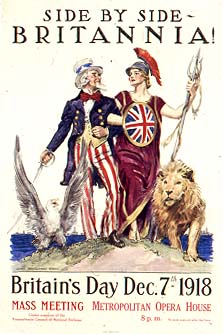
World War I propaganda poster depicting Britannia and Uncle Sam. Image via Wikipedia.

An anonymous Romney adviser has allegedly told the Daily Telegraph that Romney would improve relations with Britain because:

“We are part of an Anglo-Saxon heritage, and he feels that the special relationship is special,” the adviser said of Mr Romney, adding: “The White House didn’t fully appreciate the shared history we have”.

What a lot of people are talking about is the racial angle (pardon the pun) of this alleged quote.  One thing to keep in mind is that Obama is in fact partly English on the side of his mother, Ann Dunham.  (Dunham is an English name, for one thing.) But people are thinking this is a not-too-veiled racial attack.  I’d have to say I don’t what else the point of such quote could be, although it should be noted that the Romney campaign is saying this quote is inaccurate.  Well, if so, they should sue the Telegraph for libel.  If they don’t, it might seem like their guy actually said that, and they’re lying to cover it up.

What I really want to talk about, though, is this “special relationship” stuff.  I remember there was a big dust-up back in 2009 about the “special  relationship”, when Obama gave then-Prime Minister Gordon Brown a set of DVDs as a gift.  The Prime Minister had given him a pen-holder made from the HMS Gannet.  This upset a lot of people, but from what I can tell, Brown was treated like this by virtually everyone.  He had that anti-charismatic thing (a lot like Al Gore) that made people dislike him instinctively.  So I don’t think this means Obama doesn’t like Britain.

In practice, the “special relationship” seems to work like this: the British give us their culture–actors and actresses, authors, musicians–and we give them help whenever there’s a world war.  It’s not a bad system, all told.

Seriously, though: the “special relationship” seems to have been heavily emphasized by Winston Churchill, presumably for the purpose of convincing the U.S. to intervene in World War II.  And certainly, since America was founded people who had been British, there’s no doubt the two countries have a lot in common.  However, I don’t know that it is really that “special”.  Diplomatic relationships are usually forged and dismantled based on financial or military interests, not sentimentality.  If–Heaven forbid!–the United States’ relationship with Britain deteriorated, we would no doubt start saying “well, the whole country was founded because of a war with them, after all.”

That’s really the point: a lot of this is contrived stuff for people to argue about that ultimately doesn’t mean very much.  Example:  Romney says he’ll put a bust of Winston Churchill back in the Oval Office if elected.  Big deal.  I admire Churchill, but that really doesn’t matter very much in the scheme of things.  This is all a lot of pointless fighting over symbolism, as far as I’m concerned.
Everyone is talking about the Supreme Court’s ruling on Obamacare.  But I don’t want to talk about that now.  I want to address another controversial 5-4 ruling, one that many said was the last one before this to garner such attention.  James Fallows alluded to it in his hyperbolic-yet-interesting-but-ultimately-irrelevant pre-ruling post: the curious case of Bush v. Gore.

Since I didn’t start blogging until nine years after that decision, I’ve never really talked about it on here.  It’s quite interesting.  What does our go-to source, Wikipedia, tell us? 

The Court held that the Equal Protection Clause guarantees to individuals that their ballots cannot be devalued by “later arbitrary and disparate treatment”. Even if the recount was fair in theory, it was unfair in practice. The record, as weighed by the Florida Supreme Court, suggested that different standards were seemingly applied to the recount from ballot to ballot, precinct to precinct, and county to county, even when identical types of ballots and machines were used.

So, Florida screwed up the recount, huh?  What the heck were they doing, counting in Greek numerals?  How can you screw up a simple vote count unless corruption is involved?  Well, whatever.  Then:

The Court stated that the per curiam opinion’s applicability was “limited to the present circumstances, for the problem of equal protection in election processes generally presents many complexities.”

I have read this over and over.  I am no legal expert, but I can read English.  I am going to write, in a separate paragraph, in bold, my reading of this.  If you are a legal expert, please explain to me if I am making mistake in the following paragraph, for I can see no other interpretation.

The Court had to make sure their ruling applied only in that case, because otherwise it could conceivably call into question many other elections in the history of the United States, and future ones as well.  Certainly, every recount was now suspect.  According to their findings, known methods of vote counting may have been unconstitutional.  I mean, if they couldn’t recount votes in a constitutional manner, how could anyone be sure they had counted them right in the first place?

I am not saying the Court was wrong.  I am only saying that if they were right, there existed a possibility that the entire system was fundamentally flawed.  At least that’s how I read it.  Am I wrong?

However, this part was a 7-2 ruling.  The 5-4 ruling was the controversial one, the one that said they couldn’t try a constitutional recount.

Conservatives have been quick to point out that the Court did not decide the election for Bush because, had the recount continued in those counties, Bush would have won anyway.  they cite this New York Times story from 2001:

A close examination of the ballots found that Mr. Bush would have retained a slender margin over Mr. Gore if the Florida court’s order to recount more than 43,000 ballots had not been reversed by the United States Supreme Court.

The story went on to note:

But[…] Mr. Gore might have won if the courts had ordered a full statewide recount of all the rejected ballots.

Please observe that the story is from 2001.  Not 2000.  That means that people only found out what would have happened almost a year later.  The Court making their decision knowing that if they stopped the recount Bush would win, whereas if the recount continued, it was unknown whether he or Gore would win.  Now, we learned after the fact that Bush would have won had they allowed the count in those counties to continue, thus rendering it a moot point, but they did not know that at the time.  We must evaluate their decisions based on the knowledge they possessed when they made the ruling:

  • Stop recount: Bush chance of victory = 100%
  • Continue recount: Bush chance of victory = x, where x < 100%

I think it’s clear what the dominant strategies are in this case for any political partisan, no?

But the Supreme Court is not political!  They are just a machine that ruthlessly interprets the law, not biased in any way, shape or form, right?  They wouldn’t decide an election based on anything other than legal precedent.  That wouldn’t be logical.  What would Vulcan High Command say?

Let’s hear from Justice Scalia on the matter:

There you have it.  They had to do it!  Everyone was laughing at us!

I was watching The Dick Van Dyke Show on TV last night.  The episode I saw was called “The Bad Old Days“.  In a nutshell, it went like this: one of Rob’s colleagues tells him about an article on “the decline of the American male”, and how men are becoming more subservient to their wives.  This worries Rob, who starts to fear that Laura too often tells him what to do.  The episode culminates in a hilarious dream sequence, in which Rob imagines himself as an overbearing, bullying 19th-century-style husband, who makes his wife do all the housework and forces his son to work in a factory.  Of course, Rob wakes up and realizes that this wasn’t such a great way to live, after all.

It’s kind of funny to me, because you often hear this complaint of “feminized” men being subordinated to their wives these days, especially in conservative and “alt-right” circles.  Often, the 1950s and early ’60s are considered the archetype of a more restrictive and socially conservative era, and to some extent the setup of The Dick Van Dyke Show is emblematic of that.  I remember my blogger-friend Thingy contrasting Mary Tyler Moore’s accommodating housewife character on Dick Van Dyke with her independent, single, career-woman character on The Mary Tyler Moore Show in the ’70s.

But then, here we have an episode of Dick Van Dyke from 1962 that addresses this same “men are too subservient to their wives” idea.  So, it seems like that idea must have been in the air even back then.  Which, in turn, suggests the possibility that perhaps there is an ever-recurring nostalgia among authoritarian men of every era, that they had it better in, as Rob says, “the bad old days”.

Well, that’s enough sociological musing!  The point is, it was a very funny show.  It does amaze me that the best thing on TV some nights is a show from 50 years ago, but there you have it.

Image via Wikipedia

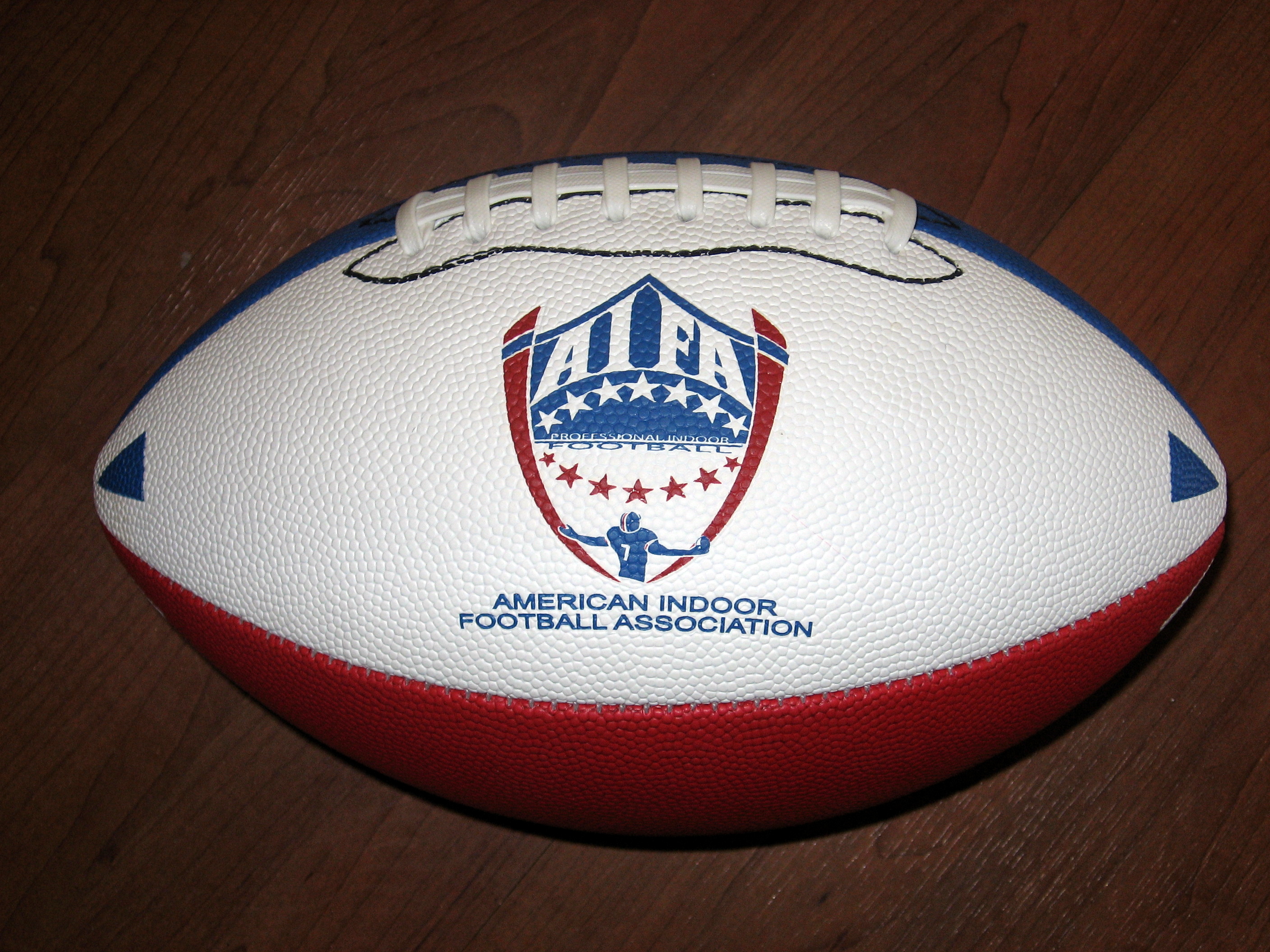
“Gentlemen, this is a football.”  Thus did the famous coach Vince Lombardi supposedly begin every first team meeting of the season, while holding up same.   The point being, you always start off with the basics. However, I don’t know about the AIFA; some of their players might be seeing a football for the first time.

The other day, somebody got to this blog by searching for the terms “how would max weber view american football”. I don’t know if he was even thinking of the same Max Weber I’m so fond of, but regardless, I thought to myself: “Heck, I would like to read that article.”  So, here is a cursory attempt at writing it.

Of course, it’s hard to figure out the answer without a Ouija board and some arcane black magic.  And even then, it would probably only be something simplistic like “the competitiveness reflects the Protestant ethic” or “the Browns are 6 and 10 this year, best case.”

I’m not too familiar with his most famous writings about religion; I’ve mostly studied Weber’s contributions to political thought. Long-time readers probably remember his three types of authority:

  1. Charismatic authority
  2. Traditional authority
  3. Legal authority

Well, I suppose he’d think that coaches like Rex Ryan and players like Tim Tebow have charismatic authority, whereas coaches like Belichick and players like Ray Lewis rely on a sort of traditional authority–they have enjoyed a lot of success, so people are supposed to automatically respect them.  The equivalent to Legal authority is, well, the referees and the commissioner. (As the Saints are discovering.)

But this doesn’t tell us anything about the broader social phenomenon of football. Maybe Weber would note the similarity of the sport to religion.  After all, some fans follow it with the same zeal that people follow religions. They even collect artifacts and relics relating to the heroes of the sport.  And then, of course, there’s the ubiquitous Mr. Tebow. (I know I’m breaking my vow here. I’m sorry. But I promise you one thing: you will never see another blogger try as hard not to mention him as I will try the rest of the off-season.)

I once saw an NFL Films show about the Pittsburgh Steelers championship run in 2005.  It started off with this quasi-hymn or chant-like music that sounded religious and very eerie all at once. Imagine “Duel of the Fates“, only way creepier.  It seemed pretty serious for a bunch of football highlights.  But there are people who definitely see football as nearly as important. (Another Lombardi line, of which there are some variations: “All that matters is your God, your family and the Green Bay Packers”.)

Still, Weber studied religions as a way of highlighting differences in cultures and people’s philosophies.  The superficial resemblance of sports fanatics to religious fanatics is obviously more about the features of fanaticism than religion.  So we’re still at a dead end.

Let’s approach this from a different direction: we know that American football, though wildly popular in the United States, is not the number one sport in any other country. Perhaps the reasons for this are tied to “American exceptionalism”.  But this is more Tocqueville than it is Weber. (Where is that Ouija board?) And unfortunately, I cannot find much that Weber had to say about America.

So once again, I am frustrated.  I leave it to you, blogosphere and distinguished commenters, to sort this problem out.  What would Max Weber think of American football?

Last week in Scotland, there was an academic conference on the Harry Potter series. The Guardian reports:

Billed as the world’s first conference to discuss Harry Potter strictly as a literary text [as opposed to what?–MM], almost 50 lectures are lined up, with academics taking on issues including paganism, magic and the influence on Rowling of CS Lewis, JRR Tolkien and Shakespeare. Seminar titles range from “Moral development through Harry Potter in a post-9/11 world”  to “Harry Potter and Lockean civil disobedience”.

The article goes on to quote Prof. John Mullan of University College London as saying: “[The participants] should be reading Milton and Tristram Shandy: that’s what they’re paid to do.”

Well, I’m sure the world will manage to struggle on despite some professors not reading their Milton and Tristram Shandy for a few days. Somehow, I don’t think those works will change much over that time frame, so I don’t think there’s a lot of urgency.

It is not that literary analysis is a useless pursuit–I have often engaged in a bit of it myself, in my amateurish way–it is just the rather odd, almost arbitrary mechanism by which things are deemed worthy of it (or not) that annoys people.

Why shouldn’t our friendly neighborhood professors spend a little time reading the adventures of Harry Potter, in lieu of another go-round with Paradise Lost? Is it because they are not as good as the works of Milton? Perhaps they are not. But how can you claim that, without first having subjected them to the same scrutiny that has been applied to Milton’s work? They could give their profession a much greater reputation for academic rigor if they did that, I think. Prof. Mullan’s idea is somewhat akin to astronomers continually proving to this day that the Earth does in fact orbit the Sun, and smacking down any loose talk about this “Sloan Great Wall“.

Not that Potter is as good as the classic Great Works–it isn’t, in my opinion, but who is to say that they won’t one day come along with something that is better than those old books? It could happen, you know, but academia won’t find out about it unless they analyze them. And even if they never actually do get surpassed, you don’t need to keep reading and writing about them over and over to be sure.

This conference is, nevertheless, a bit ridiculous. I know I sound like a Tea Partier saying this, but there is a vague touch of elitism about the whole thing: “We are academics! We can discuss this book series better than you (dare I say it?) ‘muggles’ can.”

I don’t mean to imply it isn’t worth doing, because they’re professional critics. The ridiculousness of the situation derives less from the fact that they’re discussing Harry Potter and more from the fact that academic literary criticism in general is fairly ridiculous. It is for this reason that so many people think the entire profession is useless and stupid, when in fact it is only that they are using the wrong techniques. And the reason they are using the wrong techniques, I suspect, is that they are mostly analyzing old texts, and consequently have to reach further and further for new topics that haven’t been addressed before. There are only so many ways you can say “Hamlet is really quite interesting.”

Unfortunately, the techniques honed by critics for doing this are the only tools available to those critics who would write about something slightly newer such as Harry Potter. To paraphrase Oscar Wilde’s assessment of the United States: “critical analysis of Harry Potter went from barbarism to decadence without civilization in between.” (There was, I am sure, a “Golden Age” of Shakespeare analysis. It was probably in the 1700s.)

I don’t really know why it’s such a big deal, all told.  Amateurs on fan sites were analyzing the Harry Potter books well before this and will continue to do so. Academics may join in if they like, or not. It doesn’t much matter.

For a long time, Thomas Edison was held up as a model of American ingenuity, an inspiring figure whose inventions changed life for everyone. But, relatively recently, Nikola Tesla has received more acclaim as the better inventor, and his works are considered to have been unfairly neglected in favor of Edison’s. lately, it seems like Tesla is more popular than Edison. Perhaps it’s just one of those fashions that goes back and forth. (You might even say it “alternates” which one is “current”.)

Freddie DeBoer linked to a comic that exemplifies the lately fashionable Tesla-worship. I agree with Freddie’s reaction; even though I’m disposed to be more sympathetic to Tesla, that comic made me feel kind of uneasy about it, so strident was its tone.

I know I’ve used this quote before in other contexts, and I hate to keep using the same things, but damn it if it isn’t completely appropriate for summing up Edison and Tesla:

“One of them is half-mad–and the other, wholly unscrupulous.”–Claude Rains, as Mr. Dryden in “Lawrence of Arabia.”

Edison was a cutthroat businessman, there can be very little doubt. You don’t enjoy the kind of success he did without pulling some pretty mean stuff, I think. Tesla, meanwhile, was pretty clearly crazy. That was probably why he was such a great innovator.

For an example, it’s not clear to me whether Tesla’s “particle gun” was actually something real or just an idle thought he had. I sometimes think certain people–like the author of the above-mentioned comic–are too quick to credit Tesla with “inventing” stuff when actually it was just stuff he dreamed up in some of his less-rational moments.

Not that he wasn’t a great inventor. I’m just saying he’s a little over-celebrated. Of course, so was Edison when you look at all the rotten things he did, such as electrocuting animals for a PR campaign. I’m sure a lot of the admiration for Tesla comes as a direct result of people hearing in school about how wonderful Edison was.

There’s also an under-current of culture war to it, I think. Consider: the wily, Midwestern-born businessman/showman vs. the misunderstood, introverted immigrant. I don’t know if anyone has ever done a poll to look for correlation between political affiliation and support of Tesla or Edison, but I bet I know how it would come out.

I think part of it is the misrepresentation of Edison–like the author of the comic said, “he didn’t invent the light-bulb, he sold it.” Is that wrong?  Why, people greatly admire Steve Jobs, but if you think about it, a lot of what he did was selling what Jonathan Ive designed. That doesn’t make Jobs a phony; it makes him great at what he did: selling stuff.

Have you heard the news? Abraham Lincoln invented a fore-runner of Facebook. No, really! It must be true because it said so on the internet.

Well, the hoax was exposed within a day, but not before a lot of major news sources fell for it. Here’s an excerpt from the hoax article:

The whole Springfield Gazette was one sheet of paper, and it was all about Lincoln. Only him. Other people only came into the document in conjunction with how he experienced life at that moment. If you look at the Gazette picture above, you can see his portrait in the upper left-hand corner… But just to the left of his picture, and above that column of text, is a little box. And in that box you see three things: his name, his address, and his profession (attorney).

The first column underneath his picture contains a bunch of short blurbs about what’s going on in his life at the moment – work he recently did, some books the family bought, and the new games his boys made up. In the next three columns he shares a quote he likes, two poems, and a short story about the Pilgrim Fathers…

Put all that together on one page and tell me what it looks like to you. Profile picture. Personal information. Status updates. Copied and shared material. A few longer posts. Looks like something we see every day, doesn’t it?

And it goes on:

Lincoln was requesting a patent for “The Gazette,” a system to “keep People aware of Others in the Town.” He laid out a plan where every town would have its own Gazette, named after the town itself… Lincoln was proposing that each town build a centrally located collection of documents where “every Man may have his own page, where he might discuss his Family, his Work, and his Various Endeavors.”

This right here should have tipped anyone who read this off that this was a hoax, by the way: the use of the word “page” sounds very odd here, not at all like someone from the 1800s would use it, and exactly like someone familiar with the internet would use it.

And surely it must have struck the people reading this that the concept is on its face absurd. People would have no need for such a tool back in the 1800s. They already had town newspapers. The faux-proposal sounds just stupid when you put it like this. This, again, should have given the whole thing away.

What this hoax exposed–perhaps unwittingly–is that Facebook is not a lot more useful than a town newspaper. It gives you some ability to stay in touch with your friends, but for the most part it’s just a time-waster. It’s addictive, sure, but not all that useful. It is barely more than a glorified bulletin board. or newspaper.

Lincoln invent Facebook! The idea is laughable at first sight!

He was much too smart for that.

I’m currently reading a very interesting article from the March, 1932 issue of The Atlantic about Adolf Hitler. The author, Nicolas Fairweather, makes some terrifyingly accurate predictions about the Nazi regime. It’s very disturbing to read, but at the same time the amateur historian in me can’t help but be interested in it.

(Hat Tip to Brian Resnick)

Andrew Sullivan muses:

Richard Nixon’s Southern Strategy… still poisons our politics. For a very long time, the deep cultural divide in this country was in part managed by the Democratic party. Its alliance of Southern conservatives and Northeastern liberals – perhaps exemplified by the Kennedy-Johnson ticket – gave what we now call parts of red and blue America a joint incentive to work out their differences through a common partisan affiliation. The had a fellowship that facilitated compromise. A less coherent ideological party structure actually created a more coherent political debate. I wonder if civil rights legislation would ever have been achieved without this.

That’s one way to look at it. But as Lyndon Johnson supposedly said at the time, the Civil Rights act was also what ended that coalition. Nixon happened to be in the right place at the right time to benefit from it, but the South was not going to support a Democrat again after that. I’ve talked about this before, but in my view, Nixon’s “Southern Strategy” didn’t really change much; it was larger societal changes that destroyed the New Deal coalition.

Image via Wikipedia

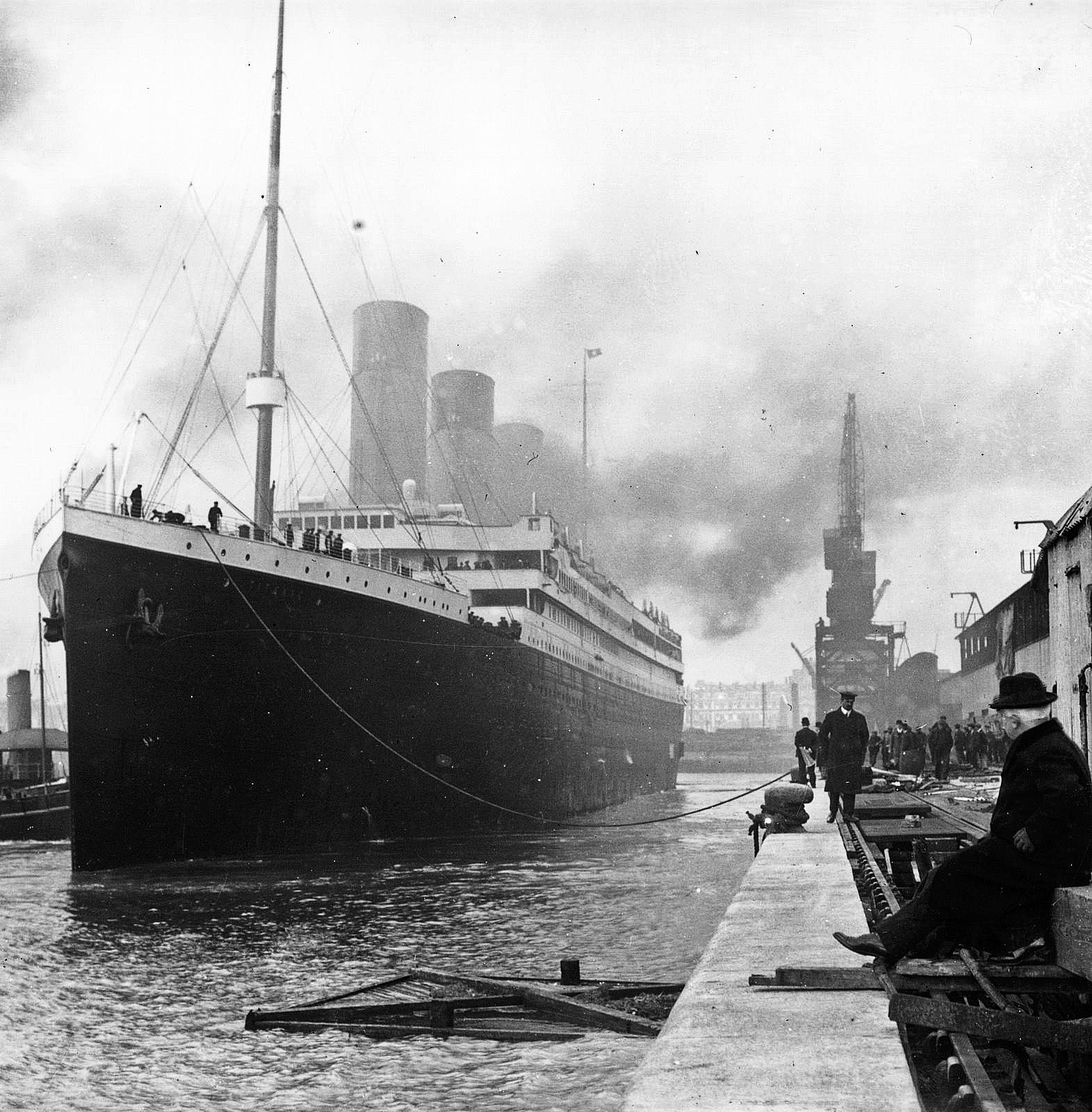
I don’t quite get it. It’s an interesting story and all, how the “virtually unsinkable” ship sank on its maiden voyage. And it’s sad that all those people died, of course.

I just don’t understand why the sinking of the Titanic still fascinates so many people. Is it just because of the movie? I can also see that, if you had an ancestor aboard it, it would be especially interesting, but most people I know don’t.

I’m not criticizing the phenomenon, by the way; any time I see people interested in a historical event, I think it’s a good thing. I guess what really interests me is how one particular event gets singled out from others. Why the Titanic, and not the Empress of Ireland, for instance?

But still, it’s a tragedy, and worth remembering.