And in the section titled “Expression of Sentiments”:
8. RESOLVED, That we favor a constitutional provision limiting the office of President and Vice-President to one term, and providing for the election of Senators of the United States by a direct vote of the people.
They would get both the income tax and the direct election of Senators. It has been about a century since both were enacted via the Sixteenth and Seventeenth amendments to the Constitution. This would have been a few years after the Populist party had disbanded–or, perhaps more accurately, consumed by the Democratic party.
Now, granted; they didn’t get everything they wanted. Like:
9. RESOLVED, That we oppose any subsidy or national aid to any private corporation for any purpose.
Good luck getting rid of that.
But the point is, some of the demands of a third party composed largely of impoverished farmers were implemented 20 years later, and not merely as laws, but as Constitutional amendments. Constitutional amendments are not easy to get.
Just as a successful small start-up company gets bought out by a larger corporation, a successful third party gets taken over by one of the major parties. But it’s still a victory for their ideas–so what if there was no Populist party as such, if the Democrats were accomplishing what the Populists wanted? The Populists set the stage for many of the reforms made in the first half of the 20th Century.
I watched the movie The Other Boleyn Girl on TV last night. It tries to portray Anne Boleyn as a manipulative, scheming character, but the problem is she’s actually one of the most sympathetic character in the movie. I think the overall point was about how terrible and unfair the aristocratic system of politics-by-who-marries-whom, but since Anne is a prominent victim of that, it’s odd to make her an unlikeable character.
The performances were quite good, but the characters felt empty, especially the personality-free Mary Boleyn. My thought was “well, no wonder she’s ‘the other Boleyn girl’–she’s not as interesting! So, why do we care about her again?”
I’ll admit that I’ve never been terribly gripped by the that period in history–not sure why. I think it’s because almost every man seems to have been named “Henry” or “Thomas”, which makes things hard to follow. You have Henry the VIII, who had issues with the Church, and because of it was at odds with Sir Thomas More, and then you have Henry II, who also had issues with the Church and because of it was at odds with Thomas Becket. It’s easy to get confused.
Anyway, back to the this movie. It’s weird because on the one hand I guess it’s for people who find that period in history romantic or something, but simultaneously the point of the movie seems to be that it was a terrible time, when everybody had to do bad things to get ahead. It was a movie for people who like “Merrie Olde England”, only it condemns that as a brutal period.
Upton Sinclair did not like the meat-packing industry. And so he wrote this book to explain why it–and ultimately the entire capitalist system–was corrupt and evil. The book tells the story of a Lithuanian family who comes to America and finds work in the Chicago meat-packing industry. Every single horrible thing that you can imagine happening then proceeds to happen, and so, through soul-crushing poverty, crime and death, the family breaks up.
The main character is the family patriarch, Jurgis Rudkus, who goes from being an honest working man beaten down by the cruel meat industry to a cynical and selfish criminal to finding the light of socialism, which he then espouses with religious zeal.
I have to admit, though it is about as heavy-handed as it could have been, it nevertheless succeeds somewhat in making you feel sorry for the characters by sheer force of repetition. Sinclair had this irritating habit of writing something along the lines of: “Jurgis went home that night, little knowing that something unbelievably horrible was about to happen.” This kind of kills the suspense, and is dramatically a dreadful device, but it beats you over the head with it so much it sometimes works anyway.
The irony is that though the book is famous for its depiction of the disgusting practices of the meat-packing industry, that was really just a bit of extra detail Sinclair included. His real point was much broader; it was that the workers were oppressed by the bosses. So, he actually accomplished the extremely rare feat of writing a novel that accomplished social change, but it was not the change he wanted. (It wouldn’t shock me if the reason the book is famous for the parts about the food production processes is because those bits are closer to the beginning, and most people quit reading after that.)
Sinclair wrote this novel for a socialist magazine, and this is where it comes to its central problem: the conflict between being a work of propaganda and a work of art. There can be propaganda that is also art, but when a person is writing to make a political point, there is a dilemma between portraying things as they are versus how the ideology requires them to be. So, almost all of the characters in The Jungle are just puppets with which Sinclair makes his political points.
There are vast swaths of the book that don’t really qualify as being part of the story, they are merely long lists itemizing everything that is wrong with meat-packing, or the city of Chicago, or the factories, or whatever. The last chapter of the book is just a huge lecture on the evils of Capitalism and the virtues of Socialism:
“How is the price of an article determined?”
“The price is the labor it has cost to make and deliver it, and it is determined by the first principles of arithmetic. The million workers in the nation’s wheat fields have worked a hundred days each, and the total product of the labor is a billion bushels, so the value of a bushel of wheat is the tenth part of a farm labor-day. If we employ an arbitrary symbol, and pay, say, five dollars a day for farm work, then the cost of a bushel of wheat is fifty cents.”
“You say ‘for farm work,'” said Mr. Maynard. “Then labor is not to be paid alike?”
“Manifestly not, since some work is easy and some hard, and we should have millions of rural mail carriers, and no coal miners. Of course the wages may be left the same, and the hours varied; one or the other will have to be varied continually, according as a greater or less number of workers is needed in any particular industry. That is precisely what is done at present, except that the transfer of the workers is accomplished blindly and imperfectly, by rumors and advertisements, instead of instantly and completely, by a universal government bulletin.”
That’s just a bit of it–to give you the flavor. It reminded me of Ayn Rand’s writing, and almost made me wonder if her books are better once you are familiar with clumsily-written socialist propaganda. Perhaps her sledgehammer approach to philosophical writing was intended as a parody.
There are a ton of obvious questions Sinclair fails to answer in the concluding chapters. Given the benefit of hindsight, the “Socialism is Our Salvation” message of the book is truly ironic. Just in the above passage, you may ask “how exactly will this ‘universal government bulletin’ work?” Or perhaps, if you’re after the big game, you might wonder “if price is determined by labor, wouldn’t that mean something produced with more labor–that is, less efficiently–be more valuable than the same good produced with less labor?”
Ok, that second one is unfair. I’m criticizing Sinclair for repeating Marx’s mistake. But if we just stick to the problems with this as a novel, it’s still pretty bad to end your book with a series of “Marty Stu” characters giving speeches. This Socialist F.A.Q. in the last chapter made me think of a quote from Marx–Groucho, that is. In one of their movies, there’s a bit where Chico is asking and answering his own rhetorical questions and then asks Groucho, “Now so far I’m right?”. Groucho responds: “It’s pretty hard to be wrong when you keep answering yourself.”
Now, don’t misunderstand me–I’m sure a lot of the criticisms Sinclair made of the meat industry were quite valid. It was just the solutions where he went wrong, I think. According to Wikipedia, an employee at the publishing company for The Jungle wrote:
One feels that what is at the bottom of his fierceness is not nearly so much desire to help the poor as hatred of the rich.
Doubtless, Sinclair would say that this employee was just slandering him on behalf of the capitalists in order to crush the glorious proletariat uprising. “Now we see the violence inherent in the system!”
Seriously, though, that person was right that Sinclair hated the rich. He seems to have surprisingly little actual interest in the poor, and besides that, he seems to have had odd little prejudices of his own. (Especially against the Irish–I think nearly all of the bad characters in the book are explicitly noted to be Irish.)
As a novel, it is pretty poor. As a work of propaganda, it is also fairly weak, though it did actually set people thinking and inspire them to take action to make changes in society, even if it wasn’t what the author himself had in mind. It caught the attention of President Theodore Roosevelt–clearly, it was an effective vehicle for getting a message across.
And if nothing else, it made me glad I’m a vegetarian, even though I’m quite certain the meat industry’s practices have improved over the last century.
I’ve been sort of following the news about the re-enactments of the battle of Gettysburg that are being held for the 150th anniversary of the battle.
Re-enactors provide a valuable service to those interested in history, no doubt, but I can’t help feeling they just can’t imitate the feeling of urgency which the real battle must have had. I imagine it was much more frenetic on that day 150 years ago when Pickett’s men charged across the field.
It’s easy to see now that tactics like that, tactics that led Prussian Field Marshal von Moltke to dismiss the Civil War as simply “armed mobs”, were disastrous and borderline insane. But then, people who were tired and starving and under fire can hardly have been thinking clearly when making these decisions.
(Aside: in the CBS video above, isn’t it ironic that Professor Goodwin and that reporter talk about how Lincoln’s speech was what made the place matter, when in the address itself President Lincoln said: “the world will little note, nor long remember what we say here; while it can never forget what they did here”?)
I went to Gettysburg years ago, and I do remember that it was an eerily peaceful place. Like it had seen enough violence for all its existence, and was exhausted.
It’s also fitting that what was effectively the deciding battle in a war that redefined the United States and ended the institution of slavery that had been such a terrible stain on the country from its birth, ended right before Independence Day. As so many others have noted, there’s something poetic about it.
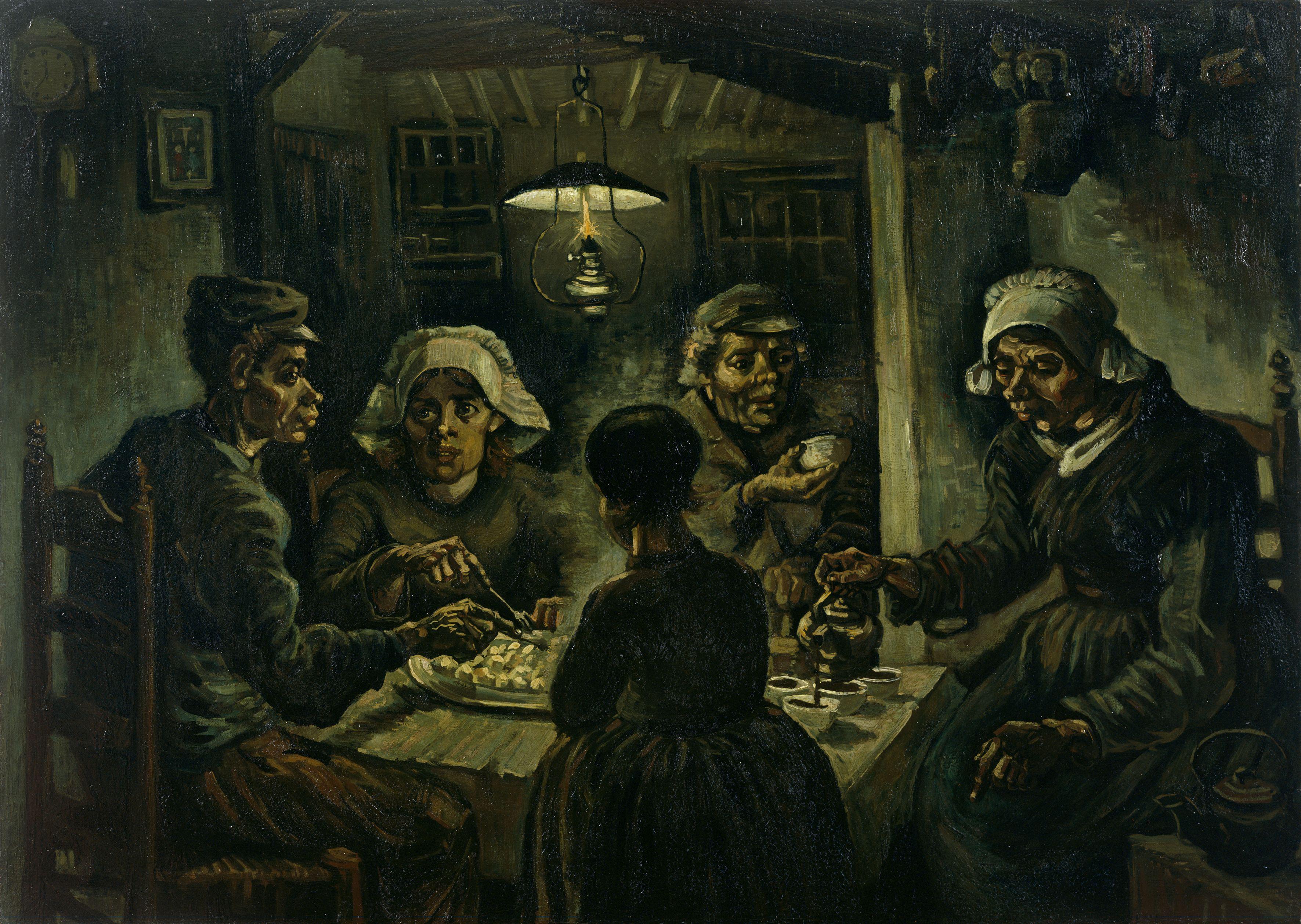
I’ve been reading about Vincent van Gogh lately. The guy was kind of crazy, as you may have heard, and also pretty unbearable. He was always mooching off of his brother to support himself. He would have been almost impossible to put up with, I think.
I’ve also been surprised by how many of his paintings were kind of lousy. One of his famous early paintings was The Potato Eaters, which was not that well-received:
Vincent van Gogh [Public domain], via Wikimedia CommonsTo be honest I kind of like that one, but it was not popular in its time, and I can see why. The ones I really cannot stand are his paintings of farmers at work in sunny fields and colorful little hamlets. They are painted in a cartoonish, weird style, and oftentimes the lighting is just too much for me. This one, The Olive Trees, gives you some idea:
Vincent van Gogh [Public domain], via Wikimedia CommonsI like his night paintings much better. This one, Starry Night Over the Rhone, I prefer even to his more famous Starry Night:
Vincent van Gogh [Public domain], via Wikimedia CommonsI wonder if painting, maybe more so than other artistic endeavors, just requires that you keep at it. I don’t mean just in terms of practicing to learn how to paint, but even once you are a technically skilled painter, you have to just keeping painting stuff until you happen to get something good. There are one-hit wonder novelists and musicians, but maybe painting is more of a “quantity leads to quality” kind of thing.
Ah ha, Charles Fort, you tricky rascal, you! I knew I’d find you one day!
Charles Fort. Image via Wikipedia
Some readers may recall that I did a rather silly post, nearly a year ago now, trying to think of the last name of some philosopher whose first name was “Charles”. Well, the other day I finally stumbled across his Wikipedia page again. That’s one mystery solved.
So, after all that, what was the deal with this Fort guy? He was, from what I read, a bit of an oddball. He didn’t really trust mainstream science much, and had a way of coming up with his own offbeat sort of logic.
Not that he seems to have taken any of that seriously either,and to go by his Wikiquote page, he was a very witty fellow, and it sometimes seems like his interest in weird stuff was an excuse to make clever quips.
So, that’s Charles Fort in a nutshell. (Which, some would say, is exactly where he belongs.) I hope you you found this worth the wait.
The retreat from child rearing is, at some level, a symptom of late-modern exhaustion — a decadence that first arose in the West but now haunts rich societies around the globe. It’s a spirit that privileges the present over the future, chooses stagnation over innovation, prefers what already exists over what might be. It embraces the comforts and pleasures of modernity, while shrugging off the basic sacrifices that built our civilization in the first place.
What’s particularly curious is that the second paragraph of Mr. Douthat’s column begins:
It’s a near-universal law that modernity reduces fertility.
On the face of it, this appears nonsensical. “Modern” means “of or pertaining to present and recent time; not ancient or remote“. As such, there can be no “universal laws” about modernity. All we can say is that in modern times fertility decreases, but “modern” is itself a relative term. What is “modern” today will be ancient some time from now, and if the birthrate goes up at some time in the future, the law will reverse itself.
There is a kind of logic to it though, if you buy into Spenglerian theories of civilizational life-cycles. In this view, all civilizations are born, grow and die. If “modernity” is taken to mean “the end of the cycle”, then this makes some sense. I think that is the only way it does, in fact.
When an NYT columnist echoes an ultraconservative German nationalist, it naturally causes a stir. Really though, Douthat’s article is thoroughly in agreement with biological determinism–whatever group of people produces the most offspring will “win” in the eyes of biological determinists, and the quality of the upbringing is only a secondary concern. (I am not saying Douthat actually believes this. I am just saying what he wrote in that column agrees with it.)
It’s the old “nature vs. nurture” debate that lies at the core here, and that debate is so old–I’ve said my bit on it here–I think it’s safe to conclude that it is insoluble. Probably it will turn out that Ray Kurzweil is right, and it is all a moot point anyway.
As I think I’ve mentioned before on here, I don’t have cable TV. I just get the major networks, PBS, a few local channels and a bunch of Christian channels. The last are mostly devoted to people on elaborate stages giving speeches and asking for money. However, the other day on one of these channels, I saw a different sort of program.
I don’t know the name of the show or the channel, otherwise I’d tell you. All I know is that it was some older fellow standing in the middle of the desert on the outskirts of Jerusalem, reading from a bunch of papers he was holding and trying to keep from blowing away. The production values were, to say the least, horrifying. If any of you readers can guess what show this may be, feel free to tell me.
What the guy had to say, however, was somewhat… interesting. He was talking about how many intellectuals, especially in the atomic age, desired a “one world government”. He dated this impulse back all the way to Nebuchadnezzar II, and said that they [the intellectuals] did not believe you could have many strong countries, you could only have one government. (I’m paraphrasing.) I got the impression he was getting towards the point that these intellectuals were wrong, and one world government was a very bad idea, and that the Bible had predicted all of this. He was taking his time about it though, and I had work in the morning, so I didn’t get to hear how it all ended up.
(The politics on these religious shows are always interesting. One day, while channel surfing I saw a show claiming that people were now placing their faith in government instead of God. What we need, according to the Bible, so they said, was less government. Smaller government. In fact, watching some of these shows, you get the impression that they feel the Republican Party platform is the word of the Almighty.)
“One World Government” is a phrase conspiracy theorists throw around a lot to mean all sorts of wild things. But I think it is true that many people would like to see more international cooperation and conflict resolution by some means other than wars between nations. I think this train of thought really started because of World War I, which showed a lot of the problems that can arise with multiple competing nations.
In Europe, in the late 1800s and early 1900s, you had lots of strong, independent nations–strong empires, even–such as Britain, France, Austria-Hungary, the Ottoman Empire, Germany and so on. The peace among these nations, such as it was, was kept by treaties the countries made with each other. Unfortunately, this system of treaties proved to be unstable in the face of rebellious nationalist agitators and military build-ups between competing nations, and thus, through a complicated series of events, the treaties dictated that a massive war broke out.
In the aftermath, people looked around and said, quite logically, “how can we make sure that this doesn’t happen again?” That very intellectual President, Woodrow Wilson, even proposed the League of Nations, though ironically the U.S. did not join it. Of course, the League failed to prevent ultra-nationalist sentiment in Germany from igniting another, even more terrible war.
The League was replaced with the United Nations after World War II. And ever since, nationalist sentiment has opposed the U.N., fearing that it will destroy all of the country’s traditions and create a one world government. As some readers know, I am fascinated by conspiracy theories, even though I do not believe in any of them. And, as I said, there are a lot of conspiracy theories about the “one world government”, and I think the root reason for all of them is the nationalist elements’ fear of being governed by cosmopolitan intellectuals.
Having said all that, I think really all most people actually want is some international way of resolving conflicts without having to go to war. People, both nowadays and especially in the immediate aftermath of the World Wars, just don’t want to see a repeat of that. Seems hard to blame them, really.
On Sports Illustrated today, there’s an interesting excerpt from the book When Saturday Mattered Most by Mark Beech. It’s about Army Black Knights football coach Red Blaik’s invention of the famous “Lonesome End” formation in 1958:
Blaik[…] began to wonder. What if a team lined up in nothing but unbalanced wide-receiver sets, making them constitute the entirety of the offensive attack? And what if the receiver — in Blaik’s words the “far flanker” — was positioned far wider than was normal?
Unbalancing his offensive line, Blaik knew, would not only give his offense overwhelming force on one side, but it would also compel the defense to make a choice — whether to remain in its normal alignment, conceding the advantage to Army’s running game on the strong side, or to shift players over Army’s extra blockers, leaving itself exposed to a play that went the other way. Splitting the end extremely wide on the strong side would break up the defensive front.
What’s cool about this is how seemingly minor this innovation was. So he had the end stand a bit further out. So what? But sometimes, making minor tweaks can lead to game-changing results, just because no one else thought of it because it seemed so minor.
I remember in Marv Levy’s book Where Else Would You Rather Be?, he mentioned how some American football coaches who went to the Canadian league dealt with the fact that Canadian football is 12 against 12, rather than American-style 11 against 11. Levy said they simply put the extra player far out near the sideline, forcing one man to cover him. And then just ignored those players, and played 11-on-11 football. Not the ideal solution, but still clever.
_-_The_Olive_Trees_(1889).jpg)


