As if on cue, a guy named Rob Flickenger has invented a Tesla energy gun:

Cool. I like electricity. But notice that the thing’s range is apparently 12 inches. And it took only took a little over a hundred years to do it! To me, this somewhat long development time does explain why the armies of the world weren’t lining up to pay Tesla when he first talked about his energy weapon.

By the way, people keep calling it a “Tesla coil gun”. I believe there is also a “coil gun” that is a different thing altogether, invented by Carl Gauss–sometimes called a “Gauss gun”. And yes, I only know about this stuff from playing Fallout. With Science!

But, we can sleep soundly in our beds knowing that our best and brightest are devising new and better weapons. Hey, wait…

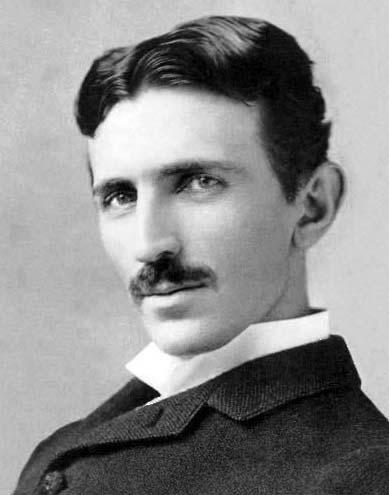
Nikola Tesla, via Wikipedia.

Amused at This Ruthless World (thanks for liking my last post, BTW) wrote a really good post awhile back in response to an essay written by one “John J. Wall”. I’d never read Wall’s piece before, but I have heard the idea advanced within it many times in the past. It is this: that the “liberals” and “conservatives” are so deeply divided on all issues that it would be better for both if each group formed separate countries. Amused’s post inspired me to write something of my own on the matter.

Of course, if you’re a reader of this blog, you know that there are actually three groups: materialists, nationalists and cosmopolitans. But still, let that not dissuade us from this engaging in this thought-experiment. It is still only a simple matter of dividing the country into three instead of two.

The nationalists may have the southeast–the old Confederacy minus Virginia. The materialists may have the West; that is, the area extending from California to east Texas. A vast area to be sure, but one which they will no doubt set about harvesting every inch of for resources. And the cosmopolitans shall retain the Northeast and parts of the Midwest. Everything east of Kansas and north of Tennessee would remain in cosmopolitan hands. Cosmopolitans would also get Hawaii, and Nationalists would hold Alaska.

(Oddly enough, this division into regions mimics a similar scheme by economic historian Douglass North. But he was writing only about the United States internal trade flows in the early 1800s. And then, evidently, something happened around 1861 to fundamentally alter the structure of the country.)

As part of the deal, suppose everyone starts with the same governmental structure and Constitution as we have today.  so, now we just go ahead and simulate to see where it will all go.

I imagine the taxation issue would quickly cease to be of interest to the nationalists, once they are no longer trying to destroy a cosmopolitan government. Presumably, they would focus their immediate efforts on bulking up their immigration laws. They would also probably raise tariffs in order to keep their manufacturing sector strong. It might even be a mini-boom along the lines of the 1950s auto-industry. Naturally, in the Nationalist State, minorities and foreigners would be viewed with suspicion until their Nationalist-credentials had been soundly proven. I imagine congressman Allen West would make a successful career in this place, as would Sarah Palin. The political structure would change to be based more heavily on charismatic authority. No doubt the social structure would closely resemble that of 1950s America for the most part, with women being encouraged to be housewives and men being seen as heads of house. Gay marriage, the issue under so much discussion at present, would be utterly unthinkable, as would Civil Unions etc. Gays would also likely be barred from military service, but it is likely that this country would reinstate the draft, so there would be no problem with lack of personnel.  Fashion and art would both become considerably more conservative, quite possibly up to the point of introducing government censors.

In the materialist West, meanwhile, it is likely that the world would come to resemble the United States as a whole in the 1870-90s. Almost all environmental regulations would be removed, and worker safety laws would be scaled back. Unions would cease to exist. Tariffs would also be very low or nil, so as to encourage foreign investment. Immigration laws, likewise, would be quite lax so as to gain a cheap labor force. Military force would assume the character of a highly-paid internal security outfit, and be largely defensive in nature. (One imagines the Erik Princes of the world would have to think long and hard over whether his fortune lay to the South or the West.) Social issues would be non-existent; societal mores being relaxed to please the fancies of the wealthiest. Indeed, the city of Los Angeles as it exists today, would probably go on functioning as if nothing had happened under the new arrangement. Art and fashion would all go as the popular will dictated; thus movies, for example, would be solely of the “summer blockbuster” variety all year round.

Of the cosmopolitan North, there is less to say; perhaps because the area is well on its way to being that already. It is probable that taxes would be raised, of course; as it would no longer be so politically abhorrent to do so. A massive influx of public money go to support higher education, which would likely lead to the Academy being the primary institution in the country. Other than that, however, things would change less, principally because the cosmopolitan sees diversity as a strength, and would need to undergo less modification to suit its philosophical beliefs. The military would be fairly small, and probably what there was of it would be based heavily on technological superiority, not man-power.

It would be interesting to see how long this state of affairs persisted. It would not be long, surely, before each country recognized that there was much to be gained from the others. The materialist sector, in particular, might look an inviting target for conquest; though of course it is questionable whether it would be profitable to do so. Also, the nationalist and cosmopolitan states by their nature invite comparison to ancient Athens and Sparta.

Ultimately, the optimal move for each country would be strategic alliances with its neighbors, as each would have something to provide to the others. However, there is also the dark possibility that two would form an alliance against the third, and thereby destroy it either militarily or economically.

And there I conclude this experiment, but you are welcome to add thoughts of your own.

For myself, I see this as rather a gloomy idea. I believe each type has something to contribute to the country. But then, I would, wouldn’t I? I’m a cosmopolitan.

…of abysmally boring Presidential campaigns, that is.

Whether singing the praises of ancient Sparta or doing his best Joseph McCarthy impression, Congressman Allen West has shown himself more than capable of being to Mitt Romney’s ticket what Sarah Palin was to John McCain’s.

Really, why not have West for VP? No less than Ted Nugent has testified to Mr. West’s readiness for this role. (I assume he did so only after his own Presidential campaign floundered on finding that “Commodus 2012″ made a poor slogan.) But Nugent is surely right that West would be a much-needed “game changer” for Romney’s campaign. Specifically, he would change Romney’s game from The Corporate Machine to Gears of War.

Moreover, it would give the writers at Saturday Night Live something to work with, which, as Maureen Dowd reports, is something they desperately want. The only real question would be: could they get Samuel L. Jackson to portray West? If yes, then the catchphrases very nearly write themselves.

Yes, all in all, I think West definitely has the potential to be 2012’s version of Sarah Palin. Don’t you agree?

I keep hearing the words “Hunger Games” being bandied about. I see signs with the words “Hunger Games” plastered on them. People keep making references to “the Hunger Games”. I believe there is even a blog on the front page of WordPress that has something to do with the “Hunger Games” on it. I never really paid enough attention to figure out what they were about or why I should care.

And then I read Thingy talking about “The Hunger Games” on her blog, and so I decided it was time to find out about them. I whisked myself to Wikipedia forthwith, and commenced to read. So, The Hunger Games is a series of books for young adults, which, like all YA books nowadays, has been adapted into a movie, which comes out tomorrow.

I have to admit, just reading the synopsis made me a little bored. “Post-apocalyptic America…dystopian totalitarian government… sacrifices by lottery…” It all seemed tired to me. As Thingy noted, the “deadly lottery” aspect of the story sounds a lot like “The Lottery” by Shirley Jackson. (Full disclosure: I only know about that story because it’s the model for Vault 11 in Fallout: New Vegas… another post-apocalyptic tale.)

But then,as Zaphodb2002 commented on this post: “It is more about how the story is told, not necessarily what the story is about.” So, just because it’s got a lot of familiar trappings doesn’t mean it’s not an interesting book. I’m willing to give it the benefit of the doubt.

I wonder why the post-apocalyptic idea is so popular. I guess because it gives the author a “clean slate” to build the kind of world s/he wants. And maybe because it lets you show familiar settings in a state of destruction, and that’s pretty dramatic. But it certainly seems like the post-apocalyptic genre is popular with audiences these days. I wonder why.

I’m not an expert on the genre, but I don’t think it was always thus. It seems to me that fiction that dealt with “the end of the world as we know it” used to be just plain apocalyptic–e.g. Dr. Strangelove, where the end of the movie is the nuclear annihilation. I wonder what the change signifies.

And another thing: is it true that one of two things almost always happens with the post-apocalypse: either there is no government, no law and order, and humanity is reduced to fighting gang-warfare style, or else there is a tyrannical, all-powerful government controlling the wasteland. Or is that just my impression?

As long as we’re on the subject, how is this related to another phenomenon both Thingy and Ferrerman have addressed lately: “preppers”? That is, people preparing for what they believe to be the imminent apocalypse. Are they fans of post-apocalyptic fiction? If so, since they all seem to be going the “gang warfare” camp, where’s the sign-up sheet for the “tyrannical government” camp? I bet the first 50 people in get cushy positions in the Thought Police or something.

Anyway… how depressing. Perhaps Tom Lehrer can make us feel better:

This wasn’t so much a “Trump ploy” as it was trompe l’oeil–as early reports said he’d be endorsing Gingrich, and now they’re saying it’s Romney. (And I’ve been waiting for years to use that awful pun, so you had best be laughing right now.)

But really, the question is: can there really be anyone who cares what Trump says? And if so, is there any reason to think there is still hope for the country?

I jest, of course. People are always interested in celebrity endorsements. And that’s not indicative of a dangerously shallow approach to politics by press and populace alike.

I’m really not being sarcastic here. I’m actually trying to convince myself of that.

The best secret agent in all of the land
      Was told to report for his briefing.
                 His boss said the orders that he would reveal
Came from the top of the chain of command;
       For, after through much intelligence leafing,
                 They knew where to find the plans he must steal.
“Tell me,” said he, at the end of the talk,
         “What are these plans–what’s their import?
                  Must be big, to such risky attempts to compel you.”
Back and forth, the leader did walk,
           And said “After you get in and return from that fort,
                   The content of those plans I’ll be only too happy to tell you.”
Dispatched then, by chopper,
       To that secret fortress way out in the East,
                  He readied himself to take on this mission.
Assuring his footing was proper,
         He watched from a hill till patrolling had ceased,
                   And swung on a line down into position.
From there, using cunning and stealth,
         He sneaked behind boxes and under the trees,
                   And finally leapt (from twenty feet up!) through a skylight.
(If you want to take care of your health
          This profession is very unlikely to please,
                   But if they make this a movie, this will be a highlight!)
He silently slipped through the place
          And made his way to the big metal safe–
                   But, for his life, he couldn’t see how he could crack it!
The alarms went off all over the base,
          A guard saw our agent, and started to strafe,
                   And right past his ear whizzed a full metal jacket.
The mission was scrubbed then and there!
          He escaped, though ten times he nearly died;
                    And he asked when he radioed in to command:
“I’ve failed! But please make me aware–
           That safe was unbreakable–what plans were inside?”
                     The reply: “the plans to cracking that safe, as I understand.”
The moral, my friends, is simple enough;
            It’s something of which all should be aware,
                      (Even if they’re not a spy crossing a border.)
Because, even though it can be tough,
            Everyone really ought to take care
                       To see to it that they keep all their orders in order.                  

Conservatives fret
About raising the debt;
Yet they haven’t a plan to raise taxes.
The ceiling, they praise it
Saying “if we don’t  raise it,
Well, Earth will still spin on its axis.”
Disaster they court
Obama to thwart,
So take what they say with some salt.
I’ve got a feeling
We must raise the ceiling
Or else Limbaugh will “win by default”.

“Was it something I did in another life?/I try and try, but nothing comes out right/for me.”  

So begins Warren Zevon‘s darkly humorous 1987 hymn to bad luck “Bad Karma”. I often joke that this ought to be the fight song for my favorite sports team, and indeed it seems quite fitting for almost any team that I support even casually in any sport. They almost always seem to lose in heartbreaking fashion once I start pulling for them.

This is another way of saying I’m sorry that I took a passing interest in the fortunes of the U.S. women’s soccer team. It always ends badly for teams I support.

…I thought I’d share with you this amusing little piece from the conservative site American Thinker on what the author calls the “Global Warming hoax”. It may make fun reading during the coming heat wave.

I just don’t know what to say.

“I was going to suggest to you that you serve your eggs with hollandaise sauce in hubcaps. Because there’s no plates like chrome for the hollandaise.”–Thus spoke Mitt Romney, in a terribly awkward move for a Presidential candidate, according to Dana Milbank of The Washington Post.

Well, if we can’t have presidential campaigns based upon anything substantive or important–and that ship sailed a long time ago–I suppose there are worse things than seeing who tells the best puns and shaggy dog stories.