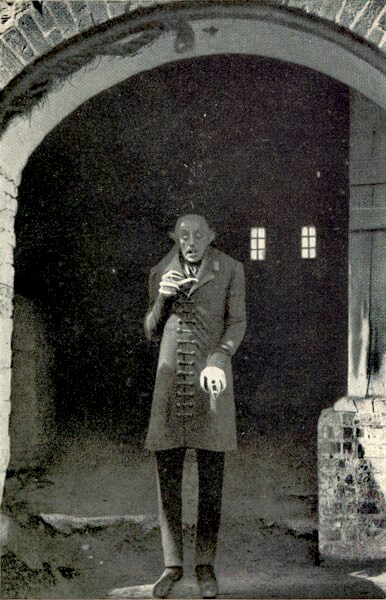
Famous scene from the 1922 film “Nosferatu”. The shadow is scarier than the actual monster (see below) because your imagination fills in the details.

Saw the movie House of Dracula on TV the other night.  It’s a 1945 Universal Monsters flick that contains three of their most popular monsters: Dracula (duh) the Wolf-Man, and Frankenstein’s monster.  It was fairly well-done for what it was.  John Carradine is great as Dracula.  Also, the film features the stereotypical hunch-backed assistant to the mad scientist, but for a change the character is female, and fairly attractive apart from the hunch-back. It’s an unusual role, and the actress, Jane Adams, does a pretty good job.

But what was especially notable about the movie was that it falls into the awful horror movie pitfall of trying to explain the source of the horror scientifically.  So, it turns out that Dracula has a blood disease, and that the Wolf-Man can be cured by brain surgery and some kind of weird fungus that the aforementioned scientist grows in his castle.

Folly!  I’ve blogged about this before: horror movies should not rationalize or explain the horror in any way.  When they do, it becomes less frightening.  They make this mistake all the time in horror movies.  It’s much better when the scientifically-inclined are skeptics and shown to be wrong, and the monster is an inexplicable violation of the laws of nature.   The intelligent, scientific  types being wrong is how you know you’re in trouble.

If you try to explain everything, it is less scary.  This applies not only to trying to give explanations for the monster’s origin or condition or whatever, but to every element in any scary story.  Just give people a few hints of the monster, and  let them piece together the rest, that’s what I say.

See what I mean?


I tried to read the first book of the Hunger Games series awhile back, and although I thought it was well-written and had a good setting, it was hard for me to get into it because it was fairly predictable.  I’m sure that’s partially because it was written for a younger audience, but I think it also is a just a little too cliche filled.  I’m not saying it’s bad.  It’s a decent book, but I pretty much knew where it was going from a very early point.  This is a problem I have with a lot of dystopian fiction–it all seems cut from the same cloth.

You know, I had an idea for a dystopian movie once.  It would be set at an undefined place and time, in a country where a totalitarian, fascist government had taken over.  The main character would be some kind of violent goon for the government who went around suppressing all dissenters.  And the whole film would present him as the hero–he’d be played by a “leading man”, the camera angles would present him heroically–the whole film would seemingly approve of the dystopian society.  Then, at the end, there would be some kind of title card or something telling the audience that this was a propaganda film approved by the fictional government, perhaps even detailing some of the techniques involved.

The point of this would be to pull the rug out from under the audience; see how many of them would have found themselves being subtly seduced into rooting for the main character–and the society he represents–by the film’s technique.  The “plot twist” would actually be a test to see how much people would start to buy into something awful because of good cinematography. Then they would have to re-evaluate what they had just watched.

The trouble is, this is more of a science experiment than an entertainment movie.  The trick of the movie is that usually, in dystopian stories, the protagonist begins to question his society, and through him, the audience is told about the society’s problems. (e.g. Winston Smith in 1984, Guy Montag in Fahrenheit 451)  There would be none of that in this movie.  He’d be 100% behind the society, and looking to maintain it.  It would be kind of like 1984 from O’Brien’s perspective.

The thing about my idea–and I’m not saying it’s a good idea–is that it plays with the tropes of the dystopian genre.  Dystopian stories give the audience some character they can turn to to see the dystopia’s flaws; or at least the “tone” of the piece, or the “voice” of the narrative give it away.  Here, there are no societal outcasts or anything like that for people to turn to. (The main character takes care of that.)  I thought this up largely from noticing that every dystopian story seems to rely on the same devices, and that makes them pretty predictable.

“And have you a pale blue dress on?” “Jane Eyre” illustration by F.H. Townsend. Via Wikipedia

So, it seems Jane Eyre is being re-written as a trashy romance novel.  Or should I say, a trashy romance novel for our time; as I believe the original Jane Eyre was a trashy romance novel by Victorian standards, as indeed are all books that are any good.  But times change, and audiences seem to go less and less for subtlety.

The author of the new version, Eve Sinclair, said:

I think that readers through the ages have appreciated the smouldering sexual chemistry between Jane and Rochester and I have changed very little of Bronte’s original to retell the timeless story of a young girl falling for an unattainable older man and getting out of her depth in a sensual world she cannot control.

Well… it seems like she would have had to change rather a lot of the story, since the plot hinges on Jane not wanting to, ah, “live as Rochester’s wife” without actually being Rochester’s wife.  And that only happens at the end of the book.  And if she didn’t change it much, then… what was the point of this again?

You know, I think this is the same problem I complain about in the horror genre: nothing gets left to the reader’s imagination anymore.

Check out this BuzzFeed article about a Scholastic Books series called Survive Anything!  The article claims that the books are “misogynistic” because there is an edition for boys and an edition for girls.  The boys’ edition teaches things like “How to Survive a Tornado”, “How to Survive a Broken Leg” and, perhaps least usefully, “How to Survive a T-Rex”. (Oughtn’t they at least teach how to survive time-travel first?)  The girls’ edition, on the other hand, teaches stuff like “How to survive a BFF Fight”, “How to Show You’re Sorry” and “Top Tips for Speechmaking”.

This, the writer at BuzzFeed says, is not right.  Why do girls get tips on emotional, domestic-type stuff when boys get tips on how to survive in the wild?

Well, I agree it’s not right, of course. But I don’t think it’s misogynistic.  It’s really just sexist. But if you must use a stronger term, it’s misandrist.  Surviving a tornado is a useful skill, although frankly, unless you already have tornado shelter built, it’s purely a matter of luck.  Most of the Indiana Jones-like scenarios the boys’ version seems to cover are situations that (a) probably will never happen and (b) would be decided mostly by chance if they did happen.

The girls edition teaches all sorts of things that might actually occur.  I’m a man, and I’ve never needed to know how to survive my parachute failing, but I have had to give speeches and say “I’m sorry” for things.  But these books merely assume that men would never be concerned with such things.  Well, enough of that prejudiced thinking, say I!  I resent the notion that we fellas are only good for feats of brute strength and endurance, and that the civilized arts of diplomacy are closed to us!

Last week in Scotland, there was an academic conference on the Harry Potter series. The Guardian reports:

Billed as the world’s first conference to discuss Harry Potter strictly as a literary text [as opposed to what?–MM], almost 50 lectures are lined up, with academics taking on issues including paganism, magic and the influence on Rowling of CS Lewis, JRR Tolkien and Shakespeare. Seminar titles range from “Moral development through Harry Potter in a post-9/11 world”  to “Harry Potter and Lockean civil disobedience”.

The article goes on to quote Prof. John Mullan of University College London as saying: “[The participants] should be reading Milton and Tristram Shandy: that’s what they’re paid to do.”

Well, I’m sure the world will manage to struggle on despite some professors not reading their Milton and Tristram Shandy for a few days. Somehow, I don’t think those works will change much over that time frame, so I don’t think there’s a lot of urgency.

It is not that literary analysis is a useless pursuit–I have often engaged in a bit of it myself, in my amateurish way–it is just the rather odd, almost arbitrary mechanism by which things are deemed worthy of it (or not) that annoys people.

Why shouldn’t our friendly neighborhood professors spend a little time reading the adventures of Harry Potter, in lieu of another go-round with Paradise Lost? Is it because they are not as good as the works of Milton? Perhaps they are not. But how can you claim that, without first having subjected them to the same scrutiny that has been applied to Milton’s work? They could give their profession a much greater reputation for academic rigor if they did that, I think. Prof. Mullan’s idea is somewhat akin to astronomers continually proving to this day that the Earth does in fact orbit the Sun, and smacking down any loose talk about this “Sloan Great Wall“.

Not that Potter is as good as the classic Great Works–it isn’t, in my opinion, but who is to say that they won’t one day come along with something that is better than those old books? It could happen, you know, but academia won’t find out about it unless they analyze them. And even if they never actually do get surpassed, you don’t need to keep reading and writing about them over and over to be sure.

This conference is, nevertheless, a bit ridiculous. I know I sound like a Tea Partier saying this, but there is a vague touch of elitism about the whole thing: “We are academics! We can discuss this book series better than you (dare I say it?) ‘muggles’ can.”

I don’t mean to imply it isn’t worth doing, because they’re professional critics. The ridiculousness of the situation derives less from the fact that they’re discussing Harry Potter and more from the fact that academic literary criticism in general is fairly ridiculous. It is for this reason that so many people think the entire profession is useless and stupid, when in fact it is only that they are using the wrong techniques. And the reason they are using the wrong techniques, I suspect, is that they are mostly analyzing old texts, and consequently have to reach further and further for new topics that haven’t been addressed before. There are only so many ways you can say “Hamlet is really quite interesting.”

Unfortunately, the techniques honed by critics for doing this are the only tools available to those critics who would write about something slightly newer such as Harry Potter. To paraphrase Oscar Wilde’s assessment of the United States: “critical analysis of Harry Potter went from barbarism to decadence without civilization in between.” (There was, I am sure, a “Golden Age” of Shakespeare analysis. It was probably in the 1700s.)

I don’t really know why it’s such a big deal, all told.  Amateurs on fan sites were analyzing the Harry Potter books well before this and will continue to do so. Academics may join in if they like, or not. It doesn’t much matter.

I’ve been reading a curious book called As Told at The Explorers Club. It’s a collection of stories mainly having to do with exploration and adventure, but frankly the types of stories are pretty varied. There’s one fairly cute one about the discovery of the coelacanth, but it’s not really an “adventure.” In the introduction, editor George Plimpton claims they are all “true-life” stories. Sometimes this seems very hard to believe, but who knows.

But for me, the most remarkable story I’ve read so far is one entitled “Arctic Ghost”, by Felix Riesenberg. It’s almost indescribable–the writing is so vivid, mystical and powerful, and the subject matter so bizarre, I am forced to assume it is at least a bit embellished. But what a story! It is an eerie tale that I doubt Poe or even Lovecraft himself could have dreamed up. The atmosphere of the tale is amazing.

I have tried to find out more about this Riesenberg guy and this story, but so far I haven’t found much. I have decided that, since he was apparently an arctic explorer, he should have signed his name as “F. Riesenberg”–pronounced “freezin’ berg”.

Sorry about that. I don’t know what came over me.

Slate has an article about a guy named Neal Stephenson calling for more Utopian, less Dystopian, science-fiction. The idea is that people need to be more optimistic about the future in order to be motivated to invent things.

I’ll comment on that anon, but first a language lesson. Quoth Wikipedia:

The word [Utopia] comes from the Greek: οὐ (“not”) and τόπος (“place”) and means “no place”. The English homophone eutopia, derived from the Greek εὖ (“good” or “well”) and τόπος (“place”), means “good place”. This, due to the identical pronunciation of “utopia” and “eutopia”, gives rise to a double meaning.

So, when Sir Thomas More wrote Utopia, he was making a sort of pun in the title. Now you know. And “dys” is apparently Greek for “bad”, so when they say that, they’re really dyssing something. (Sorry.) I like these double-meanings, but people have kind of forgotten about that nuance. (It’s like the subtleties of language are being lost. Someone should write a dystopian novel about that.)

The problem is that most Utopian fiction is boring. There’s nothing interesting about a place where there are no problems. (Which is, in a sense, a problem. Someone should write a dystopian novel about that, too.) Even worse, it comes across as somebody preaching to you about what they think society ought to be like. I have enough of that as it is.

Also, would-be inventors can be forgiven for fearing that even their most brilliant efforts will be all to the bad. May I present Alfred Nobel and Robert Oppenheimer?

The only way to make an interesting Utopian story that I can see is to have some external threat appear in the Utopia, and destroy it. It’s best if the threat is from the present-day of the writer of the story. (This is kind of the plot of Gilbert and Sullivan’s Utopia, Limited, in which a bunch of Englishmen show up and ruin a Utopian island.) And even this is pretty heavy-handed as a satirical technique.

I keep hearing the words “Hunger Games” being bandied about. I see signs with the words “Hunger Games” plastered on them. People keep making references to “the Hunger Games”. I believe there is even a blog on the front page of WordPress that has something to do with the “Hunger Games” on it. I never really paid enough attention to figure out what they were about or why I should care.

And then I read Thingy talking about “The Hunger Games” on her blog, and so I decided it was time to find out about them. I whisked myself to Wikipedia forthwith, and commenced to read. So, The Hunger Games is a series of books for young adults, which, like all YA books nowadays, has been adapted into a movie, which comes out tomorrow.

I have to admit, just reading the synopsis made me a little bored. “Post-apocalyptic America…dystopian totalitarian government… sacrifices by lottery…” It all seemed tired to me. As Thingy noted, the “deadly lottery” aspect of the story sounds a lot like “The Lottery” by Shirley Jackson. (Full disclosure: I only know about that story because it’s the model for Vault 11 in Fallout: New Vegas… another post-apocalyptic tale.)

But then,as Zaphodb2002 commented on this post: “It is more about how the story is told, not necessarily what the story is about.” So, just because it’s got a lot of familiar trappings doesn’t mean it’s not an interesting book. I’m willing to give it the benefit of the doubt.

I wonder why the post-apocalyptic idea is so popular. I guess because it gives the author a “clean slate” to build the kind of world s/he wants. And maybe because it lets you show familiar settings in a state of destruction, and that’s pretty dramatic. But it certainly seems like the post-apocalyptic genre is popular with audiences these days. I wonder why.

I’m not an expert on the genre, but I don’t think it was always thus. It seems to me that fiction that dealt with “the end of the world as we know it” used to be just plain apocalyptic–e.g. Dr. Strangelove, where the end of the movie is the nuclear annihilation. I wonder what the change signifies.

And another thing: is it true that one of two things almost always happens with the post-apocalypse: either there is no government, no law and order, and humanity is reduced to fighting gang-warfare style, or else there is a tyrannical, all-powerful government controlling the wasteland. Or is that just my impression?

As long as we’re on the subject, how is this related to another phenomenon both Thingy and Ferrerman have addressed lately: “preppers”? That is, people preparing for what they believe to be the imminent apocalypse. Are they fans of post-apocalyptic fiction? If so, since they all seem to be going the “gang warfare” camp, where’s the sign-up sheet for the “tyrannical government” camp? I bet the first 50 people in get cushy positions in the Thought Police or something.

Anyway… how depressing. Perhaps Tom Lehrer can make us feel better:

Joe Queenan in The Wall Street Journal has a good article entitled “Why Italian Moms Are the Best”. It’s about this ridiculous fad, started by Amy Chua, of books claiming what groups produce the best mothers.  The article does a pretty good job pointing out the absurdities of it all, even if it does sort of engage in them at the same time.

I’m getting pretty tired of this stuff myself. It’s a stupid concept. Logically, if one group consistently produced the best mothers, it would also consistently produce the best sons and daughters, and therefore be immediately and obviously superior to all the others. That this is not the case shows that the different groups each have their advantages and disadvantages. Everyone already knew that. This is just a way to sell books by giving them provocative titles about a subject people are sensitive about.

A friend of mine told me about this book not too long ago, and then I read that Thingy had enjoyed Selznick’s book Wonderstruck, but since Hugo Cabret was written first, I thought I’d check it out first.

The book is quite interesting in that it makes use of illustrations to tell the story. By that I mean not simply that it illustrates scenes from the text, but rather that it alternates telling the story in text, then in pictures, then back to text again. This quality makes it hard for me to discuss the actual story in this review, since it’s hard to describe it without including all the pictures. Besides, I wouldn’t want to spoil it for you. So, my review focuses mostly upon the book’s style rather than its story.

I will say, however, that the story is quite cute–it’s intended for children, so perhaps there were times when certain plot elements were obvious to me, but the intended audience would not have seen them coming. But it’s still a very good little tale even without the innovative method of telling.

This method, however, is definitely the book’s big selling point, and with good reason. Selznick’s pictures call to mind a storyboard, and with good reason, given the subject of the story. Moreover, the alternation of pictures and text gives a “pace” to the flow of the story that would be quite unachievable otherwise.

It’s not always perfect–there were a few scenes where I felt the illustrations were unnecessary, and a few where I couldn’t make out what I was looking at very easily, which is a problem when the picture is integral to the story. But even so, when it works, it works very well. There are times when the pictures flow together like a 1930s-style animation–a quality which, again, is highly relevant to the story, for reasons which I will let you discover.

I think Selznick’s style is very clever, and may indeed be put to even more ambitious use than it is in Hugo Cabret. For some reason–perhaps simply the Parisian setting the two stories share–I thought it would be interesting to see H.P. Lovecraft’s The Music of Erich Zann adapted in this style. Selznick’s illustrations have a mysterious and otherworldly quality that would lend itself well to a horror story, even though Hugo Cabret is certainly not that.

At any rate, it’s an innovative book. I encourage you to check it out.