What can I say about Shatzer’s works that I haven’t said already? Well, at a minimum, he’s prolific. This is the fifth book of his that I’ve reviewed this year, and it contains all the elements I’ve come to enjoy in his work: zany magical mishaps, oddball characters, and usually at least one book-within-a-book.
Actually, The Cowboy Sorcerer itself started out as a book-within-a-book. The title is referenced in Shatzer’s Sorcerers Wanted. In my review of that volume, I desperately wished that it was a real book, and now ta-da! It is. Sometimes wishes do come true. Noah Goats said that books lead on to books, and that certainly is the case with Shatzer’s rapidly-expanding oeuvre.
The Cowboy Sorcerer is in some ways an echo of some of Shatzer’s other great characters. There’s more than a little of Ebbius from The Beach Wizard in the stoic sorcerer who arrives in the town of Destiny’s Crack, searching for a vampire. The way Shatzer riffs on these concepts in different ways throughout his books is one of the pleasures of reading his work. He’s like Wodehouse in that respect; similar situations and characters recur, but we never get tired of reading about them, because of the light and entertaining way he tells the story.
If you’ve already been reading Shatzer, then you probably already picked this book up the second you saw it existed, and don’t need any further convincing. But if you are new to his books, then this is as good an introduction as any.
Last week’s review was of a techno-thriller video game tie-in novel. This week’s review is of a techno-thriller video game tie-in novel. By thunder, I hope I’m not turning into one of those people who only reads one type of book. Hopefully, this review will prove interesting enough to justify it.
I should tell you up front: this is going to be long. Brace yourselves accordingly. I’m going Full Berthold on this one.
First, we need a bit of grounding in the universe of Metal Gear, which I’m guessing most of my readers have never heard of, and it may strike the uninitiated as a bit weird. So let me provide some background: as the “2” in the title suggests, this story is a sequel. The original Metal Gear Solid is about a commando named Solid Snake, who infiltrates a military installation in Alaska called Shadow Moses Island, where an elite terrorist unit has taken hostages and captured a huge walking battle tank equipped with nuclear missiles called “Metal Gear Rex.”
Well, long story short, Solid Snake ultimately defeats the terrorists, led by his cloned twin brother Liquid Snake, and destroys Metal Gear Rex. This summary doesn’t even begin to do the story justice, but a proper synopsis would take forever, and it’s not even what we’re discussing today. By the way, here’s your warning that I’m going to spoil MGS 2 in this review. The game came out in 2001, so I feel comfortable discussing every aspect of the plot.
Sons of Liberty begins with Solid Snake infiltrating a huge tanker on the Hudson River, in search of a new Metal Gear prototype. He’s assisted by Hal “Otacon” Emmerich, a scientist who worked on the original Metal Gear, whom Snake rescued during the events of MGS 1.
In short order, the tanker is seized by Russian commandoes, working with Revolver Ocelot, the lone terrorist to survive Shadow Moses. In what has become a hallmark of this series, complicated betrayals occur in rapid succession, and the tanker is sunk to the bottom of the river, seemingly with Snake aboard.
Two years later, a huge cleanup facility called “The Big Shell” has been created on the site to contain the environmental disaster. And–are you sensing a pattern here?–it’s been captured by a terrorist unit called “Dead Cell,” which has taken hostages, including the President of the United States, and is threatening to detonate a nuclear device. A new operative from Snake’s unit FOXHOUND, codenamed “Raiden,” is sent to defeat the terrorists and rescue the president.
I remember when this game came out, even though I didn’t play it, that this was a huge controversy. Fans were outraged that they were playing as the androgynous, awkward rookie Raiden instead of the grizzled, tough, high-testosterone action hero Solid Snake. Even reading the story in novel form, it’s still jarring to go from the stoic confidence of Snake to the amateurish bravado of Raiden. (By the way, the pronunciation of “Raiden” rhymes with the name of the 46th President of the United States, and not with “maiden” as I initially thought.)
Raiden is guided on his mission through communications with his commanding officer, a Colonel, and, bizarrely, Raiden’s girlfriend Rose, who insists on calling him “Jack.” This is also in keeping with MGS 1, where Snake was guided by a number of officers and intelligence analysts. But whereas they formed a coherent unit, the dynamic with Raiden, the Colonel, and Rose just feels… odd.
Speaking of odd things, the Dead Cell terrorists make the villains from the 1960s Batman series seem subtle and understated. They include a woman named Fortune, who is apparently immortal and only wishes to die, an obese explosives expert called… wait for it… “Fatman,” who wants to become notorious as the maddest bomber in history, and finally, an actual vampire.
While things are initially presented as realistic, and as in a Tom Clancy novel, great care is taken to ensure that the weapons and other military technologies feel authentic, the whole Big Shell is teeming with the surreal and the bizarre. It doesn’t take long for Raiden to start feeling like he’s living in a waking nightmare.
Adding to the strangeness, Snake and Otacon also show up to help him, despite the fact that Raiden has been told Snake is either (a) dead or (b) the leader of the terrorist group. This is a running theme in the story: everyone is lying all the time. Raiden is constantly being deceived by every person he talks to. Poor guy; at some point you have to feel sorry for him.
Remember when I said the universe of Metal Gear may strike you as weird? Guess what, ladies and gents: I haven’t gotten to the weird part yet!
Raiden eventually finds the President, who explains that the Big Shell is camouflage for a new Metal Gear, codenamed Arsenal Gear, being built under the water. POTUS had been hoping to seize control of Arsenal for himself, to use it as leverage against a group known as [ominous music plays] “The Patriots.”
Raiden asks who the Patriots are, and the President explains:
“The power controlling this country… Politics, the military, the economy – they control it all. They even choose who becomes President…
The Space Defense, income tax reduction and the National Missile Defense (NMD) programs -– every policy that’s been credited to me was actually done according to their instructions.”
“Wait a second. Space Defense was initiated by Congress!”
“That’s what the Patriots want the country to believe… It’s all a show. ‘Democracy’ is just a filler for textbooks!”
The President then outlines the Patriots’ intentions for Arsenal Gear:
“Arsenal Gear is more than just a military tool. It is a means to preserve the world as it is… The Arsenal plans include a system to digitally manage the flow of information, making it possible to shape the ‘truth’ for their own purposes. In short, the Arsenal system is the key to their supremacy.”
“The key?”
“Yes, the ‘GW’ system. Short for George Washington. GW is the Patriots’ trump card… once operational, it will be a completely new form of power for the Patriots to wield.”
The President explains he was going to bargain with the Patriots, but he was overruled by his predecessor, who is now the leader of the terrorists and is also yet another clone of the Snake brothers: this one named Solidus Snake, and he intends to seize Arsenal for himself and defeat the Patriots.
The President tells Raiden to find Emma Emmerich, Otacon’s sister, who is somewhere in the Big Shell, and who has created a computer virus that can destroy the GW system. Then he gets killed by Revolver Ocelot, leaving Raiden more befuddled than before.
Anyway, Raiden works with Solid Snake (not Solidus, who is seemingly the bad guy, remember) and eventually they find Emma and upload the virus. Unfortunately, at that point Raiden gets abandoned by Snake and a mysterious cyborg ninja, and captured by the terrorists.
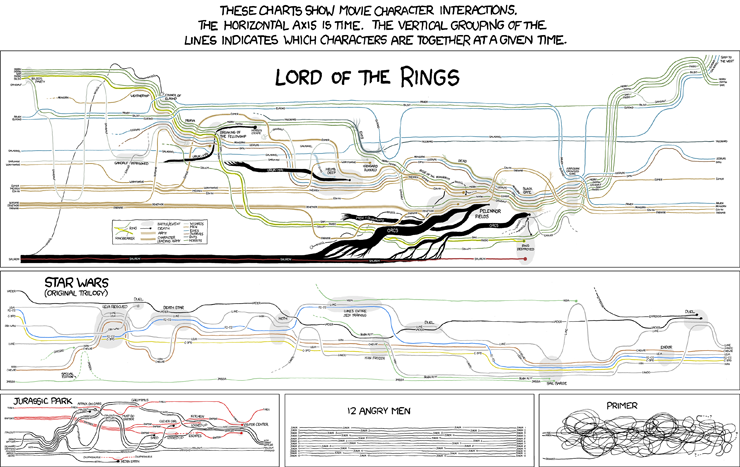
I feel like I need to pause to catch my breath. I bet you do, too. You know, there’s an old webcomic that graphically shows the narrative structure of famous movies. You can see it here. Some of these are pretty involved, but can you even imagine what a graph like this for Metal Gear would look like? I’m not sure two dimensions is sufficient to render it. And let me be clear, I’m giving you just the bare-bones outline here. MGS is famous for deep dives into the backstories of even secondary characters. There are a couple in this one, Peter Stillman and Olga Gurlukovich, whom I haven’t even discussed but who are actually some of the most interesting people in the story.
By the way, this is where I should probably mention that, although the novel I’m reviewing here is by Raymond Benson, who is a respected author of spy thrillers, including some James Bond books, the fact is he largely just transcribed the dialogue and added some minimal description. When it comes to the labyrinthine plot of this thing, “one man deserves the credit, one man deserves the blame,” and Hideo Kojima is his name.
Kojima is, in my opinion, the ideal person to write techno-thrillers. He’s clearly obsessed with American action movies, references to which abound throughout his games, but at the same time he brings a very different perspective to the topic of American military technology, being as how he’s Japanese.
All right, have you got your second wind? Good, because it’s time to delve into the last act of Metal Gear Solid 2, and it is not merely a doozy, but, if I may be so bold, a real humdinger. The disturbing personal revelations and insane plot twists come thick and fast at this point.
Raiden is freed from a torture chamber that mimics a facility where Solid Snake was captured in MGS 1. Then he learns that the entire operation has been designed by the Patriots to replicate the Shadow Moses incident, in order to demonstrate that with proper psychological conditioning, anyone can be molded into a tough-as-nails super-soldier like Solid Snake. Not only that, but it is also revealed that Raiden was once a child soldier in an army under Solidus Snake’s command, although he repressed the memories.
(Say what you want about Solidus, but the guy has quite a CV: from fighting a civil war in Liberia to leading a terrorist organization, with a brief stint as U.S. President in between.)
Finally, Raiden discovers that the Colonel and Rose, with whom he’s been communicating throughout the mission, are actually merely AI constructs, generated from his own memories and expectations via the GW system. And since the system is now infected with a computer virus, the AI is beginning to talk nonsense to him, as in this (in)famous message from the Colonel:
I hear it’s amazing when the famous purple stuffed worm in flap-jaw space with the tuning fork does a raw blink on Hara-Kiri Rock. I need scissors! 61!
Has anybody gotten ChatGPT to say this yet?
But, there’s no time for Raiden to grapple with all this now, because Solidus Snake and Ocelot are busy betraying each other while raising the Arsenal Gear from beneath the water and crashing it into downtown Manhattan. The book diverges a little from the game here: there’s no animation of the huge fortress crashing into the skyline in-game, because it was cut at the last minute. Remember, this came out in late 2001, so I bet you can guess why. But Benson does give a little description of the horror and devastation.
Of course, Raiden and Solidus are both still alive and standing in the wreckage. Solidus explains that he has done all this to try and liberate humanity from the digital censorship regime the Patriots are about to impose. And then Raiden gets another call from the Colonel and Rose.
This is the moment that made me decide I had to review this book. Not for nothing has this scene been called by some “the most profound moment in gaming history.” And for this reason, I’m going to ask that you watch the clip as it appears in the game. I don’t consider this “cheating,” because all this dialogue appears verbatim in the book, but I do feel the voice acting and sound effects add something here. This is quite simply required viewing. I promise, it’s worth thirteen minutes of your time:
In 2001, most of the buzz around MGS 2 was the outrage about Raiden replacing Snake. And if it wasn’t that, it was that the story was too damned strange and bizarre. I mean, I glossed over some of the weirder stuff, like a guy who is possessed by a dead man because he had an arm transplant from him, or the really creepy incestuous backstory involving Otacon and Emma. And did I mention the vampire also does flamenco dancing?
And so this moment at the climax, about AI controlling the flow of digital information to manipulate human thought, just seemed like yet more incomprehensible techno-babble in 2001.
But as the years have turned into decades and life has gone on in these United States, people have started to reevaluate this scene. Some of these lines, as they say, “hit different” now:
“Trivial information is accumulating every second, preserved in all its triteness… all this junk data, preserved in an unfiltered state, growing at an alarming rate.”
And even more pointedly:
“The untested truths, spun by different interests, continue to churn and accumulate in the sandbox of political correctness and value systems. Everyone withdraws into their own small gated communities, afraid of a larger forum. They stay inside their little ponds, leaking whatever truth suits them into the growing cesspool of society at large. The different cardinal truths neither clash nor mesh. No one is invalidated, but nobody is right.”
To say nothing of the suggestion of inhuman intelligences gradually gaining control of society. Of all the fascinating lines in this dialogue, the one that intrigues me most is probably the one at the beginning:
“To begin with, we’re not what you’d call ‘human.’ Over the past two hundred years, a kind of consciousness formed layer by layer in the crucible of the White House. It’s not unlike the way life started in the oceans four billion years ago.”
Okay, hold up. In-universe, the events of Metal Gear Solid 2 were supposed to take place in 2009. Two hundred years before that puts us in the Madison administration. I don’t think even Kojima is prepared to claim there were AI supercomputers then, so what does this line mean?
Well, if you think about it, a government is actually a bit like an artificial intelligence. It is a series of processes, aimed at administering a population. Theoretically speaking, government as a process could be carried on with no independent thought at all, merely the “correct” application of laws and rules.
But when you put it that way, doesn’t it all sound rather inhuman? Well, there’s a reason Thomas Hobbes named his famous book on government after a legendary sea monster. Even before the computer age, there was a recognition that “the State” was something different than just a bunch of folks getting together to talk.
“The Colonel” then elaborates:
“We are formless. We are the very discipline and morality that Americans invoke so often. How can anyone hope to eliminate us? As long as this nation exists, so will we.”
“This description was similar to the Japanese philosophical concept of kokutai or civic soul, which is derived from the mytho-political past of Japan, in which the Japanese emperor is held to be a direct genetic descendant of the sun goddess Amaretsu. This living presence of the soul of a nation has no precise analogue in Western culture, the closest match in American political language being ‘patriotic spirit’.”
Perhaps. But I think we’re all familiar with the idea of a national soul, a figure embodying the fabric of the country. What are Uncle Sam or John Bull, if not the soul of their respective nations? Does it matter that these characters don’t actually exist? In a way, if everyone believes in them, or rather what they represent, don’t they kind of exist? Then again, isn’t that pretty much what O’Brien tells Winston regarding Big Brother at the end of Nineteen Eighty-Four? Hm.
See, there is certainly a lot to take in here. I mean to say, game dialogue came a long way since “our princess is in another castle,” what?
Inevitably, it all leads to a final fight with Solidus, which Raiden wins, and then Solid Snake gives a schmaltzy speech about how you are what you choose to be, your decisions make you who you are, and so on. I admit, everything after the last chat with the Colonel seems perfunctory to me.
Then again, how could it be otherwise? There are whole books’ worth of ideas in that scene. (If you want to read one, I recommend The Meme Machine, by Susan Blackmore. And if you want a deep dive into Metal Gear Solid 2, I recommend this video.)
As a final note, I want to say I’m glad they did this novelization, because the story on its own is interesting enough to be worthwhile for non-gamers. In fact, I’d argue it’s a better story than it is a game. I actually own a copy of the special edition, Metal Gear Solid 2: Substance, which I got for ninety-nine cents at a used game store that has since been demolished. I’ve never been able to make it very far in the game.
Well, that’s that. If you want a mind-bending techno-thriller, see if you can get yourself a copy of this. If it all just made your head hurt, well, I can understand that, too. In any case…“sayonara, kid! Have a nice day.”
This book is a neo-noir mystery. In terms of plot, it’s a fairly straightforward yarn about a detective who is tasked with tracking a mysterious femme fatale. Along the way, he delves into a depraved criminal underworld, is forced to flout the normal rules of police procedure at risk to his own career, and ultimately finds his own and his family’s lives threatened.
I guess this all sounds pretty standard for a detective mystery, doesn’t it? Well, I deliberately phrased it so. But I guarantee you, this is like no other detective story you’ve ever read.
It’s set in the distant future, when everything can be copied; the matter rearranged. This includes human beings. It’s not at all unusual for a person to die, and a new copy to be “instantiated” from the data stored in some central insurance system. Cosmetic alterations of all sorts can be performed instantaneously and at will.
This is in addition to the extreme nature of virtual reality programs, which can simulate anything anyone desires, creating a completely immersive experience.
In this world, the nature of reality itself starts to get fuzzy, and indeed, in the early part of the book it was hard for me to even conceptualize what was going on. Such a universe feels so bizarre it becomes difficult to ground oneself in anything relatable.
And yet… in a way it was relatable. At least to me, a terminally-online millennial, who grew up with the internet and video games. The logic of Demiurge is the logic of the 21st century media infotainment complex, carried to its natural conclusion. (It’s important to note here that the first edition was written in the year 2000.)
That was the really haunting thing about this book for me. There are sentences describing the most fantastic and mind-bindingly weird concepts, followed by sentences that feel like they could be describing the world we live in now. The overall effect is… disturbing.
Actually, many things about this book are disturbing. The femme fatale that our hero is tracking leads her admirers… clients… victims… whatever you want to call them… into a world of strange and unsettling perversity. I don’t want to spoil too much, but let’s just say that it wouldn’t be a stretch to say this book contains psychosexual horror elements.
The really chilling aspect of it is, for every unsavory thought and act referenced in the pages of Demiurge, the text seems to implicitly ask, “Could you imagine this would happen, if technology permitted?” And in every case, I could. This is no lurid penny-dreadful; making up horrible things for shock value. No, far more subtle than that… it is a window into the collective id of the age of Techno-Decadence.
Every chapter begins with epigraphs from various texts, some real, some fictional, and all related to the themes of identity, reality, and the nature of the human mind. The book would be worth reading for these passages alone, which contain brain-twisting ideas and downright eerie visions of the cyberpunk nightmare that waits for us in this imagined future.
As I approached the climax of the book, I was worried the story would, like so many noir tales, sink too deep into its own exquisitely thick atmosphere of nihilism. This can happen easily in this sort of story, when the sheer crushing weight of all the grimdark overwhelms everything else.
But no, thankfully that didn’t happen. Pacotti was able to stick the landing, and in the final chapters, he ties things up well, and in so doing, provides a character who is, I think, the perfect hero for the age of social media. It’s rare in modern storytelling to have the main character give a speech un-ironically defending his actions and his values. But then, noir detectives are rare in modern storytelling too; and that’s what makes the final chapters of Demiurge feel like coming home. After a mind-breaking, head-spinning dive into the darkest depths of humanity and technology, we come up for air and have something familiar, at last, to grab hold of.
Maddening, disturbing, terrifying, confusing, prophetic, and not without rays of hope and real emotion; Demiurge is a metaphysical magnum opus for our time.
Zachary Shatzer recommended this book to me. He called it the funniest book he’s ever read. Well, when the author of some of the most gut-bustingly laugh-out-loud funny books around says something like that, you pay attention, no? So naturally, I had to get myself a copy.
It lived up to Shatzer’s billing. Indeed, the style of humor is much the same as his, though maybe a bit darker and raunchier, skewing more towards a hard PG-13. Still the dominant feeling is one of utter absurdity. Begin with the title: “the stench of Honolulu”. Since when does Honolulu have a stench? Well, in this book, Honolulu is depicted as a horrible place, decrepit and filthy.
Of course, the narrator is far from reliable. A strange, cowardly, narcissistic and paranoid individual, he is forced to accompany his “friend”–using the term loosely–on a quest to find a golden monkey statue said to be in the Hawaiian islands.
The book continues in this vein, with each escapade more bizarre than the last, including recurring violent yet inexplicably non-lethal encounters with a scientist who our narrator decides is evil. This is one of many running gags that just get funnier as the story goes on.
I could go on and on describing all the madcap episodes that form the bizarre journey, but honestly, you’re better off just reading the book. The hardest thing about reviewing a comedy, I find, is that it’s really impossible to explain why something is funny. You either get it or you don’t. Some people won’t get this, either, and that’s okay. But those who do get it are in for a zany and weird and hilarious ride. I’m very grateful to Mr. Shatzer for the recommendation.
The Matrioshka Divide is a throwback to the Golden Age of science fiction, in the tradition of Heinlein and Asimov, where advanced spacefaring technology is used to explore political and philosophical ideas.
The main character is Samir Singh, a retired starship captain known as “the Butcher of Three Systems” for his actions during war. He is persuaded to come out of retirement to serve as captain on a vessel tracking down a signal from a derelict ship on the edge of galaxy. Captain Singh reluctantly accepts the mission, seeing it as a chance to redeem himself for his past.
As it happens, the old war veteran on a quest for redemption is one of my favorite sci-fi tropes, mostly because it is the main theme of my belovedKotOR II, and so I immediately became interested in Singh.
Then there is Erika Terese, the arrogant scientist convinced that her models tell her everything about how the universe works, and how to respond even to encountering new forms of intelligence. She believes everything can be measured, quantified, and understood with mathematical precision. She and the religious Captain Singh clash frequently.
Then there is Miles Kieth, the cynical pilot, who couldn’t care less about politics or religion, and is just out for his own sake. Or is he? Naturally, there ends up being more to the man than meets the eye.
And then we have Amos Singh, a descendant of Captain Singh (prolonged lifetimes allow for more distant relatives to survive contemporaneously with their ancestors), who wants to succeed to clear the family name and right the wrongs committed by the man who commands him.
Finally, there is Glen Tannis, the Machiavellian operative of the Free Exchange, the powerful shadow government that controls and manipulates all of human society. I love sinister organizations like this, reminiscent of the Bene Gesserit in Dune or the Timermen in Fitzpatrick’s War.
The book takes this cast of characters and throws them into an extreme situation, encountering incomprehensible aliens on the edge of the galaxy. But the aliens are really just there as a catalyst for the different characters to spar over their philosophical differences.
The concept of a crew on an isolated ship, in high-pressure situations and all distrustful of one another, is another trope that I love. It reminded me of Frank Herbert’s The Dragon in the Sea. The characters clash repeatedly over their moral and philosophical beliefs, with allegiances changing frequently as their circumstances become more dire.
That said, I don’t mean to suggest the conflicts are purely philosophical. This is sci-fi after all, so there are plenty of space battles and shootouts too. The balance of spacefaring adventure and intellectual exercise that is one of the hallmarks of classic sci-fi is here.
The simplest way I can put it is, if you enjoyed my book The Directorate, with its blend of space battles and political machinations, you’ll probably enjoy this one as well. I could say more about the plot and the ending, but given that this book is relatively new, I don’t want to spoil anything for those encountering it for the first time. Sci-fi fans should definitely give it a try.
This is an amazing book, I’ll just say it right up front. It’s a clever blend; part fable, part post-apocalypse, part fantasy, it tells the story of Anastasia, a rabbit who is un-warrened–that is exiled from her home–and left to be “Glorified” by the “Blessed Ones”. Which is the way the rabbit religion describes being killed by predators. The rabbit religion is a pacifistic one, which views a rabbit’s purpose in the world as food for larger animals.
But Anastasia decides to fight back. After a chance encounter with a fox ends with her stabbing it with a sharp stick, she realizes that perhaps rabbits need not be helpless prey animals. And as her legend begins to grow, more rabbits, mice, and other animals flock to her side, slowly building a coalition that fights back against the foxes, coyotes, and wolves.
The world-building is phenomenal. The reason why there are no humans in this world is explained gradually, through little hints glimpsed once in a while through the eyes of animals. The rabbits study the writings of the “Dead Gods,” as a way of understanding the world, largely through scholars known as Readers and Rememberers. They also interpret the meaning of the rabbit scriptures, which include the word of the supreme being “Dah,” and indeed, one part of the plot hinges on the interpretation of a particular passage.
This is what I loved best about the book: the philosophical issues it explores. Nature vs. technology, the right of self-defense, and the ethics of killing are all explored in great detail here, and don’t think for a moment that because the characters are woodland creatures the philosophy loses any of its punch. In the grand tradition of Aesop, St. John has used non-human characters to explore big questions of meaning and morality.
But at the same time, the characters never feel like mere puppets. They are all carefully crafted and engaging. I especially enjoyed Wendy, the floppy-eared and savage rabbit heretic, and Bricabrac, the cunning rat who helps the bunnies forge their arsenal.
I know, some of you are like, “A book about talking animals? Heck no!” But… I encourage you to give it a chance. As of this writing, it’s free, so you’ve got nothing to lose. And what awaits you is a book that makes you think about old ideas in new ways.
Finally, I rarely do this, but I’m just gonna say it: I got this book after I saw an ad on Goodreads and thought “That looks like something Lydia Schoch might like.” But of course, I had to read it first to make sure, before I recommended it to her. Having read it, I feel even more strongly she’d like it.
Another excellent Brad and Karen thriller. In this one, a case of academic misconduct escalates to murder and corruption. As always, Cooper does a great job using the political machinations of academia as a starting point to weave a tale of deception and crime.
If you’ve read previous books in the series, you already are familiar with the dynamic between Brad and Karen, and together they once again form an effective crime-solving partnership. I don’t want spoil anything here, but I think the ending of this one is my favorite in the series. (So far.)
I’ve been reading some traditionally-published thrillers by big name authors lately, and I have to say, many of them have over-the-top, superhero-like characters, which makes them hard to relate to. I prefer a book like this, where the characters are people you would like to meet in real life. That’s the big draw of the Brad and Karen books for me; I just like these two, and they make for pleasant company while venturing into the darker side of the academy.
Weird westerns are so cool, don’t you think? Well, I think so. Cowboys and six shooters and ghosts and horses and vampires and steam engines… yes, there’s something about the marriage of the American southwest and supernatural beings that just produces some very interesting offspring.
Speaking of interesting offspring, that’s what the titular character of this book is. A young woman named Mary Anne O’Sullivan had a child with a supernatural being, and this child was then spirited away by a mysterious witch. Anne’s husband sought the child, but… well, that’s how she became a widow.
Not to be deterred, she asks Zarahemla Two Crows, a Federal lawman who specializes in the occult, to track down her son. But, despite the Marshal’s reservations, she insists on accompanying him. And so, this unlikely duo sets off across a haunted land of vampires, witches, zombies, giant mechanical golem cavalry, and a whole host of interesting characters.
I feel like I don’t need to say any more, and already, you should be hooked. But, just in case you’re not, let me say a little more. I loved this book. The pacing, the characters, the atmosphere; all of it is great. Anne is my favorite character, and I enjoyed seeing her growth over the course of the story. Like Zarahemla himself, we watch her transform from being merely a “confounded woman” into a confident, capable, and relatable character.
One thing I should mention is that the story is chock full of Catholic motifs. Faith is a major theme that informs the characters. This might give some readers pause, but I want to emphasize that this isn’t done in the preachy way that you get in some religious fiction. Rather, the discussions about faith feel like a natural part of the characters’ evolution.
There are also plenty of cool action sequences; big battles, with infantry, airships, and especially those great steampunk cavalry golems I mentioned earlier. How can you not want to read a book that has a scene with zombies attacking a huge spider-tank?
In summary, I really, really enjoyed this novel. It was everything I hoped it would be and then some. If you like westerns at all, and especially weird westerns, you’ve got to check it out.
Oh… and one last thing. There are a number of sly cultural references sprinkled throughout the book. At first, I wasn’t sure if that’s really what these were, or if I was just imagining things. I won’t spoil them for you, but after I read a description of a certain weapon devised in Antioch, I was sure I knew what was going on. These are fun little Easter eggs to discover as you read.
This is a mystery about a detective tracking down a clown who is scheduled to perform at a local boy’s birthday party. The clown, who is also the boy’s uncle, has suddenly vanished with no explanation, and the boy hires Detective McKeever to find him.
Of course, Detective McKeever is only 8 years old, so this makes it hard for her to conduct an investigation. But she’s resourceful and plucky and, like any kid, doesn’t know any better. So, naturally, she finds herself involved in all sorts of comic misadventures, from infiltrating clown meetings to spying on cheating air hockey players. It’s full of all the zaniness we’ve come to expect from Shatzer’s books.
What really makes the story work is McKeever’s seriousness and her annoyance at the refusal of adults to ever take her seriously, which as often as not she turns to her advantage. It’s a fun story that captures how the world seems to a kid.
Remember McGorgol and Hockney at the Guano Island Hotel? That book was a fun take-off on mystery tropes with bird detectives. There’s something similar going on here, with kids acting out the roles of a noir mystery. Having incongruous characters enacting a familiar set of tropes is a good recipe for comedy, and Shatzer, master of humor that he is, uses it well.
Devoted Shatzer fans, of which I am one, and hopefully I’ve managed to persuade a few more, will no doubt enjoy this latest addition to his body of work.
I’m a sucker for stories with amnesiac protagonists. Mostly, this is because of video games like Planescape: Torment which uses this device to create a sprawling, philosophical tale of self-discovery. After that, I was hooked on the idea of a story about someone who can’t remember their own past, and so I was happy to see that this novel, by the great Kevin Brennan, uses this device.
Jack, the protagonist of Yesterday Road, suffers from a form of memory loss that causes him to forget almost everything he knows each day. All he really remembers is that he’s looking for his daughter, who he thinks is named Linda, and that he needs to head “back east.” Other than that, it’s pretty much a blank slate for him after a day or two.
Along his odyssey, Jack meets plenty of interesting characters who help him on his vague quest, from a 31 year-old man with Down Syndrome to a middle-aged diner waitress. He also meets some less than savory characters as well, including drug dealers and carjackers. All of it leads to a wild road trip–there’s always a road trip in Brennan tales–that goes to a lot of places, both physically and spiritually. There is plenty of humor and plenty of tragedy in these pages; and Brennan’s gorgeous prose evokes all the emotions flawlessly.
Whenever people ask me to define literary fiction, I point to Brennan’s works. To me, he captures what it means to tell a story that fits no specific genre, but instead lets the reader meet people and learn their stories, almost like reading an account of something that really happened. He is a master of the craft, pure and simple. And Yesterday Road contains some of his finest work. A story that asks us to empathize with and understand some deeply wounded but resilient people, to get to know them, and to share in their world.
It’s all fiction, of course. But Brennan makes it feel real. It’s like magic, and when you read Yesterday Road, and follow Jack as he tries to recover some of his memories, you’ll find some of your own bubbling to the surface. Like Warren Zevon once sang, “We had to take that long, hard road / to see where it would go.” Every book really is the reader’s as much as it is the writer’s, but it’s the writer’s job to know what words to use to draw the emotions out of us. And Kevin Brennan can do it with the best of them. Yesterday Road is unforgettable and deserves to be widely read.
 What can I say about Shatzer’s works that I haven’t said already? Well, at a minimum, he’s prolific. This is the fifth book of his that I’ve reviewed this year, and it contains all the elements I’ve come to enjoy in his work: zany magical mishaps, oddball characters, and usually at least one book-within-a-book.