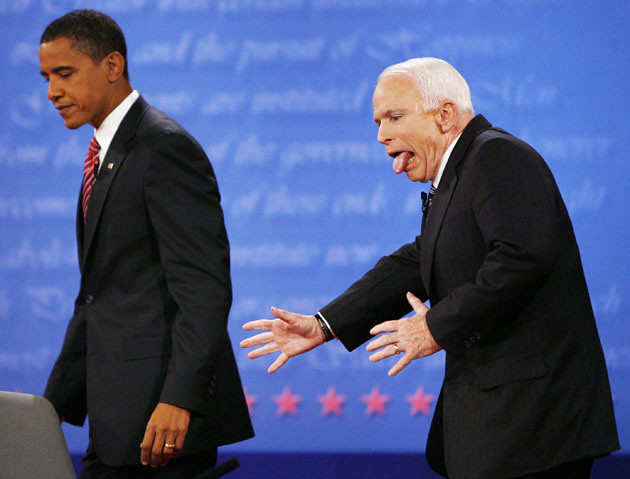
Jonah Goldberg, author of Liberal Fascism, writes this about the Jan Brewer finger-wagging controversy:

“[G]iven the liberal overreaction to this incident, you’d think the governorship of Arizona outranked the presidency, or that Obama was a beleaguered civil-rights activist sneaking into Arizona by cover of night, and not the president of the United States touching down in Air Force One.”

I have read and re-read this sentence many times, each time with great care. No matter how I try, dear reader, I cannot make sense of it. Goldberg appears to have thoroughly misunderstood the problem in a way I would not have imagined possible.

The reason it was upsetting to liberals is precisely because the president outranks the governor of Arizona, and therefore ought to be treated as a superior by the latter. She doesn’t have to like him, or agree with him. She can even argue fairly passionately with him. But, it was my understanding that the office commanded some element of symbolic respect, which is not consistent with wagging one’s finger in the occupant’s face. 

Now, I hesitate to judge anything based on a still picture. Still pictures may be misleading. (If anyone can link to a video of the incident, I’ll embed it.) But if it was what it looked like, it seems to show a lack of respect. I’m not quite sure what Goldberg thinks the problem is.

One of the things I have noticed in my reading about Otto von Bismarck–which is, let me emphasize, not at all thorough–is how much his style of politics reminds me of President Obama’s. He was a master of compromise, deal-making, and piecemeal political maneuvering. He was very pragmatic in his decision making, much as Obama is.

Politics nowadays are much less hospitable to this sort of thing than they were in Bismarck’s day. The motto of the Republican freshman class of 2010 was “No compromises.” There are fewer and fewer deal-makers in either executive or legislative capacities Such hard-line stances and theatricality are the hallmarks of politics today, and it is a small wonder; as I have said, such tactics favor the somewhat unpredictable charismatic authority of which Max Weber wrote. For instance, as described in a 1989 article by Peter Boyer:

The House, which limits the length of debate over legislation, has a rule allowing so-called special orders –permission to give lengthy speeches at the end of each legislative day. These have long been a means by which congressman could read into the Congressional Record various matters of importance to their constituents, usually matters of trivia. But [Newt] Gingrich, concerned less with the Record than with the potential television audience, [Emphasis mine] began to use special orders regularly as his platform for advancing ideas and, especially, for attacking the Democratic majority. 

At first, his approach gave the impression that he was a brave young crusader, taking on the opposition in heated floor encounters, but, in truth, most of his diatribes were delivered before a virtually empty House.

So do the politics of Weber’s “legal authority” give way to “charismatic authority”. (Frankly, though, Gingrich is not very charismatic. But he thinks he is.)

 The pragmatism, compromise and negotiation aspects of politics are not very interesting to people today, and so they do not pay attention to them, and so politicians do not emphasize them. Of course, it was not interesting to people in Bismarck’s time, either, but there was no medium like television to bias things in favor of the charismatic. Thus, people’s judgments were based more on who accomplished what.

It is also the case that Bismarck functioned in a very different political environment than does Obama. It was not a democratic state, and Bismarck was himself was fairly hostile to democracy. The pool of people who could elect or appoint Bismarck to things was far smaller than the same is for Obama. Yet, the art of politics as practiced by both men seems to me to be very similar. Bismarck may have been accountable only to the Kaiser, whereas Obama is accountable to the entire U.S. voting population, but in terms of what they each had to do to keep their employers happy, they use much the same techniques of statesmanship.

What’s interesting about Obama is that he is also a very charismatic man, but still seems to have a very calculating and realistic mind. This is a very rare quality, as most charismatic politicians rely purely on their instincts, their passion, for their power, and as such seem like “loose cannons” to all those not taken in by their personalities. Sarah Palin is an example of this.

Another way of combining charisma and technocratic maneuvering is simply to have one person specialize in the former and one in the latter running on the same ticket. This was basically what George W. Bush and Dick Cheney did. Bush provided the charismatic “everyman” charm to get elected, Cheney provided the political know-how to accomplish their ideological goals once in office.

Such a method is effective, or at least, it would have been effective if their ideology itself had been more sound. As it was, it paved, the way for six years of Republican dominance. (After the 2006 election, they lost  much of their ability to implement their agenda.) 

The point is that Obama is actually, in a sense, a much older style of politician than we ordinarily see, even though he appears to rely on his charisma for his appeal. And obviously, Obama is very different ideologically and morally from Bismarck. I am addressing only his technique as a statesman here.

Lastly, I want to remind readers again that I am only an amateur historian, and therefore may be mistaken about things. If I have made any error or debatable assertion, please tell me in the comments. Benjamin Disraeli and William Thomson are both claimed to have said: “The best way to become acquainted with a subject is to write a book about it.” I write these posts mainly in the hope that a blog post is the second or third best way.

President Obama and Secretary of State Clinton are the most admired man and woman, according to a Gallup poll. The “big news” to come out of this poll, however, was that Tim Tebow finished higher in the poll than the Dalai Lama did. (Is it even fair to choose the Dalai Lama? After all, my understanding is that, if what he believes is true, he has to behave the way he does, that “there ain’t no other way, baby, he was born that way”.)

Personally, while I think Obama is doing a great job as President, I can think of lots of people I admire more than him. I have trouble really admiring any politician, because all politicians must present a likeable facade, and so it’s hard to really know what the actual person is like. Basically, a politician’s job is to be admired, or else his or her career will flounder. In other words, they have an incentive to make themselves seem admirable. Maybe I’m just being foolish, but in my mind that sort of cheapens it.

That’s where charisma comes in, of course; making people feel like they really know someone even when they don’t. And Obama is a tremendously charismatic man.

As for Tebow’s ranking, well, to me that’s just inexplicable. He’s not a great quarterback, and it’s not like his story is that remarkable. I suppose he must have charisma, as well.

Here’s an interesting story: a Pew Research center study reported that Obama has received the most negative coverage of all the 2012 candidates recently.

One thing I like about the CBS News story linked above is its claim that this report “cuts against the widespread conservative claim that the ‘liberal media’ aides [sic] Mr. Obama…” No, it doesn’t. I don’t believe there is anything whatever that could cut against that claim in the minds of Conservatives, because anything that does must necessarily be a product of same “liberal media”, according to the Conservative way of thinking. It’s an utterly un-falsifiable concept.

Nor is there a major pro-Conservative bias in the press, however. I think the study found what it did because, as President, Obama has to actually do things that have measurable effects, as opposed to simply talking and being talked about like his prospective opponents.

A professor named Allan Lichtman has a model for predicting elections that indicates Obama will win re-election. According to that article, his model has been right about every election since 1984.

I agree with most of what his model says, but I take issue with his assessment of point #12 of his model “Incumbent charisma”. He says:

“‘I did not give President Obama the incumbent charisma key. I counted it against him. He’s really led from behind. He didn’t really take the lead in the healthcare debate, he didn’t use his speaking ability to move the American people during the recession. He’s lost his ability to connect since the 2008 election.'”

I disagree with the idea that Obama didn’t “take the lead”. He did give speeches on all of those issues, after all. He’s not the King, as both Liberals and Conservatives sometimes seem to think; he still has to deal with Congress. These are vague complaints, which I think reflect wishful thinking on Prof. Lichtman’s part.

Also, Obama after 2008 was dangerously close to becoming overexposed. If he’d kept showing up everywhere to talk about issues, people would be sick of him. Obama has wisely conserved his charismatic abilities so as to be able to use them for his campaign.

Bottom line, though, I agree with this appraisal. The one other caveat, as I see it, is on point #13 “Challenger charisma”. Palin has some charisma, so if she decided to run it would change things, but it’s hard to know what she’s doing. And I still think Obama would win.

(Hat Tip to Megan McArdle)

What was he thinking of? What were his advisors thinking of? In my opinion, this makes it look like he caved in to the endless demands of conspiracy theorists. It just sends the wrong message. It seems to me to say: “demand something for long enough, and no matter how stupid it is, eventually I’ll do it.”

But, then again, I have friends who disagree and think it was a brilliant move on the President’s part.

Okay, let me take another stab at what I was saying in this post: President Obama, like nearly every pundit in Washington, believes in the “Left-Center-Right” model of politics. Also like most pundits, he believes the Center is the best of these.

Because of this, he feels a need to explicitly talk about the good points and bad points of each side in his speeches. This isn’t wrong, unless you’re willing to argue that one side is perfect.

The problem is–apart from my quarrels with this model in general–that Obama does this so often it’s become boring and predictable. Now; because it’s a budget speech, you can’t expect it to be exciting, or even intelligible, to people who aren’t experts in this area.

Still, it just seems to me that Obama is forcing it when he really doesn’t need to.

First of all, I should mention that I don’t think I understand the budget issues well enough to comment on the technical details, which are the most important. All I can comment on are the superficial aspects.

Overall, from this perspective, I thought it was a good speech. Obama is a very good speaker, so this is no surprise. But he just seemed to me to be forcing the “Centrism” thing to the point of near-absurdity. I’m not necessarily saying he’s not Liberal enough; what I mean is that he just seems to look for ways to talk like a “Centrist” for no particular reason.

What do you think?

UPDATE: By the way, if this post seems a little incoherent, I apologize. I plan to go more in-depth with this point soon, (though I have sort of discussed similar issues before on here) but I just don’t have time tonight.

Walter Hudson writes, in a Conservative rebuttal to claims that President Obama’s speech on Libya proves his belief in American exceptionalism:

“De Tocqueville observed that the young American nation had a unique ability to prosper. This was the result of an exclusive political and economic environment, namely liberty, which enabled a culture of success… this was no special claim to international leadership or a moral duty to intervene in the affairs of others. The Left, including President Obama, are making that up.

The exceptional quality which de Tocqueville noted enabled America to become prosperous and therefore powerful. Conversely, the Left’s bastardization of American exceptionalism, the so-called “responsibility to protect,” is a product of power which dictates its use. These two views of American exceptionalism are mutually exclusive and diametrically opposed.”

I’ve thought about it for a while, and I’m fairly certain that last sentence is objectively false. Correct me if I’m wrong, but de Tocqueville says “Here is why they will have power.” Obama says “Here is what we must do with the power.” I see no reason at all that they can’t both be correct. I’m not saying they necessarily are, you understand, but that they might be. But I’m no logician.

At any rate, the core of Hudson’s argument is quite revealing. “[I]f we are bound to others by some special calling”, he writes “we are not free to pursue our own interests.” And note that, in the passages Hudson quotes, de Tocqueville says nothing whatever about what America ought to do. He is merely giving a description of Americans, not offering any moral prescriptions.

Way back in December of 2009, I wrote a post about President Obama’s Nobel prize acceptance speech, and I quoted one particular passage from it, a part of which I thought of today:

“I know there is nothing weak –nothing passive – nothing naïve – in the creed and lives of Gandhi and King. But as a head of state sworn to protect and defend my nation, I cannot be guided by their examples alone. I face the world as it is…”[Italics still mine]

I don’t know if I’d still write the same things I wrote about it then, but I thought the speech was worth revisiting in light of the Libya intervention. Here is his whole speech.