I’ve written about this film before, but I fear my review of three years ago fell short of its intended purpose. A friend of mine, a fellow writer whose opinion I greatly respect, watched it on my recommendation, and she hated it.

It could be due to an age difference, I suppose. Christmas Crush has what I think of as a millennial sensibility. Joke-y, banter-y, with lots of cultural references in the dialogue. It’s a bit like Adam Bertocci’s writing, and as I’ve mentioned before, Bertocci’s fiction is what I consider quintessentially millennial.

And let’s face it: we millennials are a polarizing bunch. Our culture is one people either love or hate. So it is with Christmas Crush. It is not by any means a complicated story. The plot is simple: a woman named Addie has a crush on her next-door neighbor, Sam. She makes a wish that her next-door neighbor will fall in love with her.

Unfortunately, her careless wording results in the wish being misapplied, and her other next-door neighbor, a man named Pete who is engaged to be married shortly after Christmas, falls in love with her. What follows is a series of humorous episodes as Addie tries to undo her wish and make the lovestruck Pete go back to his fiancée, Gina. All the while, trying not to give Sam the impression she’s two-timing him.

Such is the basic synopsis. Nothing earth-shattering, I’m sure you’ll agree. But as Chuck Litka reminds us, why does every story need to have high-stakes? Isn’t the future happiness of the characters reason enough to care about them?

So why do I like the film so much? Well, let us count the reasons:

#1: I’m Sick Of The Grimdark

Grimdark!” Isn’t that a wonderful word? It comes to us from the world of Warhammer 40K, a science-fiction universe where life is nasty, brutish, and short. But there are countless films, books, TV series, etc. that feature the grimdark aesthetic. It’s got to where it’s seeping into everything. They made a horror spin-off of Winnie the Pooh, for crying out loud.

Now, I don’t mind a bit of darkness in my stories. I regularly re-read H.P. Lovecraft, you know. But recall the Duke of Dunstable’s speech from Gilbert and Sullivan’s Patience:

Duke. Tell me, Major, are you fond of toffee?

Major. Very!

Duke. Yes, and toffee in moderation is a capital thing. But to live on toffee – toffee for breakfast, toffee for dinner, toffee for tea – to have it supposed that you care for nothing but toffee, and that you would consider yourself insulted if anything but toffee were offered to you – how would you like that?

For “toffee,” read “grimdark.” At some point, the consensus in the entertainment industry became that nothing wholly pleasant can be allowed to exist. Or if it does exist, it should be mocked. And that is why everything became saturated with gloom and serial killers.

Christmas Crush, like any good Christmas movie, is not grim. Even when Addie’s spirits are at their lowest, the mood is still one of holiday cheer. Also, Hollywood, if you’re reading this: it’s in color!

#2: Sincerity 

Now, I have to be careful with this one, because even Christmas Crush has its share of ironic humor. That banter I referred to above can’t exist without a certain style of comedy that relies on a developed sense of irony. To a degree, this goes hand-in-hand with that millennial sensibility I alluded to earlier, and is again something Christmas Crush shares with the works of Bertocci. (I’ve said it before, and I’ll say it again: Zachary Shatzer is the millennial P.G. Wodehouse, and Bertocci is the millennial Oscar Wilde.)

But the conclusion of Christmas Crush is sincere, as all Christmas movies are.

I’ve got a theory that most people who watch these Christmas movies with a mocking eye secretly hope to be charmed. We actually want to see a nice, sweet story that is pleasant and predictable. But, our culture does not exactly reward wholesome content, so we mask our desire with a veneer of irony. And of course, a lot of the movies are quite silly, so it’s not like it’s hard to find things of which to make fun.

But, as Nietzsche said, “He who scoffs at Christmas movie cheesiness should take care that he does not become a cheesy Christmas movie antagonist. And when you hate-watch the Hallmark channel, know that the Hallmark channel also hate-watches you.”

Or something like that. The point is, once you get used to sneering at sincerity, you become immune to it. You can’t appreciate it, even when it is earned.

#3: …But Also Comedy

If you’ve made it this far into this post, you probably can at least tolerate comedy. But some people just aren’t into it. They will see no humor, for instance, in the scene where Pete’s jilted fianceé, working at a Christmas pop-up store to pay for her canceled wedding, tearfully greets customers with a somber, “Welcome to Santa’s Ho-ho-holiday emporium, the happiest place south of the North Pole.” They will not delight in the numerous references to the holiday event that Addie and her friend Drea are planning for a client named Donner as “the Donner party,” before hastily correcting themselves.

Obviously, there are many different kinds of comedy. For Christmas Crush, you’ve got to like wordplay and maybe a dash of light slapstick. If these don’t do it for you, then probably Christmas Crush will fall flat. Actually, probably all of my top favorite Christmas movies (Fitzwilly, Jingle All The Way, and The Lion in Winter) will not work for you. And that’s okay.

#4: No Villain

So many movies feel obliged to give us a villain: the cheating fiancé, the wicked step-mother, etc. There’s nothing wrong with that in most stories, but in the spirit of the Christmas season, isn’t it nice to have a story where no one is motivated by evil intentions? Pete, even at his most obnoxious, is only doing what he is doing because a spell has twisted his inherently good nature. Gina, even when she is rude to Addie, only does so in reaction to understandable hurt feelings.

I don’t mind a good villain. But I also find it refreshing to have a story without one.

#5: Avoiding Clichés and Boring Romance Tropes

We all know how holiday movies rely on clichés. It’s a running joke on Twitter: how many movies are there where the overworked big-city something-or-other is forced to go to a small town for Christmas, where, despite her best efforts, she falls in love with the man of her dreams, who as often as not turns out to be the Prince of Monte Carlo traveling incognito?

Instead of Addie being a workaholic who finds love when she is whisked away to a bucolic setting, she actually likes her job, and finds love with the guy next door. And instead of bonding over something superficial, like, I don’t know, chocolate or something, Addie and Sam discover they actually have mutual interests in philanthropy. That’s something that can be a foundation for a relationship.

#6: Addie Takes Action

Instead of waiting around for the plot to resolve itself in her favor, Addie steps up and takes responsibility. At the end, she says something that is, by the standards of made-for-TV Christmas movies, rather profound:

To everyone in this room, I wish you all the courage to tell the people close to you how you really feel about them. Whether it’s your best friend, your fiancé, or even your next-door neighbor. Even if you’re scared. Even if you’re not sure if they feel the same. Because making a wish, even making a wish for Christmas, it’s not enough. You have to tell them. Because you don’t know what you might be losing if you don’t.

Now, I can’t live this past week over again. But I hope that next time–No. No, I have faith that I won’t make the same mistake again. 

Unlike so many stories of this type–or maybe of many types–Addie grows and learns over the course of the story. She realizes her mistakes, she admits them, and she vows to grow. Maybe you laugh and say that’s a low bar to clear for a story. Maybe it is. But ask yourself this: how many modern Hollywood blockbusters give us this level of character development?

#7: A Beginning, not an Ending

And what I like best of all is that at the end, it’s suggested that Addie and Sam will start dating. Not get engaged, not have a royal wedding, but maybe go out for coffee. I’m not saying whirlwind romances can’t happen, but in general, it makes far more sense for people to fall in love over a period of months or years, not a few days as so often happens in these things.

A real romance is a whole life-time long, and a wedding is just one stop along the way. So many stories treat it as the Final Boss, the last quest before the story ends. Real relationships seldom work in such a cut-and-dried manner, and that is what makes them magical.

Conclusion

Here, my case rests. It may be you are unmoved by all this. Like my friend, you might find Christmas Crush the most awful dreck. And, well, after all, you may be right. I may be crazy. But it just may be etc.

If this blog has an agenda–which I am not prepared to admit, but I say only if it does–that agenda is to convey to people that the media that is easy and accessible may not be the greatest art there is. To find great work takes great work.

The flip side of this is that you can find it anywhere, and sometimes in places where the critical consensus least expects it to be. Thus, we find that when our curators of High Culture are debating whether video games are art, some of the greatest stories being told in that form. And when we hear the voices of the taste-makers putting down made-for-TV Christmas movies, we wonder: are the lavish, big-budget productions of the major studios any better?

And of course, there is the humble indie book. We all know, beyond any doubt, that great stories are being told in the pages of little volumes sent out into the world by lone authors, supported by nothing more than their desire to tell them.

My technique when reviewing something is to try and forget, insofar as possible, how and where I found it, and evaluate it on its own terms, independent of who wrote it or whether or not fashionable people sing its praises, and simply ask myself if I like it.

(There is of course a final irony here in that, by publishing my opinion, I am in some measure trying to be one of those people who influences other peoples’ thoughts on the matter. And indeed, there have been times when I have had to ignore myself in order to evaluate something clearly.)

I don’t mind if anyone else’s opinion varies wildly from mine on these things. I am, indisputably, a highly idiosyncratic critic. There is only one key to reviewing anything, be it a Christmas rom-com or a war epic, a Renaissance painting or a video game, a big-name publishing house novel or an indie ebook; and that is to make sure that your opinion is authentically yours, not one that somebody else told you to have. It’s not as easy as it seems, but it’s more rewarding that way.
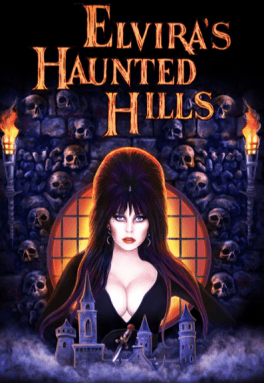
This is a parody of the Edgar Allan Poe-inspired Roger Corman/Vincent Price films. It stars Elvira as… Elvira. All right, so technically the actress is named Cassandra Peterson, but she really does have a unique persona when she dons the black wig. (If you don’t know who Elvira is, well, I think the poster pictured here gives you a pretty good idea of what she’s all about.)

Anyway, Elvira is on her way to open a revue in Paris when she and her servant Zou Zou are picked up by a coach traveling through the Carpathian Mountains. The coach’s passenger is a charming man named Dr. Bradley, who is bound for the remote Castle Hellsubus, the inhabitants of which are all suffering from mysterious neuroses brought on by the family curse.

Elvira handles the situation with her trademark campy, vampy, valley-girl cluelessness, which is amusing enough. What really makes the thing tick, however, are the supporting cast, all of whom do a great job in their roles as stock characters straight out of a Gothic melodrama. But Scott Atkinson as Dr. Bradley just about steals the show with his uncanny channeling of Vincent Price. He absolutely nails Price’s distinctive mannerisms and tone.

There are spoofs of most of the classic Poe horrors, from The Cask of Amontillado to the crumbling mansion of The Fall of the House of Usher to The Pit and the Pendulum. No points for guessing how Elvira deals with that situation.

Admittedly, your enjoyment of the film may depend to a degree on how much humor you feel can be derived from the basic premise “this woman has large breasts.” Because they, er, milk that joke for all it’s worth, and then some. But for me, the real humor is how well the film manages to mimic the atmosphere of the Poe/Corman/Price series, while also poking affectionate fun at it. There are some genuinely creepy scenes in it–at least, until Elvira’s antics turn them into music hall routines.

If you like the Corman films, as I do, you’ll probably get a kick out of this one. It’s clear that everyone involved was having fun and had great admiration for their source material, and it’s always enjoyable to share a good-natured laugh at something with someone else who appreciates it. In short, the movie is better than it really had any business being.

Zachary Shatzer recommended this book to me. He called it the funniest book he’s ever read. Well, when the author of some of the most gut-bustingly laugh-out-loud funny books around says something like that, you pay attention, no? So naturally, I had to get myself a copy.

It lived up to Shatzer’s billing. Indeed, the style of humor is much the same as his, though maybe a bit darker and raunchier, skewing more towards a hard PG-13. Still the dominant feeling is one of utter absurdity. Begin with the title: “the stench of Honolulu”. Since when does Honolulu have a stench? Well, in this book, Honolulu is depicted as a horrible place, decrepit and filthy.

Of course, the narrator is far from reliable. A strange, cowardly, narcissistic and paranoid individual, he is forced to accompany his “friend”–using the term loosely–on a quest to find a golden monkey statue said to be in the Hawaiian islands.

The book continues in this vein, with each escapade more bizarre than the last, including recurring violent yet inexplicably non-lethal encounters with a scientist who our narrator decides is evil. This is one of many running gags that just get funnier as the story goes on.

I could go on and on describing all the madcap episodes that form the bizarre journey, but honestly, you’re better off just reading the book. The hardest thing about reviewing a comedy, I find, is that it’s really impossible to explain why something is funny. You either get it or you don’t. Some people won’t get this, either, and that’s okay. But those who do get it are in for a zany and weird and hilarious ride. I’m very grateful to Mr. Shatzer for the recommendation.

I don’t know what else I can say, folks. If my reviews of all Shatzer’s other books haven’t convinced you to try them, I don’t see how this one can.

So I won’t review it as I normally would. Instead, I’ll try some different approaches…

***

Review by an Academic Literary Critic

A Cozy Christmas Murder (Z. Shazter, 2021) satirizes 21st-century capitalism in its portrayal of the independent bookstore operator Roberta Smith and her cat, Mr. Bigfluff, who together represent Messianic figures who protect the town of Quaintville from the avaricious motivations of a criminal who symbolizes the profiteering of the wealthiest classes, while at the same time indulging in a pastiche of various pre-post-modernist textual norms. Smith’s friends, Jeannie and Sheriff James, symbolize conflicting modes of sexuality in a petit-bourgeois milieu…

Review by someone who has only read one very specific type of book

I couldn’t follow this story at all. The characters were not wizards, but seemed to all be non-magical people. I kept waiting for something about a prophecy to explain the plot, but there was nothing. Also, the family bloodlines and lineages were left unexplained, so I couldn’t easily categorize the characters.

Review by someone who is too easily offended

The protagonist of this book is a woman. Are they trying to say that men can’t solve mysteries? Do they want our young boys to grow up believing themselves to be incapable of logic and reasoning? Also, why do they only mention Christmas? Are they suggesting that all the other holidays should be illegal? If so, that is offensive and wrong. 

Review by That Guy; you know the one…

⭐️

To be clear, I love the book itself. The characters are funny and engaging, and the whole thing is a delightful send-up of cozy mysteries. However, I’m only giving it one star because Amazon delivered it three minutes late to my houseboat in the middle of a Category 5 hurricane.

Review by someone whose keyboard only has the letter “h”

hhhhhhhhhhhhhhhhhhhhhhhhhhhhhhhhhhhhhhhhhhhhhhhhhhhhhhhhhhhhhh

Review by someone who is overly nostalgic

They don’t write books like this anymore. I say that because this book was written in the past, which is not the present, and therefore by definition is not being written now. You couldn’t write a book like this today. People would say it had already been written, and in a way, they’d be correct. Because we can only move through Time in one direction. Still, if you want to pretend that it isn’t now but the past, then you should read this book in your near future!

***

Yuck, what was in that eggnog?

Anyway, I hope you enjoyed this silliness. Definitely give Shatzer’s books a try if you haven’t already. Merry Christmas, Happy Holidays, and to all a good night!

Just when I thought I couldn’t get any more dazzled by Zachary Shatzer powers of comedic storytelling, he goes and writes a cozy zombie apocalypse story.

Shatzer’s recent book The Beach Wizard cemented his place on my Mount Rushmore of comic novelists. It’s a fantastic mixture of absurd comedy and stoic philosophy. I’ve read it twice since it debuted in August. Everyone should read it.

But, anyway; about this book. It’s the third book in Shatzer’s series of cozy mystery parodies, starring amateur sleuth Roberta Smith, her cat Mr. Bigfluff, and their idyllic (aside from the surprisingly frequent murders) town of Quaintville.

You have to read the first two books in the series to get the most out of this one, but as they’re all extremely short, this shouldn’t be a problem. You can read the whole series in about an hour.

Now, I’ll admit to the possibility that this particular brand of parody might not be for everybody. You have to be familiar with the cozy mystery genre to get why it’s funny. I suppose if you’ve never heard of cozy mysteries before, you’ll find it a bit baffling. But then again, who hasn’t heard of cozy mysteries?

Additionally, an Indie-Skeptic may argue that the books are (a) very short or (b) contain typos. I have seen these arguments made many times by readers who hesitate or outright refuse to spend money on indie books.  Sometimes at the same time, which doesn’t even make sense. It’s like the old joke about the restaurant where the food is terrible and the portions are too small.

The argument that a book is too short doesn’t hold up. You’re not paying for the words, you’re paying for the effect they produce.

As for the typos, I’ve pretty much reached a point as a reader where I hardly notice them, unless they actively impede my understanding. Yes, of course, in an ideal world, there would be no typos, and all spelling and grammar would be perfectly uniform. But we’re not in an ideal world, and this is far from the main reason why.

One of my hobbies is reading old books, especially those from my favorite historical period, the American Revolution. One thing I quickly noticed was that spelling was very much an inexact science in those days. George Washington himself struggled mightily with orthography.

The snobs of the world who sneer at typos in indie books would no doubt say, if transported back to Colonial America, “This man’s letters be full of errors most grievous against our Common Tongue. Hark ye, sirs and ladies, never could he lead a ∫ucce∫sful revolution against the Crown of England!”

Or words to that effect. But old George seemed to do all right for his country, and Zachary Shatzer has done all right for the art of writing comic fiction. Like I said at the outset, folks: Mount Rushmore.

Shatzer’s books never fail to make me laugh out loud, and this one is great for getting in the Halloween spirit. (Not that I need help with that, but…) I highly recommend it.

This is actually the 2nd book in Shatzer’s “Cozy Murders” series. The 1st book is the only one of his I haven’t reviewed yet, because it’s a Christmas-themed tale, and I’m saving it for December. But, you can read them out of order.

I like cozy stories. I even like Hallmark-esque Christmas-themed cozy stories. That said, there are certainly things about the genre that do invite parody. And that’s what Shatzer does here, using his comedic pen to lampoon the cloying earnestness sometimes found in such stories.

What do I mean by that? Well, here’s an example:

“Hi, Mrs. Smith,” he said. “I just wanted to thank you for giving me that anti-drug pamphlet. It really made me think. I had no idea drugs could be so dangerous. I’m never going to take them again.”

“I’m glad to hear that, Jimmy,” I said.

“I showed the pamphlet to my friend, Tyler,” he went on. “Tyler told me he was thinking about taking drugs, but then after I gave him the pamphlet and he learned about all the bad things that can happen when you take drugs, he decided not to.” 

Shatzer is parodying the typically unsubtle and occasionally preachy style that sometimes accompanies coziness. The whole book (which is only about a ten minute read) is written in this silly, fairy-tale-for-grown-ups tone. Maybe not everyone will find it funny, but personally, I think it’s a hoot.

As the title suggests, the plot of this book centers around extraterrestrial visitors to the protagonist’s aggressively-charming town of Quaintville. With one exception, the aliens are just as friendly as the human residents of Quaintville. In fact, one of them is strikingly simpatico with our narrator.

Is it kind of a goofy concept? Yeah, it is. It probably wouldn’t work as a full length novel or even novella. But as a short story, it made me laugh. The best thing I can compare it to are MAD magazine spoofs of yore, that would take their inherent silliness and run with it. In fact, I can almost picture the story illustrated by Mort Drucker. It’s that kind of light-hearted fun.

[Audio version of this review available below.]

“But Berthold, this is one of those made-for-TV Christmas movies!”

“I know, but what can I say? I enjoy them. Some are better than others, and this is one of the best.”

“But last year you said the same thing about Christmas Crush, and one of your friends saw it on your recommendation and thought it was terrible!”

“Well, Christmas Crush does have a very millennial sense of humor to it, which I think may not be for everyone. The jokes in it come from the awkward conversations and ironic coincidences. Not everyone’s cup of tea. I should have mentioned that.”

“Okay, fine. So, why do you think this movie is so good?”

“It really comes down to the relationship between the protagonists. Jessie Temple is a tough, no-nonsense cop assigned to protect witness Dean Cupo until he can testify. She’s not just waiting around for a prince to sweep her off her feet like many of the female characters in these kinds of movies. She and Dean do a lot of verbal sparring at first, which makes sense, but then gradually they bond over little things, like a shared love of old horror movies.”

“It’s still sounds cheesy to me.”

“Well, yeah; and I’d be lying if I said it’s not. But, it’s a holiday movie. You don’t go watching a Christmas movie in the hopes that you’ll discover some sort of edgy, avant-garde experimental film. You watch it because you want to see a cozily familiar drama performed by likable characters. See my comments about pantomime in the Christmas Crush review.”

“No, I don’t think I will. Can’t you stay on topic?”

“Sure. Most Christmas movies are just too saccharine for my taste. Nothing whatsoever happens. It’s like, ‘Oh, I fell in love with the Prince of Monte Carlo! Oh, but there was some trivial misunderstanding and now we broke up! Oh, but now it turns out we cleared it up and we’ll get married!’ It’s all so vapid.”

“Uh huh.”

“Whereas a movie like A Christmas Witness has some real plot to it. How many Hallmark Christmas movies end with armed standoffs? I mean, yes, you know how the journey’s going to end, but at least you feel like you went somewhere.”

“Hmmmm.”

“I get that you’re skeptical, and I respect that. And I’m not saying, ‘Oh, man this movie is great! It should win all the Academy Awards! Go home, Lawrence of Arabia, we have a new cinematic classic!’ I’m not saying that.”

“That’s good.”

“It’s just that it’s pleasant holiday entertainment. When I sit down to watch a Christmas movie, I really don’t want my expectations subverted, or to get a dark, hardboiled mystery, full of mistrust and morally ambiguous characters. But nor do I want something so sugary-sweet that it makes my teeth hurt. This movie gets the balance just right for me.”

“I see. Well, I can’t say you’ve convinced me, but maybe some of those people out there will feel differently about what you’ve said. Thank you for your time.”

Earlier this year, I reviewed Zachary Shatzer’s The Goose Finder, and said it was one of the funniest books I’d ever read. So when I saw he released a new short story, I eagerly pounced on it.

And yes, if you liked The Goose Finder, you’ll like this too. As with the earlier book, I laughed out loud multiple times reading it. It has the same zany, absurd, laugh-a-minute style as it recounts the history of John Warbly, Chad Crackleman, Portman Humberson, and, of course, Old Man Cornwell, as they combine their musical talents and embark on a wild and tumultuous journey.

Once again, it’s really impossible for me to describe the book, so let me offer a few quotes. Here’s the description of Old Man Cornwell:

“He seldom spoke, and when he did it was usually in a confusing and cryptic way, often utilizing spiritual symbolism and references to ancient mythology. Sometimes he would imply that he was older than time itself, but when asked to further explain his meaning, he would simply chuckle and change the subject to the price of gasoline.”

Or this, when the band has its first hit:

“Despite insisting he wouldn’t let success change him, John instantly let success change him in numerous ways.”

Later, when the band breaks up, Portman takes up a new profession:

…writing political thriller novels, including but not limited to The President’s Secret Code, Senator/Spy, and The Shadow Government That Covertly Rules the Country and is Run By the Ghost of Warren G. Harding.”

I don’t mind telling you, I really, really want that last book to be real. Maybe Shatzer will consider writing it next.

Maybe none of this makes you chuckle, but if it does, I highly recommend checking this book out. It’s a short read, but given that there’s a laugh on every page, it’s well worth it.

[Audio version of this post will be available as soon as possible.]

This is a classic mystery, in the vein of Agatha Christie. We have a brilliant detective, Professor Edwin McGorgol, and his not-so-brilliant, but good-hearted sidekick, George Hockney. There’s a hotel full of suspects, snobbish rich types, a femme fatale, and an escalating series of crimes that put the pressure on them to solve it before it’s too late.

Oh… and did I mention they’re all birds? Well, they are. McGorgol is a sandpiper and Hockney is a seagull. All the characters are different types of fowl that suit their personalities perfectly. Also, the book is illustrated, which only adds to the charm.

And I have to say, while this is obviously designed for kids, the mystery was still well done. I’ve read mystery novels for adults where the solution was more obvious than it is in this one. I had my suspicions, but I was still eager to see how it would all play out.

But the best part of all is the afterword, where we get the story behind the story, of how it all came to be. That story really made me smile.

This is a short book, but it packs lots of lighthearted humor into a small space. It’s a fun read for all ages. I highly recommend it.

[Audio version of this review available below]

Best Food: Pizza. Once again, these cheese and tomato sauce miracles captured the title.

Best Halloween: 2017. Because it was the first time I did this:

pumpkin 2017

Best Buffalo Bills victory: the Bengals beating the Ravens.

Best Football Team That Doesn’t Seem To Constantly Cheat: the Seattle Seahawks

Best Maxwell’s Maximum:

Best Political Story: “House Stenographer Seizes Microphone In Bizarre Rant”–this would make a great opening scene for a thriller novel. It was so surreal.

Best Batman: Will Arnett

Best New Toy: Space Explorer Remote Control Helicopter.

Best Computer: My MacBook Air. It survived a major scare with water, so extra points for toughness.

Best Movie: Jane Got a Gun. My in-depth take on it here.

Best Book: There were many–see list here.

Best Video Game: Fallout: New Vegas. This was a tough call. The Outer Worlds, Spec Ops: The Line and Mass Effect: Andromeda all made strong cases, but in the end I had to go with the epic post-apocalyptic wasteland that I put nearly 200 hours into. Don’t forget to get the DLC.

Best Awards Show Besides This One: 2017 Academy Awards

Best Tree: The Big One Near the Middle.Tree.jpg

Best Sky:

september sky


Best Gilbert and Sullivan Production: The Stanford Savoyards’ 2012 Ruddigore.

Best Wildlife Moment: 

Best TV series: Angie Tribeca. Tragically, ended after four seasons. But we’ll always have detective Hoffman.


Best New Album: Stripped Down, by Jo’Rinda Johnsen

Best Video Game Analysis Series: Ross’s Game Dungeon

Best Presidential Candidate for Gilbert and Sullivan Lovers: Russ Sype

Best Presidential Candidate for Literary Fiction Lovers: Mark Paxson (Technically, Mark’s campaign is for 2020, but he declared in 2019, so I’m counting it. If that’s wrong… then Mark will just have to pardon me when he wins.)

Best 52 Short Stories in 52 weeks Challenge Winner: Phillip McCollum

Best Eastern Canadian Blogger: Lydia Schoch

Best Western Canadian Blogger: Audrey Driscoll

Best Western Canadian Napoleonic Historian: Shannon Selin

Best Byzantine Historian: Eileen Stephenson 

Best At Overcoming Technical Difficulties: R.J. Llewellyn 

Best Review of Anything Star Wars-related: Joy V. Spicer’s review of Kenobi

Best Author of a Book About the Dark Side of Academia: Geoffrey Cooper for Nondisclosure

Best Epic Science Fiction Author: Lorinda J. Taylor for The Man Who Found Birds Among the Stars

Best Book Vlogger: Book Club Mom

Best Army Black Knights Fan: Barb Harvey-Knowles 

Best ESXIII: ESXIII

Best Author of a Novel about a Virtual World, United States: Ben Trube

Best Author of a Novel about a Virtual World, Australia: A.C. Flory

Best Mass Effect fan: Isabella Norse

Best KotOR II fan: S

Best W.S. Gilbert historian: Andrew Crowther

Best W.S. Gilbert quoter: Charlee

Best Short Story That You Can Read For Free Right Now: Snowlight by Noah Goats

Best Visual Artist: Katie Dawn. She does lots of great work, but this is one of my favorites:

Best Wisconsin Blogger and Raging Agnostic Snowflake Vegetarian Who Never Learned To Whistle: Thingy

Best Golfer, Historian, Author, Literary Critic, Book Blogger Friend: Pat Prescott

Best Social Commentator, Writing Blogger, Thriller Author, and Ally An Indie Writer Could Ever Have: Carrie Rubin

Best Blog Reader: You!

Berthold Thanks You 2