This post isn’t just about football, though at first glance it appears to be. Stick with me, non-gridiron fans, it will be worth your while…

10 years ago tomorrow, the New England Patriots played the Denver Broncos for the AFC Championship. It’s one of my favorite football games ever, partially because I predicted how it would play out almost exactly. Defense wins championships, and the Denver defense of 2015 was tough enough that they could shut down the mighty Patriots and Tom Brady, with Peyton Manning more or less playing the football equivalent of El Cid.

But it wasn’t just that I called the game correctly that makes it a favorite memory of mine. I remember that at the same time I was watching it, I was also following news of the Paris premiere of a movie called Jane Got a Gun. I can literally remember seeing a picture of Natalie Portman and Joel Edgerton at the photocall at the same moment as Brady was throwing a seam route to Gronkowski on the Patriots’ last valiant, but ultimately doomed drive.

I’d been looking forward to Jane Got a Gun for months, and indeed I got to see it for myself on its US release five days later. See here for my retrospective thoughts on that film. It’s a small, but important, part of this story.

Fast-forward ten years, and a lot has changed. Not much of it, I am sad to report, for the better. Tom Brady won three more Super Bowls. Does Natalie Portman even still make movies? And there were… um… other things, too. We don’t need to get into specifics. To quote Jane Got a Gun: “It’s hard to remember how things seemed when you know how they actually turned out.”

But, like the Vicar of Bray, “whatsoever king may reign”, the Patriots will still be in the AFC championship, sir! And they are facing none other than the Denver Broncos again. Instead of Brady vs. Manning, we get Drake Maye (who?) vs. Jarrett Stidham (again, who?) What was it Marx said? Something about, “the first time as tragedy, the second time as farce”? Or, in the words of the anti-human philosopher Nick Land summarizing a scene in Nietzsche’s Thus Spoke Zarathustra:

The dwarf makes some kind of remark like, “even eternity is a circle,” or some kind of flip little remark… And Zarathustra says to the dwarf, “Oh, you know, don’t be an asshole. You know, like, it’s more interesting than that.”

It is, indeed, more interesting than that.

At first blush, you think: so the Broncos are starting some guy who hasn’t thrown a pass all year, the Patriots should easily beat them. But then you remember that even the Great and Powerful Belichick’s legendary defense lost to Nick Foles in a Super Bowl. And there is actually a possible advantage in starting a quarterback who hasn’t played all year: there is no film on him for the Patriots to study. Whatever little tics, tendencies, and tells Stidham has will have to be discovered as the game plays out.

I did say above that defense wins championships, and both the Broncos and the Patriots have outstanding defenses. It would be delightful for a traditionalist like me, in this modern era when all the rules are designed to give us 52-49 games, to see a conference championship decided by a score of 6-3. Or better yet, 5-0. Football is supposed to be a brutal, physical game where getting a field goal feels like a hard-won victory. Nowadays coaches pass up field goals like they are nothing. Is this related to the decline of modern society generally? I’m not saying that. I’m not not saying it either…

But, I’ve not yet finished explaining why that 2016 AFC Championship game is one of my favorites. Like the writers of Jane Got a Gun, I’ve deliberately structured this to keep the most important revelation for the end. You see, on that prediction post of mine from a decade ago, I made a friendly bet with a reader and fellow blogger named Barb Knowles. That led to an online friendship with Barb. And through Barb, I met Carrie Rubin. And Carrie pretty much single-handedly encouraged me to keep writing when I was about to give up.

It goes deeper than that. Through Carrie, I met Mark Paxson, and through him, Audrey Driscoll and Kevin Brennan. And through all of them, in various way, I’ve found Lorinda Taylor and Richard Pastore and Noah Goats and Peter Martuneac and Lydia Schoch and Chuck Litka and Roger Lewellyn. And through Noah, I’ve discovered Zachary Shatzer, and through Lydia, Adam Bertocci… and the list goes on and on. There’s a sidebar on this blog that has the full roster.

What if Barb hadn’t commented on that post? Or what if I had picked the Patriots, and she hadn’t felt the need to say anything as a result? Would I know any of these wonderful people? (Not to neglect the old guard, like Pat Prescott and Maggie, who have been with me since the Blogger days!)

So that’s why it’s one of my favorite football memories, even though on paper I should really dislike both teams. It led to some of the most enjoyable friendships I’ve made in my life, and I would be vastly poorer without them. It just goes to show you how a simple post about something as ephemeral as a football game can change your life in ways you never expected.

Anyway… I see Vegas favors the Patriots, just like they did last time. They’re probably right to. But as I just explained, I won big by picking the underdog ten years ago. And so… for auld lang syne:

Broncos: 22
Patriots: 20

“All that is human must retrograde if it does not advance.”

–Edward Gibbon, The Decline and Fall of the Roman Empire

“Everyone got famous. / Everyone got rich. / Everyone went off the rails / And ended in the ditch.”

–Warren Zevon, “Ourselves to Know.”

Don’t close the window just because this book is about football!

I know, I know; most of you care not a whit about our strange, violent American pastime. The names “Tom Brady” and “Bill Belichick” probably mean nothing to most of my readers. Well, in a way, I envy you.

But football is still America’s game, like it or not, and the story of the New England Patriots dynasty is one of its epics. And mark this well: it is about more than just football. The story it tells is part of the story of the early 21st-century United States, and there are lessons to be gleaned from it that extend far beyond the field. That’s why I wanted to review this book, and why I think even non-football fans should read it.

At the same time… there will still be quite a lot of talk about football here. So, I have highlighted in bold the parts that contain more general information, of interest to the laity. So you can skip over the parts about whether a short pass to Faulk on 4th-and-2 was the best call, if that sort of thing doesn’t interest you.

The book begins at the end, with New England losing to the Tennessee Titans (coached by once and future Patriot, Mike Vrabel) in the 2019-20 playoffs. It then flashes back to the very beginning, when Tom Brady was just another high school kid with dreams of making getting to play for a top college, and when Belichick was an assistant coach for the famously harsh Bill Parcells.

Basically, Belichick and Brady both had massive amounts of resentment over perceived wrongs–Brady because he couldn’t even be named the full-time starting QB for one of the lesser Big Ten schools, Belichick because Parcells treated him badly, and also probably because he coached the Browns. Coaching the Browns would be enough to turn any man to evil, I suppose.

Anyway, these two psychopaths found their way to New England, a historically poor franchise, and in the autumn of 2001—a pivotal time in the history of the United States—Brady became the starting quarterback and the Patriots upset the heavily-favored Rams in the Super Bowl.

It’s hard to remember now, but at the time, they were America’s darlings: with the country united in a spirit of patriotism (also hard to remember now) the fact that the plucky all-American kid could come out of nowhere to lead a team literally called “the Patriots” to an improbable victory was just too much. It was like a Disney movie out there.

Wickersham recounts how Brady, the kid-next-door, started receiving calls from actresses and models and celebrities, and generally fêted by the power elite. It was a classic rags-to-riches story.

Naturally, Brady and Belichick wanted to do it all again. And they did, two years later, winning another championship after a 14-2 season that began with a 31-0 loss to the Buffalo Bills. (Just wanted to get that in there.) And then they won another the next year. And by this point, everyone was pretty much sick of them.

Wickersham notes how, en route to building their dynasty, the Patriots, and more specifically Belichick’s defense, actually changed the way football is played. After a playoff game in which they defeated the Indianapolis Colts by physically dominating their receivers, the league altered the rules to essentially make this type of hard-hitting pass defense illegal.

Naturally, the Patriots also took advantage of the new rules a few years later, creating what was to that point the greatest passing offense in NFL history in 2007.

While I may not like them, I would still contend that the ’07 Patriots are in fact the greatest team in NFL history, or at least, the greatest team of the salary cap era. I don’t care that they lost the Super Bowl on a fluke play; they had an absolutely insane offense and a wily, tough defense coached by the best defensive coach of the era. I still can picture them annihilating my hapless Bills on Sunday Night Football that year.

In any case, Super Bowl XLII is where the first phase of the Patriots dynasty ends. If we want to talk in world-historical Spengler/Toynbee-esque terms, this is the part where the nascent culture has flourished into a full-blown civilization. “The Patriot Way” was now well-established.

Of course, as Wickersham is quick to note, few within the Patriots organization ever uttered the words “Patriot Way” or “culture.” The best line I ever read on this was, “Belichick doesn’t believe in ‘culture.’ He believes in ruthlessness.”  (Another good line from this book: Belichick “‘doesn’t hold grudges,'” someone says. ‘He holds death.'”)

What I would argue “The Patriot Way” is actually describing is asabiyya, as defined by the historian Ibn Khaldun:

[Khaldun] explains that ruling houses tend to emerge on the peripheries of existing empires and use the much stronger asabiyya present in their areas to their advantage, in order to bring about a change in leadership. This implies that the new rulers are at first considered ‘barbarians’ in comparison to the previous ones. 

And indeed, the rise of the Patriots is a prime example of the rise of such a “ruling house.” The old guard of the NFL was annoyed at the rise of these newcomers. The great Don Shula himself repeatedly expressed his antipathy to Belichick, whom he believed to be a cheater. Which he is, but, as this book explains in some detail, basically everyone in the NFL is constantly trying to cheat everyone else at all times. Yes, I know; who would have thought that some of the most competitive alpha males in the world, with millions of dollars as well as prestige at stake, would try to cheat one another? Possibly in a different era, that prized honor and integrity more highly, this would not be tolerated. But we are not in such an era.

And speaking of eras, the Patriots now transitioned to the second phase of their time in the sun, a run during which they would have consistent success, but not quite be able to crack the very pinnacle of the sport.

To some extent, I think the Patriots got away from what made them successful in the early 2000s, which was strong defense. From 2007 – 2013, their strength was unquestionably Brady’s offenses, which were consistently effective in the regular season yet somehow always seemed to fail when they were most needed. I mean, good lord, 17 points against a mediocre Giants team? And let us not forget that Brady gave the Giants 2 points with a stupid safety on the first play of the game. Personally, I think it’s funny that the greatest player of his era, and the most successful player in the history of the Super Bowl, also made one of the dumbest plays in the history of same.

Still, every year the Patriots were a threat to win at all, and always owned the AFC East and my (still) hapless Bills. But that was not enough for the ruthlessly competitive Belichick, and nor was it enough for Brady, who, despite having a supermodel wife and young children, continued to be obsessively dedicated to his craft. Honestly, if the rewards weren’t so spectacular, you’d say someone this absurdly devoted to a mere sport has a mental health issue.

I’m not blaming Brady. Our society has, in a way, failed him. It would be better, I think, if society incentivized intensely-driven and competitive young men to prove themselves as statesmen, explorers, warriors, diplomats, and so forth. Had he lived in the 1950s, Tom Brady might have pushed himself with the same fanaticism to excel as a soldier or an astronaut, instead of merely flinging a ball for our amusement. Still, here we are.

(I’m less bothered by Belichick’s dedication to the sport, simply because Belichick is an old man, “and the vices of peace are the vices of old men” etc.)

Speaking of the vices of old men, it’s time to discuss the third character in the triumvirate on the cover: Robert Kraft, the owner of the Patriots and noted illegal brothel enjoyer.

Kraft took over the struggling franchise in the early ’90s. The first three coaches to work for him are all Hall-of-Famers: Bill Parcells, Pete Carroll, and Belichick. Which of course is the job of a good owner: to hire good people, then sit back and let them succeed. Kraft did well at this part.

To get even more esoteric than this review is already, it is interesting to me to observe the parallels in the Belichick/Brady/Kraft dynamic with the Victorian comic opera partnership of Gilbert/Sullivan/D’Oyly Carte. (If this seems incongruous, remember that ultimately both football and comic opera are forms of entertainment.) Belichick is an obvious analogue to Gilbert, the irascible, sometimes tyrannical director; overseeing his show with meticulous attention to detail. Brady is Sullivan, a master of his art continually believing himself to be under-appreciated no matter how many accolades come his way. And Kraft is Carte; the businessman desperately working to manage the egos of these two mad geniuses in order to keep the gravy train rolling. In the end, of course, Carte couldn’t, and neither could Kraft.

If there is anything in cyclical theories of history, then it would seem there is an entropic process to which empires, comic opera companies, and football teams alike are subject. Namely, that their prosperity ultimately destroys them, as the ambition for a larger share of the credit divides the very elites who originally powered the success of the organization.

But I’m getting slightly ahead of the story: the Patriots had two of their best seasons in 2014 and 2016, both capped off with victories in two of the most memorable Super Bowl games ever played. These victories cemented their status as the greatest dynasty in NFL history, and Brady and Belichick as the best of their era at their respective roles. To Patriots fans, it was euphoria. To fans of all other 31 teams, it was like a never-ending nightmare, an Ugg boot, stamping on a human face—forever!

Ah, but the brightest light casts the darkest shadow! When you are at the top, there is nowhere to go but down! And any other cliché you care to use. The very fact of the Patriots success now set the stage for their eventual collapse. Wickersham documents how Belichick’s joyless discipline, Brady’s paranoid resentment of backup quarterback Jimmy Garoppolo, and Kraft’s failures to reconcile the two men, made the 2017 season a particularly grim slog. It is a testament to the Patriots’ success that the fact that they made a Super Bowl again that year feels like an afterthought.

Something happened in 2017 to permanently damage the relationship between Belichick and Brady; something that not even another championship a year later could patch up.  Most Patriots fans, spoiled brats that they are, will tell you 2018 is the team’s worst Super Bowl win. (If you are fan of a team which has never won a Super Bowl, you can’t help but feel a sense of schadenfreude about what happened next.)

And so we come back to where the book began: that game against the Titans in the playoffs, with a terrible sense of ending in the air. It’s not often that the word “elegiac” can be applied to a football game, but it fits this one, particularly this play, in which Brady connected with veteran tight end Ben Watson. A combined 34 years of NFL experience allowed them to improvise when the play broke down… but it was negated by a penalty. This is the way the Patriots dynasty ended; not with a bang, but an ineligible man downfield, exploitation of obscure loopholes in the timing rules, and a botched “Stanford band” play. As of this writing, it is the last playoff game played at Gillette Stadium.

The book briefly covers Brady’s escape to Tampa Bay, where he built a team of superstars that won him a 7th title and elevated him above Belichick in the minds of most football fans. The fact that Belichick’s Brady-less teams struggled to achieve even mediocrity further hammers home the point: it was Brady, not Belichick, who was responsible for the Patriots multi-decade run of success. Not that fans don’t continue to debate it even now.

But this “debate” ultimately misses the point: everyone knows it is players, not systems, that win games. The greatest football coach in the universe will not win consistently if he does not have players who can execute his schemes. A great coach gets the most out of his players. His success or failure depends, ultimately, on what the players’ ceiling for “most” is.

There was a very telling incident last season, when Baker Mayfield, Brady’s successor as quarterback of the Buccaneers, talked about how “everybody was pretty stressed out” during the time of TB12, and how Mayfield saw himself as bringing “the joy back to football.”

Brady responded: “I thought stressful was not having Super Bowl rings… There was a mindset of a champion that I took to work every day. This wasn’t day care. If I wanted to have fun, I was gonna go to Disneyland with my kids.”

Indeed, Brady so relentlessly pushed himself that he didn’t even go to Disneyland with his kids all that much, and there is some reason to think that his borderline pathological pursuit of greatness destroyed his marriage. But there can be no doubt Brady’s obsession with constantly improving himself and his teammates made him the perfect man to execute Belichick’s scheme. I don’t like to put too much stock in generational stereotypes, but it may be that Brady, with his classic Gen X nose-to-the-grindstone, chip-on-the-shoulder attitude, was just a better fit for the quasi-military mindset Belichick demanded, contrasted with the more laid-back attitude often attributed to the millennials who followed him. (I am a millennial, so I can say it: neither Brady nor Belichick would be the sort of guys to take kindly to participation trophies.)

This is where Wickersham’s chronicle ends, and as a rise-and-fall story–well, it ain’t Barry Lyndon, but it ain’t bad. But something is missing. It’s not Wickersham’s fault. His publication deadline prevented him including the last chapter of the saga, which I feel is necessary to complete the story of the Patriots Dynasty.

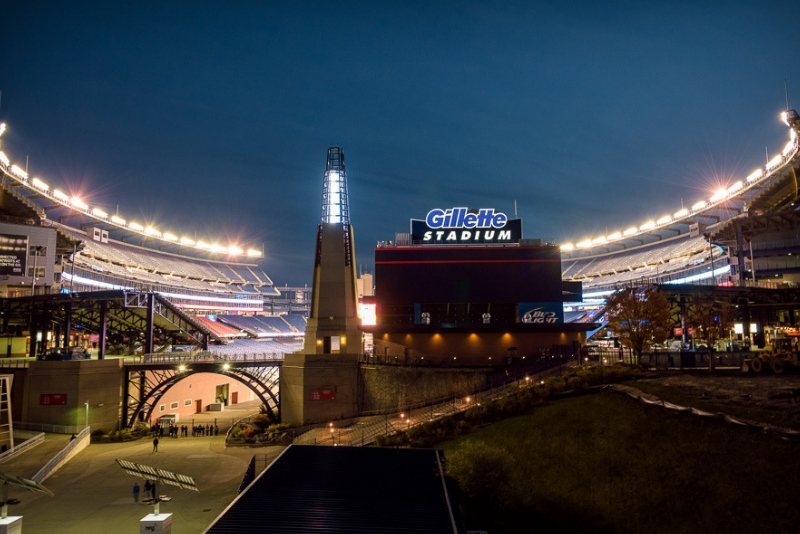
At the start of the 2023 season, on a rainy, windy day in Foxboro, the Patriots played the Philadelphia Eagles. The now-retired Tom Brady was the guest of honor, and was named the inaugural “Keeper of the Light” at the newly-renovated Gillette Stadium lighthouse.

As with many another empire, we can learn so much about a place and a people from their architecture. (It’s best if you can imagine the word spoken in the accent of Lord Kenneth Clark: “ar-KEY-tek-sure.”) The Gillette Stadium lighthouse tells the story of the New England Patriots in two simple images. Here is the original lighthouse as it looked from 2002 until 2023, during almost the entire run of New England’s success.

Sleek and spare, more a concept or suggestion of a lighthouse than a full-scale replica, without any unnecessary ornament. A pure column of light; Spartan maximization of efficiency. A turn-of-the-millennium expression of power and energy, just like the great Patriots teams of the era.

And here is its 2023 replacement: an unimaginative, gray, boxy, brutalist beast, squatting low over the field like a miserly ogre. Bigger? Yes. Better? Not by a long shot. It is emblematic of an organization whose vital energy is spent. Whatever fire Brady, Belichick, and Kraft had stolen from the gridiron gods long since burned out. Watching an oddly gaunt Brady standing atop this monstrosity, as the team he once led to glory fumbled its way to an ugly loss, I couldn’t help but think of Shelley’s classic lines:

And on the pedestal these words appear:
“My name is Ozymandias, King of Kings:
Look on my works, ye Mighty, and despair!”

No thing beside remains. Round the decay
Of that colossal wreck, boundless and bare
The lone and level sands stretch far away.

Oh, well. “For one brief, shining moment” and all that. As Patriots receiver Julian Edelman prophesied, while in the thick of the greatest comeback in Super Bowl history: “It’s gonna be one helluva story.”

Look, I know this book is about American football, and I know most of my readers couldn’t care less about American football. But hear me out, okay? Because this post isn’t really about football. I mean, there will be references to some football-related matters, but you can skim past those if you want. No, this post is actually about something deeper, more essential… this post is about aesthetics.

What do I mean by that? Time will tell. For now, let me begin by summarizing: Paul Brown was the coach of the Cleveland Browns, who dominated the sport during the 1950s. Brown’s teams racked up records and championships during the first few decades of their existence. Until a new team owner, Art Modell, took over and fired Brown after a few bad years.

Like Coriolanus, Brown decided to raise a team of his own in the south, and take his revenge. And thus the Cincinnati Bengals were born in 1968, and instantly became a major rival of the Browns. Throughout the ’70s and ’80s, the Bengals and Browns met twice a year, usually with one team having something to play for and the other merely playing out the string on a lost season. Oddly, surprisingly often, the team with nothing to play for would win.

The ’80s were peak years for the rivalry, with both teams enjoying considerable success during the decade, although neither ever managed to win the Super Bowl. Twice, the Bengals fell short to San Francisco 49er teams coached by a former assistant coach of theirs, Bill Walsh.

And then, in 1991, Paul Brown died, and the two teams collapsed. The Bengals became a perennial joke throughout the ’90s and the Browns–well, remember that Modell fellow from before? He packed up and moved the team to Baltimore, rebranding as the Ravens. Not until 1999 would Cleveland be granted a new team, with the colors and records of the old Browns, but most certainly not the tradition of winning.

And this is Knight’s thesis: the Bengals and Browns are haunted by the man who essentially created them both. Somewhere out there in the ether, the ghost of Paul Brown hovers over them, looking down with grim disapproval at his once-proud teams. Neither can succeed until this angry spirit is appeased.

Of course, this is all a manner of speaking, in the grand tradition of sports curses. There are plenty of obvious materialistic explanations for the Bengals’ and Browns’ many failures. Although, there are some things that do strain probability…

This book was published in 2018, and since then both teams have enjoyed some success. The Browns finally broke their playoff-less streak in 2020, and the Bengals actually made it to the Super Bowl in 2021. (Losing, it must be noted, in very much the same way they did to the 49ers in 1988.) So perhaps the curse is lifting. But can it really be said to be ended until at least one of these teams holds aloft the Vince Lombardi trophy?

Knight’s prose is light and enjoyable, and he has a knack for clever phrasing and for highlighting amusing instances of ironic misfortune in the histories of both clubs, of which there are many. I’m pretty well-versed in football trivia, but I still learned a few new factoids.

All well and good, you say; but why am I dedicating one of my October blog posts, normally reserved for reviewing Halloween-related stories, to this book?

Watch this clip of the Browns/Bengals game from Halloween of last year. You don’t need to know a thing about football. All you need to know is that it’s Halloween night, and two teams whose colors are orange and brown and orange and black, are battling it out under the lights, amid a sea of roaring fans, many of whom are rigged out in costumes befitting All Hallows’ Eve.

The whole spectacle is weird and eerie, and, I’d argue, perfect for Halloween. The NFL should make it a tradition: every year, on the Thursday, Sunday, or Monday night closest to October 31st, the Bengals play the Browns. It’s really the perfect uniform combination for the occasion.

Now, it’s true that other teams, including the Broncos, Bears, and Dolphins have orange in their uniforms. (And indeed, the Bengals played a memorably weird game against the Dolphins on Halloween a decade ago.)  But only the Bengals and Browns have that added (pumpkin?) spice of being arch-rivals. The memories of past triumphs and defeats echoing in every hit; the vaguely Biblical theme of two feuding brothers, and the added passion of the costumed fans, all combine to make a potent brew for epic gridiron madness.

And, in my opinion, football is as much a part of the Halloween season as jack-o’-lanterns and candy. Granted, I live smack dab in the middle of the state where the sport was effectively invented, but it is impossible to imagine midwestern Autumn without the thwack of offensive and defensive lines smashing together, seeing replica jerseys everywhere, team banners and pennants flying amid the Halloween decorations, and hearing the Monday morning radio shows buzzing about how the season is going. There’s a reason why, when I wrote a short story as a love-letter to the Halloween season, I had to include a scene at a football game.

And, as some of you may know, I am not even primarily a fan of either of these teams. (Though I will always have some fondness for the Bengals.) My team plays further north, and is more associated with the “something of winter in their faces” that  John Facenda once spoke of, than with the warm orange-and-brown hues of Autumn. Yet, my judgment remains the same: the Bengals and Browns are the perfect Halloween teams.

Okay, I know most of you couldn’t care less about American football. But hear me out on this.
George Plimpton was a pioneer of participatory journalism—that is, journalism in which the writer actually participates in what he’s writing about, as opposed to simply describing it as a bystander. His many exploits included playing in the New York Philharmonic Orchestra, boxing with Archie Moore, and pitching in an MLB game.

But arguably his most famous act of participatory journalism was his time as quarterback of the Detroit Lions. Plimpton joined their camp during the 1963 season, and participated for five plays in an inter-squad scrimmage. Here’s how he introduces the fateful moment:

“The offensive team in their blue jerseys, about ten yards back, on their own twenty yard line, moved and collected in the huddle formation as I came up, and I slowed, and walked toward them, trying to be calm about it, almost lazying up to them to see what could be done.”

After his five plays were run, the Lions had lost 29 yards. Certainly an inauspicious playing career, although as time has gone on, it’s proven to be far from the most embarrassing thing to happen to a Lions quarterback.

How interesting could a book about a man being terrible at football be, you ask? Well, that’s just it. Plimpton may have been a bad quarterback, but he was a magnificent writer. He could make anything sound interesting. Something as boring as lining up under center, he makes memorable:

“I took a few tentative steps toward Bob Whitlow, the center, waiting patiently over the ball. I suddenly blurted out: ‘Well, damn it, coach, I don’t know where to put my… I just don’t know…’

The coaches all crowded around to advise, and together we moved up on Whitlow, who was now peering nervously over his shoulder like a cow about to be milked.”

What makes Paper Lion great isn’t Plimpton’s scrimmage performance by itself. That just serves to give the book a structure and a dramatic climax. But the real meat of the book is in Plimpton’s descriptions of what goes on behind the scenes of an NFL team, like the annual revue they put on after the final roster cutdowns, in which the rookies mock coaches, veterans and league officials. Plimpton describes himself performing in the role of then-NFL commissioner Pete Rozelle:

“I wore a Napoleon hat, a cloak, a wooden sword, three cap pistols and a rubber dirk; and I carried a pair of handcuffs, a tack hammer, and a frying pan. These artifacts… were supposed to suggest the inquisitorial aspects of Rozelle’s office.

…and when I clanked toward the footlights, and said ‘Howdy, I’m Petesy Rozelle,’ the audience delivered a stiff barrage of invective.”

Or, during a hazing session where rookies are made to sing their college fight songs before the entire team, Plimpton struggles to recall his alma mater:

Crimson in triumph flashing

‘Til that last white line is past.

er… We’ll fight for the name of Harvard

‘Til… that last white line is past….

There are his depictions of all the Lions players, like Earl Morrall, the journeyman quarterback who would later go on to join the legendary 1972 Miami Dolphins, and of George Wilson, the Lions’ firm but good-natured coach. Dick “Night Train” Lane, whose record for interceptions in a season still stands to this day. Dick LeBeau, who would go on to a Hall of Fame career as a defensive coach, was a member of the team, whom Plimpton recalls the players likening to a pop star.

Above all, there are the antics of lineman Alex Karras. Karras was suspended for the 1963 season for gambling, but he still makes his presence felt as Plimpton recounts stories of him. Karras was a hambone, a performer by nature, always improvising skits and stories to amuse his teammates waiting in the hotel before a game, as in his recollections of an imagined “former life” in World War II:

“I knew all those cats, Runstedt, Goering–Bavaria Fats we called him–and Rommel. He had a terrible weak stomach, Rommel did. He used to get sick all the time. I’d come rushing up to him in the morning to fling the salute at him, and say, ‘Hello, hello, heil, heil, good mornin’ gener’l,’ and he’d get sick.”

It’s no surprise Karras went on to a career in acting after his football days ended. He had a natural gift for entertaining—but then, as Plimpton describes, as game time drew near, he would grow serious, and sick to his stomach. Karras’ queasiness and unpredictable temper actually reassured his teammates: “Alex is ready,” they murmur when his mood turns sour, “In five minutes he’ll be out there on the field making the poor fellow from Philadelphia opposite him pay for it.” Plimpton concludes the chapter, “We crowded into the elevator. No one said anything going down. Karras would sit alone on the bus.”

Plimpton had an incredible talent for knowing just how to end a chapter. I’m not sure I’ve ever read anyone else who could do it as well as he could. Here’s his conclusion of the chapter about his ill-fated scrimmage, when he hears a woman in the stands call out to him:

“She was wearing a mohair Italian sweater, the color of spun pink sugar, and tight pants, and she was holding a thick folding wallet in one hand along with a pair of dark glasses, and in the other a Lions banner, which she waved, her face alive with excitement, very pretty in a perishable, childlike way, and she was calling, “Beautiful; it was beautiful.”

The fireworks lit her, and she looked up, her face chalk white in the swift aluminum glare.

I looked at her out of my helmet. Then I lifted a hand, just tentatively.”

Plimpton’s time with the Lions occurred in the shadow of departed star quarterback Bobby Layne, who had led the team to multiple NFL championships in the ’50s. Legend has it, Layne cursed the team when they traded him, saying they would not win another title for 50 years. And as of this writing, they still have not, being one of the worst franchises in the NFL over the last half-century.

I wonder if the book would have been the same if Plimpton had chosen some other team for his experiment. He had tried to go to the New York Giants, the New York Titans (now Jets) and the Baltimore Colts. But somehow, it seems right that it was the Lions who had this awkward, lanky quarterback who wore number 0 and who stumbled on his first play from scrimmage. There is a poetic quality to it—someone who knows he hasn’t got a chance, but is trying anyway, because, well, how else to know what it’s like? 

The Lions play on national TV every Thanksgiving. Generally, they lose. Even if they don’t, the game is usually meaningless, as they have almost always been eliminated from playoff contention by that time. But I love this tradition, because there’s a kind of melancholic beauty to it, just as there was to Plimpton’s venture. Sitting down to Thanksgiving dinner on a dreary day—as midwestern November days always are, somehow even when they are sunny—and watching the Honolulu blue and silver appear on the screen as the Lions go into another ill-starred competition makes me think of old Plimpton and his wonderfully nerdy courage. 

It’s said that the owners of baseball’s Chicago Cubs believed that fans didn’t care about winning as much as they did entertainment. They were probably wrong, but I still see where they got that idea. Anyone can cheer for a winner; but it takes something special to cheer on a perennial loser, year after year. Don’t we teach kids it’s not whether you win or lose, it’s how you play the game?

And in a way, Plimpton did win. He wrote one of the greatest sports books ever—a book that captures both the details of the game and the poetry of it. Football is a late autumn sport, and is tightly connected with the mood of the season. As John Facenda said in the intro to an NFL films production I once saw, there is “something somber in the eyes of the men, something of winter in their faces…” Paper Lion depicts football’s essence, in all its violent, weird, funny, fading autumnal glory.

I’ve loved football since I was a kid—I first read Paper Lion when I was 13 years old—so I’m probably biased. But I do believe it’s possible to enjoy the book even without being a football fan, because Plimpton was such a fantastic writer. In the introduction to the 1993 edition, Plimpton described an encounter with a rustic fellow who came up to him and said that he had only ever read one book—Paper Lion. Flattered but nonplused, Plimpton asked if he’d ever considered reading another one. The man replied with the greatest compliment a writer can receive: “Have you written another one?”

Indeed, he had, and this is why I think even a non-football fan may enjoy Paper Lion. I’ve read lots of other things he wrote, on subjects which normally hold no interest for me, but which I enjoyed anyway because of his masterful storytelling and wit.

In 2003, less than a week before he died, Plimpton went to Detroit for a ceremony at halftime of a Lions’ game to commemorate the 40th anniversary of the book and reunite with some old Lions’ stars. I remember watching the game on TV, and thinking how weird it was to see number 0 on a football jersey.

Of course, the Lions lost the game, 23-13.

I’ll keep this short; since I haven’t been following football as closely as in the past. In the preseason, I predicted the Rams would lose the Super Bowl, albeit to the Steelers. I’m tempted to just say well, that was my pick going in, and leave it at that.

But no; you deserve better. In the conference title round, I predicted the Rams would somehow win despite the Saints being the better team, and sure enough, that’s what happened–the refs (and bone-headed Saints’ play-calling) handed the game to the Rams.

Meanwhile, the Patriots have been left for dead multiple times this season, only to rise again like the Terminator coming after Linda Hamilton. Can the Rams beat them, and avenge the loss of 17 years ago that started it all?

Let’s go back to first principles: defense wins championships. While neither team has a great defense, the Patriots at least have a decent one, whereas the Rams, despite having all-star talent, have a pretty bad defense.

Ironically, the Rams’ main defensive strength–their linemen–would have been better equipped to beat the Patriots of past years, who were very pass-happy and almost entirely dependent on Brady. But this New England team relies more on the power running game than previous editions.

The Rams will still get pressure, but I suspect it won’t matter as much as it would have in the past. The Patriots will run the ball to slow down the rush. When the Rams are on offense, the Patriots will take away their running game and force Goff to beat them through the air. He may do OK, but I doubt he’ll be able to repeat the performance Foles put up last year against New England.

I would love an ugly, defensive slugfest that ended with a score like 9-6. Mostly just to spite the NFL executives and TV people who were hoping for a Rams/Chiefs rematch so they could have another ridiculous 54-51 game. There is beauty in well-played defense, I tell you!

Oh, well. That probably won’t happen. I applaud the Rams for wearing their beautiful throwback jerseys, which I’ve always thought were some of the best in football, and I wish them well. But, in the end, I’m sticking with my pre-season prediction that the Rams will come up short.

NE: 28

LA: 20

…and think, if not for their mystifying inability to beat bad teams, it might so easily have been the Steelers!


51fFraKeUML._SX331_BO1,204,203,200_This is a light-hearted novel about two imaginary expansion NFL teams, the Los Angeles Leopards and the Portland Pioneers. The two teams enter the league simultaneously—the Leopards led by coach Bobby Russell, who takes a methodical, conservative approach to slowly building a team. 

After a few seasons, Leopards owner Cedric B. Medill (yes, he’s a movie producer) grows impatient, and fires Russell, replacing him with brash, loud-mouthed defensive coordinator Randy Dolbermeier. Russell gets picked up as defensive coordinator by the Pioneers and, after a car accident leaves Pioneers coach Denzel Jackson incapacitated, takes over as interim head coach. And—can you believe it?—finds himself coaching in the Super Bowl against his old team and Dolbermeier.

Interwoven with the on-field exploits of the Pioneers and the Leopards is a subplot with a sportswriter/poet and a few of his colorful friends, who have been gradually uncovering that Dolbermeier is more than just an arrogant jerk—he’s an outright cheater, using underhanded methods to gain an advantage over his opponents. There have been hints of this beginning with his time as defensive coordinator for the Leopards, and once he’s given full control of the team, it gets really out of hand. And of course, they finish building their case against Dolbermeier just as the Leopards/Pioneers Super Bowl is about to be played, setting up a denouement which I won’t give away here.

The book is written with a light touch—Levy tends to favor warm, sometimes downright corny humor over tension or drama. A good example is when the journalist and his friends are investigating the visitors’ locker room at the Leopards’ stadium, suspecting that Dolbermeier has bugged it. I figured it would be a thriller-like sequence, where they have to sneak in to Dolbermeier’s hidden room and avoid getting caught. But no, they just end one chapter by saying “let’s go check it out” and in the next chapter, they say, “Yep, sure enough, it’s bugged.”

Don’t get me wrong; Levy’s humor and good-nature are infectious. Some of the malapropisms uttered by the heavily-accented equipment manager made me chuckle. And then, of course, there are Levy’s countless references to the NFL’s heyday. 

For those who didn’t recognize the name, Levy isn’t just a football fan. He is a Hall of Fame NFL coach who guided the Buffalo Bills to four consecutive AFC titles. (Alas, they went 0-4 in their Super Bowls.) His novel is filled with references to the football stars of the ‘80s and ‘90s. In particular, characters like Kelly James, Thomas Thurber and Deuce Smithers, among others, are clearly modeled on Bills greats who played for Levy. (The names that aren’t clear references to famous players or coaches are usually groaner puns—e.g. the front-office secretaries, sisters Nina and Ada Klock.) 

Even if you don’t like football, it’s an amusing book. Football fans will get the most out of it though, with all the references to famous players, and the discussions of football philosophy—Russell’s conservative, defensive-minded approach versus the glitzy, high-scoring style is part of the conflict at the heart of the story.

It’s also interesting to speculate as to who Levy had in mind as the model for coach Dolbermeier. While most of the good characters are pretty thinly-veiled, Dolbermeier is a little harder to figure out. His “whatever it takes to win” philosophy and his contempt for rules will make most football fans think immediately of Bill Belichick, but his brash, loudmouth manner seems more Rex Ryan-ish.  He might also be based on Chuck Dickerson, a defensive line coach for the Bills whom Levy fired for publicly trash-talking an opponent.

It’s worth noting that many of the cheating methods Dolbermeier employs have been used in the real NFL. The New England Patriots’ videotaping scandal is the most obvious parallel—although they’ve never been found guilty of taping other teams at practice. It is said that Peyton Manning believed the locker room at Gillette Stadium was bugged, although again, no one ever proved this. And coaches’ headsets are notorious for malfunctioning in Foxboro, another tactic that Levy’s villain uses. Dolbermeier also implements a bounty system like the one the New Orleans Saints used during their Super Bowl season. (Levy’s book was published in 2011, before that scandal broke.) 

It’s remarkable to me that a Hall of Fame coach would write a book like this, with cheating in the Super Bowl as the heart of the plot. It almost makes me wonder if Levy was trying to hint that cheating really is occurring in the NFL. Or at least, suggesting that the league is employing too many dishonorable, Dolbermeier-like coaches, and not enough forthright, honest ones like Russell and Jackson.

In any case, Between the Lies is a fun read for anyone who enjoys football, and especially for Bills fans like me, who long for the glorious days when Coach Levy had us winning the AFC, and the Patriots were in the cellar.

As I warned in the preamble to my season-opening haiku, I haven’t watched much football this year. In fact, I wasn’t even going to do this post. But then I remembered how I met (well, virtually met) my friend Barb Knowles three years ago thanks to my title game predictions post. And through Barb, I met Carrie Rubin and a host of other wonderful people. So you never know what’s going to come from these things. And besides, I’m a big believer in maintaining traditions.

But if I haven’t watched football, you ask, how can I predict the games? Well, I have a colleague who keeps me informed about the season—every week we discuss our hatred of what the NFL has become, and he briefs me in detail on all the horrible, stupid things the players, coaches and organizations have done. It’s actually really helpful—saves me the time of watching. That, combined with checking a few stats, leaves me fully qualified to talk about this. Or at least, no less qualified than when I did watch football religiously.

NFC 

The NFC game is easy. I picked the Rams to represent the NFC in the Super Bowl in my preseason picks. I’m not changing it now; even though New Orleans has homefield advantage and beat the Rams earlier in the season.

…And have the better quarterback. And are generally a more balanced team.

Ugh, it’s a big hill for the lads from Los Angeles to climb isn’t it? Nevertheless, I am steadfast! The Rams wore their beautiful throwback blue and yellow uniforms against Dallas. They should bring out the road version of that for the title game—it’s a gorgeous uniform, and the one they wore in their lone Super Bowl victory as well. It’s time once again to “Ram It, LA!”:

I know. Words fail.

Anyway, I’m actually not feeling great about LA’s chances. But they are healthier on defense than when the Saints trounced them earlier this year. I predict they manage to get it done.

RAMS: 34

SAINTS: 30

AFC

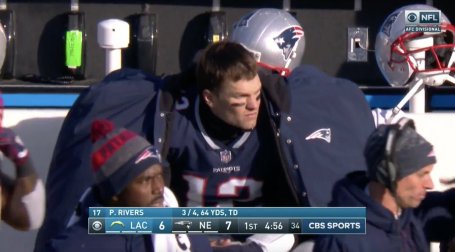
Like death and taxes, the Patriots are. They were supposed to finally fall apart this season, and indeed they haven’t been as good as usual. But here they are, yet again. Honestly, I think the fact that they annihilated the Chargers tells you more about how hard it is to come from California to Massachusetts in January than about the quality of the Patriots. It was a chilly day in Foxboro, so much so that Tom Brady broke out the Napoleonic greatcoat he first wore as a rookie during the 1812 invasion of Russia:

Dwz73jXWsAEdU5d

It’s even better with the hat:

image

But enough fun! The Patriots hate fun. And no one embodies fun like the loose, energetic, youthful up-and-coming Patrick Mahomes and his high-flying, quick-scoring, no-look-passing, what-is-defense-anyway Kansas City Chiefs.

The Chiefs are the sort of team the NFL loves—a pro version of a Big 12 team. A team that scores a ton of points, and gives up almost as many. I’m sure the league office is lighting candles and praying they get a rematch of that absurd Rams/Chiefs Monday night game for the Super Bowl. The old defensive coaches of yore are spinning in their graves.

The problem is, these kinds of all-offense, no-defense teams have historically fallen apart in the playoffs. Look at the Bills in 1990. The Rams in 2001. The Patriots in 2011. The Broncos in 2013. The Chiefs are the sort of team that sets records in the regular season, and collapses in the playoffs. And Belichick built his reputation beating these kinds of teams—he was responsible for the defenses that shut down the ’90 Bills and the ’01 Rams. (And the ’11 Patriots, come to think on it…)

 Then you have Chiefs coach Andy Reid. There are two threads running through his career—one of them is going to be the storyline come Sunday night. 

The first thread is a story of failure. As coach of the Eagles, Reid lost the NFC title game to the Rams in 2001, to the Buccaneers in 2002, to the Panthers in 2003, and then finally got over that hump only to lose to Belichick’s Patriots in 2004. For good measure, he lost a final NFC championship to the Cardinals in 2008. A few more early-round losses and he was run out of Philadelphia, taking his knack for regular season success and post-season disaster to Kansas City, where he has added a real dramatic flair to the heartbreak, blowing huge leads to the Colts in 2013 and the Titans—the Titans, for God’s sake!—in 2017. And in 2015, he even did a sort of reenactment of his Super Bowl defeat, by mismanaging the clock in a loss to the Patriots.

Ah, the Patriots. That’s where the second thread of Reid’s career comes in. With Philadelphia, he generally struggled against them. (Join the club!) But with Kansas City, he has had the distinction of administering two of the most lopsided beatings the Patriots have suffered during Belichick and Brady’s time. First in 2014, a 41-14 drubbing that made some people wonder if The Terror was over, and then in 2017, a shocking 42-27 bloodbath that saw the Patriots give up 537 yards of offense. And imagine how bad it would have been if Belichick weren’t a defensive genius!

And let’s not forget that Doug Pederson, whose Eagles defeated the Patriots in last year’s Super Bowl while racking up 538 yards of offense, is a disciple of Reid who uses many of the same offensive concepts. In summary, it’s fair to say New England struggles against this offense.

It’s an interesting matchup: the Chiefs flying circus offense is exactly the kind that fails in the playoffs. On the other hand, the Patriots bend-and-then-break-and-then-hope-like-hell-Tom-Brady-bails-us-out defense also tends not to perform well in these games. It’s the very stoppable force vs. the eminently movable object.

As for that relying-on-Brady strategy? It’s not working like it used to in the past. And I think Belichick knows it—he’s calling more on the running game, because he knows old number 12 can’t make all the throws he used to. People keep waiting for Brady to decline, but I think he’s already started to—it’s just that the Patriots are great at hiding it. (And Brady, to his credit, is still a crafty veteran who knows lots of mind games to play with a defense to compensate for his declining arm strength.)

Yes, I know the Patriots managed to beat the Chiefs earlier this year—but it was in Foxboro, and the score was 43-40. Doesn’t sound to me like they really shut down the Chiefs offense like they did another team from Missouri, back in the old days. 

The Patriots struggle on the road, and this game is being played in notoriously loud Arrowhead stadium. I predict Reid and Mahomes will field enough offense to win in frigid conditions, and that Napoletom Bradyparte will, if not meet his Waterloo, at least get exiled to a remote island until next season.

CHIEFS: 23

PATRIOTS: 19 


[I wrote this a while ago, but never posted it. Then I saw Mark Paxson’s post today and thought “why the heck not?”]

Pericles was an ancient Greek politician who presided over what is sometimes referred to as the “Golden Age of Athens”. During this period, the Athenians made many artistic and architectural achievements that are still admired in Western Civilization.

However, what sometimes gets neglected is that Pericles also presided over the end of the Golden Age, and the beginning of the Peloponnesian War. The Greek city-states turned against one another, and Athens collapsed into war and plague, the latter of which killed Pericles himself.

“Life”, as the commercials say, “comes at you fast.”

What’s this got to do with NFL commissioner Roger Goodell?

Well, he presided over the Golden Age of Football in the United States. The NFL drew huge viewership numbers and was easily the most lucrative of the major professional sports during his tenure. In his tenure, American football has gone global, and stadiums have become bigger and more ornate than ever. Even the NFL’s premier event has changed from being a predictable blowout that it used to be into, more often than not, a highly-competitive and exciting game.

But now, the end of that Golden Age is at hand. A lot of it is the self-inflicted hubris of all great powers: from making teams play awful games on Thursday nights (dressed in hideous uniforms to boot) despite the fact that players and fans alike hate it, to relocating beloved teams to richer, but less football-loving markets, the NFL’s own greed now works against it.

And then there are political divisions that turn the organization on itself. The National Anthem controversy has made the league a lightning rod for criticism, and it has reacted by trying to come up with a “compromise” that has angered people on both sides of the issue.

Then there are the concussions, which are causing fewer children to take up the sport in the first place. The NFL’s supply of gladiators to feed to the brutal sport is drying up, and so they are changing rules to try to compensate. In the process, they are destroying football in order to save it.

For all these reasons, I think the NFL is in sharp decline, and that it will soon cease to be the dominant sports league in America. And yet, it was only a few years ago that it appeared to be an invincible juggernaut.

OK, maybe this post is a little unfair to Pericles. Although he and Athens fell on hard times at the end of his career, he at least was by all accounts a charismatic orator, competent general, and left the world some marvelous ruins that still stand today. I doubt anyone will be looking at NFL stadiums a thousand years from now.

But the general point holds: when you’re at the height of your power, always remember that there’s nowhere to go but down. Or, in the words of another legendary statesman, Abraham Lincoln:

“It is said an Eastern monarch once charged his wise men to invent him a sentence, to be ever in view, and which should be true and appropriate in all times and situations. They presented him the words: ‘And this, too, shall pass away.'”


I debated whether to even bother writing these this year. I probably won’t be following the NFL very closely any more for a while. But this is a tradition here at Ruined Chapel, and as Tevye would say, tradition is how we keep our balance. So I went ahead and did it.

As usual, the order in which they appear reflects my prediction for each team’s standing in the division at the end of the season.

AFC East

Patriots

Empire’s Twilight:
Still can win the division.
But not playoff game.

Dolphins

Mediocre team
But good enough for second
In AFC East.

 Jets

Always rebuilding
Jets will be bad yet again
And fire their coach.

Bills

We ended the drought!
Then lost all our good players
And drafted a bust.

AFC North

Steelers

In Big Ben’s last year
They recapture the magic
Of Two thousand Five.

Ravens

So much for Flacco
They struggle again, and start
Jackson by week five

Bengals

Besides Death and Tax
Bengal mediocrity
Is only sure thing.

Browns

Belichick’s jealous!
Hue doubles career wins (team)
In just one season!

AFC South

Colts

Luck returns to form
And they win the division
But lose to Steelers.

Jaguars

Still a strong defense
But Blake Bortles regresses
And they miss playoffs.

Titans

Were lucky last year;
Won’t happen again this year.
Better unis, though.

Texans

Watson was a fluke;
This year, teams figure him out
And they go nowhere.

AFC West

Raiders

Gruden brings them back
To their old playoff glory
But not Super Bowl.

Chargers

They should be better
But always underachieve.
This year is the same.

Broncos

The “case” of the fluke
Quarterback in title game
Ends with the Broncos.

Chiefs

They’ll be missing Smith
When unproven gunslinger
Throws twenty-plus picks.

NFC East

Eagles

Is Wentz really good?
Yes, but they’re also lucky;
They will not repeat.

Cowboys

Who are they really?
Last year’s bad team or ’16’s?
I think it’s last year’s.

Redskins

Still paying the price
For bad management’s past sins.
Will underperform.

Giants

First round running backs
Seldom give good ROI–
Too bad for Saquon.

NFC North

Packers

Back where they belong
Reigning over division–
But can’t beat the Rams.

Vikings

The magic ran out
Against  Philadelphia;
Won’t be  recaptured.

Bears

Could surprise people
But Trubisky will flame out
In the second half.

Lions

Stafford’s getting old
Defense has never been good–
Into the cellar!

NFC South

Panthers

Behind strong runners
They win the division but
Lose out to the Rams.

Falcons

Ryan ‘s MVP
But team itself ‘s lackluster–
It’s the old story.

Saints

Brees’s decline starts
And Kamara suffers slump;
They miss the playoffs.

Buccaneers

Winston is a bust
Now they’ll have to start over
Should have known better.

NFC West

Rams

Completely stacked team
Has best record in the league;
But loses S.B.

49ers

Jimmy G is good;
But they won’t overcome Rams.
But wait till next year.

Seahawks

How do you squander
A superstar like Wilson?
Just ask Pete Carroll.

Cardinals

Poor old Fitzgerald
Has played so long on bad teams.
And he will again.

Well, well, well, I went 0-for-2 in my conference championship predictions. I think that’s the first time that’s happened since I started doing these. The New England victory wasn’t really a surprise, although the Jaguars did pretty much everything they needed to in order to win. It reminded me of the last time the Jaguars were in the playoffs—they played a near-perfect game against the Patriots and lost that one, too.

More shocking to me was the Eagles beating Minnesota. The vaunted Vikings defense looked like they were playing with lead weights in their shoes as the Eagles blew them out.

So now the Eagles draw the most dangerous opponent in all of football—the team that can be down 28-3 with 18 minutes to go in the game and still win. The Eagles knew they had won the NFC championship at halftime when it was 24-7. Even if they have a lead like that at the halfway mark of this game, there will be no such assurance.

The last time the Patriots and Eagles played, back in 2015, was one of the strangest games I can remember. Philadelphia was just playing out the string of the failed Chip Kelly experiment, and New England was, as usual, gunning for the number one seed in the AFC.

The Patriots took an early 14-0 lead, and then some bizarre spell came over everyone at Gillette Stadium and one crazy thing after another transpired. First Belichick made a shocking mistake, punting instead of running out the clock, and Philly blocked it for a touchdown right before halftime. Then in the 3rd quarter, Brady made a rare red-zone mistake and threw an interception that the Eagles returned for a touchdown.

The weirdness wasn’t over. Later on, New England ran a trick play where Amendola threw a pass to Brady. The play gained 36 yards, and then on the next snap Brady was intercepted again.

The Eagles had a 35-14 lead early in the 4th, and then New England rallied with two quick scores to close it to 35-28. The Eagles promptly fumbled the ball back to New England with a minute to go, and at this point, we all knew where this was going: another patented Touchdown Tom Terrific All-American Miracle Clutch Ageless Boy Wonder Comeback was in the offing, right?

And then… nothing happened. The Patriots got one first down and then threw four incomplete passes. Ballgame.

It was one of the weirdest games I’ve seen, and may have cost the Patriots a shot at Super Bowl 50, by causing them to lose homefield advantage to Denver, where they would ultimately lose the AFC championship.

A lot has changed since that game, especially for the Eagles, who have a new coaching staff, and a completely overhauled offense. The Patriots, while still the Brady/Belichick show, are famous for evolving considerably from one game to the next, let alone from season to season. So it might be that there isn’t much to be learned from that 2015 game.

There are still a few veterans from that Philly defense, however–maybe most importantly, defensive linemen Fletcher Cox and Brandon Graham. Graham had two sacks in that 2015 game, and everybody knows the key to beating New England is for the line to get pressure on their signal-caller.

The NFL’s final four this year came down to the Patriots and three teams seemingly designed to beat the Patriots: the Jaguars, Vikings, and Eagles all feature the strong defensive lines needed to bring pressure without blitzing. This probably isn’t a coincidence; at this point, everyone knows that if you want to win the Super Bowl, odds are you’ll have to go through the Patriots to do it.

If there’s a ray of hope for the Eagles; it’s this: they match up with New England far better than last year’s Falcons did, and that team managed to get a 28-3 lead. And though the Patriots probably won’t play as badly as they did in the first half of last year’s game, one of the oddities of the New England dynasty is that for all their football expertise and unmatched playoff experience, they never seem to bring their “A” game in the Super Bowl. The only ones where they really seemed to be giving it their best shot against an evenly-matched opponent were the one against the Seattle team that embarrassed Denver the year before, and their very first one, against the mighty St. Louis Rams and their high-powered “Greatest Show on Turf”.

All the other Super Bowls of the Brady/Belichick era (or Reign of Terror, if you prefer) have been weirdly sloppy and played down to the level of their opponent—from the defensive struggle-turned-shootout against an underdog Carolina team in 2004, to their offense’s bumbling first half against Andy Reid’s badly beat-up Eagles in 2005, to their two upset defeats at the hands of mediocre Giants squads, to last year’s furious comeback to beat a prolific but one-dimensional Atlanta team. Throughout all their Super Bowls, these Patriots have never mustered any points in the first quarter—unless you want to count Brady scoring two points for the Giants on an intentional grounding penalty in 2012.

Maybe the Patriots will notice this, come out guns blazing, and score 28 points in the first quarter. At this point, though, an underwhelming first half is starting to look like a pretty consistent habit.

As for the Eagles, while the story line this week is “what chance does unlucky backup Nick Foles have against a Belichick defense”, I’d argue that it’s actually an advantage to the Eagles to have him playing quarterback. There’s not an entire season’s worth of film of how he runs the offense for Belichick to study and learn his weaknesses.

Now, having said that there are reasons for hope if you’re rooting for the Eagles—and pretty much all of America outside of a corner in the northeast is—I don’t want to understate the magnitude of their challenge. They are facing the greatest quarterback and coach in the history of the sport. The Patriots are impossible to rattle, even if they face adversity early in the game. Beating them requires playing perfectly, and sometimes even that isn’t enough.

The Eagles will have to be very bold and aggressive if they want to shock the Pats. I’m reminded of what Sean Payton said about facing the Colts in Super Bowl XLIV and wanting to “steal a possession”. Payton’s way of doing that was a surprise onside kick to start the second half. It will take a similar level of guts to pull off the win against New England.

Do the Eagles have it in them?

Well, if I’m wrong, I’ll just go down as one more football fan who wanted to see somebody outfox Goliath. But if I’m right, I’ll look like a genius. Why the heck not?

PHI: 37

NE: 35