This is a steampunk adventure-comedy about a group of geniuses, The Hogalum Society. When their founder and namesake, Dr. Yngve Hogalum, dies suddenly, one of the society’s members, Phineas Magnetron, takes it upon himself to make a daring, perhaps even mad, effort to restore Dr. Hogalum to life.

The book is written in a verbose, overly-ornate style that is a deliberate parody of Victorian prose. It takes place in 1877, albeit an alternate 1877 with many counterfactual technologies.

A few times, the author succeeded a little too well at mimicking the wordy style of the day, to the extent that I sort of wishes he’d get to the point more quickly. I got used to this eventually, and by the end found the narrator’s sesquipedalian tendencies rather entertaining.

The book is a quick 30 minute read that serves as an intro to the world of the Hogalums. I happened to stumble across it while searching for retrofuturistic books, and while it’s really an alternate history as opposed to actually retrofuturistic, I nevertheless enjoyed it very much.

Even more than the book itself, I liked the afterword where the author explains all the historical references and deliberate anachronisms. Things that sounded like impossibilities as I read them (a 20-chamber revolver???) turned out to be based in fact. I always learn something from these “stories behind the story.”

All in all, this is a very entertaining story for anyone who likes humorous steampunk adventures.

In this, the year of our Ford 115, limitless entertainment can be summoned for us at the push of a button. We live in an era where shows, films, games, and musical performances surround us constantly. If that’s still not enough, advanced computer technology will soon allow us to create our own customized artistic experiences on a whim. Want to see photos of Star Wars as a Spaghetti Western? It’s not quite ready to produce the full film version yet, but that day will come…

Yet, for everything we have in entertainment, we lack in imagination. Indeed, there is a very clear trade-off of imaginary power being made here. When you ask the A.I. to show you a new interpretation of Star Wars, you are literally outsourcing your imagination to a machine. Isn’t that a little scary?

‘Twas not always thus. It used to be that people relied on these things called “books” for entertainment. With a book, your task is to use your imagination to complete the ideas suggested by the author’s words. It’s similar to a computer program compiling, actually. In a sense, every book is a collaboration; the author gives us the basic furnishings, but it’s up to us as readers to finish it.

Which is not to minimize the importance of the author. Quite the contrary. Whereas, say, the director of a film has the power to manage every frame, every line, every sound, to inspire a specific reaction in the audience, (and we all know the stereotype of the tyrannical micromanaging film director) an author’s job is much tougher. What is not written is as important as what is. An author has to know what to state baldly, and what to only imply. An author has to know exactly what to tell the reader.

Which brings me at last to the subject of today’s review: Gold of the Jaguar, the third installment in Peter Martuneac’s Ethan Chase series.

Gold of the Jaguar takes us on an adventure in the jungles of South America, far away from the ease of modern life. It invites us to imagine lost treasure, ancient temples, and mysterious islands guarded by eerie predators that keep watch from the trees.

And Martuneac, a U.S. Marine Corps veteran, knows what details to give to immerse you in the adventure. The combat scenes feel vivid and immediate, the equipment, ancient and modern, is so real you feel like you can touch it, and the occasional flashbacks to earlier epochs give the setting a sense of history.

Beyond that, though, this book also deals with themes of recovering from addiction, abuse, reconciliation and healing. In that respect, it feels closer to Martuneac’s zombie apocalypse series, His Name Was Zach. While this is still a light adventure compared with the ultra-dark tone of those books, this one has some emotional weight to it.

Bringing all this back around to the point I made at the beginning: why, in 2023, should you read the Ethan Chase series, out of all the various forms of fiction competing for your attention? Well, I say the answer is because it’s sincere. I don’t care if it makes me sound like Linus in the pumpkin patch; there’s nothing but sincerity as far as the eye can see. It’s an adventure story, with heroes and villains and a lot of heart.

It is not the product of a focus group at some multinational entertainment megacorp, or a famous brand-name author who long since farmed the actual writing out to nameless drudges, or an A.I. piecing together bland assemblages of words to produce simulacra of stories.

No, it’s just a tale that one man wanted to tell, and he did it, and reading it is like coming along with him on a great adventure. Let his imagination team up with yours, and be swept away in a rollicking yarn of lost treasure, danger, and exploration.

A friend recommended this to me, and though it’s not the sort of book I normally read, I gave it a shot.

Dead Cert is told from the perspective of Alan York, an amateur jockey who is horrified when his friend Bill Davidson falls during a race, and dies from his injuries. York, who was right behind him when he fell, is convinced he saw a wire used to trip his friend’s horse, but on returning to the scene finds nothing.

But York isn’t the sort to give up, and keeps digging, trying to bring Davidson’s killers to justice. In so doing, he uncovers a taxi company acting as a front for a protection racket, a systematic scheme to rig races, and a beautiful young woman for whose affections he competes with one of his fellow riders.

It’s a classic mystery book, and York is a likable protagonist. His guts, determination, and stoicism make him easy to root for, even when he does run some pretty crazy risks. The writing is snappy and clever, and moves things along briskly and wittily.

All in all, it’s a really good book. Now, as it happens, I was able to guess who the ultimate “baddie” was the minute they were introduced.  Which is fairly early in the book, but there were plenty of tell-tale signs. And yet, this diminished my enjoyment of the story not at all. Even being pretty sure what would happen, seeing it unfold was still a treat, thanks to how well-written the story was.

More than the plot itself, what I really enjoyed was the portrayal of everyday life in early 1960s Britain. The social customs feel quaint and alien to a modern reader. That’s a compliment. Francis captured the setting beautifully,

While reading about this book, I came across this gem of a quote from The Guardian‘s obituary for Francis, describing his writing:

It was an American style that many clever people in England had attempted to reproduce without much success, and it was a wonder how a barely educated former jump jockey was able to do the trick with such effortless ease.

Yeah, pretty crazy that a former jockey would be able to write a book about being a jockey, isn’t it?

This is a short YA romance story that… no, wait, don’t run away! I mean, I don’t normally read YA romance either, but hear me out. This is by Adam Bertocci, the author of such favorites as The Hundred Other Rileys and Samantha, 25, on October 31. So let’s give him a chance and see where he takes this.

Iris, our protagonist, is a high school student with a strong contrarian streak. She just doesn’t like to follow the crowd. So when everyone at school insists she needs to wear green for St. Patrick’s Day, she refuses. (Pro tip from a veteran contrarian: to be really contrary, wear orange.)

However, when she’s forced to dress up as a leprechaun to hawk cookies for her father’s coffee shop, her stubborn independence is tested when she encounters the cute boy from school whom she’s had her eye on.

I really liked Iris. She reminds me of me, when I was that age. And maybe still. If you read this blog regularly, you know I tend to march to a different drummer.

I think a lot of kids are this way, and they feel kind of like misfits in school. And really, they shouldn’t. As much as anything, I think that’s what the real point of this book is. It’s okay to be different. But it’s also important not to let your commitment to being different override your own happiness.

This isn’t as complex a book as Samantha or Riley, but it’s not meant to be. It’s a fun YA short story, told with Bertocci’s typical wit and clever phrasing. It’s a good introduction to his style, and a nice read for St. Patrick’s Day.

Oh and one last thing: I loved Iris and her friend’s school assignment on debating the American Revolution. Naturally, Iris is taking the side of the British. I just want to note that if Iris actually existed, I’d encourage her to read A True History of the American Revolution by Sydney George Fisher to build her case for rebelling against the rebels.

This is a science fiction film about the crew of a deep space exploration ship, U.S.S. Palomino, who, on a search for habitable planets, stumble upon a derelict vessel sitting at the edge of a black hole.

Kate McCrae, one of the crew members, recognizes it as the long-lost U.S.S. Cygnus  because her father served aboard it, and has been missing and presumed dead since its disappearance. 

At first, the Cygnus seems abandoned, but soon springs to life, lights flickering on and defense systems activating. The explorers are quickly conducted to the bridge, where they meet Dr. Hans Reinhardt, a brilliant scientist, who explains that he alone remained aboard after the ship became disabled. He ordered the rest of the crew to return to Earth, and is saddened to learn they did not make it. 

Reinhardt has kept the ship running with a crew of robots that he has built, led by one sinister machine called “Maximillian.” The crew of the Palomino is duly impressed with what Reinhardt has accomplished, and assures him he’ll be hailed as a genius when he returns home with them.

But Reinhardt has other plans. Over the decades that he has waited at the edge of the black hole, he has been making calculations and running experiments, and become convinced that he can pilot the Cygnus into it and emerge somewhere else. He plans to conduct this experiment soon, and invites the members of the Palomino to act as observers. Until then, of course, he is happy to have them as his guests.

While Reinhardt is undoubtedly brilliant, it’s clear there’s something strange going on aboard his creepy, nearly-deserted ship. The captain of the Palomino witnesses the hooded robot crew performing something akin to a funeral ritual.

(I couldn’t find a good still of this scene online. The above was the best I could do, but it doesn’t do it justice. It’s super-eerie.)

Meanwhile, the Palomino‘s science officer, Dr. Durant, is gradually becoming just as obsessed with the beckoning void as Reinhardt is, and seems to be falling under the sway of the charismatic scientist. This culminates in a great scene where McCrae is trying to reason with him to return to the Palomino, and suddenly Reinhardt appears looming over them both, intoning the lines from the Book of Genesis:

And darkness was on the face of the deep. And the spirt of God moved upon the face of the waters.

(By the way, this verse is also used in “Fact of Existence” by Noah Goats, another story about a creepy spaceship run by a crew of robots built by a mad scientist.  It’s a great piece of philosophical science-fiction, and I’ll never pass up a chance to hype it. We now return you to our regularly scheduled programming.)

Yes, if you hadn’t figured it out already, Dr. Reinhardt isn’t altogether on the level. He’s been concealing some important facts, which I won’t reveal here, but which you can probably guess.

The end of the film is a series of shootouts with Reinhardt’s robot crew, followed by an unexpected meteor barrage which tears the Cygnus apart even as Reinhardt, going full Captain Ahab, remains fixated on the black hole.

And yes, they do go into it eventually. What happens? Well, I’ll discuss that a little later on. For now, I want to summarize that this movie has almost all the elements I like in sci-fi: a creepy abandoned vessel in deep space, vaguely occult atmosphere, and battle robots with laser guns. And it weaves these elements into a fairly interesting story.

So, as a concept, I’d give The Black Hole an A+

But concept is only half the battle. What about the execution?

(For some reason, this makes me think of an apocryphal story about football coach John McKay.) 

Seriously folks, as good as the basic idea of The Black Hole is, the actual translation of it to the screen leaves a great deal to be desired.

First of all, apart from Maximilian Schell as Reinhardt and Anthony Perkins as Durant, the acting is pretty bad. Most of the actors deliver their lines as if they’d learned them phonetically. 

Then, there are the robots. Not the cool, bipedal evil robots; those are great! No, I mean the two little floating robots who serve as the comic relief:

These things are so annoying, and their cartoonish look clashes with the aesthetic of the rest of the film. I don’t understand why they are here.

Wait a minute; yes, I do! They’re in this film because it was the Walt Disney Company’s attempt to cash in on the popularity of science-fiction movies following Star Wars

But the thing is, this movie otherwise doesn’t really feel like Star Wars, which was a fun space operatic romp. Until the third act, this is harder sci-fi; more Trek than Wars, and thus the robots feel out of place.

About that third act… that’s where everything goes to hell, in more ways than one. As the Cygnus collapses, so does any pretense of scientific realism or logic. Let it suffice to say that, if I could ask the director of the film, “Is there oxygen in outer space?”, I am not at all sure what kind of answer I would have received. It looks more like a hurricane than a black hole at that point.

Once through the black hole, things get weirder. If the rest of the film was Walt Disney’s Star Trek, this part is Walt Disney’s 2001: A Space Odyssey. There’s no dialogue, just a series of weird images, evoking both Heaven and Hell, before a final extremely ambiguous and unsatisfying ending. 

I’ll give it this: the Hell image is very striking. There are a number of references to Heaven, Hell, and God in the dialogue, including the Bible verse quoted above, and I’m almost tempted to read the film as a religious allegory of some sort. But I’m not qualified to do that. (Patrick Prescott is. So, Pat, if you’re reading this…)

My grade for the execution of this fantastic concept is a C-, and that’s being generous. It’s disappointing, because the film could have been so much more. It’s enough to make me wish for a remake with some of the flaws ironed out, but of course with its steadfast commitment to looking forward and boldly experimenting, Disney would never consider bringing an old property out of mothballs for a quick buck.

Earlier this week, Lydia Schoch asked me where I find the things I review. Obviously, I mostly review books, not films, but this is as good a place as any to answer this question. To put it simply, I look for stuff that’s weird. In this case, I saw a video on YouTube about The Black Hole and it sounded interesting. Especially because it’s a film by a big studio, with recognizable actors, and yet I’d never heard of it before.

Of course, I can’t always count on the YouTube algorithm to serve me up a gimme like that, especially when it comes to books. For those, I’ll sometimes just search Amazon for keywords that sound interesting to me, and see what comes up that has relatively few reviews. Another technique is to pick a famous book, then try to find out what other, less-famous books are like it, and read those. For example, say you want a story about a boy at a school for wizards who must learn magic to confront an evil sorcerer. You might find the 1991 novel Wizard’s Hall, by Jane Yolen. I have not yet read this book, but maybe someday.

Above all, when I look for things to review, I try to make them random. Of course, they are not truly random, as any scientist will be quick to tell you. But they are at least, I hope, a road less traveled by. 

Lastly, I try to keep my search for interesting media informed by three quotes. The first is something Natalie Portman says in my favorite movie, Jane Got a Gun:

You might want to see a day where the sun don’t just shine on your story. Because there is a whole world out there of other people’s tales, if you just care and listen.

The second is a dialogue from the 1988 adaptation of The Hound of the Baskervilles, when the great detective explains to Henry Baskerville why even a seemingly trivial matter is worth investigating:

Holmes: “I think it is worth troubling about, as a matter of fact.”

Baskerville: “You do? Why?”

Holmes: “Because it’s inexplicable.”

Baskerville: “Good… That’s good.”

Holmes: <Jeremy Brett smile.>

And finally, something the aforementioned Noah Goats told me once that never fails to prove true:

Books lead on to books, and sometimes in strange ways. They all seem to be connected somehow.

Keeping these words in mind always helps me remember to look for the unexpected connections and the weird little rabbit holes that lead in interesting directions.

That’s probably a longer answer than Lydia wanted, but I found it a fun question to ponder. Of course, it could be I’m a nut like Dr. Reinhardt in The Black Hole; too obsessed with the bizarre for his own good. But hey, he was the best character in the whole show, so maybe that’s not all bad.

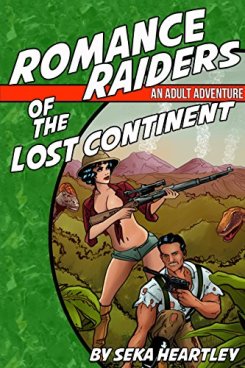
I reviewed the first book in this series last year, and this one is more of the same. Well, except the first one was sci-fi, and this is a classic 1930s pulp adventure. If the first one was Star Trek as a sex comedy, this is Indiana Jones as a sex comedy. Last time I said that the protagonist’s name, which is once again Dirk Moorcock, told you everything you needed to know. Well, I’ll add that this book has a spy named “Mata Hottie,” in case there’s any lingering confusion.

This time, around Dirk is hired by a beautiful Russian countess to guide her to, as you may have surmised, a lost continent discovered by her father. Naturally, an assortment of evil villains and monsters stand in their way, as does Dirk’s overactive sex drive.

I think the sex scenes in this book were somewhat more explicit than in the last one, which may be a good thing or a bad thing depending on your own personal preferences. They are easy enough to skim past if you don’t want to hear all the details. Though, if that’s the case, you may not want to bother with reading this in the first place. Still, if you liked the first book, you’re sure to enjoy this one as well.

I have to say, this is a great example of how you do a sequel. In general, my opinion is that it’s really difficult to keep telling good stories with the same characters again and again. Eventually, a writer starts reusing ideas, or making the characters behave in odd ways. I like this way of handling it, as a spiritual sequel (if the word “spiritual” can be used in regard to this bawdy tale) in a new setting. It allows the author freedom to keep what works from previous tales without being too closely bound by events of previous books. Hollywood should take note.

There’s simply nothing like a Zachary Shatzer book to make you laugh. This one is no exception. The sequel to Sorcerers Wanted gets going early with a hilarious recap of the events of the first book, and never lets up from there.

I can’t summarize the plot; it’s simply too wild. You have a demonic talking hamster, inter-dimensional travel, an evil overlord who turns everything into candy, and a sweet Canadian hockey mom who practices occult magic on the side. And that’s just the tip of the iceberg.

It is wacky and zany and bizarre and hilarious. I’m sure it won’t be to everyone’s taste, but if you couldn’t already tell from my reviews of all his other books, Shatzer’s style is very much to mine. I laugh out loud reading his books, which is something I almost never do, even when I am genuinely amused by a piece of writing.

Go pick this book up. If you struggle to envision the scenes in a way that strikes you as funny, try the following experiment: imagine how the book would play as a movie performed by Monty Python. As the Pythons were no strangers to playing multiple roles, you can assign them to as many characters as you like.

It’s just an idea. If you’re like me, you won’t need any additional mental tricks to enjoy this book. It will be a non-stop laugh-fest from start to finish.

Did I not say, in my end-of-year post for 2022, that I intended to review a greater variety of books? Well, this is an example of what I mean. Never before on this site have I reviewed a comic book. I haven’t even read a comic book since I was about 12 years of age.

But, last year, my friend Joy Spicer wrote about of her favorite comics, including Wonder Woman. Joy’s post about WW features the 1987 reboot of the character, illustrated by George Pérez, and I highly recommend reading it. That post was what inspired me to write this.

At first, I thought I’d start with the same comic that Joy highlighted. But you know me, I prefer to start a series at the beginning. Or close to it. The real beginning of Wonder Woman is actually in All-Star Comics #8. But this is her second-ever appearance and, well, Sensation Comics #1 is free on Kindle, whereas All-Star Comics #8 costs $1.99. Yes, I’m cheap; I admit it.

One sees instantly that the art of comic books evolved greatly in the years between ’42 and ’87. Compare the lavish artwork by Pérez with the, um, less lavish ones we find here:

Another thing which I did not expect, though perhaps I should have, was that this plot was already known to me.

You see, I know Wonder Woman from the 1970s TV series starring Lynda Carter. The pilot episode for the first season is a fairly faithful adaptation of this comic, albeit with more subplots interwoven.

The basic plot is this: Wonder Woman rescues American pilot Steve Trevor, and takes him back to Washington, D.C. Entering the “world of men,” she draws much attention, first for her appearance and then for foiling a bank robbery. She is hired to perform her feats of super-strength by a sleazy impresario, who attempts to flee with the revenue, but is of course thwarted.

Trevor, by this point recovered, attempts to fly a mission but is shot down by an enemy plane. Wonder Woman rescues him and together they find the bad guys’ hideout and defeat them. Wonder Woman then assumes the identity of a nurse at the hospital named Diana Prince.

As you know, I’m not big on rules of writing, which is good, because this comic definitely breaks some fairly basic guidelines for dramatic storytelling. You know, things like “don’t randomly give your characters new powers transparently for the purpose of advancing the plot.” That sort of thing. And frankly, I was okay with this. People nowadays take everything too seriously and want even their superhero stories to conform to dramatic conventions. But there’s nothing wrong with a bit of daft fun now and then.

But perhaps there is more to Wonder Woman than just fun, after all. Wikipedia informs us that:

William Moulton Marston… struck upon an idea for a new kind of superhero, one who would triumph not with fists or firepower, but with love. ‘Fine,’ said Elizabeth. [Marston’s wife] ‘But make her a woman.'”

[Note: I highly recommend reading Marston’s wiki. It’s one of those “impossible-to-predict-the-next-sentence” things.-B.G.]

Marston ran with Elizabeth’s idea, writing:

“Frankly, Wonder Woman is psychological propaganda for the new type of woman who, I believe, should rule the world.”

And of course, if you’ve seen the show, you must remember the theme song:

Make a hawk a dove / Stop a war with love / Make a liar tell the truth.

Which is why it’s hardly surprising that in both this comic and the TV show, Wonder Woman solved problems through conversation and empathy rather than fists and force.

LOL, psych! That’s not what happens at all. She pummels baddies left and right. She doesn’t, say, fly the invisible plane to Germany and slap the golden lasso around Hitler. I mean, that might have saved some trouble, right?

You know, there were real people, even in the 1940s, who tried to “stop a war with love.” I recently finished reading Human Smoke by Nicholson Baker, a book which, through chronologically cataloging first-hand accounts and contemporary news reports, tells the story of the global pacifist movement during the beginning of World War II. And it ends on December 31, 1941. Which means if you read Human Smoke and then read Sensation Comics #1, you’re effectively reading primary sources of World War II in chronological order.

Human Smoke is perhaps the single most depressing book I’ve ever read. Going from it to a comic book that sold for 10¢ in drugstores to amuse children is a uniquely bizarre and downright discomfiting experience. But you see, I love history, and Wonder Woman is surely as much a piece of history as any other document printed in the 1940s.

Needless to say, the real-life efforts at stopping war with love went down to defeat. Perhaps it is for the best. There are plenty of moral justifications for the use of force, and World War II is literally the textbook example. Not to go all Lt. Col. Dubois on you, but perhaps Wonder Woman is simply acknowledging the need for controlled violence to prevent uncontrolled violence. The proper role of the state, most philosophers would say, is to use its monopoly on violence to uphold the set of standards which produce civilization. A matriarchal society, as Marston apparently envisioned, would obviously need something to act as guarantor of its authority. Ultima ratio reginarum, you know…

Ah, but you see? I’m doing just what I said not to do, and taking things too seriously. That’s what happens when you read an unsparing catalog of all the human sins and miseries that led up to a global war of annihilation, and then follow it with what amounts to cotton-candy for the brain. But as the Ancient Greeks would follow their tragedies with satyr plays, so I feel compelled to follow something dark with something light. “If one is to understand the great mystery, one must study all its aspects…”

Or something like that. Anyway, Wonder Woman is an iconic character, and as silly and quaint as her early incarnations may look to us today, when you put them in the context of their time, you realize they must have served as a welcome dose of hopeful idealism and light entertainment in a world gone mad.

This is a textbook example of what I’d call magical realism. On the one hand, it’s a story about the mining of uranium in the Southwest, and the health effects it had on the miners.

But there’s more to this story, and Bruce weaves it together with the myths and legends of the native peoples. The meat of the tale is about people, beaten down by the materialistic and greedy society around them, learning to let go of their linear conceptions of time and to embrace a cosmic, cyclical view of life.

This all sounds a bit esoteric, I’m sure. And it is, but Bruce makes it understandable and relatable. With just a few sentences, I could empathize with his characters, and it was a pleasure to join them on what ultimately becomes a story of healing.

This book is definitely in the same mold as Bruce’s novel Oblivion, about a sort of commune built in the desert, around motifs of nature and healing. Like Tolkien and so many of the greats, Bruce loves his native landscape and deplores its destruction by modernity.

It’s funny; I think everyone knows, deep down, that there’s something wrong with the annihilation of nature to make way for more technology, more artificial and unwholesome modes of life. And yet no one can stop it. Like Leonard Cohen sang: “Everybody knows the war is over. / Everybody knows the good guys lost.”

Still, it’s never too late to heal, and the best time to start is always now. Quite apart from being a commentary on society, or an exploration of ancient legends, the book is about people coming to terms with their own mortality, and making peace with it.

This is a small book; but it contains massive ideas. I highly recommend it.

Last year, Lydia Schoch and I made an agreement that January 31 would be “Second Halloween.” Accordingly, I’m observing the day by reviewing a book appropriate for that spooky season.

And look at that cover. How, I ask you, could I possibly not read a book with that cover? Even though it is the sixth book in Boyack’s “Hat” series, and I have not read any of the others, I simply could not resist.

Fortunately, Boyack writes such that you don’t have to read the others to understand it. Maybe a few references went over my head, but I could follow it well enough. It tells the story of a musician named Lizzie, her magical talking hat, and a friend of theirs who has been revivified Frankenstein-style and needs to find medicine to stay alive.

But, finding the medicine means finding the doctor who restored him, and he has fallen into the clutches of the titular monster, the sinister-looking entity pictured above.

The book is fast-paced and action-packed. Lizzie and her friends must mow down waves of pumpkinheaded zombies to reach the Rambler in time. There are also moments of downtime when they gather clues by listening to a paranormal late-night radio show along the lines of Coast-to-Coast AM. As you can imagine, I loved these parts of the story.

This is a fun and enjoyable read for Halloween. Or, in this case, Second Halloween. Which is going to be a thing, by golly! What better way to liven up this dreary time of year?