“All that is human must retrograde if it does not advance.”
–Edward Gibbon, The Decline and Fall of the Roman Empire
“Everyone got famous. / Everyone got rich. / Everyone went off the rails / And ended in the ditch.”
–Warren Zevon, “Ourselves to Know.”
 Don’t close the window just because this book is about football!
I know, I know; most of you care not a whit about our strange, violent American pastime. The names “Tom Brady” and “Bill Belichick” probably mean nothing to most of my readers. Well, in a way, I envy you.
But football is still America’s game, like it or not, and the story of the New England Patriots dynasty is one of its epics. And mark this well: it is about more than just football. The story it tells is part of the story of the early 21st-century United States, and there are lessons to be gleaned from it that extend far beyond the field. That’s why I wanted to review this book, and why I think even non-football fans should read it.
At the same time… there will still be quite a lot of talk about football here. So, I have highlighted in bold the parts that contain more general information, of interest to the laity. So you can skip over the parts about whether a short pass to Faulk on 4th-and-2 was the best call, if that sort of thing doesn’t interest you.
The book begins at the end, with New England losing to the Tennessee Titans (coached by once and future Patriot, Mike Vrabel) in the 2019-20 playoffs. It then flashes back to the very beginning, when Tom Brady was just another high school kid with dreams of making getting to play for a top college, and when Belichick was an assistant coach for the famously harsh Bill Parcells.
Basically, Belichick and Brady both had massive amounts of resentment over perceived wrongs–Brady because he couldn’t even be named the full-time starting QB for one of the lesser Big Ten schools, Belichick because Parcells treated him badly, and also probably because he coached the Browns. Coaching the Browns would be enough to turn any man to evil, I suppose.
Anyway, these two psychopaths found their way to New England, a historically poor franchise, and in the autumn of 2001—a pivotal time in the history of the United States—Brady became the starting quarterback and the Patriots upset the heavily-favored Rams in the Super Bowl.
It’s hard to remember now, but at the time, they were America’s darlings: with the country united in a spirit of patriotism (also hard to remember now) the fact that the plucky all-American kid could come out of nowhere to lead a team literally called “the Patriots” to an improbable victory was just too much. It was like a Disney movie out there.
Wickersham recounts how Brady, the kid-next-door, started receiving calls from actresses and models and celebrities, and generally fêted by the power elite. It was a classic rags-to-riches story.
Naturally, Brady and Belichick wanted to do it all again. And they did, two years later, winning another championship after a 14-2 season that began with a 31-0 loss to the Buffalo Bills. (Just wanted to get that in there.) And then they won another the next year. And by this point, everyone was pretty much sick of them.
Wickersham notes how, en route to building their dynasty, the Patriots, and more specifically Belichick’s defense, actually changed the way football is played. After a playoff game in which they defeated the Indianapolis Colts by physically dominating their receivers, the league altered the rules to essentially make this type of hard-hitting pass defense illegal.
Naturally, the Patriots also took advantage of the new rules a few years later, creating what was to that point the greatest passing offense in NFL history in 2007.
While I may not like them, I would still contend that the ’07 Patriots are in fact the greatest team in NFL history, or at least, the greatest team of the salary cap era. I don’t care that they lost the Super Bowl on a fluke play; they had an absolutely insane offense and a wily, tough defense coached by the best defensive coach of the era. I still can picture them annihilating my hapless Bills on Sunday Night Football that year.
In any case, Super Bowl XLII is where the first phase of the Patriots dynasty ends. If we want to talk in world-historical Spengler/Toynbee-esque terms, this is the part where the nascent culture has flourished into a full-blown civilization. “The Patriot Way” was now well-established.
Of course, as Wickersham is quick to note, few within the Patriots organization ever uttered the words “Patriot Way” or “culture.” The best line I ever read on this was, “Belichick doesn’t believe in ‘culture.’ He believes in ruthlessness.” (Another good line from this book: Belichick “‘doesn’t hold grudges,'” someone says. ‘He holds death.'”)
What I would argue “The Patriot Way” is actually describing is asabiyya, as defined by the historian Ibn Khaldun:
[Khaldun] explains that ruling houses tend to emerge on the peripheries of existing empires and use the much stronger asabiyya present in their areas to their advantage, in order to bring about a change in leadership. This implies that the new rulers are at first considered ‘barbarians’ in comparison to the previous ones.
And indeed, the rise of the Patriots is a prime example of the rise of such a “ruling house.” The old guard of the NFL was annoyed at the rise of these newcomers. The great Don Shula himself repeatedly expressed his antipathy to Belichick, whom he believed to be a cheater. Which he is, but, as this book explains in some detail, basically everyone in the NFL is constantly trying to cheat everyone else at all times. Yes, I know; who would have thought that some of the most competitive alpha males in the world, with millions of dollars as well as prestige at stake, would try to cheat one another? Possibly in a different era, that prized honor and integrity more highly, this would not be tolerated. But we are not in such an era.
And speaking of eras, the Patriots now transitioned to the second phase of their time in the sun, a run during which they would have consistent success, but not quite be able to crack the very pinnacle of the sport.
To some extent, I think the Patriots got away from what made them successful in the early 2000s, which was strong defense. From 2007 – 2013, their strength was unquestionably Brady’s offenses, which were consistently effective in the regular season yet somehow always seemed to fail when they were most needed. I mean, good lord, 17 points against a mediocre Giants team? And let us not forget that Brady gave the Giants 2 points with a stupid safety on the first play of the game. Personally, I think it’s funny that the greatest player of his era, and the most successful player in the history of the Super Bowl, also made one of the dumbest plays in the history of same.
Still, every year the Patriots were a threat to win at all, and always owned the AFC East and my (still) hapless Bills. But that was not enough for the ruthlessly competitive Belichick, and nor was it enough for Brady, who, despite having a supermodel wife and young children, continued to be obsessively dedicated to his craft. Honestly, if the rewards weren’t so spectacular, you’d say someone this absurdly devoted to a mere sport has a mental health issue.
I’m not blaming Brady. Our society has, in a way, failed him. It would be better, I think, if society incentivized intensely-driven and competitive young men to prove themselves as statesmen, explorers, warriors, diplomats, and so forth. Had he lived in the 1950s, Tom Brady might have pushed himself with the same fanaticism to excel as a soldier or an astronaut, instead of merely flinging a ball for our amusement. Still, here we are.
(I’m less bothered by Belichick’s dedication to the sport, simply because Belichick is an old man, “and the vices of peace are the vices of old men” etc.)
Speaking of the vices of old men, it’s time to discuss the third character in the triumvirate on the cover: Robert Kraft, the owner of the Patriots and noted illegal brothel enjoyer.
Kraft took over the struggling franchise in the early ’90s. The first three coaches to work for him are all Hall-of-Famers: Bill Parcells, Pete Carroll, and Belichick. Which of course is the job of a good owner: to hire good people, then sit back and let them succeed. Kraft did well at this part.
To get even more esoteric than this review is already, it is interesting to me to observe the parallels in the Belichick/Brady/Kraft dynamic with the Victorian comic opera partnership of Gilbert/Sullivan/D’Oyly Carte. (If this seems incongruous, remember that ultimately both football and comic opera are forms of entertainment.) Belichick is an obvious analogue to Gilbert, the irascible, sometimes tyrannical director; overseeing his show with meticulous attention to detail. Brady is Sullivan, a master of his art continually believing himself to be under-appreciated no matter how many accolades come his way. And Kraft is Carte; the businessman desperately working to manage the egos of these two mad geniuses in order to keep the gravy train rolling. In the end, of course, Carte couldn’t, and neither could Kraft.
If there is anything in cyclical theories of history, then it would seem there is an entropic process to which empires, comic opera companies, and football teams alike are subject. Namely, that their prosperity ultimately destroys them, as the ambition for a larger share of the credit divides the very elites who originally powered the success of the organization.
But I’m getting slightly ahead of the story: the Patriots had two of their best seasons in 2014 and 2016, both capped off with victories in two of the most memorable Super Bowl games ever played. These victories cemented their status as the greatest dynasty in NFL history, and Brady and Belichick as the best of their era at their respective roles. To Patriots fans, it was euphoria. To fans of all other 31 teams, it was like a never-ending nightmare, an Ugg boot, stamping on a human face—forever!
Ah, but the brightest light casts the darkest shadow! When you are at the top, there is nowhere to go but down! And any other cliché you care to use. The very fact of the Patriots success now set the stage for their eventual collapse. Wickersham documents how Belichick’s joyless discipline, Brady’s paranoid resentment of backup quarterback Jimmy Garoppolo, and Kraft’s failures to reconcile the two men, made the 2017 season a particularly grim slog. It is a testament to the Patriots’ success that the fact that they made a Super Bowl again that year feels like an afterthought.
Something happened in 2017 to permanently damage the relationship between Belichick and Brady; something that not even another championship a year later could patch up. Most Patriots fans, spoiled brats that they are, will tell you 2018 is the team’s worst Super Bowl win. (If you are fan of a team which has never won a Super Bowl, you can’t help but feel a sense of schadenfreude about what happened next.)
And so we come back to where the book began: that game against the Titans in the playoffs, with a terrible sense of ending in the air. It’s not often that the word “elegiac” can be applied to a football game, but it fits this one, particularly this play, in which Brady connected with veteran tight end Ben Watson. A combined 34 years of NFL experience allowed them to improvise when the play broke down… but it was negated by a penalty. This is the way the Patriots dynasty ended; not with a bang, but an ineligible man downfield, exploitation of obscure loopholes in the timing rules, and a botched “Stanford band” play. As of this writing, it is the last playoff game played at Gillette Stadium.
The book briefly covers Brady’s escape to Tampa Bay, where he built a team of superstars that won him a 7th title and elevated him above Belichick in the minds of most football fans. The fact that Belichick’s Brady-less teams struggled to achieve even mediocrity further hammers home the point: it was Brady, not Belichick, who was responsible for the Patriots multi-decade run of success. Not that fans don’t continue to debate it even now.
But this “debate” ultimately misses the point: everyone knows it is players, not systems, that win games. The greatest football coach in the universe will not win consistently if he does not have players who can execute his schemes. A great coach gets the most out of his players. His success or failure depends, ultimately, on what the players’ ceiling for “most” is.
There was a very telling incident last season, when Baker Mayfield, Brady’s successor as quarterback of the Buccaneers, talked about how “everybody was pretty stressed out” during the time of TB12, and how Mayfield saw himself as bringing “the joy back to football.”
Brady responded: “I thought stressful was not having Super Bowl rings… There was a mindset of a champion that I took to work every day. This wasn’t day care. If I wanted to have fun, I was gonna go to Disneyland with my kids.”
Indeed, Brady so relentlessly pushed himself that he didn’t even go to Disneyland with his kids all that much, and there is some reason to think that his borderline pathological pursuit of greatness destroyed his marriage. But there can be no doubt Brady’s obsession with constantly improving himself and his teammates made him the perfect man to execute Belichick’s scheme. I don’t like to put too much stock in generational stereotypes, but it may be that Brady, with his classic Gen X nose-to-the-grindstone, chip-on-the-shoulder attitude, was just a better fit for the quasi-military mindset Belichick demanded, contrasted with the more laid-back attitude often attributed to the millennials who followed him. (I am a millennial, so I can say it: neither Brady nor Belichick would be the sort of guys to take kindly to participation trophies.)
This is where Wickersham’s chronicle ends, and as a rise-and-fall story–well, it ain’t Barry Lyndon, but it ain’t bad. But something is missing. It’s not Wickersham’s fault. His publication deadline prevented him including the last chapter of the saga, which I feel is necessary to complete the story of the Patriots Dynasty.
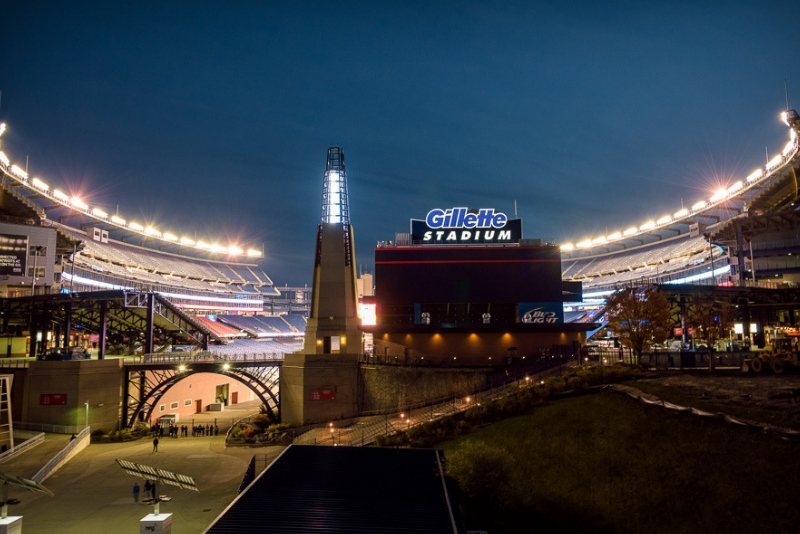
At the start of the 2023 season, on a rainy, windy day in Foxboro, the Patriots played the Philadelphia Eagles. The now-retired Tom Brady was the guest of honor, and was named the inaugural “Keeper of the Light” at the newly-renovated Gillette Stadium lighthouse.
As with many another empire, we can learn so much about a place and a people from their architecture. (It’s best if you can imagine the word spoken in the accent of Lord Kenneth Clark: “ar-KEY-tek-sure.”) The Gillette Stadium lighthouse tells the story of the New England Patriots in two simple images. Here is the original lighthouse as it looked from 2002 until 2023, during almost the entire run of New England’s success.
Sleek and spare, more a concept or suggestion of a lighthouse than a full-scale replica, without any unnecessary ornament. A pure column of light; Spartan maximization of efficiency. A turn-of-the-millennium expression of power and energy, just like the great Patriots teams of the era.
And here is its 2023 replacement: an unimaginative, gray, boxy, brutalist beast, squatting low over the field like a miserly ogre. Bigger? Yes. Better? Not by a long shot. It is emblematic of an organization whose vital energy is spent. Whatever fire Brady, Belichick, and Kraft had stolen from the gridiron gods long since burned out. Watching an oddly gaunt Brady standing atop this monstrosity, as the team he once led to glory fumbled its way to an ugly loss, I couldn’t help but think of Shelley’s classic lines:
And on the pedestal these words appear:
“My name is Ozymandias, King of Kings:
Look on my works, ye Mighty, and despair!”
No thing beside remains. Round the decay
Of that colossal wreck, boundless and bare
The lone and level sands stretch far away.
Oh, well. “For one brief, shining moment” and all that. As Patriots receiver Julian Edelman prophesied, while in the thick of the greatest comeback in Super Bowl history: “It’s gonna be one helluva story.”
Like this post? Then please share it!
 The title is a lie. This isn’t just a review of Zachary Shatzer’s new book, The Beach Wizard and the Easy Mind. This makes the third entry in the Beach Wizard chronicles, and while I have no idea if Mr. Shatzer plans to continue the series or keep it as a trilogy, this seems like as good a time as any for a big picture retrospective