mini red hearts wallpaper
Photo by Ylanite Koppens on Pexels.com

[Thanks to Lydia Schoch for inspiring me to write this. Be sure to check out her post on fictional romances.]

You’ll notice I don’t often write romantic sub-plots in my stories. I was feeling pretty bold with 1NG4 and included one, but it’s largely implied and in the background of the larger story. 

Romance is hard to write. You need characters who work on their own, and also complement one another. It’s about balance. If you get unbalanced characters, it doesn’t work—or at best, it only works as wish-fulfillment for people who want to imagine their perfectly ordinary self being married to a demigod or goddess. 

And if you’re writing a story where the romance is the plot, then you also have to come up with some reason why two characters who clearly belong together aren’t. Usually social expectations are the best mechanism for doing this, to the point that it’s a cliché—A can’t marry B because it would violate all of their society’s most sacred traditions!

The problem with these sorts of stories is that too often, it becomes more about the pursuit, and in the process, one character gets reduced to nothing more than a McGuffin that the other character is trying to get. I hate that.

Here are some fictional romances I consider effective. You’ll notice that they are generally sub-plots, or at least not the sole focus of the story.

Evie Carnahan and Rick O’Connell (The Mummy) 

Image result for rick and evie o'connell
Evie Carnahan (Rachel Weisz) and Rick O’Connell (Brendan Fraser) The Mummy. Universal Pictures. Re-used under Fair Use

This works because it’s pretty well-balanced—Evie’s brains and Rick’s adventuring skills make them a natural team. This is what I mean—if Evie were always a helpless damsel in distress, or Rick were always a big stupid lug, it would be dopey. But as it is, you can see why they would gravitate to one another, apart from “It’s a movie and we need a romance.”

Thomasin Yeobright and Diggory Venn (The Return of the Native, by Thomas Hardy)

When you read about Return of the Native, 90% of what you hear about is Eustacia Vye this, Damon Wildeve that. I love the book, but as far as I’m concerned, both of them can go soak their heads. Oh, wait—I guess they do. Sorry if I spoiled this 141-year-old book. Anyway, what I like about the book is Venn’s loyalty to Thomasin, and his (admittedly credulity-straining) adventures as the almost super-human “Reddleman” looking out for her.) 

Miranda Lawson and Commander Shepard (Mass Effect 2-3)

Image result for miranda lawson shepard
Commander Shepard (voiced by Mark Meer) and Miranda Lawson (voiced and modeled on Yvonne Strahovski) Mass Effect 3. Electronic Arts. Re-used under Fair Use.

Am I the only person who doesn’t hate Miranda? I might well be. Most players find her stuck-up, but I like her. Maybe part of it is that because ME 2/3 built up Commander Shepard as this awesome hero, and Miranda seems like the nearest thing to his equal in a universe that otherwise regards him as something close to a God. She saved his life, and she’s genetically engineered to be perfect, so she  can meet him on even ground. I like that. I don’t see an equivalent romantic interest for female Shepard.

But maybe it’s just my fondness for Australian accents that’s making me biased here.

Honorable Mentions: Unrequited Romances

I started out to make a list of good requited romances, because those are harder for me to write than unrequited ones. But that’s not to say that an unrequited romance can’t make for a good story, because it absolutely can. In fact, the advantage of these stories is that they have conflict inherent in them, as opposed to having to be introduced externally. So, here are some good ones:

-The Carlo/Corelli sub-plot in Corelli’s Mandolin. One of the most interesting things about the disastrous movie adaptation was that this was the only romantic sub-plot that even remotely made sense. 

– The Atris/Jedi Exile relationship in Knights of the Old Republic II. I talk a little about that here. Actually, KotOR II is brimming with tons of unfulfilled or outright doomed romances. Chris Avellone is great at writing those.

-Elsie Maynard and Jack Point in The Yeomen of the Guard. Just listen to this.

And now, for my favorite fictional romance…

Jane Ballard and Dan Frost (Jane Got a Gun)

Jane and Dan
Jane Ballard (Natalie Portman) and Dan Frost (Joel Edgerton) Jane Got a Gun. The Weinstein Co. Re-used under Fair Use.

Come on, you all knew this would be here. I love this movie, and a big reason why is the relationship between the two leads. The way they gradually rekindle their relationship under brutal circumstances makes for a great story, and the carefree romance of their past contrasted with the grim present is very powerful. True, a lot of what makes it work is the acting as much as anything—the same lines with lesser actors wouldn’t work as well.

I suppose that writing romance for the screen or the stage is easier than writing it in a novel. In a visual medium, putting two attractive people with great chemistry together gets you at least halfway to making the audience to buy in. On the page, though, you have to do a lot more work.

I’ll keep this short; since I haven’t been following football as closely as in the past. In the preseason, I predicted the Rams would lose the Super Bowl, albeit to the Steelers. I’m tempted to just say well, that was my pick going in, and leave it at that.

But no; you deserve better. In the conference title round, I predicted the Rams would somehow win despite the Saints being the better team, and sure enough, that’s what happened–the refs (and bone-headed Saints’ play-calling) handed the game to the Rams.

Meanwhile, the Patriots have been left for dead multiple times this season, only to rise again like the Terminator coming after Linda Hamilton. Can the Rams beat them, and avenge the loss of 17 years ago that started it all?

Let’s go back to first principles: defense wins championships. While neither team has a great defense, the Patriots at least have a decent one, whereas the Rams, despite having all-star talent, have a pretty bad defense.

Ironically, the Rams’ main defensive strength–their linemen–would have been better equipped to beat the Patriots of past years, who were very pass-happy and almost entirely dependent on Brady. But this New England team relies more on the power running game than previous editions.

The Rams will still get pressure, but I suspect it won’t matter as much as it would have in the past. The Patriots will run the ball to slow down the rush. When the Rams are on offense, the Patriots will take away their running game and force Goff to beat them through the air. He may do OK, but I doubt he’ll be able to repeat the performance Foles put up last year against New England.

I would love an ugly, defensive slugfest that ended with a score like 9-6. Mostly just to spite the NFL executives and TV people who were hoping for a Rams/Chiefs rematch so they could have another ridiculous 54-51 game. There is beauty in well-played defense, I tell you!

Oh, well. That probably won’t happen. I applaud the Rams for wearing their beautiful throwback jerseys, which I’ve always thought were some of the best in football, and I wish them well. But, in the end, I’m sticking with my pre-season prediction that the Rams will come up short.

NE: 28

LA: 20

…and think, if not for their mystifying inability to beat bad teams, it might so easily have been the Steelers!


51Uao-BtASL-1._SX321_BO1,204,203,200_W.S. Gilbert is a major reason—possibly the major reason—I’m a writer. As a teenager, my mom introduced me to the Gilbert and Sullivan operettas, and I was fascinated by Gilbert’s lyrics, and then later, by his dialogues and his entire style of storytelling. He wrote stories that were clever and strange and witty, and that usually included some veiled social commentary. And as often as not, he did it in rhymes that were both intricate and yet easy to understand, thanks to his massive vocabulary. 

And the really amazing thing is that so much of his commentary still seems relevant. Sometimes, I read about politics, and immediately what comes to my mind is some line of Gilbert’s, though he died more than a century ago. That’s a testament to the power of his words and his ideas.

At some point, probably around the age of 14 or 15 years old, I unconsciously began thinking, I want to be like that!

Strangely, I was always drawn more to Gilbert’s poems and his stage works than to his short stories. So when I saw that Andrew Crowther, the secretary of W.S. Gilbert Society, had released a collection of Gilbert’s short stories, I realized I needed to seize the opportunity to correct that.

Most of the stories contain Gilbert’s trademark sense of humor—the concept of introducing tropes of fairy tales and stage plays with practical, everyday life occurs frequently. I admit that the stories about pantomime and harlequinade baffle me to a degree. I read about pantomime, and I still don’t fully “get” it, and as a result, don’t totally get Gilbert’s stories riffing on them, either. It probably made sense to people who were familiar with pantomime. I’m not saying these stories are bad—far from it. “The Fairy’s Dilemma” in particular is quite good, it’s just hard for me to appreciate the Harlequin references.

Many of the stories in the collection were later adapted by Gilbert for the stage. Such is the case withAn Elixir of Love”, which he later turned into an operetta set by Sullivan, The Sorcerer.

I’ve always thought The Sorcerer was one of the weaker G&S operettas. But “An Elixir of Love” is absolutely hilarious. I laughed out loud multiple times reading it—the humorous idea of ordinary, sober businessmen who happen to deal in supernatural curses and love potions etc. is played to great effect here. (It’s in The Sorcerer too, but in my opinion, it just kind of gets lost amid all the demon-summoning.)

“Wide Awake” is an exercise in one of Gilbert’s other favorite motifs: people disguising their pure, black-hearted selfishness with a sop to politeness and decorum. Most of the characters are out for themselves, but they try to cloak it with manners and solicitude. 

“A Tale of a Dry Plate” is short and very sweet.

“The Story of a Twelfth Cake” is extremely funny and clever. It is marred by one unfortunate thing that I’ll address shortly, but overall it might be the funniest story in the collection. It’s another that Gilbert later adapted for the stage. 

“Lady Mildred’s Little Escapade” is a delightful tale—probably packed more of a punch in Victorian times than today, just because of changing social mores, but it’s still very clever.

“A Christian Frame of Mind” is downright shocking, for its time. A Swiftian satire, I would say.

There are more stories in this collection, and all of them are must-reads for Gilbert fans, and should-probably-reads for everyone else. And now, about that one little thing I have to address.

To a degree, everyone is a product of their time and place. Gilbert lived in Victorian England, and was a middle-class and later wealthy man. As you might expect, he held many of the typical attitudes of his time on such matters as race and sex. He was, by nature, a kind-hearted man, and so generally he seems well-disposed towards people, but that doesn’t stop him from writing things that modern readers will find shocking. The “n” word occurs in these pages, so be warned. Similarly, while Gilbert is no misogynist, and many of his female characters are actually quite interesting, there’s no doubt he could be patronizing towards them at times.

The book also includes Gilbert’s own illustrations to accompany his stories. These are a nice addition, although here again there is a problem with how Gilbert depicts non-white characters. (Interestingly, they are often depicted sympathetically in the stories.) Nevertheless, I do agree with the decision to present the stories and drawings uncensored, as Gilbert originally intended. The point of these things is, at least partly, their value as reflections of a bygone era, and it’s important for history’s sake to get an undistorted view of it, for good or ill.

Now, I know this book is a departure from what most people read. Indeed, Mr. Crowther had to work very hard to find a publisher for it. In this world of thrillers and horror and literary fiction, the modern reader may ask, “Why should I read this book of satirical Victorian fairy tales?”

Well, I’m going to make that case.

First of all, I have to address the fact that most of the modern books I read aren’t discernibly Gilbertian, unless you want to count Noah Goats’s comic novels, but he’s closer to a literary descendant of Wodehouse than Gilbert. Moreover, the books I’ve written aren’t especially Gilbertian. The influence that H.P. Lovecraft and Robert W. Chambers and various pulp and YA science-fiction authors had upon me is much more obvious. And yet, when you ask who got me into this writing business, there’s absolutely no question that the answer is Gilbert.

Precisely because Gilbert’s stories are mostly fairy tales and/or deal with superficially simple things like the stereotypical characters of low comedy, they are accessible as fiction. But because Gilbert was putting his own spin on them—playing with the conventions of fiction and of theater, they get at the most basic principles of telling a story. There’s always a lot more going on under the surface of a Gilbert story than you realize at first, and that’s what makes them interesting: they teach you how to think about fiction.

Short stories are better suited to experimentation than novels are. If you write a whole novel with an odd twist or a “meta” ending, there’s a huge risk you’ll leave the reader feeling like they’ve been shortchanged—like they invested in something that didn’t pan out. Whereas short stories encourage twists and unexpected endings. The goal of a short story is to surprise, to take a common trope and turn it on its head. This is what Gilbert excelled at.

As I was reading The Triumph of Vice, I realized Gilbert has a lot in common with my other unlikely storytelling hero, the great game-designer Chris Avellone. Both of them tell stories that upend the common conventions of their chosen medium. Gilbert wrote of honest burglars and incompetent demons, just as Avellone writes Dungeons-and-Dragons fantasy with chaste succubi and super-powerful rats.   

This willingness to play with tropes, to subvert convention, is the sign of somebody who really knows their stuff. When you’re a master of the craft, you know which rules you can break, and you’re always testing the limits. Gilbert was a great stage director because he was always pushing the edge of what stage directors could do.

And that’s what I want you to take away from this: Gilbert was great at what he did, and reading his work offers you a chance to see a brilliant creative mind working in a time very different from our own, without the constraints of current fads and fashion. Somebody who wrote nearly a hundred and fifty years ago, and his work is still read today. That’s what every writer wants, isn’t it?

[This started out as a comment on this post by Phillip McCollum. Then I couldn’t post it for some reason, and I realized it was really too long to work as a comment anyway. But you should read Phillip’s post before reading this.]

The big mistake I initially made when I started writing fiction was not doing enough description. I’ve talked about this before, and how it took my friend Pat Prescott repeatedly encouraging me to do more description before I finally got the message.

In my arrogance, I thought that description was boring and a waste of time, and that I was a genius for not doing it. But description isn’t boring—only bad description is boring. Done well, it seems like an integral part of the story.

There are probably other ways that I’ve gotten better at writing over the years, but this is the one that comes immediately to mind. And I want to stress that it was only because I was lucky enough to have a reader like Pat who would tell me (more than once; kudos to him for his patience) that I needed more description. If not for that, I would probably still be blithely bumbling along, writing stuff that contained no description, and thinking I was brilliant for doing so.

The real point here is less about description than about listening. Listen to what your readers tell you. A reader who is willing to comment honestly on your work is the most valuable thing a writer can have.

51t4ES+OgsLYou ever flip through the TV channels and see infomercials for all sorts of bogus products? These can be pretty funny to watch until you realize there are people who fall for it.

Say Uncle is a comic novel about a young man named Toby who works at a company that churns out just such a product. His uncle Theo has amassed a fortune by pulling one scam after another. The latest is diet pills, which Theo ropes his nephew into advertising. Toby is forced to juggle the ethical dilemma this presents with the pressure of courting the company’s receptionist–whose affections Theo is also competing for–and the constant meddling of one of his uncle’s pompous employees.

It’s a fast-paced and amusing book. I read Goats’s earlier comic novel, Incomplete Works, and loved it. This book is shorter, but just as funny. As in Incomplete Works, there are some particularly hilarious burgling antics. This is a highly enjoyable leitmotif in Mr. Goats’s comic stories.

The characters are all good, but the standout is uncle Theo–a charming and utterly amoral businessman who is completely forthright about his total dishonesty. Almost every line of his is a comic gem. A close second for the prize of funniest character is the hilariously irritating Mr. Winston-Frobisher, who constantly interferes with Toby in vain attempts to secure his position at Theo’s fly-by-night company.

It’s a quick, well-plotted, and funny story. The only quibble I have with it is that I didn’t like how the romantic subplot ended–but I could make the same complaint about some stories of W.S. Gilbert’s, and that doesn’t stop him from being one of my favorite writers, and it won’t stop Goats from being another.

If you liked Incomplete Works, you’ll like this one. If you didn’t like Incomplete Works, it’s probably because you didn’t read it, and there’s an easy cure for that. Read both of them if you enjoy a good comic caper.

As I warned in the preamble to my season-opening haiku, I haven’t watched much football this year. In fact, I wasn’t even going to do this post. But then I remembered how I met (well, virtually met) my friend Barb Knowles three years ago thanks to my title game predictions post. And through Barb, I met Carrie Rubin and a host of other wonderful people. So you never know what’s going to come from these things. And besides, I’m a big believer in maintaining traditions.

But if I haven’t watched football, you ask, how can I predict the games? Well, I have a colleague who keeps me informed about the season—every week we discuss our hatred of what the NFL has become, and he briefs me in detail on all the horrible, stupid things the players, coaches and organizations have done. It’s actually really helpful—saves me the time of watching. That, combined with checking a few stats, leaves me fully qualified to talk about this. Or at least, no less qualified than when I did watch football religiously.

NFC 

The NFC game is easy. I picked the Rams to represent the NFC in the Super Bowl in my preseason picks. I’m not changing it now; even though New Orleans has homefield advantage and beat the Rams earlier in the season.

…And have the better quarterback. And are generally a more balanced team.

Ugh, it’s a big hill for the lads from Los Angeles to climb isn’t it? Nevertheless, I am steadfast! The Rams wore their beautiful throwback blue and yellow uniforms against Dallas. They should bring out the road version of that for the title game—it’s a gorgeous uniform, and the one they wore in their lone Super Bowl victory as well. It’s time once again to “Ram It, LA!”:

I know. Words fail.

Anyway, I’m actually not feeling great about LA’s chances. But they are healthier on defense than when the Saints trounced them earlier this year. I predict they manage to get it done.

RAMS: 34

SAINTS: 30

AFC

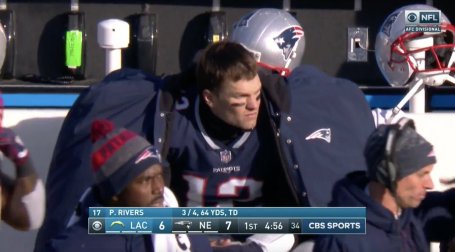
Like death and taxes, the Patriots are. They were supposed to finally fall apart this season, and indeed they haven’t been as good as usual. But here they are, yet again. Honestly, I think the fact that they annihilated the Chargers tells you more about how hard it is to come from California to Massachusetts in January than about the quality of the Patriots. It was a chilly day in Foxboro, so much so that Tom Brady broke out the Napoleonic greatcoat he first wore as a rookie during the 1812 invasion of Russia:

Dwz73jXWsAEdU5d

It’s even better with the hat:

image

But enough fun! The Patriots hate fun. And no one embodies fun like the loose, energetic, youthful up-and-coming Patrick Mahomes and his high-flying, quick-scoring, no-look-passing, what-is-defense-anyway Kansas City Chiefs.

The Chiefs are the sort of team the NFL loves—a pro version of a Big 12 team. A team that scores a ton of points, and gives up almost as many. I’m sure the league office is lighting candles and praying they get a rematch of that absurd Rams/Chiefs Monday night game for the Super Bowl. The old defensive coaches of yore are spinning in their graves.

The problem is, these kinds of all-offense, no-defense teams have historically fallen apart in the playoffs. Look at the Bills in 1990. The Rams in 2001. The Patriots in 2011. The Broncos in 2013. The Chiefs are the sort of team that sets records in the regular season, and collapses in the playoffs. And Belichick built his reputation beating these kinds of teams—he was responsible for the defenses that shut down the ’90 Bills and the ’01 Rams. (And the ’11 Patriots, come to think on it…)

 Then you have Chiefs coach Andy Reid. There are two threads running through his career—one of them is going to be the storyline come Sunday night. 

The first thread is a story of failure. As coach of the Eagles, Reid lost the NFC title game to the Rams in 2001, to the Buccaneers in 2002, to the Panthers in 2003, and then finally got over that hump only to lose to Belichick’s Patriots in 2004. For good measure, he lost a final NFC championship to the Cardinals in 2008. A few more early-round losses and he was run out of Philadelphia, taking his knack for regular season success and post-season disaster to Kansas City, where he has added a real dramatic flair to the heartbreak, blowing huge leads to the Colts in 2013 and the Titans—the Titans, for God’s sake!—in 2017. And in 2015, he even did a sort of reenactment of his Super Bowl defeat, by mismanaging the clock in a loss to the Patriots.

Ah, the Patriots. That’s where the second thread of Reid’s career comes in. With Philadelphia, he generally struggled against them. (Join the club!) But with Kansas City, he has had the distinction of administering two of the most lopsided beatings the Patriots have suffered during Belichick and Brady’s time. First in 2014, a 41-14 drubbing that made some people wonder if The Terror was over, and then in 2017, a shocking 42-27 bloodbath that saw the Patriots give up 537 yards of offense. And imagine how bad it would have been if Belichick weren’t a defensive genius!

And let’s not forget that Doug Pederson, whose Eagles defeated the Patriots in last year’s Super Bowl while racking up 538 yards of offense, is a disciple of Reid who uses many of the same offensive concepts. In summary, it’s fair to say New England struggles against this offense.

It’s an interesting matchup: the Chiefs flying circus offense is exactly the kind that fails in the playoffs. On the other hand, the Patriots bend-and-then-break-and-then-hope-like-hell-Tom-Brady-bails-us-out defense also tends not to perform well in these games. It’s the very stoppable force vs. the eminently movable object.

As for that relying-on-Brady strategy? It’s not working like it used to in the past. And I think Belichick knows it—he’s calling more on the running game, because he knows old number 12 can’t make all the throws he used to. People keep waiting for Brady to decline, but I think he’s already started to—it’s just that the Patriots are great at hiding it. (And Brady, to his credit, is still a crafty veteran who knows lots of mind games to play with a defense to compensate for his declining arm strength.)

Yes, I know the Patriots managed to beat the Chiefs earlier this year—but it was in Foxboro, and the score was 43-40. Doesn’t sound to me like they really shut down the Chiefs offense like they did another team from Missouri, back in the old days. 

The Patriots struggle on the road, and this game is being played in notoriously loud Arrowhead stadium. I predict Reid and Mahomes will field enough offense to win in frigid conditions, and that Napoletom Bradyparte will, if not meet his Waterloo, at least get exiled to a remote island until next season.

CHIEFS: 23

PATRIOTS: 19 


41JZ1SRtsjL

I got the idea for this story not too long ago, and once I had the outline down, I raced to get it all finished as fast as I could. This tale, which I’m calling a “long short story” (hat tip to Mark Paxson for that idea) is the result.

As I think most readers know, I love conspiracy stories with weird and mysterious elements–Deus Ex, The X-Files, The Mothman Prophecies etc. fascinate me. I’ve tried writing something in this vein before, but that novella left some readers (understandably) unsatisfied. I think I was much more successful with this story–it’s way shorter than Majestic World, but I think it packs just as much conspiracy weirdness into a much tighter package. But that’s ultimately your call to make.

Some other notes:

  • It’s approximately 15,734 words. I say “approximately” because I made a few edits after converting it from a Word document, and I don’t know how to see word count in the Kindle file format.
  • There is some bad language and violence, but nothing too horrible. I think it would probably be rated PG-13 if it were a movie, but these days, who knows?
  • This is easily the fastest turnaround time I’ve ever had between thinking up an idea for a story and actually completing it. Whether that is good or bad is, again, up to you to determine.

That’s all the relevant info I can think of. It’s available on Kindle for 99 cents, and free on Kindle Unlimited.


Number Seven and the Life Left Behind by [Hirtzel, Mayumi]I love spy thrillers, especially the old Cold War ones, like the show Secret Agent with Patrick McGoohan. Those stories were a little different than modern high-tech thrillers, with lots of gadgets and gizmos–they relied on good old-fashioned intrigue, cleverness, and rising tension.

Number Seven is a book in that vein. The titular character is an ex-soldier now working as a government-assigned bodyguard for a star athlete. Number Seven and his charge find themselves caught up in political machinations that involve not only themselves, but also an old friend of Seven’s who brings a good deal of sex and romance to the story, in the fine spy thriller tradition.

The book has more romance than I was expecting, but that was also true of a lot of older spy/espionage stories–they tended to tell stories about people caught up in events, rather than merely using people as catalysts for exciting events. I appreciated that.

This is a short book, which in my opinion is not at all a problem, especially in a thriller. Better a short, tight novella with a good pace than a padded-out novel that drags when it doesn’t need to. It’s a good length for the story it has to tell, and never wears out its welcome. I enjoyed it.

Lucy is about a woman named, in fact, Lucy (Scarlett Johansson) who gets tricked into carrying an experimental new drug for a gang in Taipei. When the drug is accidentally released into her body, it gives her superhuman powers as it unlocks more of her brain, gradually turning her into a seemingly omniscient being. And that’s pretty much it. Thanks for reading!


What? I need more words or it throws off the formatting of the poster? OK, gimme a minute…

The trouble with this movie is that it feels like there’s not much to it beyond the concept I outlined above. Which is a good concept, but also kind of thin. I like to imagine they filmed it and then realized they only had a forty-five minute movie.

As a result, there’s a lot of filler: clips from nature documentaries loosely analogous to what’s happening in the plot, a lecture by a professor (Morgan Freeman) who studies the human brain, lots of B-roll of Scarlett Johansson walking places in tight clothes, and an interminable car chase through the streets of Paris.

Car chases in general bore me. This one was especially bad:

Movie: Look, she’s driving the wrong way!

Me: Yeah, I see that.

Movie: No, see when you drive the wrong way, other cars come towards you! Look!

Me: Uh huh. Can they please get to the destination so the plot can advance?

Movie: …but see, also the police pursuing her are getting into these crazy wrecks because they too are forced to drive the wrong way!

I don’t mean to be too harsh. There are some good things in this movie–the opening twenty minutes are filled with tension when the gang kidnaps Lucy, as well as some delightful banter in the first scene between her and her boyfriend Richard (Pilou Asbæk), who initially tricks her into delivering the drugs. Johansson and Asbæk are really good together.

The acting in general is fine; nobody is asked to do anything spectacular, but all the actors are competent. And the story, despite being based on a completely inaccurate idea that humans only use 10% of their brains, is well-told and clever.

It’s just way too padded out. At one point, about halfway through, Lucy has the main villain completely at her mercy and doesn’t kill him. This is after the guy has killed her boyfriend, kidnapped her, killed another prisoner in front of her, and sewn drugs into her stomach so she can act as an unwilling mule for him. And she’s already killed a bunch of his henchmen by this point, so she’s no pacifist. The only reason for her to spare him is because otherwise there would be no plot.

This story would’ve been much better as a one-off episode in a show like The Twilight Zone or something. It’s a nice concept, but not one that can sustain 90 minutes of screen time without any other elements thrown in.

I watched this movie because someone said it was like Ghost in the Shell. And there are some similarities: in both movies, Scarlett Johansson is turned against her will into a nearly-unstoppable super-human crimefighter. Also, the best scenes in both movies are the ones with Johansson and Asbæk together.

So yeah, it’s a fair comparison. But Ghost in the Shell has more interesting characters and a meatier plot with more twists and turns. Lucy is more like a first draft of a promising script that no one bothered to revise.