A guy I know once told me that he thought Star Trek: The Original Series was a “fascist” TV show.  I asked him to elaborate, and he listed me some reasons:

  • All the heroes are military personnel.
  • All of them belong to a socialist federation
  • They all wear uniforms that signify their rank within the rigid hierarchy.
  • The main hero, Capt. Kirk, is a Carlyle-esque “Great Man” figure. A masculine paragon of excellence, who often triumphs through a Nietzschean casting aside of Spock’s “logic” in favor of genuine emotion.

I didn’t buy it then and I don’t buy it now, but it’s a fascinating argument.  Of course, I made some counterpoints:

  • The Federation is clearly supposed to be a neo-liberal society, built on tolerance and understanding between different groups.  It is more like an idealized version of the United Nations.
  • The Enterprise’s goal is ostensibly exploration and understanding, not conquest.
  • The real “fascist” version of Star Trek was shown in the famous “Mirror, Mirror” episode, in which the war-like crew of the parallel universe Enterprise fit the Fascist bill much better.
  • Besides this, there at least two other episodes where they bump into copies of the original fascists and the most famous of the “modern day” fascists.
  • The show’s values were generally liberal and progressive, as evidenced by the diverse cast and certain moments like Kirk and Uhura’s kiss, which was very controversial at the time.

Naturally, I think my argument stands up better.  However, my friend’s idea is still kind of interesting.  After all, despite that “peace and understanding” stuff, the Federation did find itself at war with those swarthy foreigners, the Klingons, awfully frequently.  (I think it’s significant that they changed this for The Next  Generation.)

What was the deal with the Federation?  Were they just a bunch of nice guys, or was something more sinister at work?  Does upholding the virtues of tolerance, inclusiveness and diversity except for the primitive and brutal “Others” still get you into the Tolerant Liberal Club, or does it put you in the Conquering Empire with Good P.R. Club?

Somewhere—I can’t find the exact quote, sorry—the radical libertarian Albert Jay Nock wrote that the people who opposed fascism and also supported a “league of nations” seemed to be saying that a drop of something was deadly poison, but a gallon of it was a miracle elixir.  What, Nock’s thinking went, was one-world government, a “league of nations”, if not authoritarian nationalism writ large?

Of course, Nock was wrong, at least in the case of the Earth.  For if there were a “one-world government” modeled on the United States, with each country being functionally equivalent to a State,  it would have no “Other” to make into its enemy.  It would not, as far as I can see, have the ultimate hallmark of a fascist nation: the racial or at a heritage-based class system.  This does not at all mean a one world government is a good thing, but it is not fascist.

But in Star Trek the Federation did not encompass all known sentient life in the universe, although it did seem that its doors were open to all who would join.   There were other systems of government and life-forms.  The Federation was just trying to… triumph over them.  Fascism!

There is an old quote I’ve seen attributed, probably incorrectly, to Huey Long: “When Fascism comes to America, it will be called anti-Fascism!”  I suppose you could say that is what the Federation has done, since they are committed to freedom and tolerance… and will destroy anyone who isn’t.

The new Star Trek movie Into Darkness especially seemed to accentuate the fascistic element of the series.  The grey uniforms the cadets at Starfleet wear (especially the hats), and the warmongering admiral make it seem like it’s on its way to being the Evil Empire.

Ross Douthat generated quite a lot of chatter with his column this past week on America’s declining birthrates.  Particularly controversial was this passage:

The retreat from child rearing is, at some level, a symptom of late-modern exhaustion — a decadence that first arose in the West but now haunts rich societies around the globe. It’s a spirit that privileges the present over the future, chooses stagnation over innovation, prefers what already exists over what might be. It embraces the comforts and pleasures of modernity, while shrugging off the basic sacrifices that built our civilization in the first place.

What’s particularly curious is that the second paragraph of Mr. Douthat’s column begins:

It’s a near-universal law that modernity reduces fertility.

On the face of it, this appears nonsensical.  “Modern” means “of or pertaining to present and recent time; not ancient or remote“.  As such, there can be no “universal laws” about modernity.  All we can say is that in modern times fertility decreases, but “modern” is itself a relative term.  What is “modern” today will be ancient some time from now, and if the birthrate goes up at some time in the future, the law will reverse itself.

There is a kind of logic to it though, if you buy into Spenglerian theories of civilizational life-cycles.  In this view, all civilizations are born, grow and die.  If “modernity” is taken to mean “the end of the cycle”, then this makes some sense.  I think that is the only way it does, in fact.

When an NYT columnist echoes an ultraconservative German nationalist,  it naturally causes a stir.  Really though, Douthat’s article is thoroughly in agreement with biological determinism–whatever group of people produces the most offspring will “win” in the eyes of biological determinists, and the quality of the upbringing is only a secondary concern.  (I am not saying Douthat actually believes this.  I am just saying what he wrote in that column agrees with it.)

It’s the old “nature vs. nurture” debate that lies at the core here, and that debate is so old–I’ve said my bit on it here–I think it’s safe to conclude that it is insoluble.  Probably it will turn out that Ray Kurzweil is right, and it is all a moot point anyway.

As I think I’ve mentioned before on here, I don’t have cable TV.  I just get the major networks, PBS, a few local channels and a bunch of Christian channels.  The last are mostly devoted to people on elaborate stages giving speeches and asking for money.  However, the other day on one of these channels, I saw a different sort of program.

I don’t know the name of the show or the channel, otherwise I’d tell you.  All I know is that it was some older fellow standing in the middle of the desert on the outskirts of Jerusalem, reading from a bunch of papers he was holding and trying to keep from blowing away.  The production values were, to say the least, horrifying.  If any of you readers can guess what show this may be, feel free to tell me.

 
What the guy had to say, however, was somewhat… interesting.  He was talking about how many intellectuals, especially in the atomic age, desired a “one world government”.  He dated this impulse  back all the way to Nebuchadnezzar II, and said that they [the intellectuals] did not believe you could have many strong countries, you could only have one government.  (I’m paraphrasing.)  I got the impression he was getting towards the point that these intellectuals were wrong, and one world government was a very bad idea, and that the Bible had predicted all of this.  He was taking his time about it though, and I had work in the morning, so I didn’t get to hear how it all ended up.

(The politics on these religious shows are always interesting.  One day, while channel surfing I saw a show claiming that people were now placing their faith in government instead of God.  What we need, according to the Bible, so they said, was less government.  Smaller government.  In fact, watching some of these shows, you get the impression that they feel the Republican Party platform is the word of the Almighty.)

“One World Government” is a phrase conspiracy theorists throw around a lot to mean all sorts of wild things.  But I think it is true that many people would like to see more international cooperation and conflict resolution by some means other than wars between nations.  I think this train of thought really started because of World War I, which showed a lot of the problems that can arise with multiple competing nations.

In Europe, in the late 1800s and early 1900s, you had lots of strong, independent nations–strong empires, even–such as Britain, France, Austria-Hungary, the Ottoman Empire, Germany and so on.   The peace among these nations, such as it was, was kept by treaties the countries made with each other.  Unfortunately, this system of treaties proved to be unstable in the face of rebellious nationalist agitators and military build-ups between competing nations, and thus, through a complicated series of events, the treaties dictated that a massive war broke out.

In the aftermath, people looked around and said, quite logically, “how can we make sure that this doesn’t happen again?”  That very intellectual President, Woodrow Wilson, even proposed the League of Nations, though ironically the U.S. did not join it.  Of course, the League failed to prevent ultra-nationalist sentiment in Germany from igniting another, even more terrible war.

The League was replaced with the United Nations after World War II.  And ever since, nationalist sentiment has opposed the U.N., fearing that it will destroy all of the country’s traditions and create a one world government.  As some readers know, I am fascinated by conspiracy theories, even though I do not believe in any of them.  And, as I said, there are a lot of conspiracy theories about the “one world government”, and I think the root reason for all of them is the nationalist elements’ fear of being governed by cosmopolitan intellectuals.

Having said all that, I think really all most people actually want is some international way of resolving conflicts without having to go to war. People, both nowadays and especially in the immediate aftermath of the World Wars, just don’t want to see a repeat of that.  Seems hard to blame them, really.

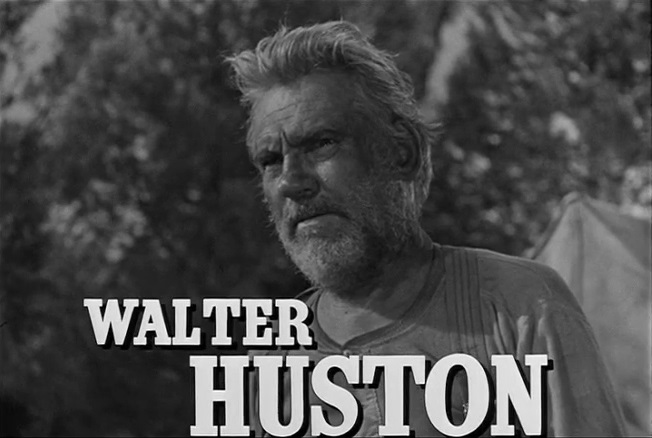
In the trailer for “The Treasure of the Sierra Madre”.

This movie really surprised me.  It was made in 1948, around the time of what is called the “Second Red Scare“, when concern about communist infiltration was very high.  Given that, the content of the movie is astounding.

Fred Dobbs (Bogart) and Bob Curtin (Tim Holt) are unemployed guys looking for work.  They convince an old prospector named Howard (Walter Huston) to help them on an expedition for gold in the Sierra Madre mountains.  The first remarkable thing about the movie is a speech given by Howard in his first scene:

Howard: Say, answer me this one, will you? Why is gold worth some twenty bucks an ounce?
Flophouse Bum: I don’t know. Because it’s scarce.
Howard: A thousand men, say, go searchin’ for gold. After six months, one of them’s lucky: one out of a thousand. His find represents not only his own labor, but that of nine hundred and ninety-nine others to boot. That’s six thousand months, five hundred years, scramblin’ over a mountain, goin’ hungry and thirsty. An ounce of gold, mister, is worth what it is because of the human labor that went into the findin’ and the gettin’ of it.
Flophouse Bum: I never thought of it just like that.
Howard: Well, there’s no other explanation, mister. Gold itself ain’t good for nothing except making jewelry with and gold teeth.

What’s so remarkable about that, you wonder?  Well, what Howard is describing there is what is known as a Labor Theory of Value–the value of something is determined by the labor put forth to get it.  This is an economic idea that is commonly associated with a fellow named Karl Marx.  And it’s a response to the claim that gold’s value derives from its scarcity–a major component of non-Marxian, liberal economics.

Also in the trailer for “The Treasure of the Sierra Madre”

So, about twenty minutes into the movie, we have gotten a lecture on Marxian economics.  This is all the more interesting because the rest of the movie is devoted to proving over and over that greed for wealth corrupts people–specifically, Dobbs.  Howard repeatedly predicts that the gold will drive men to madness, and does it ever.

Dobbs’s inevitable corruption is fun to watch–that Bogart guy was a pretty good actor, you know that?–and Walter Huston  is excellent, even though his role is fairly predictable.  He is, essentially, an infallible sage, and normally those characters are pretty dull, but Huston imbues him with personality.  What is not clear to me is why he bothered to come along, since he believes almost from the outset that the expedition will be a disaster, and it proves to be exactly that.

It was odd to me that the movie’s most famous, yet often mis-quoted, line: “Badges? We ain’t got no badges. We don’t need no badges. I don’t have to show you any stinking badges” was spoken by a rather poorly-acted, bandit character.  I thought his character was pretty weak.  In fact, I felt that the bandits had too big a role in the film, when all they really needed to do was show up at the end when Dobbs’s luck runs out.

I keep coming back to the economic “moral” of the movie, though.  It’s a very socialist message, what with the capitalist who desires to earn for himself being depicted as either a monster or a buffoon, and the character who opens up describing the labor theory of value depicted as a wise and thoughtful figure.

Now, I know what you’re thinking.  You’re thinking: “Well, this is it– Mysterious Man has finally gone completely crazy and is now seeing communist conspiracies everywhere.  He must have been listening to Glenn Beck too much, and he just lost his tenuous grip on reality.”

1950s anti-communist pamphlet

To be clear, I’m not saying I think this movie was some kind of evil communist-Hollywood indoctrination plot.  It was based on a book by a mysterious German called “B. Traven“, who was apparently a socialist.  Well, when your movie is based on a book by a German socialist, you can’t be surprised if some German socialism creeps in.  I doubt John Huston wanted to make Marxist propaganda; he just wanted to make a Western, and the book he adapted it from had some Marxist propaganda in it.

What surprises me is that, despite how popular accusing people in Hollywood of communism was at the time, the film wasn’t banned or censored, and John Huston wasn’t hauled up before the H.U.A.C. to explain himself.  I’m not saying any of that should have happened, I’m just saying it’s weird that the film apparently got released without any censorship or controversy, which is kind of amazing given the zeitgeist.

I was watching The Dick Van Dyke Show on TV last night.  The episode I saw was called “The Bad Old Days“.  In a nutshell, it went like this: one of Rob’s colleagues tells him about an article on “the decline of the American male”, and how men are becoming more subservient to their wives.  This worries Rob, who starts to fear that Laura too often tells him what to do.  The episode culminates in a hilarious dream sequence, in which Rob imagines himself as an overbearing, bullying 19th-century-style husband, who makes his wife do all the housework and forces his son to work in a factory.  Of course, Rob wakes up and realizes that this wasn’t such a great way to live, after all.

It’s kind of funny to me, because you often hear this complaint of “feminized” men being subordinated to their wives these days, especially in conservative and “alt-right” circles.  Often, the 1950s and early ’60s are considered the archetype of a more restrictive and socially conservative era, and to some extent the setup of The Dick Van Dyke Show is emblematic of that.  I remember my blogger-friend Thingy contrasting Mary Tyler Moore’s accommodating housewife character on Dick Van Dyke with her independent, single, career-woman character on The Mary Tyler Moore Show in the ’70s.

But then, here we have an episode of Dick Van Dyke from 1962 that addresses this same “men are too subservient to their wives” idea.  So, it seems like that idea must have been in the air even back then.  Which, in turn, suggests the possibility that perhaps there is an ever-recurring nostalgia among authoritarian men of every era, that they had it better in, as Rob says, “the bad old days”.

Well, that’s enough sociological musing!  The point is, it was a very funny show.  It does amaze me that the best thing on TV some nights is a show from 50 years ago, but there you have it.

Amused at This Ruthless World (thanks for liking my last post, BTW) wrote a really good post awhile back in response to an essay written by one “John J. Wall”. I’d never read Wall’s piece before, but I have heard the idea advanced within it many times in the past. It is this: that the “liberals” and “conservatives” are so deeply divided on all issues that it would be better for both if each group formed separate countries. Amused’s post inspired me to write something of my own on the matter.

Of course, if you’re a reader of this blog, you know that there are actually three groups: materialists, nationalists and cosmopolitans. But still, let that not dissuade us from this engaging in this thought-experiment. It is still only a simple matter of dividing the country into three instead of two.

The nationalists may have the southeast–the old Confederacy minus Virginia. The materialists may have the West; that is, the area extending from California to east Texas. A vast area to be sure, but one which they will no doubt set about harvesting every inch of for resources. And the cosmopolitans shall retain the Northeast and parts of the Midwest. Everything east of Kansas and north of Tennessee would remain in cosmopolitan hands. Cosmopolitans would also get Hawaii, and Nationalists would hold Alaska.

(Oddly enough, this division into regions mimics a similar scheme by economic historian Douglass North. But he was writing only about the United States internal trade flows in the early 1800s. And then, evidently, something happened around 1861 to fundamentally alter the structure of the country.)

As part of the deal, suppose everyone starts with the same governmental structure and Constitution as we have today.  so, now we just go ahead and simulate to see where it will all go.

I imagine the taxation issue would quickly cease to be of interest to the nationalists, once they are no longer trying to destroy a cosmopolitan government. Presumably, they would focus their immediate efforts on bulking up their immigration laws. They would also probably raise tariffs in order to keep their manufacturing sector strong. It might even be a mini-boom along the lines of the 1950s auto-industry. Naturally, in the Nationalist State, minorities and foreigners would be viewed with suspicion until their Nationalist-credentials had been soundly proven. I imagine congressman Allen West would make a successful career in this place, as would Sarah Palin. The political structure would change to be based more heavily on charismatic authority. No doubt the social structure would closely resemble that of 1950s America for the most part, with women being encouraged to be housewives and men being seen as heads of house. Gay marriage, the issue under so much discussion at present, would be utterly unthinkable, as would Civil Unions etc. Gays would also likely be barred from military service, but it is likely that this country would reinstate the draft, so there would be no problem with lack of personnel.  Fashion and art would both become considerably more conservative, quite possibly up to the point of introducing government censors.

In the materialist West, meanwhile, it is likely that the world would come to resemble the United States as a whole in the 1870-90s. Almost all environmental regulations would be removed, and worker safety laws would be scaled back. Unions would cease to exist. Tariffs would also be very low or nil, so as to encourage foreign investment. Immigration laws, likewise, would be quite lax so as to gain a cheap labor force. Military force would assume the character of a highly-paid internal security outfit, and be largely defensive in nature. (One imagines the Erik Princes of the world would have to think long and hard over whether his fortune lay to the South or the West.) Social issues would be non-existent; societal mores being relaxed to please the fancies of the wealthiest. Indeed, the city of Los Angeles as it exists today, would probably go on functioning as if nothing had happened under the new arrangement. Art and fashion would all go as the popular will dictated; thus movies, for example, would be solely of the “summer blockbuster” variety all year round.

Of the cosmopolitan North, there is less to say; perhaps because the area is well on its way to being that already. It is probable that taxes would be raised, of course; as it would no longer be so politically abhorrent to do so. A massive influx of public money go to support higher education, which would likely lead to the Academy being the primary institution in the country. Other than that, however, things would change less, principally because the cosmopolitan sees diversity as a strength, and would need to undergo less modification to suit its philosophical beliefs. The military would be fairly small, and probably what there was of it would be based heavily on technological superiority, not man-power.

It would be interesting to see how long this state of affairs persisted. It would not be long, surely, before each country recognized that there was much to be gained from the others. The materialist sector, in particular, might look an inviting target for conquest; though of course it is questionable whether it would be profitable to do so. Also, the nationalist and cosmopolitan states by their nature invite comparison to ancient Athens and Sparta.

Ultimately, the optimal move for each country would be strategic alliances with its neighbors, as each would have something to provide to the others. However, there is also the dark possibility that two would form an alliance against the third, and thereby destroy it either militarily or economically.

And there I conclude this experiment, but you are welcome to add thoughts of your own.

For myself, I see this as rather a gloomy idea. I believe each type has something to contribute to the country. But then, I would, wouldn’t I? I’m a cosmopolitan.

Jonah Goldberg, of Liberal Fascism fame, has a new book out entitled The Tyranny of Clichés: How Liberals Cheat in the War of Ideas. I love reading Goldberg, because when he is wrong, which is very often, it is quite funny. And when he is right, it is usually not in the way he thinks he is right, but very important nonetheless. So, I really will have to read this book of his at some point.

In the meantime, here are some excerpts from an NPR interview with him. [Goldberg’s words in red]:

“What you have often in American political discourse are appeals to clichés that steal territory, steal terrain unearned by argument. And all I want is an argument. I don’t care that liberals have an ideology. I want them to have an ideology. I want to have a contest of ideas. What bothers me is when they come in and they say, ‘Oh, you guys are the crazy ideologues with your labels and all of the rest, and we’re just pragmatists who care about sound science and the numbers and the facts’ and all that.’ “

What becomes rapidly apparent from listening to Goldberg is that he is not, in fact, against cliches. He is only against liberal cliches. Well, to paraphrase Nietzsche: “he who fights clichés should take care that he does not himself become a cliché”. And indeed:

On the response that conservatives also have their own clichés

“Yeah, and some of these things I absolutely agree. I think that there is something endemic — one of the reasons why some of these cliches appeal, why they have power, why they move men, is because they appeal to the hard-wiring in our human nature. We’re all built from the crooked timber of humanity; we all want to live in groups; we all want to live in tribes; we all want to, you know, band together and do good things.”

It might have been good to notice that before you wrote the book. So, he certainly is willing to allow as how conservatives also have clichés. But whatever, it’s okay, because everyone does. But liberals, when they do it, do it wrong and perniciously. Got it?

But when an actual instance of something thought to be a conservative cliché is raised, Goldberg is skeptical of its status as “cliché”:

On the saying, “Government is the problem”

“No, I’m not against having a government. I don’t know if that qualifies as the kind of cliché that I am talking about … The mainstream media never talks as if government is the problem — you never hear that repeated over and over again. Even on Fox, to a certain extent, you won’t hear that sort of thing. It’s a catchphrase, to be sure, and it’s a glib catchphrase that oversimplifies things, but the context in which I was talking about it was that Ronald Reagan had said, ‘In the current situation, government is the problem, not the solution.’ And that is the beginning of a serious argument.”

Yeah, but the point is, when you just start quoting that line of Reagan’s all the time when talking about the government, then it becomes a cliché. That’s how clichés work, Goldberg. Remember; every cliché was an original thought once.

At bottom, though, his point is correct. Clichés in politics are a problem, like I wrote about in this post. As I see it, both Democrats and Republicans use clichés all the time, and it does, as Goldberg says, hinder productive argument.

But as far as I can tell, without having read the thing yet, Goldberg’s book is just a compilation of liberal clichés. I haven’t heard anything to suggest he offers a solution to our cliché-filled politics. Which is fine, but how would one go about fixing it?

George Lucas once said “Don’t avoid the clichés–they are clichés because they work!” And he proved it, too, by making billions of dollars off of a movie franchise built around some of the oldest clichés of all. It works the same with political clichés.

Like I said in the other post, people learn their communication through imitation. Why should political communication be immune from this? Think about the effort involved in figuring out how to not think in political clichés: you’d have to be willing to ignore all the slogans and ideas told to you by your friends, family, colleagues, political analysts, writers and the politicians themselves. The you would have to try to reevaluate everything about politics. And even then, there’s no guarantee of success. You might just become Alex Jones.

Back to what Lucas said: “clichés work”. They sure do. It’s a cliché to say the Republicans are defenders of the super-rich, and indeed, that is oversimplifying things greatly, but even so it’s still a pretty good synopsis that gives you a decent idea of their behavior. It’s not the whole story, but it’s part of it, and if you go around operating on that assumption, it will be awhile before you notice anything that makes you question it.

It goes back to what I’ve talked about before lots of times on this blog: people are too busy to get really involved in politics beyond following the leaders of their parties. And it’s not because people are lazy or stupid; it’s because really thoroughly understanding politics is a full-time job.

The most merciful thing in the world, I think, is the inability of the average blogger to correlate all his links. We live on a placid island of ignorance, in the midst of black seas of Wikis, and it was not meant that we should check the references. The Wiki editors, each biased in their own direction, have hitherto harmed us little. But someday, the linking together of barely-associated articles will open up such terrifying vistas of the internet–and of our own frightful pagerank therein–that we will either go mad from the revelation, or flee from the deadly light into the peace and safety of icanhascheezburger.com (Many apologies, Howard–MM.)

It all started with this post from Thingy–I realized I had never found out the origin of the common phrase “it was a dark and stormy night. So, I followed the link and it turns out, it was from this guy Edward Bulwer-Lytton. He was a prolific writer who also coined the phrase “the pen is mightier than the sword”.

So, I decided to read some of his books. Being a fan of horror, I chose to start off with The Haunted and the Haunters: or, The House and the Brain. It starts off as a fairly generic ghost story, but the end has some very interesting bits of philosophizing. Not a great work, but an enjoyable read, all in all.

He also wrote a book called Vril, the Power of the Coming Race. I tried to read it, but it was pretty dull. The plot did remind me a little of Arthur Machen’s later work The Novel of the Black Seal, which influenced Lovecraft greatly. But apparently, Vril inspired something of a “cult following”, and by that I mean that people actually thought it was true. The book is about a super-race that lives underground and has a powerful substance “Vril”, which allows them to do all sorts of amazing things. Some, notably the theosophists, believed that “Vril” existed.

Which is curious to me, because I know basically three things about theosophists:

  1. In the paragraph immediately after the one I parodied above in Call of Cthulhu, Lovecraft mentions the theosophists briefly.
  2. The Theosophical Society was founded by Helena Blavatsky, who I know about solely because of the lines in the Warren Zevon song “Sacrificial Lambs”: “Madame Blavatsky and her friends/Changed lead into gold, and back again.”
  3. They have one weird logo. Observe:
Theosophical Society emblem, via Wikipedia

I only saw this symbol the other day, when I was reading about the lyrics to the They Might Be Giants song “I Palindrome I”, which includes the lyric “I am a snake head eating the head on the opposite side”. The technical word for this is Ouroboros. That word is also whence the name of the character Borous in the Fallout: New Vegas add-on Old World Blues is derived.

“Hold up, Mysterious Man,” cries the bemused reader. “What the Devil is the point of all this free-association?” Well, I’ll tell you: there was some philosopher I was reading about many months ago who had some sort of reasoning system of free-association, “correlating contents” and looking for subtle inter-connectivities in Nature. It was really interesting, but in recent days I have searched Wikipedia with considerable diligence, but I can’t find his page. I think his first name might have been Charles, but that’s all I can remember. Any information you can furnish me with as to who the guy was would be appreciated.

It’s become the style lately to call the Republicans “Social Darwinists”, just as it has for some time been the style for Republicans to call Democrats “socialists”.  I’ve often said in responding to the Republican charge that, by their definitions, virtually everyone is a socialist. And I have to say, from what I read, by any definition, everyone is a “Social Darwinist”.

“Social Darwinism” means using the idea of  “survival of the fittest  to justify social policies which make no distinction between those able to support themselves and those unable to support themselves”, according to Wikipedia. Whenever I hear it, I think of Mandalore in KotOR II saying “the purpose of the weak is to feed the strong”. That’s what it boils down to: “Go Team Strong! Crush the Weak!”

The thing is, “the Strong” and “the Weak” are rather nebulous concepts. I mean, people are strong in some areas and weak in others.

For instance, here is a list of the most athletic Presidents ever. I bet Rob Gronkowski is a better athlete than any of those guys. Compared to him, they’re weak athletically. Yet, Rob Gronkowski will never be the Commander in Chief of the World’s most powerful military. And that’s because he is probably one of the weakest people in the world when it comes to politicking.  Bill Gates can’t bench as much as Ryan Kennelly, and yet he has done alright for himself in the world. Who is “weak” and who is  “strong” depends on the situation.

“Survival of the fittest” is practically tautological: “Who survives?” “The fittest!” “How do we know they’re the fittest?” “They survive!” (Before anyone gets excited, note that this does not disprove Darwin’s Theory of Evolution, much as some of my religious friends wish it did.)

In the broadest sense, “Social Darwinism” could be said to just mean “the world needs more good people and less bad people”. Everyone agrees with that. The difficulty comes in defining “good” and “‘bad”.

Ayn Rand, as we well know, chose to define good people as “people who had earned a lot of money by selling stuff in the free-market”, and bad people as “people who produce nothing and take government money”. So, the Randian worldview, somebody on welfare is “bad”, but a billionaire author is “good”. I have chosen these examples because I have in mind one person who was both: J.K. Rowling. And she would not have been able to be a billionaire author had she not taken government assistance. This is one of the biggest problems with the Randian worldview.

The Republicans are not “Social Darwinists” as much as they are “Defenders of People with Lots of Money”. Paul Ryan may have repudiated Rand the other day, but let’s face it; he’s just saying that so people don’t start saying he’s an atheist.

According to a Pew Research Center report:

Female eligible voters participated in the 2008 election at a higher rate than male eligible voters—65.7% versus 61.5%. Nearly 10 million more women voted than men.

As this report from the Center for American Women and Politics shows, this isn’t new, either.

Given this, how incredibly, amazingly, stupendously boneheadedly stupid would the Republican strategists have to be to wage a “war on women”, as they are accused of doing? Surely, no party with many well-paid strategists could fail to notice how the math works out here.

I mean, if they’re really planning to be the party of misogyny and want to have a chance of ever winning an election again, they’ll have to repeal the 19th amendment. And the Democrats would never let that happen.

Personally, though I’m no supporter of the Republican party in general, or their policies on abortion, contraception etc. in particular, I cannot bring myself to believe they are so abysmally dense as all this. Why, some women are quite in favor of their policies. This New York Times article notes:

The battles over access to contraception and other women’s health issues that have sprung to life on the Republican campaign trail in recent weeks have had the effect of disenchanting some moderate Republican women. But for conservative women, the opposite may be true.

“[Rick Santorum’s] ideas don’t infringe upon my rights at all,” said Lauren Deppe, 21, a student at the University of Illinois at Urbana-Champaign. “As far as birth control, my mom and I say you’ve got birth control right with you. It’s called abstinence.”

Conservative women support the conservative candidate, and non-conservative women don’t. Think of that!

Presumably, Santorum and his crew don’t intend to wage war on women like Ms. Deppe, who will apparently vote for him. No, “there is no war here,” as Tion Medon told Obi-Wan Kenobi, “unless you’ve brought it with you.”

So, what are the Republicans really up to? Perhaps you have heard that a recent poll discovered that most Conservatives do not trust the scientific establishment. Perhaps you have heard, also, about Rick Santorum calling universities “indoctrination mills”.

You see, this is not a war on women; this is a war–metaphorically speaking–on intellectualism. Anybody, male or female, who goes about worrying about anything sophisticated or intellectual, in addition to the tasks of day-to-day life, is the true target of their policies. What the Republicans oppose is anything that deviates from their very rigid and traditional vision of society.