If you follow me on Twitter, you probably know that I’ve been working on a new novel for the last two months. My goal at the outset was 100,000 words, and I’ve been keeping a running update of my progress. Here’s my latest:
Good news: 55.8%
Possibly bad news: story has reached its logical end point. Am now re-reading draft to see how it flows. https://t.co/r0NrqRcRjG
I re-read it, and I think the story has a pretty decent pace overall. It may be a little too brisk (it turns out these things seem much faster when you’re reading them than when you’re writing them), but I think I have the central plot arc in place. And there’s just no way to pad it out to 100,000 words, which is bad, because it’s a sci-fi novel, and those are generally “supposed” to be at least 80,000 words.
I can and probably will throw in some additional world-building detail and “local flavor”, tie up a few minor loose ends in the plot, and add some more description of scenes and characters. (Description, as long-time readers know, has always been my weak point.) But even all that will probably bring it to around 60,000 words, at the maximum.
But of course, the publishers don’t see it that way. They have certain rules for word count by genre. In my opinion, this “quantity over quality” approach encourages overly-long books, but then again, when you have to review thousands of manuscripts, it helps to have some rules that let you automatically eliminate some of them. (This article summarizes it well.)
The key question here is; what do readers like? Assuming the two books are equal in price, does the typical reader prefer to have a longer one to a shorter one? Do they want to maximize the number of words they get for their money? Or do other considerations take precedence?
For myself, I generally make decisions based on other factors. I read the synopsis to see if it sounds like an interesting premise, then I flip through the book a little and see if I like the author’s style. Cover art also makes a difference to me, even though we all know we shouldn’t judge a book by its cover.
What about you? What factors most heavily influence your book-buying decisions? How much do you care about the length of a book?
[You can make a case for any of these characters being “Mary Sues”. From left: Robert Pattinson as Edward from Twilight, Miranda Lawson from Mass Effect 2, Sean Connery as James Bond, and Daisy Ridley as Rey in Star Wars: The Force Awakens. All images via respective Wiki pages and re-used under ‘fair use”]
A Mary Sue (if female) or Marty Stu (if male) is an idealized and seemingly perfect fictional character…
The term “Mary Sue” comes from the name of a character created by Paula Smith in 1973… The story starred Lieutenant Mary Sue (“the youngest Lieutenant in the fleet — only fifteen and a half years old”), and satirized unrealistic characters in Star Trek fan fiction.
“Mary Sue” is now a shorthand for an unrealistically capable character, with no flaws or foibles. It’s the mark of an amateurish writer, too lazy to flesh out their characters.
Naturally, there’s a discussion to be had here about the use of the term’s sexist connotations, and whether the pejorative “Mary Sue” is now used by lazy critics to put down any female protagonist. It’s a very interesting issue, but it’s not the thing about Mary Sues I want to discuss here.
What I want to address is the motivation for creating such characters in the first place. Often, critics assume that the reason is wish-fulfillment; that authors imagine themselves to be these characters, and make them perfect as a result. (Critics usually assume that everyone is as conceited as they are.)
But perfect–or at least, incredibly highly-skilled–characters are actually very tempting for reasons of plot, especially in a science-fiction or fantasy setting. Simply put; when your plot takes place in a big, complicated universe, you want your character to be able to participate in every aspect of that universe.
If I’m writing a sprawling epic with, say, a league of heroic knights who go around fighting dragons, it’s a bit of a letdown if I say “But sadly, Bob the protagonist was an archer who knew nothing about horsemanship or swordsmanship, and so could never be a knight.” By the same token, if Bob is a knight, then it’s a real shame if he can’t be in any archery attacks.
When you’re writing a story, you generally want your protagonist to be able to participate in most of the action. Having them figure out and solve the central conflict makes a better story than: “Bob found out a lot of interesting information about dragons. So he gave it to the experts who handle that sort of thing. 8 months later, he read in the newspaper about how the dragon issue had been solved. ‘Huh,’ he said. ‘So that’s how that all played out.’ The End.”
Now sure, you can have lots of characters with different skill sets, and still have the protagonist be involved in every step. This is relatively easy to do if your setting is the present day or recent past. For example, in a mystery novel, Ted the Brooding Detective With The Dark Past can take the evidence to Jill the Wisecracking Forensics Expert With The Rebellious Streak. (And if they fall in love, then you’ve almost got all the characterization you need.)
But this gets harder to do the more exotic your setting is, because then you have to make up a bunch of skill sets for people This is especially true in science fiction. So, there’s the girl who flies the ships, there’s the guy who fixes the ships, there’s the other guy who fixes the robots, there’s some alien who mines the raw materials for building both the ships and the robots…
It can be done, don’t get me wrong. But it’s tough to do it, and very, very tempting to the novice writer to just say, “We need to get this plot moving! We haven’t got time to meet the guy who waxes the floors. It’s faster to just make the protagonist do it.”
I’m working on a new novel. It’s an idea I’ve had for a while, but I just recently started writing it down. (I’ve hinted about it a few times already on Twitter.)
I’m about 19,000 words in, and I recently wrote a scene that bothered me a little because it reminded me of a passage in my novella The Start of the Majestic World.
There’s a scene in Majestic World where Agent Maynard has a verbal confrontation with the main villain, Colonel Preston, a handsome army colonel who tries to intimidate her into following his orders even though she’s not under his command.
Here’s a bit of it:
The Colonel stood up, and walked around the desk so that he was very close to Maynard—so close, and in such a posture, that Maynard felt he was trying to brush aside the barriers of rank and agency, and underscore primarily the difference in sex between them.
I don’t want to give away too much about the new book, but the scene in it has some very similar elements. The female protagonist is in a meeting with a handsome male colonel, and he is trying to get her to do something that may violate protocol. (It’s deliberately ambiguous in the scene, but she feels uneasy about it.) And there’s some uncomfortable sexual tension–it’s less overt than in the above, but there’s some suggestion he might be trying to seduce her.
Now, there are also some big differences, involving both the setting and the characters. But as I was sketching out the scene in my mind, I was thinking, Gosh that’s awfully similar to the Maynard/Preston scene.
So, right now you’re thinking: “Well, dummy; you’re the writer–don’t write it that way, then!”
True, that’s one option. But there are a couple reasons I hate to remove or alter the scene. First, it’s a very natural way for things to play out in the story–it works well in context, both in terms of plot pacing and characterization. I hate to lose scenes like that.
And second, it’s a much better execution of the concept than in Majestic World. The dialogue is more natural, the characters are more nuanced and less caricatured. This is encouraging to me–it’s good to know I’ve improved as a writer since writing the Maynard/Preston scene over three years ago.
The great film director John Huston once said about movie remakes: “There is a wilful, lemming-like persistence in remaking past successes time after time… Why don’t we remake some of our bad pictures… and make them good?” That’s sort of how I feel about this–sure, I tried this basic concept once, but now that I’ve improved as a writer, why not prove that I can do it better?
At the same time, I could see somebody who read Majestic World reading the new book and saying “Yawn! Another Colonel behaving inappropriately towards the protagonist. Give us something new, Berthold!”
But I can guarantee it won’t be the same thing over again. Trust me.
What do you think? Should an author revisit a concept similar to one they’ve written before, if they feel like they can write it better this time, or is it best to try to break new ground?
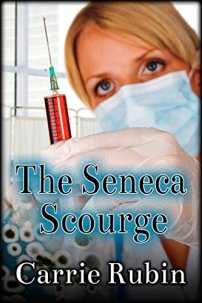
The Seneca Scourge is a medical thriller with science-fiction elements. It follows Dr. Sydney McKnight as she finds herself in the midst of a seemingly incurable influenza pandemic. Aiding the staff at her hospital is the mysterious Dr. Casper Jones. As the pandemic spreads, Dr. McKnight notices Dr. Jones behaving oddly.
As she investigates in between treating the ever-growing patient population, Dr. McKnight gradually uncovers the shocking truth about Dr. Jones.
That’s the spoiler-free synopsis. If you don’t want to know the plot twist, don’t read after the asterisks below. My spoiler-free review is that it is a very well-paced thriller that successfully combines fairly plausible depictions of medicine and viruses in the first half with science-fiction elements in the second half. If you like either medical thrillers or science-fiction (and especially if you like both) I recommend it highly.
Now, if you want to know more detail, with spoilers, read on.
I’ve heard lots of criticisms of video games over the years, but Jeff Vogel’s critique that they have too many words is a new one. He makes a strong case against one particular game–Obsidian Entertainment’s Pillars of Eternity. After reading his article, it’s hard to argue against the claim that Pillars is too verbose. The character creation and menu screens are packed with tons of text for the player to wade through.
I’m less sure about whether this is really a trend in gaming generally. After all, Pillars was explicitly designed as a throwback to the beloved text- and lore-heavy Black Isle RPGs. For example, Planescape: Tormenthas over a million words. Even I tended to ignore some of the esoteric descriptions in Planescape, and I love that game.
Scene from “Planescape: Torment”
Some players really do seem to enjoy the atmosphere of a game rich with background material. It may be true that much of the information is irrelevant to the game’s mechanics, but this is High Fantasy, and one of the things High Fantasy fans look for is a sprawling world filled with many interesting details that don’t all fit into the main narrative.
Using lots of words is indeed a problem, as Vogel says, but not just in games. The High Fantasy trope of giving tons of background information can be traced back to J.R.R. Tolkien. The Pillars of Eternity intro is nothing next to the dense opening chapters of The Fellowship of the Ring. In general, when writing in a genre, you will try to emulate the most successful authors in that genre, so it’s hard to blame Obsidian for looking to the work of Tolkien and his successors for ideas.
I myself have never been a fan of this style. And that’s despite the fact that some of my influences favored verbosity. Take H.P. Lovecraft for example–he was a pioneer in writing horror, but he tended to go overboard with some of his descriptions. I think some of that crept into my own early attempts at writing horror.
It’s much easier to use too many words than to use just the right number. The old line about “writing a long letter because I didn’t have time to write a short one” applies. It’s easy to waste words, and that dilutes their intended effect.
Think of it this way: whenever you write something, eventually you will have to stop. You only have so many words before you have to hit send, or mail it to the publisher, or whatever. While the supply of words is theoretically infinite, in practice it’s severely limited–by the reader’s attention span if nothing else.
So, you want to maximize the value you get per word. What do I mean by “value”? Well, it’s whatever idea or feeling you are trying to communicate in your writing. If it’s an informational document or a bit of technical description, then you want to be as clear and concise as possible. If you are writing a character who prefers to communicate non-verbally or who is just mysterious, you use few words, and you make them vague and open to interpretation.
Sometimes there is value in deliberately using too many words. The dramatist W.S. Gilbert (another of my favorites) would often have characters say things in as complicated and lengthy a way as possible for comic effect. “Quantity has a quality all its own,” as they say in big organizations.
Vogel is right that the Pillars opening screens are bad at conveying information. They could have communicated the same points more succinctly. But the problem is that in addition to giving the player some information, they are also supposed to be atmospheric. And you usually need more–or at least different–words to create an atmosphere than to just convey information.
It’s a difficult balancing act–the writer(s) must both communicate technical detail about how to actually play the game while also keeping the player immersed in the virtual world in which the story is set. (For an example of a character creation intro that is more integrated with the game and doesn’t bore the player, I recommend Fallout: New Vegas–-also by Obsidian.)
The “optimal” number of words is dependent on what the writer is trying to convey, as well as on the medium they are using. Obviously, a screenwriter is going to use fewer words than a novelist to describe the exact same scene, because the screenwriter knows they will have actors and sets that will communicate certain things visually.
To summarize, all writers, regardless of their subject, style or genre, should follow Einstein’s advice: “Everything should be as simple as possible–but no simpler.”
Carrie Rubin, author of “Eating Bull” and “The Seneca Scourge”
[I recently read the bookEating Bull, by Carrie Rubin. I loved it, and contacted the author. She very kindly agreed to be interviewed about her work. Enjoy!]
BG: I’ll start at the beginning: how did you get the idea for “Eating Bull”? Did the idea just come to you one day, did some specific incident suggest it, or…?
CR: A little bit of both. Overweight/obesity is a professional interest of mine. I’ve dealt with it in both a clinical and research setting. Many people assume a large BMI means a lack of willpower, but that’s both inaccurate and unfair. Many other factors come into play, especially our disastrous food environment where processed food, mega-sizes, and sugar-laden junk bombard us wherever we go.
Through fiction, I wanted to bring the issue of the food industry’s role in obesity to light. Plenty of nonfiction books exist on the topic, but with fiction you get an emotional element as well.
As for a specific incident, several years ago a tearful, severely overweight adolescent sat on my exam table and said: “Not a day goes by I don’t know I’m fat, because no one will let me forget it.” That was the catalyst for my teenage protagonist.
BG: The book has three “starring” characters, each of whom represents a different view on the roles of the individual and society in causing obesity. Can you discuss these viewpoints a little, and also how you balanced the amount of page time devoted to each? Was it difficult to strike that balance?
CR: I wanted to represent three viewpoints, from one extreme to the other, all of which exist in our society:
My secondary protagonist, a social-justice-seeking public health nurse, represents the viewpoint that society plays a huge role in our weight gain and must take responsibility.
My villain, an obsessive-compulsive fitness fanatic, believes obesity is entirely the individual’s fault and takes it upon himself to rid the world of “undisciplined sheep” … in a very bloody way.
My primary hero, an overweight teenager, falls somewhere in between, representing the viewpoint that both the individual and society play a role, but that society must make changes so that it’s easier for the individual to change too.
As for the number of pages devoted to each, I simply shifted to a new viewpoint with each chapter, rotating the characters on a regular basis, each carrying the story forward according to his or her point-of-view.
BG: Regarding the villain of the story, Darwin: He’s really a repulsive and terrifying character, but you also show just enough of a glimpse of his past to make the reader feel a little sorry for him at the same time. He seems genuinely mentally ill, rather than just a caricature of a psycho killer–I loved that. Any observations (or advice) on writing plausible, well-rounded villains?
CR: Villains are tricky to write. They can easily become one-dimensional. Rounding them out into full-fledged characters with likable—or at least relatable—traits is difficult, and I have a ways to go before I master that skill.
Darwin’s pretty despicable, but I tried to create backstory that would explain how he got that way. This proved even trickier considering I hid his identity until the climax. I had to flesh out his character without giving away who he was. That adds an element of mystery to the thriller and hopefully keeps the reader guessing until the end.
BG: I could go on forever about how much I liked the characters in “Eating Bull”. Expanding from just Darwin, what are your techniques on writing characters generally? Apart from the three starring characters, did you also write the supporting cast to reflect the central theme of the novel?
CR: Before I even start my outline, I define my main characters: their likes, dislikes, dreams, goals, mannerisms, etc. Characters drive the plot, so I like to have a firm grasp on them before I start much story planning.
As for the supporting cast, I usually have them in mind before I begin, but they tend to blossom as I go along. In Eating Bull I did indeed write some minor characters to reflect the central theme: the bullying grandfather and classmate, the unsupportive boyfriend who dislikes overweight people, the dietician and fitness coach who guide my main character toward his goal.
Some of the supportive characters heap a world of hurt on my teenage protagonist, but I wanted to reflect real life. In my research for the book, I attended a seminar in which the focus was to highlight the frequent fat-shaming that goes on in our society—including from the healthcare industry—and to shift the onus from weight loss to size acceptance. The tales the speakers told of the shaming they experience on a regular basis, from acquaintances and strangers alike, horrified me. I knew I needed to have my character experience the same thing if I wanted to be honest to the theme.
BG: What is the central message you want readers to take away from “Eating Bull”?
CR: I’ve already touched on that somewhat, but the main takeaway is: weight gain and loss isn’t as simple as calories in minus calories out. There are many other factors in the equation, including hormones, biological determinants, neurochemicals associated with addiction, socialization of food, poverty, food environment, built environments (poor walkability of a city, food deserts, etc.), and yada yada yada.
I could go on and on, but the point is, changes need to be made at all of these levels if we want to see real progress. Expecting the individual to do it alone hasn’t worked too well for us so far. It’s time to up our game.
BG: So, not to spoil anything, but you’ve mentioned you are working on another book. Any hints as to what to expect from it?
CR: I’m often reluctant to discuss my unpublished works (worried I’ll jinx things, perhaps?), but I can tell you my latest completed manuscript is a medical thriller with supernatural elements. There is no shortage of medical thrillers out there, so I like to change things up a bit. It’s pretty much ready to go, and I’ve just completed the first draft of the second in the series. I’d like to write at least three novels with the same recurring characters—maybe more—but each book will be a complete stand-alone.
BG: What other authors have influenced you, either in writing style or in genre/subject matter?
CR: I always get nervous with this question, because I worry I should list a number of literary greats, but that’s not how it is for me. I’m all about the storyteller.
In my teen years, Stephen King was a huge influence on me. More than just be a writer, I wanted to be a storyteller, and to me he’s one of the best. JK Rowling is in that category too—a gifted storyteller—and if I can match a fraction of their skill I’ll be happy.
In terms of writing medical thrillers, Robin Cook was my first influencer, and while his writing might sometimes get panned, he knows how to weave a good tale. I’m easy to please and can overlook a lot. Give me a story I can get lost in and you’ve got me as a fan forever.
Before I go, Berthold, I want to thank you for your support of my novel and for interviewing me on your blog. It’s a pleasure to be here and I enjoyed answering your questions!
BG: My pleasure. Thank you for your thoughtful and informative answers!
[Carrie Rubin is a physician, public health advocate and the author of medical thrillers Eating Bull and The Seneca Scourge. You can find her books here, and also be sure to check out her website and social media pages.]


 The Seneca Scourge
