A clever blending of two genres: pulp sci-fi adventure and hardboiled detective mystery, this book tells the story of private investigator Travis Barrett, who is hired to solve the disappearance of a wealthy businessman’s son. His client is the businessman’s daughter, Tina “Trouble” Tate.

Together, the two of them head for Mercury, pursued by the businessman’s goons, Hammerhand and Slick. (Two classic henchmen who have a highly enjoyable dynamic, by the way.) In addition to these two thugs, Travis is also running from something else: his own troubled past. Isn’t every noir detective worth his salt haunted by something? I certainly would never engage the services of one who wasn’t.

Travis and Trouble, together with a host of colorful allies, and at least one person who might be called a “frenemy,” work to uncover the mystery of Tina’s brother and uncover the secrets of the Tate corporation.

The book is fast-paced, with lots of snappy banter and exciting action scenes. It was originally published on Vella, and that’s probably why it’s so pulse-pounding and punchy, with lots of drama and suspense.

If you’ve read Vogel’s other books, his familiar knack for harkening back to adventure yarns of yore is here in force. This book isn’t massively innovative, but it’s not supposed to be. It’s supposed to make you nostalgic for the Golden Age of pulp, and it does exactly that.

Happy New Year’s Eve… Eve! As usual, I use the last Friday of the year to do a recap of all the book reviews I wrote in the past twelve months.

In January I reviewed Phil Halton’s dark tale of life in Afghanistan, This Shall Be A House Of Peace. Then for vintage science-fiction month, I took on C.S. Lewis’s That Hideous Strength, followed by Eileen Stephenson’s Imperial Passions: The Great Palace. Another vintage sci-fi review ended the month, this time of Asimov’s Foundation.

For February I reviewed Zachary Shatzer’s Sorcerers Wanted. Next up was Sailing to Redoubt by Chuck Litka. I followed that up with a couple mysteries: He Needed Killing Too by Bill Fitts and G.J. Scobie’s techno-thriller, The Copernicus Coercion.

March began with more mysteries: Jacques and May Futrelle’s The Grinning God, followed by Sid Stark’s Permanent Position. Then, for the first time in Ruined Chapel history, a two-part review of E.K. Johnston’s That Inevitable Victorian Thing.

April started off with another Shatzer book, A Cozy Alien Murder, then pivoted to the dark fantasy On The Marble Cliffs by Ernst Jünger. Then I returned to sci-fi with Cheryl Lawson’s A Dark Genesis, followed by Jünger’s memoir, The Storm of Steel. I then wrapped up the month with Karen Traviss’ Boba Fett: A Practical Man.

I began May with Nicola McDonagh’s Crow Bones, and D.N. Meinster’s sci-fi political thriller Our Friends Upstairs. Then The Prospect, Kevin Brennan’s baseball novel and another Shazter book, the whimsical The Peculiar Disappearance of the Delightfully Incorrigible Percival Pettletwixt’s Extraordinary Monocle.

June started with my take on Amanda McKittrick Ros’ Irene Iddesliegh and Michael Burns’ sci-fi adventure Starship HuntersThen I commemorated the anniversary of Waterloo with Tom Williams’ thriller Burke at Waterloo. I wrapped up the month with Frank Herbert’s The Dragon in the Sea.

July began with The Spirit of Cahir Mullach by Clayton J. Callahan, which is more of a Halloween book, but I couldn’t wait. After that, I reviewed Will Jordan’s Trial by Fire and Tammie Painter’s dark thriller Day Sixteen.

For August, I went with Maddie Cochere’s cozy mystery Sunshine Hunter. Next came Adam Bertocci’s paranormal romcom The Usual Werewolves and Chuck Litka’s humorous Lines in the Lawn. I rounded out August with the raunchy sci-fi adventure Passion Pirates of the Lost Galaxy by Seka Heartley.

September kicked off one of the best sustained runs of books in this site’s history. First up was the wonderful comic novel The Beach Wizard, the crown jewel in Shatzer’s body of work. That was followed up by Mark Paxson’s excellent short story collection Killing Berthold Gambrel. What can I say? I’d been dying to read it, and it was worth the wait. Next came two spectacular medical thrillers: Geoffrey Cooper’s Perilous Obsession and the magnificent Carrie Rubin’s Fatal Rounds. I wrapped up the month with Isabella Norse’s Halloween romance, Something Whiskered This Way Comes.

October began with Neal Holtschulte’s debut novel Crew of Exiles, then Tammie Painter’s The Ghost of Arlen Hall and a not-quite-a-review of Peter Martuneac’s adventure novel Mandate of Heaven. This was followed by another Shatzer short, A Cozy Halloween Murder. This best of all months concluded with Adam Bertocci’s masterpiece of a millennial Bildungsroman mixed with humorous Halloween hijinks, Samantha, 25, on October 31. Don’t take my word for it; Lydia Schoch liked it too.

November began with The Kill Chain, another G.J. Scobie techno-thriller, followed by the depressing Rhodesian Bush War tale Commando: Shoot to Kill by Peter Rische. To counter this, I reviewed Meredith Katz’s cozy The Cybernetic Tea Shop and another Martuneac adventure, Solomon’s Fortune.

For December, I reviewed another Bertocci tale, the fourth-wall-bending The Hundred Other Rileys and then the time-traveling epic Sunder of Time by Kristin McTiernan. I ended the month with two Christmas-themed books: Lights for Christmas: A Steampunk Conspiracy Christmas Story by C.O. Bonham and a final Shatzer book, A Cozy Christmas Murder.

Best wishes for a Happy New Year, my friends! Personally, I’m resolving to review a wider variety of books in 2023. And I’m really looking forward to seeing what all of my friends have lined up for the coming year!

I don’t know what else I can say, folks. If my reviews of all Shatzer’s other books haven’t convinced you to try them, I don’t see how this one can.

So I won’t review it as I normally would. Instead, I’ll try some different approaches…

***

Review by an Academic Literary Critic

A Cozy Christmas Murder (Z. Shazter, 2021) satirizes 21st-century capitalism in its portrayal of the independent bookstore operator Roberta Smith and her cat, Mr. Bigfluff, who together represent Messianic figures who protect the town of Quaintville from the avaricious motivations of a criminal who symbolizes the profiteering of the wealthiest classes, while at the same time indulging in a pastiche of various pre-post-modernist textual norms. Smith’s friends, Jeannie and Sheriff James, symbolize conflicting modes of sexuality in a petit-bourgeois milieu…

Review by someone who has only read one very specific type of book

I couldn’t follow this story at all. The characters were not wizards, but seemed to all be non-magical people. I kept waiting for something about a prophecy to explain the plot, but there was nothing. Also, the family bloodlines and lineages were left unexplained, so I couldn’t easily categorize the characters.

Review by someone who is too easily offended

The protagonist of this book is a woman. Are they trying to say that men can’t solve mysteries? Do they want our young boys to grow up believing themselves to be incapable of logic and reasoning? Also, why do they only mention Christmas? Are they suggesting that all the other holidays should be illegal? If so, that is offensive and wrong. 

Review by That Guy; you know the one…

⭐️

To be clear, I love the book itself. The characters are funny and engaging, and the whole thing is a delightful send-up of cozy mysteries. However, I’m only giving it one star because Amazon delivered it three minutes late to my houseboat in the middle of a Category 5 hurricane.

Review by someone whose keyboard only has the letter “h”

hhhhhhhhhhhhhhhhhhhhhhhhhhhhhhhhhhhhhhhhhhhhhhhhhhhhhhhhhhhhhh

Review by someone who is overly nostalgic

They don’t write books like this anymore. I say that because this book was written in the past, which is not the present, and therefore by definition is not being written now. You couldn’t write a book like this today. People would say it had already been written, and in a way, they’d be correct. Because we can only move through Time in one direction. Still, if you want to pretend that it isn’t now but the past, then you should read this book in your near future!

***

Yuck, what was in that eggnog?

Anyway, I hope you enjoyed this silliness. Definitely give Shatzer’s books a try if you haven’t already. Merry Christmas, Happy Holidays, and to all a good night!

“A Steampunk Conspiracy Christmas story!” What magical words! How could anyone not read something with such a subtitle? What does this world need, if not more Steampunk Conspiracy Christmas stories?

This one is a quick read, telling the story of a girl who has purchased lights for her orphanage’s Christmas tree. A series of chance encounters lead her to more than she bargained for, including an encounter with some rather shady characters who are mixed up in the holiday business.

The story is very short, and as a result, there isn’t as much world-building as one typically expects from a steampunk story. Aside from a few touches here and there, it was most a standard Victorian-esque setting.

I did like the hints of a totalitarian government assigning people to jobs, as this carried just enough hints of dystopia to make it interesting, without overwhelming the rest of the story.

All told, this is more of a quick sketch than a fully-fleshed out tale. But still, it’s a tantalizing glimpse of what could be. Perhaps, we may dare to hope, it presages the dawn of a whole genre of Christmas steampunk conspiracy stories. Imagine bookshelves stocked with seasonal tales of this type. Imagine a whole channel, like the Hallmark channel, but dedicated to films in this genre. I could go on, but you get the idea.

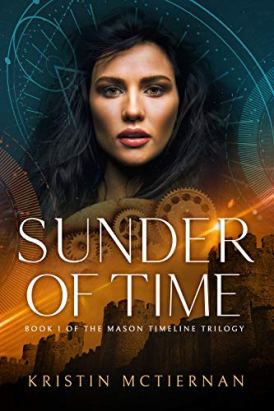
The story of why I read this book begins with a tweet. The author asked what people thought of the cover.

I have to say, I don’t love the cover. Not that it’s bad; because it isn’t. Rather, it just looks like every other cover out there. I feel like a lot of books have faces on the cover, and small wonder, because the eye is instinctively drawn to human faces. The problem is, book marketers have learned this.

But I was impressed that the author was even asking about this. And so I decided, why not pick the book up and give it a try?

I didn’t expect to like it. Early on, it felt like the sort of book I’d put aside and not re-open, as it begins by introducing us to the rather irritating Isabella Jaramillo, a rich, famous, and altogether spoiled professional time traveler. She has the world at her fingertips, and yet she’s rude, angry, and greedy.

But something made me keep going. I got interested as Isabella’s equally unlikable husband decided to strand her in the past as an act of revenge. Isabella started having to make her own way in a world totally alien to her.

The characters of the medieval town to which she is exiled all felt extremely real, too. The characters were well-written and nuanced, and none of them felt flat or clichéd. I felt like I could understand and sympathize with them, even the antagonists. They are a different people, shaped by the harshness of the time and place they were born into, but still complicated and human. And slowly, Isabella starts to be shaped by it, too.

Then the book shifted back to the future and the time-traveler organization, where Isabella’s father Alfredo is frantically trying to find out what’s become of his daughter. But he too has a murky past, and slowly it becomes clear that there are many conflicting agendas at play. The past, or perhaps I should say the pasts, begin to catch up with the powerful men who play at being Gods.

McTiernan displays a wonderful skill at knowing just when to switch from what plot thread to another, keeping the reader hooked on every development, waiting to see what happened next. In other words, by the time I was a third of the way in, the book had totally won me over, and I couldn’t wait to find out what happened next.

In last week’s book review, I mentioned the harshness of life as a medieval peasant, contrasted with the ease of our modern age. Well, this book demonstrates exactly that, as Isabella is forced to cast aside all the privileges and luxuries she once enjoyed and survive in brutal and unforgiving circumstances.

So often, when I read books about the past, they make one of two errors: either they make the past just like the present, only with the thinnest veneer of Middle Ages clichés ill-concealing a modern sensibility, or else they paint the past as miserable and unenlightened, a world of nothing but ignorant stock-characters.

I’m happy to report this book avoids both pitfalls. The people of the past feel real; both in terms of being different from ourselves in terms of values and beliefs, while at the same time having a core of humanity that makes them relatable.

The book is both science-fiction and historical fiction; both an alternate future with some dystopian elements as well a good old-fashioned adventure/romance. It’s also brimming with interesting religious themes, though I’m probably the wrong person to analyze those.

I started off thinking I’d hate this book and wouldn’t finish it, and by the end, I loved it and couldn’t wait to see what happens next. It does end on a bit of a cliffhanger, so you should know that not all the questions it raises will be answered in this volume, but it’s still a fantastic story.

If I made a Mount Rushmore of authors from the millennial generation, it would consist of Peter Martuneac, H.R.R. Gorman, Zachary Shatzer, and Bertocci. I don’t mean to imply they are the only good millennial authors, of course. As Tom Lehrer would say, “there may be many others, but they haven’t been discovered.” It’s just that they are the ones I know about, and each of them, in their own unique ways, captures something about our generation.

And of the four, Bertocci may be the most thoroughly millennial of the lot. Martuneac, Gorman, and Shatzer write of the future and the past, of the supernatural, the fantastic and the bizarre, weaving their millennial themes into their tales. Bertocci, though, writes literary fiction set in the present day, and squarely about millennials.

The Hundred Other Rileys is a perfect example: it follows a woman named Riley who is adrift in life. Here is her description of her job:

[M]y own job is not to understand, it’s to keep track of who’s doing what in Google Sheets and send a lot of emails with exclamation points asking when other people who do things will do them. ‘Riley Bender – Innovation Associate’, my signature reads…

There are versions of me in every sprawling corporation–the hubs, the go-betweens, the copier-pasters and checkers of boxes, whose lot it is neither to know nor to do, but to merely assign, assess, go after, be whatever fills the gap. We look. We circle back. We forward. We facilitate. Sometimes we liaise. We don’t strategize, that’s too serious. We sync. We send updates. We tell ourselves we don’t shuffle papers, it’s all in the digital realm. We thank in advance. No worries if not. We don’t really do what our companies do, but we get on the same page, no worries if not. We do nothing that matters, and we’re all so behind.

Isn’t that dead-on? If you’ve had a job like this, you know how it feels. It isn’t hard… it’s just so blatantly pointless.

But one day Riley sees a picture of a woman who looks like her in an advertisement. And from there, she starts seeing the same stock photo model everywhere, as if mocking her own career’s dead-endedness, alluding to all the other opportunities she missed, all the paths not taken.

What follows is a mind-bending, fourth-wall-breaking, exploration of frustration, stultification and ultimately, how to get past them. There’s even a little bit about writer’s block in it, though I won’t discuss that in detail for fear of spoilers. But every writer I know will want to read it. And that goes double for millennials, to whom Bertocci speaks like no other writer I’ve read.

Be warned, I’m about to speak in broad generalities about an entire generation. Obviously, not every millennial will fit the description I’m about to give. I myself am something of a mixed bag in this regard: in some ways, I fit certain millennial stereotypes to a “t”. In other respects, not so much. So, please don’t think I’m asserting every person born between 1981 and 1996 has all these qualities.

Okay, so what’s up with us millennials? Why, to quote some beloved Boomer family members of mine, are we such whiners? Back in my parents’ day, they had to fight two lions every day… etc. My generation has it so easy!

Well, in a sense, yes, we do have it easy. I was born in 1990. I am much happier I was born in 1990 than in say, 1950, or God forbid, 1850. This is actually an excellent time to be alive in any meaningful historical context.

Are we millennials simply coddled, spoiled, soft, decadent weaklings, like the debased aristocrats of the very late Roman Empire? Are we, or more to the point, all our complaints about society, reflective of nothing but moral turpitude brought on by the proverbial idle hands?

Well, I don’t think so. But I would say that, wouldn’t I?

The problem millennials face is exactly the one illustrated by Riley’s obsession with her doppelgänger: we face too many opportunities. In a world of endless possibilities, we all have to choose one, and it’s hard to be sure which one to take. Thus, we end up either choosing one and regretting it later, or worse yet, staying in a holding pattern too long.

Is this a good problem to have? I think so. Certainly, if Riley had been born a peasant in 1327, she would not face the same problems that she does as young person in the 2020s. And it’s hard to argue that the latter set of problems is not preferable.

What Bertocci has masterfully shown in literary form is that abundance can itself be a problem. It may be a better problem than scarcity, but it’s still a problem. And as a species, we’ve had millennia to learn to cope with scarcity. Abundance? That’s something new, weird, and very much foreign to us.  Because biologically speaking, we’re not much different than the peasants of 1327.

That’s not uniquely a millennial issue, of course. Technological progress took off earlier in the 20th century, before the millennials’ parents were even born. Other things that characterize my generation include a sense of humor that relies heavily on cultural references, and a strong desire not to get beaten down by a nose-to-the-grindstone mentality in our work lives. Whether these are positive or negative qualities is something I leave entirely up to you to decide. What I do know is that this book captures all these aspects of the millennial weltanschauung.

This is why I describe Bertocci as, well, the voice of his generation. In many ways, this is the spiritual sequel to Bertocci’s wonderful Samantha, 25, on October 31, which I consider a masterpiece. This book is every bit a worthy successor to Samantha, and in some ways is even more inventive and original. It’s another splendid work of literary fiction, and deserves to be widely read.

[Note: Special thanks to Richard L. Pastore for reading an early draft of this review and making suggestions on how to improve it.] 

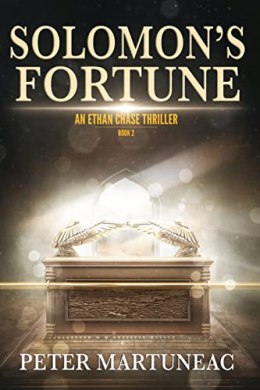
I didn’t get to write a proper review of the first book in this series, Mandate of Heaven, for reasons I explained in my not-quite-a-review post when it was published last month. But I was not a beta reader on Solomon’s Fortune, and that means I get to give it the full Ruined Chapel treatment.

Ethan Chase, and his fellow adventurers Frankie and Mei, once again find themselves on a globe-spanning hunt for a legendary treasure. This time they are seeking the Ark of the Covenant, and their journey takes them from the Middle East to Italy to a mysterious island in the Atlantic. At every step, they are forced to contend with rival treasure hunters, including a wealthy and relentless Russian arms dealer.

Of course, because they’re chasing the sacred Ark, one is tempted to compare the book with Raiders of the Lost Ark. Indeed, much to Ethan Chase’s chagrin, several of the characters draw this parallel. And why not? In my earlier post, I compared the first book to Indiana Jones. Chase’s objections notwithstanding, there’s no question that this series captures that same spirit of adventure, of wise-cracking heroes racing to stay one step ahead of sadistic villains across many exotic and famous locations.

It’s important to remember that Indiana Jones was itself an homage to the pulp adventure serials of the 1930s. We are always nostalgic for a bygone era of adventure, it seems. I’m reminded of something that somebody (Michael Caine, maybe?) said of The Man Who Would Be King: “Even when it was made, people said, ‘they don’t make films like that anymore.'”

And indeed, in our modern world, when the whole surface of the earth is mapped by satellite imagery and everybody has a digital camera in their pocket, can we even keep alive the dreams of forgotten ruins and lost treasures, of ancient mysteries and supernatural secrets, and above all, of heroism and adventure?

I say we can, thanks to books like this. While I was reading it, I found myself instantly absorbed in Ethan Chase’s world. Its themes are timeless, and its characters are likable. Even the villains have some shreds of humanity left in them, which make them all the more interesting.

These books have a vibe to them, is what I’m saying; an ethos that feels familiar and at the same time refreshing. In fact, fittingly enough, I would go so far as to say they are a treasure. If you like good stories, you should read this book, and if you haven’t read the first book in the series yet, you should read them both, and join Ethan Chase on his thrilling expeditions.

Earlier this year, Zachary Shatzer had the idea of creating a new genre called “cozypunk,” as a blend of cyberpunk and cozy mysteries.

I loved this idea, and even thought about trying to write something of the sort myself. But then, when Andrey Popov responded to my call for pleasant, uplifting book recommendations last week, I learned this book existed, and that’s pretty much what it is. And I doubt I could do as good a job of it as Katz does.

This is a short story, set in a “retro-futuristic America.” I was in love already upon reading those words. It follows wandering AI repair technician Clara, whose wanderlust takes her to Seattle, where she meets Sal, a sophisticated robot who manages a small tea shop. Clara soon befriends Sal, but before long, the two are forced to confront a number of challenges, both material and emotional.

The book is a short and sweet sketch of the two major characters, but there was also a sufficient amount of background given to make the world feel grounded. In particular, the threat of violence against sentient AIs helped make the story feel like part of a wider world. It reminded me of Asimov, if Asimov had written lesbian romance.

And it also made me crave tea! I am not even much of a tea drinker; being more of a coffee guy. But every so often, and especially of a rainy November evening, I enjoy a cup of Constant Comment. And that is what I sipped while reading this charming little story. Andrey is exactly right about it; it’s a story that is “kind and full of love.”

I don’t typically put content warnings on my reviews, but today I’m going to. There’s no way to talk about this book without talking about some pretty nasty stuff. The book includes some graphic descriptions of violence as well as plenty of swearing. It’s definitely not for anyone who is sensitive or easily-offended. Also, there are lots of racial slurs in it, although not the one you might be expecting. I can’t blame you if, in these troubled times, you prefer not to have your reading filled with such things.

It is a gritty and realistic account of commando raids, told in the first-person with startling immediacy. In great detail, the author describes the covert missions behind enemy lines undertaken by Rhodesian Light Infantry commandos.

Okay, here’s the deal: this book is supposed to be fiction. It’s in the “war fiction” category on Amazon. There’s a disclaimer in large letters at the beginning confirming its fictional nature.

But it does not read like fiction. I read enough non-fiction war memoirs to know what they’re like, and this reads just like one.

Moreover, it doesn’t have any of the standard features one expects in fiction, such as plot arcs or character development. The narrator mentions his comrades and their names and sometimes one or two minor personality traits, but they aren’t “characters” such as might be found in a novel. They are just guys who went on commando raids with him.

And there is no story, no three-act structure, or anything like that. It’s just a straightforward account of missions the narrator carried out, in chronological order.

If Rische just made all this stuff up from a combination of imagination and research, I’d have to say he did a fine job. It captures the feeling of reality with none of the artificiality of dramatic structure. But… I suspect that’s not what this book is.

Every so often, there’s a scandal where somebody writes something claiming to be a memoir, and it turns out to be largely fictional. (This is the most famous example that comes to mind.)

I struggle to think of a case of the reverse, where someone passed off a factual account as fiction. I mean, what would be the point…? Yet I have to wonder if that’s what’s happening here. It just feels too realistic.

And if it really is a work of fiction, and not a memoir, then it feels like a missed opportunity. Because the thing fiction can do that a memoir can’t is explore multiple perspectives and points of view.

The narrator of this book is not interested in doing that. Time and again, after describing some bloody attack on the enemy, he’ll say something along the lines of, “…but I didn’t feel bad about the brutality. The fact was, if we didn’t do it to them, they would be attacking innocent people.”

It never seems to occur to him that presumably his enemies are thinking the exact same thing. No doubt they could provide their own justifications for their actions, just as the narrator does for the RLI.

And this is of course the ugly logic of war: “do unto them before they do unto you.” And it makes a certain sense, once you are in such a brutal situation, but it is the logic of the vicious circle. At every point, each side’s most “rational” choice is to escalate, leading to utterly inhuman horrors.

Early in the book, there’s a section about the Rhodesian Air Force bombing an enemy camp. The pro-Rhodesia position is that it was a terrorist training facility. The anti-Rhodesia position is that it was a refugee camp. Even if, like me, you know nothing about the Rhodesian Bush war, this sort of dynamic will be familiar to anyone who has read about the Israel-Palestine conflict, or any of the United States’ recent “asymmetric” wars.

Our narrator, of course, believes 100% that it was a terrorist staging ground, and only that, and anyone who says different is just repeating enemy propaganda.

Well, as long as we’re subscribing to the idea that this is “just fiction,” sure, why not? But my sense is that in most real-life cases where things like this happen, it’s usually some combination of the two. A common tactic of the militarily weaker side is to place their agents among civilians, so the stronger side can’t avoid civilian casualties.

Even the wars that we look on as “good” wars have their share of incidents like this. No one really likes to think about it, but in any war, there is some expected amount of loss of innocent life. It’s “priced in,” as it were, when calculating the costs of war.

Do you feel a bit sick thinking about this? I feel pretty sick writing about it. As we should. It would have been interesting if the book had featured a little more introspection, a bit more musing about how the narrator and his beloved country became locked in an inescapable conflict that could only end badly. And did.

But there is no introspection here. Which, again, I would understand in a memoir much more than in a novel. As it is… this is a strange and depressing book. Which, I suppose, makes it an accurate account of how the war must have felt.

This is a cybercrime techno-thriller about a hacker who finds himself entrapped in an elaborate blackmail scheme. He’s forced to recruit old friends from his past in an effort to save himself.

What I liked most about the book was the setting. It’s a classic cyber-dystopia, with omnipresent surveillance and ongoing threats of pandemics. The atmosphere was creepy and disturbing, without being distracting.

Also, the technical details of all the hacking and counter-hacking were well done. I could follow what was going on without getting bogged down in the details.

I did struggle with some of the characters, in particular the protagonist. Let’s just say that, while he is the victim of a crime, he is far from innocent of wrongdoing himself. This made it hard for me to feel much sympathy for him.

However, if you can get past that, the book certainly makes for a fast-paced and exciting page-turner. Also, that cover is spectacular, isn’t it? Makes me think of Ghost in the Shell a little.