jane-got-a-gun.jpg
Natalie Portman in “Jane Got a Gun” All Rights Reserved by the Weinstein Co. and re-used under “Fair Use”.
[UPDATE 4/23/2016: I loved this movie so much I also wrote a more in-depth analysis of it here. Note that it gives away the ending.]


The Western genre more or less died out after the 1970s. The social scientist in me wants to attribute this to the cultural change in that decade–the mythology of the American West was focused heavily on the image of white men with guns as heroes, and cast other groups as either supporting characters or villains. Not the most progressive genre.

But as the title indicates, Jane Got a Gun gives the firearms to a female–a mother, protecting her family from a gang of villains called “The Bishop Boys”, named for their cruel leader. (Ewan McGregor)

Natalie Portman plays Jane, the frontierswoman whose husband Bill Hammond (Noah Emmerich) encounters his old gang and is shot nearly to death by them. When he returns home on the verge of death, Jane takes her young daughter to safety and rides off to get help from her old fiancé, Dan Frost (Joel Edgerton), whom she believed had died in the Civil War, and had met again only after her marriage to Bill.

Dan at first refuses to help, still bitter that Jane left him for Bill. The Bishop Boys, meanwhile, are interrogating one of Hammond’s associates in the fur trade regarding his whereabouts. Bishop clearly remembers Jane as well, and means to track them both down.

Having been rebuffed by Dan, Jane rides into town to buy weapons. As Jane is leaving town with her arms and ammunition, one of the Bishop Boy goons drags her into an alley and holds her at gunpoint, demanding to know where Hammond is and threatening to rape her.

Dan arrives, and aims his rifle at the gang member, who offers to split the bounty on Bill Hammond with him.  Dan listens, feigning interest, and Jane takes the opportunity to fire a shot into the thug’s head.

Jane and Dan hastily ride out of town and back to Jane’s ranch, where Jane pays Dan to help prepare them for the inevitable attack by the Bishop Boys.  During this, we see flashbacks to Jane and Dan’s courtship, as well as to the beginning of the trouble with the Bishop gang.

Gradually, as she and Dan scramble to prepare the home’s defenses while also tending to the wounded Bill, their old feelings start to emerge.  Dan recounts how his love for Jane had sustained him through the War, and how it broke him to find that she’d married another man and had a child with him.

That night, Dan’s resentment towards Bill nearly boils over, and he holds his gun at the bed-ridden man–until Jane enters, which prompts the drunken gunslinger to stagger away, muttering “I don’t know what you saw in him.”

As Dan keeps watch from the upstairs window that night, Jane joins him and tells him about what happened to her after she joined the Bishop’s wagon train.  She had a daughter (named Mary, after Dan’s mother) with her when she placed herself under Bishops’ “protection”.  The Bishops then took Mary from Jane, and forced Jane into prostitution. The scene flashes back to when Hammond, as a member of the gang, tried to free her, but was prevented by Bishop.

The next scene was perhaps the most disturbing, as Hammond asks one of Bishop’s men what became of Mary. He chillingly replies something to the effect that “Bishop told me to ‘take care of her’–he didn’t explain what he meant, so I made my best guess.  Did you know she can’t swim?”

In a fury, Hammond races to the brothel and, in a violent but extremely cathartic scene, guns down the clientele and rescues a weeping Jane.

The transition from Dan’s face as Jane begins telling the story, to the flashback sequence, and then back to Dan, is really powerful.  His expression changes completely, and his rage is such that he can barely spit a few words to say that he hopes John Bishop himself is coming.

As the night wears on, Jane and Dan venture outside the house.  The scene is dark and atmospheric, and Jane utters a few words of courageous resolve.  Then, shots ring out and Jane and Dan both hit the ground.

So begins the climactic showdown–I won’t spoil the ending for you, but suffice it to say that it is immensely satisfying.  Not to give too much away, but watch for a certain transition that begins with a close-up on a revolver barrel–it works really well.

What a lot of the “feminist” or “strong woman” action movies get wrong is to portray the woman as a Rambo-like super-human, crushing everything in her path.  Jane Got a Gun avoids this pitfall–Jane is believably vulnerable, but gains her strength on fiery resolve and force of will, rather than impossible physical strength. Portman does a terrific job conveying the transformation from sweet, innocent girl to hardened frontierswoman that Jane undergoes.

Edgerton is suitably gruff while conveying an underlying decency, and his chemistry with Portman is absolutely marvelous. McGregor is the very picture of the “villain we love to hate”. All the Bishop gang henchmen are utterly loathsome in different ways, making each one’s demise a satisfyingly bloody catharsis.

The beautiful landscapes and moody soundtrack really stuck with me.  I’ve been a sucker for desert movies since I saw Lawrence of Arabia as an impressionable sixteen-year-old, and my Fallout: New Vegas binge only solidified my love for the harsh, barren landscapes. Jane uses this type of scenery to create a marvelous feeling of loneliness and isolation.

It was interesting to watch this movie so soon after seeing the new Star Wars film. Jane’s behind-the-scenes connections to Star Wars are well-documented, as Portman, McGregor and Edgerton all appeared in the prequel trilogy. More significantly than that, the original Star Wars, which the new one tries so hard to imitate, was really just George Lucas’s reinvention of the western–an attempt to translate the familiar Good vs. Evil melodrama for a new generation.

The latest Star Wars tries to do this too, but fails badly on every level. Jane Got a Gun (while obviously not a film for children, because of the violence) succeeds in capturing this old-fashioned spirit.

Both films feature a Good vs. Evil plot with a strong heroine, a reluctant hero, and a cruel villain. But while Star Wars‘s Daisy Ridley and John Boyega fail in their attempts to portray the archetypes of “strong heroine” and “reluctant hero”, respectively; Portman and Edgerton play those same roles to perfection. McGregor, meanwhile, brings a chilling charisma to the villain’s role–exactly the sort of touch Adam Driver failed to give his cartoon bad guy in Star Wars.

Jane Got a Gun does not reinvent the Western by any means, but it certainly revives it admirably. The performances are all first-rate, and the pacing is terrific.  It is marketed as an action film, but there is plenty of romance and suspense as well, and the haunting desert landscape and soundtrack give it a very strong atmosphere.  Go see it.
One of my publisher’s core values is that their products–be they apps, books, or what have you–never collect user data. This is, on balance, a very good thing, as many users find it intrusive to download a product only to find that is collecting their personal information.

There is only one drawback to this policy, and that is that I never know who has bought my books. Which would be awfully nice to know, because I want to show I appreciate them. I know Barb Knowles of saneteachers is a recent customer, and I can’t thank her enough for her support. But, thanks to her, I’ve seen a real uptick in sales of The Start of the Majestic World lately, and I want to thank all my new readers for their interest. I hope you enjoy the book!

I had a friendly bet with Barb Knowles on the AFC Championship game.  The loser had to do a post about the winner’s blog.  But, I like her blog “saneteachers” so much that I am going to post about it even though I didn’t lose.

She has a delightful post about the dialect differences she encountered on coming to Ohio Wesleyan University from New York. As she puts it:

They don’t speak New York in Ohio.  They speak Ohio in Ohio. Of course, to me it sounded more like Ahia.

As a lifelong Ohio resident–I grew up about a half-hour from Ohio Wesleyan’s campus–I know what she means.  Non-Ohioans have frequently pointed out that central Ohioans sound like this when listing our home country, city and state:

I’m ‘Merican, from C’lumbus, Ahia.

but then again, they might be from a place a little way east of Columbus: Newark, which is pronounced something close to “Nerk”.

I took a linguistics class in college where we had to do an assignment on regional dialect differences.  For instance, when informally addressing a group of people, Southerners would say “you all” (often rendered as “y’all”) whereas Midwesterners say “you guys”.

That of course was small potatoes next to the big dialect difference: what do you call those glowing insects we get in the summer–fireflies or lightning bugs?

In her post, Barb also mentions the age-old debate of “soda” vs. “pop”.  (Some also call them “soft drinks” or “fizzy drinks”.)  This one I missed, because in my family we called the drinks by their brand name, but I remember the first time I heard someone call it “pop” I was puzzled.

I’d also never heard of the confusion over “bag” and “sack” that she describes–I’ve always heard both used interchangeably. With the prevalence of television regional dialects have declined over time–maybe that’s the reason. I also never heard “rubber” for “rubber band”.  I shudder to think at the mix-ups that could cause.

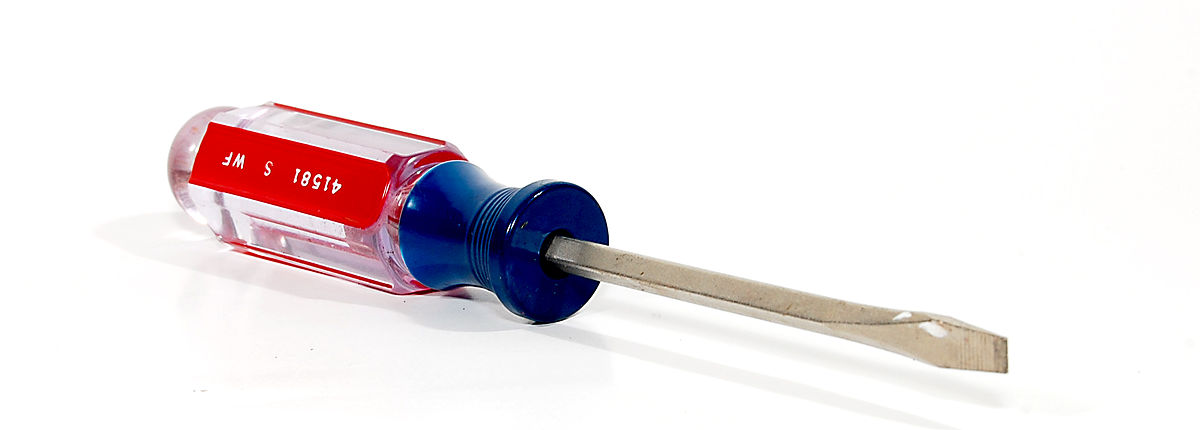
I once got into an argument with two of my friends–both of whom are also native Ohioans–about whether you call this a “flathead” or a “slotted” screwdriver. (It’s “slotted”.  Don’t let my evil friends tell you otherwise.) I don’t know if this is a generational or regional thing, but it was interesting.

I’m lucky in that I have relatives all over the country, so I get to hear a lot of different regionalisms.  Even if it does cause some confusion sometimes…

Anyway, you guys–and you all–should check out Barb’s blog.  She’s a terrific writer, and has some very witty observations.  I wouldn’t have made my bet with her if I didn’t think so–and the fun of a bet like this is that everyone wins.

NFC Championship


I live in Ohio, so I used to see a lot of Carson Palmer’s games when he played for the Bengals. He always would throw high and behind his receivers. I can’t tell you how many times I’d see some Bengal receiver have to reach up and catch the ball right over his helmet.

I tuned in to the Arizona/Green Bay game last Saturday, and it was the same story. Palmer doesn’t lead his receivers. It caused an interception in the end zone on one drive.

Palmer is a decent journeyman, but he is not the kind of guy who can carry a team. Cam Newton is. The fact that Carolina’s defense shut down Russell Wilson last week only makes me less optimistic about the Cardinals’ chances. It’s too bad, because I’d love to see the great Larry Fitzgerald get a Super Bowl ring.

Panthers: 34
Cardinals: 17


AFC Championship


Fascinating matchup, this. Most writers seem to think the Patriots should win easily. “Sure, the Broncos beat them back in November, but the Patriots had so many injuries–with Edelman, Amendola, and Gronkowski back, they are bound to win”, goes the thinking.

Sounds good, on paper. But Denver still has the best defense in the NFL. When a strong defense meets a strong offense, the defense usually wins. Denver knows this all too well–they learned it two years ago when Seattle annihilated them. After that, Elway committed to building a strong, hard-hitting defense so that wouldn’t happen again.

Of course, that same Seattle defense got picked apart a year later by these Patriots and their short passing game. So defense alone isn’t always enough, at least not when you are going against a master of the surgical, precise pass like Brady.

Against the Steelers last week, the Bronco defense shutdown the Pittsburgh running game and the short pass. The only way the Steelers could move the ball was when Roethlisberger bought time for his receivers to get open, and then let them get yards after the catch. The Steelers got five or six big gains doing that, and it almost got them an upset victory.

Brady can’t withstand pressure like Roethlisberger can, though. If Denver can keep his receivers covered, they are going to have a chance. The only reason Brady was able to move the ball against Seattle’s defense in the Super Bowl was that he could get the ball out quickly. If they neutralize that, he’s in trouble.

If I were coaching the Broncos, I’d blitz Brady early and try to make him get nervous in the pocket. Yes, I know Brady is great at reading the blitz and making a quick pass, but let’s face it: he’s going to get his share of completions no matter what. Better to at least rattle him early in the game while he does it, and then he may start to imagine pressure as the game goes on.

Then you’ve got the matchup on the other side: the offensive-coordinator-on-the-field, Peyton Manning vs. his arch-nemesis, Bill Belichick, the wily defensive genius. Belichick used to own Manning in the playoffs, but Peyton has won their last two post-season encounters.

People are saying Manning is a ghost of his former self. Even I was saying that last year. And it’s true that his arm strength is pitiful. But the thin Denver air mitigates that to an extent; as does Manning’s skill at the short pass. Manning played a decent game against Pittsburgh, and his stats would have been much better if not for a bunch of dropped passes.

The Steelers seemed to be doing their best to pressure Manning with blitzes from unexpected directions. It almost worked; they were close to sacking him more than once. But blitzing has never really been Belichick’s game–he prefers to use coverage to confuse the quarterback. But Manning is tough to confuse. He’s still got the mental game mastered, even if he is physically barely able to play.

I haven’t really mentioned the running game much. That’s because, as far as I can tell, neither team has one. I do expect the Patriots to try lots of screen passes to James White. They also have Steven Jackson, but he looked slow to me in their game against Kansas City. As for the Patriots run defense, I think they will take away Denver’s rushing attack and force Manning to beat them with his arm.

As I said above, it seems like the national sports press isn’t giving Denver much of a chance in this thing–possibly to set up a “Manning upsets the Mighty Patriots” narrative, possibly just because they are lazy–but this game has a very odd vibe to it. New England is good, but they are also worn down. The fact that the game is in Denver, where they historically struggle, only adds to their problems. (If the Patriots just hadn’t tried a punt right before halftime of their game against the Eagles, they might well be playing in New England.)

The Patriots deserve to be favored, and I was tempted to follow the crowd and pick them, but I keep hearing this nagging voice in my head telling me the Football Fates have something really weird in store for this game. Denver got to be the number one seed for a reason, and I predict they will show us why in a tough, strange game.*

Broncos: 22
Patriots: 20

*Take heart, Pats fans: I also had a feeling about the Steelers last week, and that came to nothing.

KC: 17

NE: 14

New England has a ton of injuries, and they don’t match up well with the Chiefs anyway. The last time they played, the Chiefs beat them 41-14.   Brady has had no time in the pocket the last few games, so I don’t see them winning this.

ARZ: 30

GB: 20

People are thinking Green Bay is good because they beat Washington, the winner of the weakest division in football, apart from the AFC South. I’m not buying it, even though I picked them to reach the Super Bowl in the preseason.  Arizona demolished them a few weeks ago.

CAR: 35

SEA: 28

Seattle has been a trendy pick all week to upset the Panthers.  I can see why, and was on the point of picking them myself, but when an upset is this popular, it’s no longer an upset.  The Panthers have been hearing all week about how great Seattle is. The ‘Hawks are tough, but Carolina will ultimately win.

PIT: 13

DEN: 10

All logic says to pick Denver. The Steelers have tons of injuries, Peyton Manning is rested, Denver has a great defense, which is normally the key to playoff success. But there’s something about these Steelers–they have an intangible quality that makes me think they can do it.


One of the things I like to do in my spare time is watch history videos online.  I like the ones that I can cue up and then do something else (e.g. cleaning) while listening to the narration. Audiobooks are also good for this. My first preference would be to just read about the stuff, but often I’m just too busy.

Strangely, some historical incidents–especially battles–have tons of videos made about them, and others have next to nothing.  For instance, there are plenty of documentaries about the Battle of Marathon, but almost none about the Battle of Plataea.

What I was really looking for was something in-depth on the Battle of Tours. (Which is also sometimes called the Battle of Poitiers, which is confusing, because there was another Battle of Poitiers, some 600 years later.  I know this because my friend P.M. Prescott wrote a short historical fiction story about it.)

It goes on like this.  You search on Napoleonic wars, and you can’t turn around without seeing stuff about Waterloo, but Jena, Austerlitz and even Trafalgar you have to dig to find.

Of course, there is an absolute wealth of material on World War II.  It just never ends.  I think it’s better documented even than more recent wars, especially Korea, the “forgotten war”.

A long, long time ago, I wrote about Ian Doescher’s delightful book The Empire Striketh Back–a re-imagining of the Star Wars film as though written by William Shakespeare.

Well, I recently learned that Doescher also wrote more of these books for the prequel trilogy.  As my readers know, I like the prequel trilogy very much, but there’s no denying it has a weak script that undercuts its other strengths. This is especially true of Attack of the Clones.

Doescher’s treatment fixes these problems. Most notably, it fixes the character of Anakin Skywalker.  In Doescher’s version, Skywalker seems like he actually cares about Padme Amidala.  This really helps the romance between them. (I know, you would think this would be obvious, but apparently it wasn’t to Lucas.)

That’s not the only improvement–all of the dialogue is much better when done in the style of the Bard.

The irony is that Lucas has always defended his awkward script by calling it “stylized dialogue”.  Well, Doescher’s dialogue is even more stylized; but what’s more is that it’s good. It trips off the tongue.

What Lucas should have done was give his story outline–which is very strong, with its political machinations, epic battles, and forbidden romance–to Doescher or someone like him, who could give it a fittingly poetic script to match.  Then maybe put the exceptionally talented cast under the direction of a Shakespearean director (say, Sir Kenneth Branagh?) and they would have really had something.  It would have been stunning.

The prequels are not bad–they just needed a better script.