Famous scene from the 1922 film “Nosferatu”. The shadow is scarier than the actual monster (see below) because your imagination fills in the details.

Saw the movie House of Dracula on TV the other night.  It’s a 1945 Universal Monsters flick that contains three of their most popular monsters: Dracula (duh) the Wolf-Man, and Frankenstein’s monster.  It was fairly well-done for what it was.  John Carradine is great as Dracula.  Also, the film features the stereotypical hunch-backed assistant to the mad scientist, but for a change the character is female, and fairly attractive apart from the hunch-back. It’s an unusual role, and the actress, Jane Adams, does a pretty good job.

But what was especially notable about the movie was that it falls into the awful horror movie pitfall of trying to explain the source of the horror scientifically.  So, it turns out that Dracula has a blood disease, and that the Wolf-Man can be cured by brain surgery and some kind of weird fungus that the aforementioned scientist grows in his castle.

Folly!  I’ve blogged about this before: horror movies should not rationalize or explain the horror in any way.  When they do, it becomes less frightening.  They make this mistake all the time in horror movies.  It’s much better when the scientifically-inclined are skeptics and shown to be wrong, and the monster is an inexplicable violation of the laws of nature.   The intelligent, scientific  types being wrong is how you know you’re in trouble.

If you try to explain everything, it is less scary.  This applies not only to trying to give explanations for the monster’s origin or condition or whatever, but to every element in any scary story.  Just give people a few hints of the monster, and  let them piece together the rest, that’s what I say.
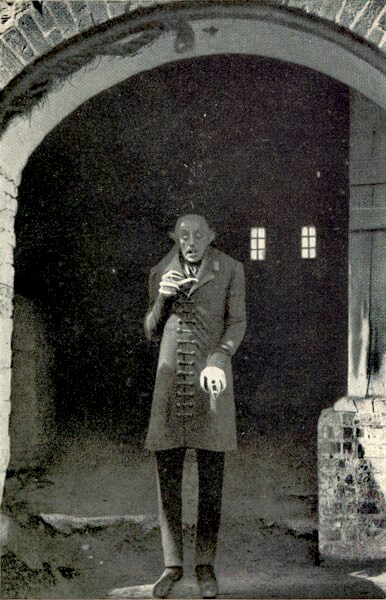
See what I mean?


I tried to read the first book of the Hunger Games series awhile back, and although I thought it was well-written and had a good setting, it was hard for me to get into it because it was fairly predictable.  I’m sure that’s partially because it was written for a younger audience, but I think it also is a just a little too cliche filled.  I’m not saying it’s bad.  It’s a decent book, but I pretty much knew where it was going from a very early point.  This is a problem I have with a lot of dystopian fiction–it all seems cut from the same cloth.

You know, I had an idea for a dystopian movie once.  It would be set at an undefined place and time, in a country where a totalitarian, fascist government had taken over.  The main character would be some kind of violent goon for the government who went around suppressing all dissenters.  And the whole film would present him as the hero–he’d be played by a “leading man”, the camera angles would present him heroically–the whole film would seemingly approve of the dystopian society.  Then, at the end, there would be some kind of title card or something telling the audience that this was a propaganda film approved by the fictional government, perhaps even detailing some of the techniques involved.

The point of this would be to pull the rug out from under the audience; see how many of them would have found themselves being subtly seduced into rooting for the main character–and the society he represents–by the film’s technique.  The “plot twist” would actually be a test to see how much people would start to buy into something awful because of good cinematography. Then they would have to re-evaluate what they had just watched.

The trouble is, this is more of a science experiment than an entertainment movie.  The trick of the movie is that usually, in dystopian stories, the protagonist begins to question his society, and through him, the audience is told about the society’s problems. (e.g. Winston Smith in 1984, Guy Montag in Fahrenheit 451)  There would be none of that in this movie.  He’d be 100% behind the society, and looking to maintain it.  It would be kind of like 1984 from O’Brien’s perspective.

The thing about my idea–and I’m not saying it’s a good idea–is that it plays with the tropes of the dystopian genre.  Dystopian stories give the audience some character they can turn to to see the dystopia’s flaws; or at least the “tone” of the piece, or the “voice” of the narrative give it away.  Here, there are no societal outcasts or anything like that for people to turn to. (The main character takes care of that.)  I thought this up largely from noticing that every dystopian story seems to rely on the same devices, and that makes them pretty predictable.

A new poll has come out showing that only 49% of Americans think President Obama is Christian.  17% think he’s Muslim.  James Rainey writes:

The lingering questions about Obama’s faith likely come from people of two mind-sets. One is those who have an intense dislike of the president and find confirmation of all their fears in a fever swamp of conspiracy websites. Where a birth certificate is not accepted as proof of someone’s place of birth, forget about verifying something as intangible as a statement of faith.

The second factor driving up Obama’s “Muslim number” is doubtless the urge of some respondents to stick it in the pollsters’ ear — to commit a small act of defiance by giving an answer the voter knows is untrue. When the interloper in the Oval Office is deeply loathed, why credit him with anything, least that he is a Christian?

Rainey focuses his attention largely on 17% who think he is Muslim.  Probably this is because it really is incredible that anyone could honestly believe he is a devout Muslim, as so many of his actions are inconsistent with that faith.

What I wonder about is the people who answered “don’t know” or “other” in the poll.  Is there also a conspiracy theory that Obama is secretly Buddhist?  Actually, most of the people I’ve talked to who doubt Obama on this suspect that he’s an atheist, not a Muslim.  Not sure why those people would answer “don’t know”, though.

As for the results on Romney’s religion, I was surprised how many didn’t know it.  It’s one of the most notable facts about an otherwise fairly dull politician.

My favorite part was the bit where the multitude of Mary Poppinses banished Voldemort and all the other villains.  (Incidentally, I thought some of the monster costumes looked a lot like the Ghost People from the Fallout add-on Dead Money.) The James Bond bit was also amusing, but sort of weird.

In general, though, I don’t like all that pageantry.  It makes the whole thing seems less about sport and more like a grand theater production, or a massive circus act.  I mean, theoretically, this is the big moment for sports; the opportunity to see who is really the best in all the world, but it all feels more like a show than a real competition.

This article says the ceremony cost $42 million to make.  I don’t know too much about London’s economic situation, but I can’t help wondering if that is a wise use of money.  Might be better to spend it on infrastructure or something.  Still, there should be a Keynesian stimulus effect from it, but probably nothing too major.

Romney may have gotten one good line in, but as I mentioned, his answer to NBC’s Brian Williams’ question on gun control was awful.  The only place I was able to find a full transcript was a Conservative website, but here it is:

Williams: As governor you signed an assault weapons ban in Massachusetts. And you said at the time, quote, ‘These guns are not made for recreation or self-defense. They are instruments of destruction with the sole purpose of hunting down and killing people.’ Do you still believe that?

Romney: Well, I actually signed a piece of legislation, as you described, that banned assault weapons in our state. It was a continuation of prior legislation. And it was backed both by the Second Amendment advocates like myself, and those that wanted to restrict gun rights, because it was a compromise. Both sides got some things improved in the laws as they existed. And I happen to think that with regards to the Aurora, Colorado disaster, we’re wise to continue the time of memorial and think of comforting the people affected. And political implications, legal implications are something which will be sorted out down the road. But I don’t happen to believe America needs new gun laws. A lot of what this young man did was clearly against the law. But the fact that it was against the law did not prevent it from happening.

Let’s break this down bit by evasive, mealy-mouthed bit, with my comments in red.

  1. “I actually signed a piece of legislation, as you described, that banned assault weapons in our state. It was a continuation of prior legislation.”  [He is basically trying to say: “it’s not my fault, it was like that when I got there.”]
  2. “And it was backed both by the Second Amendment advocates like myself, and those that wanted to restrict gun rights, because it was a compromise. Both sides got some things improved in the laws as they existed.” [It was an assault weapons ban–that means it restricted guns, period.  Don’t try to retcon everything so that you were more radically conservative.  He’s trying to appeal to the hardcore NRA members by lying to them, and what’s worse is that it’s not even a very good lie, as it makes him look like an incompetent governor.]
  3. “And I happen to think that with regards to the Aurora, Colorado disaster, we’re wise to continue the time of memorial and think of comforting the people affected. And political implications, legal implications are something which will be sorted out down the road.” [I said something similar on the day of the atrocity; I thought we should wait until more facts were known before talking about what to do to prevent it.  But now, more facts are known.  Romney is trying to dodge the question so that he doesn’t have to alienate any voters.]
  4. “But I don’t happen to believe America needs new gun laws.” [What happened to what you said in the previous sentence?  Do you want to talk about the political angle or not?  If America doesn’t need new gun laws, then tell us: what does it need?  Surely something can be done to prevent this kind of tragedy.]
  5. ” A lot of what this young man did was clearly against the law. But the fact that it was against the law did not prevent it from happening.”  [What? Yes, everyone knows mass murder is illegal, and yet it still occurs.  That’s true.  But the point is, you can make it harder for the crime to be committed.  What Romney said is a trivial generality; an attempt to dodge the question again.  And it succeeded, because Williams then moved on to another topic.] 

Stop the presses!

I know you’ll think I’m crazy, but I saw it with my own two eyes, I did!  He was being interviewed by Brian Williams of NBC, who said something like “an anonymous Romney staffer said you were planning to pick a boring white guy for VP”.  And Romney chuckled and said something like “you told me you weren’t interested.”  UPDATE: The verbatim quote from Romney was: “You told me you were not available”.  Same thing, really.

Now, it’s true that minutes earlier, Williams asked him something about a gun control law he passed as governor, and Romney answered with a barrage of weasel words and non-answers the likes of which I’ve seldom seen.  And even more pathetically, Williams totally let it go without follow-up questions.  But still, you have to give Romney credit: he made a joke that wasn’t awkward or forced, which is pretty rare for him.  And after all, “likeability” is what wins elections!

Really, it happened!  I tried to get the clip, or at least a transcript for you  at NBC’s website, but I can’t get the clip to embed, or even play correctly on my computer.  It might be here.  Or that might be an interview with Kathy Griffin.  For some reason, I was having a heck of a lot of trouble with navigating their site.

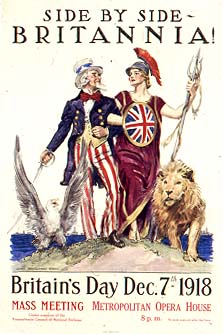
World War I propaganda poster depicting Britannia and Uncle Sam. Image via Wikipedia.

An anonymous Romney adviser has allegedly told the Daily Telegraph that Romney would improve relations with Britain because:

“We are part of an Anglo-Saxon heritage, and he feels that the special relationship is special,” the adviser said of Mr Romney, adding: “The White House didn’t fully appreciate the shared history we have”.

What a lot of people are talking about is the racial angle (pardon the pun) of this alleged quote.  One thing to keep in mind is that Obama is in fact partly English on the side of his mother, Ann Dunham.  (Dunham is an English name, for one thing.) But people are thinking this is a not-too-veiled racial attack.  I’d have to say I don’t what else the point of such quote could be, although it should be noted that the Romney campaign is saying this quote is inaccurate.  Well, if so, they should sue the Telegraph for libel.  If they don’t, it might seem like their guy actually said that, and they’re lying to cover it up.

What I really want to talk about, though, is this “special relationship” stuff.  I remember there was a big dust-up back in 2009 about the “special  relationship”, when Obama gave then-Prime Minister Gordon Brown a set of DVDs as a gift.  The Prime Minister had given him a pen-holder made from the HMS Gannet.  This upset a lot of people, but from what I can tell, Brown was treated like this by virtually everyone.  He had that anti-charismatic thing (a lot like Al Gore) that made people dislike him instinctively.  So I don’t think this means Obama doesn’t like Britain.

In practice, the “special relationship” seems to work like this: the British give us their culture–actors and actresses, authors, musicians–and we give them help whenever there’s a world war.  It’s not a bad system, all told.

Seriously, though: the “special relationship” seems to have been heavily emphasized by Winston Churchill, presumably for the purpose of convincing the U.S. to intervene in World War II.  And certainly, since America was founded people who had been British, there’s no doubt the two countries have a lot in common.  However, I don’t know that it is really that “special”.  Diplomatic relationships are usually forged and dismantled based on financial or military interests, not sentimentality.  If–Heaven forbid!–the United States’ relationship with Britain deteriorated, we would no doubt start saying “well, the whole country was founded because of a war with them, after all.”

That’s really the point: a lot of this is contrived stuff for people to argue about that ultimately doesn’t mean very much.  Example:  Romney says he’ll put a bust of Winston Churchill back in the Oval Office if elected.  Big deal.  I admire Churchill, but that really doesn’t matter very much in the scheme of things.  This is all a lot of pointless fighting over symbolism, as far as I’m concerned.

I see Michael Moore is going on Piers Morgan’s show tonight to talk about the awful shooting in Colorado and gun control.

I’ve seen three of Moore’s films: Roger & Me, Fahrenheit 9/11 and Bowling for Columbine.  Bowling is technically speaking the worst one, but it’s also by far the most interesting.  Because unlike the other two, which are amusing but kind of simplistic propaganda pieces, Bowling is really more of an open-minded exploration of the issues.

It starts out as a propaganda, dark comedy sort of movie, but it actually turns into more of a examination of American culture.  At one point in the film, Moore says that people also own lots of guns in Canada , but they don’t have the same crime problems we do. Surely, this point contradicts any gun control agenda he may have.  The middle of the movie is very interesting; Moore seems to admit he doesn’t have all the answers, and is actually revising his opinions as he learns more.

Now, towards the end, Moore remembers that he is making a movie, and he reverts to his ambush/ask awkward questions style and it totally doesn’t work and it makes him look like a jerk.  It makes for a really uneven movie, but it’s still thought-provoking to watch.

That said, I think Moore is unfair in singling out America for violence.  His new line is to portray Americans as singularly bloodthirsty, but I think we know that’s not the case.  There are mad men and evildoers in every nation.

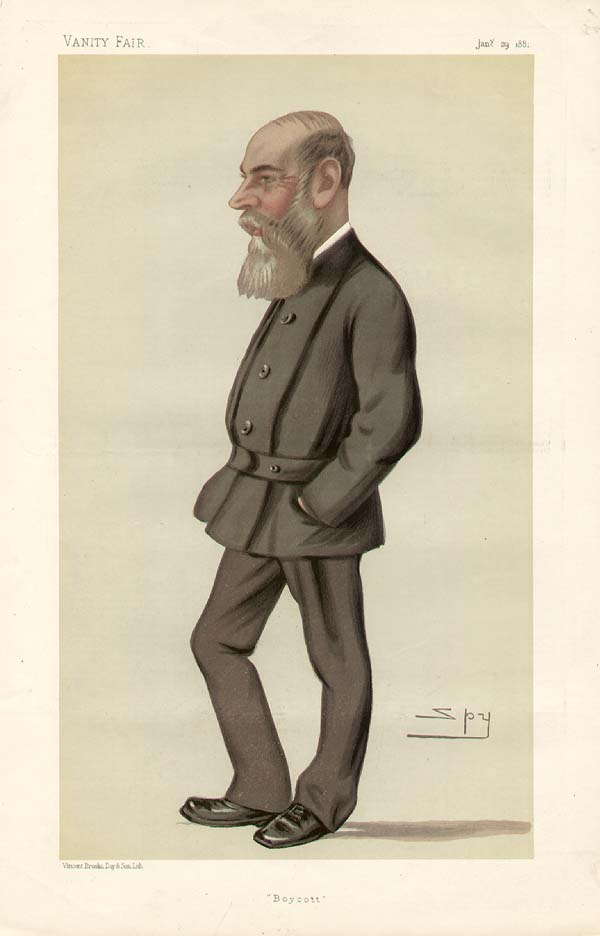
Charles Boycott caricature from “Vanity Fair”. Image via Wikipedia.

I never liked Chick-fil-A .  Not fair, I suppose, since I’ve never been to one.  Never had much call to, being vegetarian and all.  But I don’t like their name, it looks stupid.  I also don’t care for their commercials with the cows asking people to eat more chicken–again, ludicrously misspelled because apparently, although the cows have learned English, they can’t master spelling.  Whatever.  The only real impact Chick-fil-A has on my life is that they sponsor a college football game every year that I watch in dismay as an SEC team, usually Alabama, blows out some hapless other team.

So the guy in charge of Chick-fil-A said he’s against gay marriage.  And his company donates to anti-gay marriage groups.  As a result, people are organizing boycotts of the company.  Well, if they succeed it means I won’t have to see those ads any more.  Also, the mayor of Boston is saying he doesn’t want a Chick-fil-A in his city on account of this.  I am not sure if he can forbid a company from opening up shop on account of its owner’s political views, but then I am not even sure if it might move to Boston.  It seems like it’s more of a Southern restaurant.

I guess the problem with boycotting is that it is more likely to be felt by the employees of Chick-fil-A than the upper management.  That’s often the way with boycotts.  The original boycotting effort was different than subsequent consumer actions named after it because in the first case, everyone in town ostracized and refused to serve Charles Boycott personally.  It was actually more like a labor strike.  (It was also an instance of community organization which Glenn Beck would no doubt deem “Alinskyite” except that it happened 30 years before Alinsky was born.)

Peaches at A Lateral Plunge has a great post about “liking” blogs.  It’s on the front page of WordPress as of this writing, so probably lots of people have seen it already, but I wanted to mention it because it confirmed what I’ve suspected about likes on here for some time: to wit, many of them are worthless.  I mean, why would a real estate agency “like” a whimsical post about Antarctic aliens and H.P. Lovecraft?

I’ve had similar issues with “likes” on here.  When someone “likes” a 1,000 word post 3 seconds after I posted it, and without apparently viewing my blog, I know that something is rotten in Denmark.  Or Russia.  Or wherever the spam “likes” happen to be coming from.

Also, I don’t think I’ve ever “liked” a blog.  I prefer to comment, even if it’s quick, just so they know I’m not a spammer.  I’ve also never re-blogged, although I considered doing that for Peaches’ post, because it feels a little lazy to me.  Just my opinion, though.

P.S. I’m leaving “likes” on for this post.  I’ll be curious to see how many it gets–and how many are genuine.

UPDATE: Too awesome–this post earned me my “200 likes” award!  And my pageview count remains the same as it was before.