You know, I remember a more innocent time when cheating at video games meant putting in a code to make your character immortal, or exploiting a bug in the AI that let you win every time. But now it seems that exploiting little glitches in a game has gotten more serious. Because there were a million real-world dollars at stake.

I don’t follow baseball or baseball video games, and I know so little about it that I can barely even follow what exactly people were allegedly doing that was shady here, but still, it’s a helluva thing. The good news is, it apparently didn’t affect the contest in the end. But my “favorite” part of the rather depressing article has less to do with baseball video games than with human nature and social media:

Young says Haff told him to stay quiet about the exploit. Young didn’t, though, telling another person over Xbox Live about it but demanding that he stay silent. That person didn’t, and then the conflict boiled over to Facebook and other social media.

I love it: “Here’s this big secret! I’m telling you, but for God’s sake don’t tell anyone else!” You go through a couple iterations of that, and soon everyone knows.

As if on cue, a guy named Rob Flickenger has invented a Tesla energy gun:

Cool. I like electricity. But notice that the thing’s range is apparently 12 inches. And it took only took a little over a hundred years to do it! To me, this somewhat long development time does explain why the armies of the world weren’t lining up to pay Tesla when he first talked about his energy weapon.

By the way, people keep calling it a “Tesla coil gun”. I believe there is also a “coil gun” that is a different thing altogether, invented by Carl Gauss–sometimes called a “Gauss gun”. And yes, I only know about this stuff from playing Fallout. With Science!

But, we can sleep soundly in our beds knowing that our best and brightest are devising new and better weapons. Hey, wait…

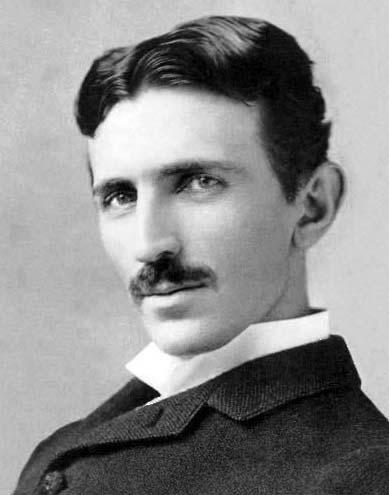
Nikola Tesla, via Wikipedia.

I read this Slate review of the movie Crooked Arrows, which is apparently a fairly predictable movie about lacrosse. I’d never heard of it till I saw the article. But from this review, it seems that it simply reinforces what I’ve said before about sports movies being dull and predictable.

I still like my idea for a movie about a super dominant team that destroys their plucky opposition. I envision a football movie, about a team on a quest for its second undefeated season in a row. I’m thinking it would be a musical, with the big number sung by the half-Lombardi-esque, half-Belichickean head coach. (I’ve thought about this too much.)

Even that would just be a satire of the sports movie genre, though. It couldn’t be a lasting formula for films, just a one-off. The problem is that sports are dramatic affairs themselves. And they’re more dramatic than movies, because they are harder to predict. If Hollywood had written it, the Cardinals would have beaten the Steelers. The Giants and Patriots wouldn’t have even been in it last year in the movies. The unpredictability is what makes it good.

I think the best sports movies are the ones that involve rigging and corruption in the game. That way, the drama of the game is subjugated to serve the larger drama of behind-the-scenes machinations. Political issues and sports might work, too. I’ve never seen all of Invictus, but I’ve watched some scenes from it, and it seems pretty good because of the larger political issues at stake in the movie. The outcome of the big game doesn’t even matter to the real point of the movie, because it’s more about what the South African rugby team means to the country.

Figures I’d have to find a way to work conspiracies and political intrigue into my sports movies, doesn’t it?

In the Marx Brothers movie Duck Soup, there’s a scene where Chico’s character, Chicolini, is on trial. The prosecutor asks, “Chicolini, when were you born?” Chico answers: “I don’t remember. I was just a little baby.”

I’ve though of this line while reading about the latest installment in Breitbart.com’s “vetting” of the President. It seems a 1991 pamphlet from his literary agent described him as “born in Kenya and raised in Indonesia and Hawaii.” Almost everyone is saying it’s a simple fact-checking error. Even Breitbart.com doesn’t claim it as evidence he actually was born in Kenya; rather, they say:

It is evidence–not of the President’s foreign origin, but that Barack Obama’s public persona has perhaps been presented differently at different times.

First of all, this is almost certainly true, as it is true of every other politician. How often have you seen a Presidential candidate, on a visit to Pittsburgh say “Go Steelers! I’ll fight for you in Washington as hard as Hines Ward blocks.” and then the next day in Wisconsin say “You know, my mother’s best friend’s brother had a cousin from Wisconsin, and I’ve always had a soft spot for those Packers. How ’bout Aaron Rodgers, huh?”

So, it’s kind of a waste of time to say “hey, look; this guy presents himself differently according to the situation! He is unfit to be President!” They all do that. Even if this isn’t a typo–and it probably is–it’s not important.

I hate the phrase “dog-whistle” used in regards to politics. It’s often used as a cheap excuse to say “well you didn’t say [awful, usually racist thing], but it’s what you meant.” That’s dishonest debating. But in this case, it seems almost like Breitbart.com is actually saying (aside, to conservatives) “Here’s evidence he was born in Kenya.” (aloud, to world in general) “We’re not saying this means he was born in Kenya; we just think he’s a liar!”

Although, at least the allegation that he was born in Kenya, crazy as it is, would be important if true. (Which it isn’t.) It relates to an actual legal issue of his eligibility to be President. The stated allegation from Breitbart.com, in contrast, is a stupid bit of minutiae even if it’s true.

I don’t think my computer will run Diablo III, and even if it could, I wouldn’t buy it. It doesn’t sound like my type of game. But even apart from that, it’s a great example of why I don’t like PC gaming.

I would think, after yet another Digital Rights Management Controversy, some PC gamers would start to re-think things. As this Forbes article says, consoles are more “consumer friendly”. (Though heaven knows they’re doing what they can to fix that.)

I have a couple PC games, but I completely prefer consoles. The reason is half for less DRM hassle and half for the fact that I don’t have to deal with compatibility issues. If it says it plays on an Xbox 360, then I know it does; I don’t have to worry about whether I have the right graphics card.

Yes, yes, I know you have more options for fixing stuff and getting mods with PCs, but it’s just not worth it to me to deal with nonsense like this for those things. I prefer the more stable, predictable world of consoles.

For a long time, Thomas Edison was held up as a model of American ingenuity, an inspiring figure whose inventions changed life for everyone. But, relatively recently, Nikola Tesla has received more acclaim as the better inventor, and his works are considered to have been unfairly neglected in favor of Edison’s. lately, it seems like Tesla is more popular than Edison. Perhaps it’s just one of those fashions that goes back and forth. (You might even say it “alternates” which one is “current”.)

Freddie DeBoer linked to a comic that exemplifies the lately fashionable Tesla-worship. I agree with Freddie’s reaction; even though I’m disposed to be more sympathetic to Tesla, that comic made me feel kind of uneasy about it, so strident was its tone.

I know I’ve used this quote before in other contexts, and I hate to keep using the same things, but damn it if it isn’t completely appropriate for summing up Edison and Tesla:

“One of them is half-mad–and the other, wholly unscrupulous.”–Claude Rains, as Mr. Dryden in “Lawrence of Arabia.”

Edison was a cutthroat businessman, there can be very little doubt. You don’t enjoy the kind of success he did without pulling some pretty mean stuff, I think. Tesla, meanwhile, was pretty clearly crazy. That was probably why he was such a great innovator.

For an example, it’s not clear to me whether Tesla’s “particle gun” was actually something real or just an idle thought he had. I sometimes think certain people–like the author of the above-mentioned comic–are too quick to credit Tesla with “inventing” stuff when actually it was just stuff he dreamed up in some of his less-rational moments.

Not that he wasn’t a great inventor. I’m just saying he’s a little over-celebrated. Of course, so was Edison when you look at all the rotten things he did, such as electrocuting animals for a PR campaign. I’m sure a lot of the admiration for Tesla comes as a direct result of people hearing in school about how wonderful Edison was.

There’s also an under-current of culture war to it, I think. Consider: the wily, Midwestern-born businessman/showman vs. the misunderstood, introverted immigrant. I don’t know if anyone has ever done a poll to look for correlation between political affiliation and support of Tesla or Edison, but I bet I know how it would come out.

I think part of it is the misrepresentation of Edison–like the author of the comic said, “he didn’t invent the light-bulb, he sold it.” Is that wrong?  Why, people greatly admire Steve Jobs, but if you think about it, a lot of what he did was selling what Jonathan Ive designed. That doesn’t make Jobs a phony; it makes him great at what he did: selling stuff.

Amused at This Ruthless World (thanks for liking my last post, BTW) wrote a really good post awhile back in response to an essay written by one “John J. Wall”. I’d never read Wall’s piece before, but I have heard the idea advanced within it many times in the past. It is this: that the “liberals” and “conservatives” are so deeply divided on all issues that it would be better for both if each group formed separate countries. Amused’s post inspired me to write something of my own on the matter.

Of course, if you’re a reader of this blog, you know that there are actually three groups: materialists, nationalists and cosmopolitans. But still, let that not dissuade us from this engaging in this thought-experiment. It is still only a simple matter of dividing the country into three instead of two.

The nationalists may have the southeast–the old Confederacy minus Virginia. The materialists may have the West; that is, the area extending from California to east Texas. A vast area to be sure, but one which they will no doubt set about harvesting every inch of for resources. And the cosmopolitans shall retain the Northeast and parts of the Midwest. Everything east of Kansas and north of Tennessee would remain in cosmopolitan hands. Cosmopolitans would also get Hawaii, and Nationalists would hold Alaska.

(Oddly enough, this division into regions mimics a similar scheme by economic historian Douglass North. But he was writing only about the United States internal trade flows in the early 1800s. And then, evidently, something happened around 1861 to fundamentally alter the structure of the country.)

As part of the deal, suppose everyone starts with the same governmental structure and Constitution as we have today.  so, now we just go ahead and simulate to see where it will all go.

I imagine the taxation issue would quickly cease to be of interest to the nationalists, once they are no longer trying to destroy a cosmopolitan government. Presumably, they would focus their immediate efforts on bulking up their immigration laws. They would also probably raise tariffs in order to keep their manufacturing sector strong. It might even be a mini-boom along the lines of the 1950s auto-industry. Naturally, in the Nationalist State, minorities and foreigners would be viewed with suspicion until their Nationalist-credentials had been soundly proven. I imagine congressman Allen West would make a successful career in this place, as would Sarah Palin. The political structure would change to be based more heavily on charismatic authority. No doubt the social structure would closely resemble that of 1950s America for the most part, with women being encouraged to be housewives and men being seen as heads of house. Gay marriage, the issue under so much discussion at present, would be utterly unthinkable, as would Civil Unions etc. Gays would also likely be barred from military service, but it is likely that this country would reinstate the draft, so there would be no problem with lack of personnel.  Fashion and art would both become considerably more conservative, quite possibly up to the point of introducing government censors.

In the materialist West, meanwhile, it is likely that the world would come to resemble the United States as a whole in the 1870-90s. Almost all environmental regulations would be removed, and worker safety laws would be scaled back. Unions would cease to exist. Tariffs would also be very low or nil, so as to encourage foreign investment. Immigration laws, likewise, would be quite lax so as to gain a cheap labor force. Military force would assume the character of a highly-paid internal security outfit, and be largely defensive in nature. (One imagines the Erik Princes of the world would have to think long and hard over whether his fortune lay to the South or the West.) Social issues would be non-existent; societal mores being relaxed to please the fancies of the wealthiest. Indeed, the city of Los Angeles as it exists today, would probably go on functioning as if nothing had happened under the new arrangement. Art and fashion would all go as the popular will dictated; thus movies, for example, would be solely of the “summer blockbuster” variety all year round.

Of the cosmopolitan North, there is less to say; perhaps because the area is well on its way to being that already. It is probable that taxes would be raised, of course; as it would no longer be so politically abhorrent to do so. A massive influx of public money go to support higher education, which would likely lead to the Academy being the primary institution in the country. Other than that, however, things would change less, principally because the cosmopolitan sees diversity as a strength, and would need to undergo less modification to suit its philosophical beliefs. The military would be fairly small, and probably what there was of it would be based heavily on technological superiority, not man-power.

It would be interesting to see how long this state of affairs persisted. It would not be long, surely, before each country recognized that there was much to be gained from the others. The materialist sector, in particular, might look an inviting target for conquest; though of course it is questionable whether it would be profitable to do so. Also, the nationalist and cosmopolitan states by their nature invite comparison to ancient Athens and Sparta.

Ultimately, the optimal move for each country would be strategic alliances with its neighbors, as each would have something to provide to the others. However, there is also the dark possibility that two would form an alliance against the third, and thereby destroy it either militarily or economically.

And there I conclude this experiment, but you are welcome to add thoughts of your own.

For myself, I see this as rather a gloomy idea. I believe each type has something to contribute to the country. But then, I would, wouldn’t I? I’m a cosmopolitan.

Jonah Goldberg, of Liberal Fascism fame, has a new book out entitled The Tyranny of Clichés: How Liberals Cheat in the War of Ideas. I love reading Goldberg, because when he is wrong, which is very often, it is quite funny. And when he is right, it is usually not in the way he thinks he is right, but very important nonetheless. So, I really will have to read this book of his at some point.

In the meantime, here are some excerpts from an NPR interview with him. [Goldberg’s words in red]:

“What you have often in American political discourse are appeals to clichés that steal territory, steal terrain unearned by argument. And all I want is an argument. I don’t care that liberals have an ideology. I want them to have an ideology. I want to have a contest of ideas. What bothers me is when they come in and they say, ‘Oh, you guys are the crazy ideologues with your labels and all of the rest, and we’re just pragmatists who care about sound science and the numbers and the facts’ and all that.’ “

What becomes rapidly apparent from listening to Goldberg is that he is not, in fact, against cliches. He is only against liberal cliches. Well, to paraphrase Nietzsche: “he who fights clichés should take care that he does not himself become a cliché”. And indeed:

On the response that conservatives also have their own clichés

“Yeah, and some of these things I absolutely agree. I think that there is something endemic — one of the reasons why some of these cliches appeal, why they have power, why they move men, is because they appeal to the hard-wiring in our human nature. We’re all built from the crooked timber of humanity; we all want to live in groups; we all want to live in tribes; we all want to, you know, band together and do good things.”

It might have been good to notice that before you wrote the book. So, he certainly is willing to allow as how conservatives also have clichés. But whatever, it’s okay, because everyone does. But liberals, when they do it, do it wrong and perniciously. Got it?

But when an actual instance of something thought to be a conservative cliché is raised, Goldberg is skeptical of its status as “cliché”:

On the saying, “Government is the problem”

“No, I’m not against having a government. I don’t know if that qualifies as the kind of cliché that I am talking about … The mainstream media never talks as if government is the problem — you never hear that repeated over and over again. Even on Fox, to a certain extent, you won’t hear that sort of thing. It’s a catchphrase, to be sure, and it’s a glib catchphrase that oversimplifies things, but the context in which I was talking about it was that Ronald Reagan had said, ‘In the current situation, government is the problem, not the solution.’ And that is the beginning of a serious argument.”

Yeah, but the point is, when you just start quoting that line of Reagan’s all the time when talking about the government, then it becomes a cliché. That’s how clichés work, Goldberg. Remember; every cliché was an original thought once.

At bottom, though, his point is correct. Clichés in politics are a problem, like I wrote about in this post. As I see it, both Democrats and Republicans use clichés all the time, and it does, as Goldberg says, hinder productive argument.

But as far as I can tell, without having read the thing yet, Goldberg’s book is just a compilation of liberal clichés. I haven’t heard anything to suggest he offers a solution to our cliché-filled politics. Which is fine, but how would one go about fixing it?

George Lucas once said “Don’t avoid the clichés–they are clichés because they work!” And he proved it, too, by making billions of dollars off of a movie franchise built around some of the oldest clichés of all. It works the same with political clichés.

Like I said in the other post, people learn their communication through imitation. Why should political communication be immune from this? Think about the effort involved in figuring out how to not think in political clichés: you’d have to be willing to ignore all the slogans and ideas told to you by your friends, family, colleagues, political analysts, writers and the politicians themselves. The you would have to try to reevaluate everything about politics. And even then, there’s no guarantee of success. You might just become Alex Jones.

Back to what Lucas said: “clichés work”. They sure do. It’s a cliché to say the Republicans are defenders of the super-rich, and indeed, that is oversimplifying things greatly, but even so it’s still a pretty good synopsis that gives you a decent idea of their behavior. It’s not the whole story, but it’s part of it, and if you go around operating on that assumption, it will be awhile before you notice anything that makes you question it.

It goes back to what I’ve talked about before lots of times on this blog: people are too busy to get really involved in politics beyond following the leaders of their parties. And it’s not because people are lazy or stupid; it’s because really thoroughly understanding politics is a full-time job.

It’s making me uneasy how much “social issues”–lousy term, by the way–keep coming up in this campaign. I had hoped that would stop after Santorum got out, but it hasn’t.

In my opinion, this is exactly the formula for an economic disaster: voters so busy worrying about this stuff that they forget the major economic problems the country’s facing. Even if we finally do recover from the recession, as we appear to be, it will be only to revert to the major economic problem of summer, 2008: high gas prices and stagflation. While I feel they are important, I nonetheless believe that a problem like a major stagflation epidemic dwarfs issues like government-subsidized birth control or whether gays can marry.

Although at least those actually are issues. What’s worst of all is how much attention is devoted to what Mitt Romney did 45 years ago in high-school, or what Obama had for breakfast as a kid in Indonesia.