Good news. I love successful covert operations.

UPDATE: For some reason, this reminded me: I remember I once heard somebody say that the “Spy” fiction genre just wasn’t the same after the Soviet Union collapsed, because real-world covert operations stuff was no longer as important.

I’ve always assumed that it was because our spies and secret agents can work better when no one’s writing movies or books about them.

Anyway, it’s good to hear about things like this.

NewsBusters is mad at Sally Quinn for saying:

“This is the Vatican’s Watergate. The Pope is Nixon. I mean, if you look at the signs, and the way they’re behaving, it’s exactly the same way. They’ve done something terrible. They’ve denied it. They’ve accused their accusers.”

Apparently, she took a much kinder attitude towards Jeremiah Wright in 2008, and that annoys NewsBusters. I don’t care about that. What’s really interesting is that it seems to me that what the Pope is accused of doing is far more serious than what Richard Nixon did. Covering up a burglary is bad, but covering up child abuse is a horrible crime.

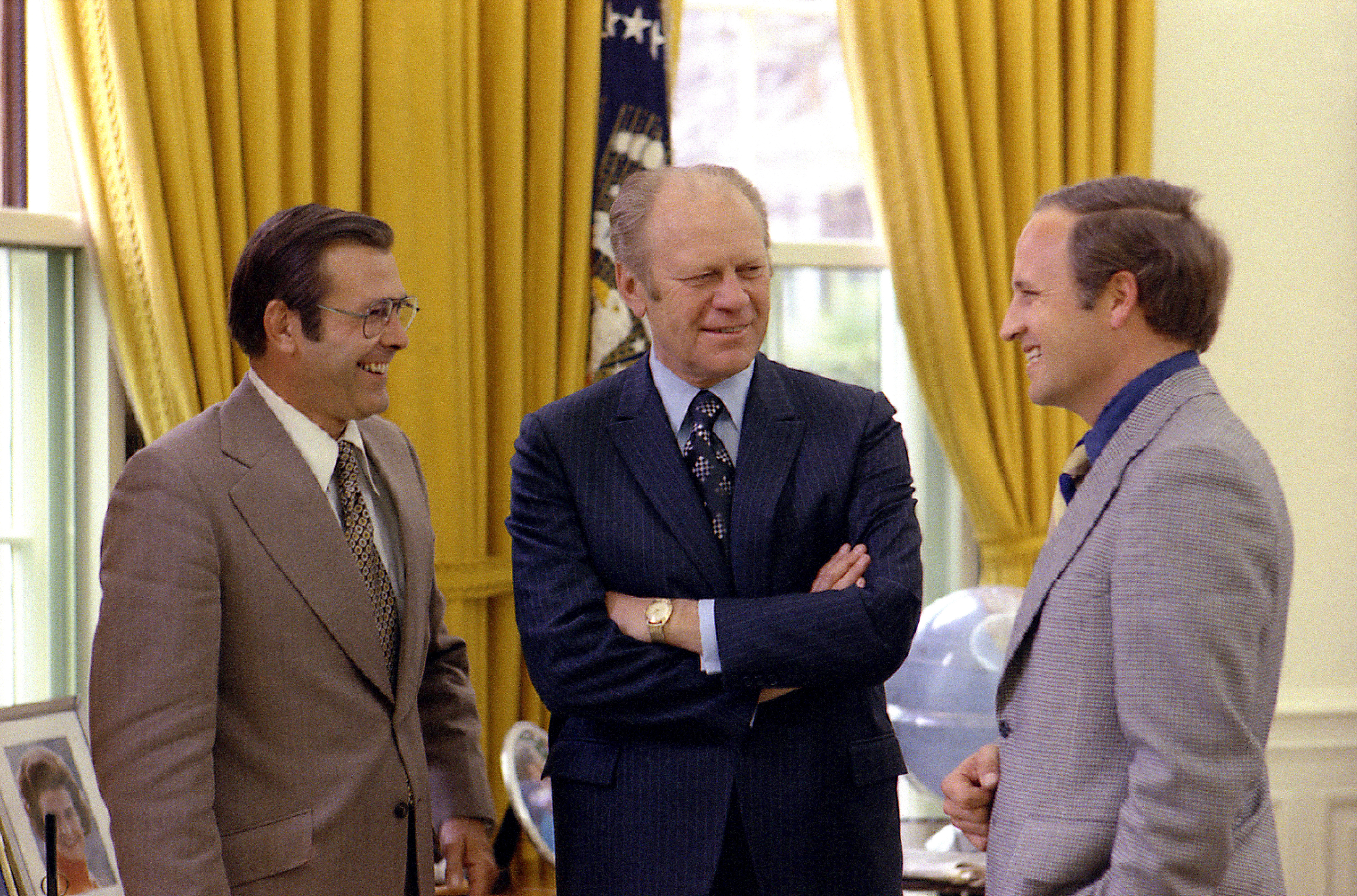
I found this picture on Wikipedia:

From left to right: Donald Rumsfeld, Gerald Ford and Dick Cheney.
Is it my imagination, or does that look like a model of a Death Star between Cheney and Ford? 


Palin will be campaigning today to help McCain in his primary battle with J.D. Hayworth.

Let’s go over this again: having a charismatic person campaign for you does not work. Her followers–the Tea Party crowd–will not like McCain better for it. This seems strange, I know, but it is what past experiences tell us.

I think it’s largely because charisma involves projection of one’s own ideas onto the charismatic person. So, even though a lot of the Tea Party crowd likes Palin, they will project their own liking for Hayworth onto her, and rationalize that she was only campaigning for McCain out of gratitude for him. So, the bottom line is that they’ll vote for Hayworth and think no less of Palin.

So, some dude says that high-ranking U.S. officials, potentially including President Obama, could face war crimes charges for using drones to hunt terrorists. He says: “Now, maybe the answer is: This is really terrible and illegal and anybody that does it should go off to the Hague. But if that’s the case, then we should not be having the president saying that this is the greatest thing since whatever.”

This is ridiculous. Using aircraft to eliminate enemy combatants? It’s war. This is how war works. Far worse things have been done by people who walked free.

Back in January, right before Scott Brown’s victory in the Senate race, I wrote:

 “Once a campaign takes on an aura of extreme importance, it changes things. Epic struggles and charismatic people complement each other beautifully…. I speculate that charisma doesn’t just help a person get involved in great events, it almost demands them to.”

I then said:

“All sending Obama to help Coakley does, I think, is demonstrate how important the election is. And that plays right into Brown’s hands.”

I was right, I think. But what I didn’t think of then was that Brown’s election didn’t mean the end for “Obamacare”, it just made it into an ‘Epic Struggle” to get it passed… and guess who the most charismatic guy in that fight was?

I’m not sure if this actually is the reason it passed; but it certainly would fit in with what I’ve said before on this blog about charisma.

12: 42 A.M: I’ll update this post as things develop, rather than have tons of posts about the subject.

9:08 A.M.: Most people are pretty sure the thing will pass. It’s assumed that the Democrats wouldn’t bother to vote on it if they thought it wouldn’t.

9:17 A.M.: Lots of sites are calling this vote “Historic” or “History Making”, which suggests to me they think it will pass. Bills that don’t pass usually don’t get much mention in the history books.

9:25 A.M: The chairman of the Democratic caucus says they have the votes. I’ve never heard of this guy; usually when they’re counting the votes, they ask the Whip, James Clyburn. It’s fun to blog about politics when you have no idea how it works.

11:52 A.M: Going by headlines, the Democrats either have the votes or “hope they have the votes”. There’s not much difference, except for all the difference in the world. But hey, hoping for change was what Obama promised and sure enough, it happened!

1:41 P.M: According to Huffington Post, it’s practically over.

1:44 P.M: Or maybe not. Their headline doesn’t seem to match their story.

4:41 P.M: It looks like it’s pretty close to a done deal that it’ll pass.

7:58 P.M: For what it’s worth, though, Republicans may have some other plan to stop stuff in the Senate. Or something. I can’t stand to learn any more obscure Parliamentary rules, though.

10:49 P.M: “Alea iacta est.”

I said I’d post my thoughts on the Texas curriculum issue, so here goes:

My opinion is that whatever they teach kids in schools is going to have less and less relation to what kids actually learn and do. The reason is the internet. Back in the old days, public school had a real chance of shaping a kid’s outlook on the world. Now, a student can just roam around on Wikipedia and learn whatever it is he/she wants to know.*

I’ve long thought that our whole model of public education is being rendered obsolete by this fact. So, it doesn’t really matter if you teach only your “Conservative” or “Liberal” or whatever biases–anybody who actually cares about it will eventually read about it online. And when you go to read about, say, Friedrich Hayek, you’ll end up finding out about a lot of his critics, too.

The real danger is that schools will eventually figure this out, and try to keep students from accessing the internet at any time and  from any place. But people won’t tolerate that.

So, while this decision speaks volumes about the character and integrity of those who made it, I personally don’t think it will end up being that damaging. Most students are smarter than we give them credit for, and they know when they’re being lied to or misled.

FOOTNOTE:
 *Some will point out that Wikipedia is unreliable because it is edited by anonymous people who don’t have to provide credentials. To which I can only quote William F. Buckley’s line “I am obliged to confess I should sooner live in a society governed by the first two thousand names in the Boston telephone directory than in a society governed by the two thousand faculty members of Harvard University.” and add that it applies equally to the Texas State Board of Education and its ilk.