In the trailer for “The Treasure of the Sierra Madre”.

This movie really surprised me.  It was made in 1948, around the time of what is called the “Second Red Scare“, when concern about communist infiltration was very high.  Given that, the content of the movie is astounding.

Fred Dobbs (Bogart) and Bob Curtin (Tim Holt) are unemployed guys looking for work.  They convince an old prospector named Howard (Walter Huston) to help them on an expedition for gold in the Sierra Madre mountains.  The first remarkable thing about the movie is a speech given by Howard in his first scene:

Howard: Say, answer me this one, will you? Why is gold worth some twenty bucks an ounce?
Flophouse Bum: I don’t know. Because it’s scarce.
Howard: A thousand men, say, go searchin’ for gold. After six months, one of them’s lucky: one out of a thousand. His find represents not only his own labor, but that of nine hundred and ninety-nine others to boot. That’s six thousand months, five hundred years, scramblin’ over a mountain, goin’ hungry and thirsty. An ounce of gold, mister, is worth what it is because of the human labor that went into the findin’ and the gettin’ of it.
Flophouse Bum: I never thought of it just like that.
Howard: Well, there’s no other explanation, mister. Gold itself ain’t good for nothing except making jewelry with and gold teeth.

What’s so remarkable about that, you wonder?  Well, what Howard is describing there is what is known as a Labor Theory of Value–the value of something is determined by the labor put forth to get it.  This is an economic idea that is commonly associated with a fellow named Karl Marx.  And it’s a response to the claim that gold’s value derives from its scarcity–a major component of non-Marxian, liberal economics.
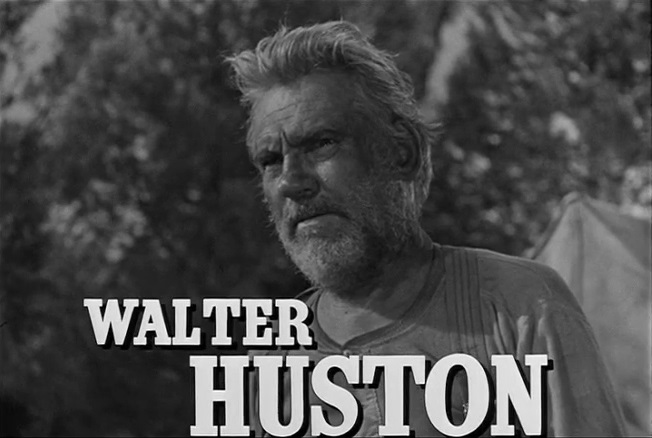
Also in the trailer for “The Treasure of the Sierra Madre”

So, about twenty minutes into the movie, we have gotten a lecture on Marxian economics.  This is all the more interesting because the rest of the movie is devoted to proving over and over that greed for wealth corrupts people–specifically, Dobbs.  Howard repeatedly predicts that the gold will drive men to madness, and does it ever.

Dobbs’s inevitable corruption is fun to watch–that Bogart guy was a pretty good actor, you know that?–and Walter Huston  is excellent, even though his role is fairly predictable.  He is, essentially, an infallible sage, and normally those characters are pretty dull, but Huston imbues him with personality.  What is not clear to me is why he bothered to come along, since he believes almost from the outset that the expedition will be a disaster, and it proves to be exactly that.

It was odd to me that the movie’s most famous, yet often mis-quoted, line: “Badges? We ain’t got no badges. We don’t need no badges. I don’t have to show you any stinking badges” was spoken by a rather poorly-acted, bandit character.  I thought his character was pretty weak.  In fact, I felt that the bandits had too big a role in the film, when all they really needed to do was show up at the end when Dobbs’s luck runs out.

I keep coming back to the economic “moral” of the movie, though.  It’s a very socialist message, what with the capitalist who desires to earn for himself being depicted as either a monster or a buffoon, and the character who opens up describing the labor theory of value depicted as a wise and thoughtful figure.

Now, I know what you’re thinking.  You’re thinking: “Well, this is it– Mysterious Man has finally gone completely crazy and is now seeing communist conspiracies everywhere.  He must have been listening to Glenn Beck too much, and he just lost his tenuous grip on reality.”

1950s anti-communist pamphlet

To be clear, I’m not saying I think this movie was some kind of evil communist-Hollywood indoctrination plot.  It was based on a book by a mysterious German called “B. Traven“, who was apparently a socialist.  Well, when your movie is based on a book by a German socialist, you can’t be surprised if some German socialism creeps in.  I doubt John Huston wanted to make Marxist propaganda; he just wanted to make a Western, and the book he adapted it from had some Marxist propaganda in it.

What surprises me is that, despite how popular accusing people in Hollywood of communism was at the time, the film wasn’t banned or censored, and John Huston wasn’t hauled up before the H.U.A.C. to explain himself.  I’m not saying any of that should have happened, I’m just saying it’s weird that the film apparently got released without any censorship or controversy, which is kind of amazing given the zeitgeist.

Image via Wikipedia
Guy Haines (Farley Granger) and Bruno Anthony (Robert Walker) in “Strangers on a Train.”

So, I finally saw the Alfred Hitchcock movie Strangers on a Train after friends of mine mentioned it to me nine months or so ago.   Yeah, I take my time with these things.

To put it briefly, my comment here about Hitchcock’s work applies perfectly.  It’s an amusing film, but by no means a masterpiece.  I’ll try to avoid spoiling everything in this review, but I will discuss certain plot elements, so be warned!   If you are the kind of sick, deranged person who reads reviews of movies they have not seen (me too)  there is a synopsis here.

The character of Bruno Anthony, played by Robert Walker,  carries the whole movie.  The guy seems completely mad and yet strangely charismatic, which is precisely what the role demands.

The problem is, this kind of works against the story even though it is really fun to watch.  It is so obvious that Bruno is not playing with a full deck that it seems like Guy Haines would have no trouble convincing the police that Bruno’s claims about him are nothing more than the ravings of a maniac.  Of course, then there would be no drama, and it would be a pretty dull movie. So…

…Haines gets enmeshed in a convoluted plot controlled by the madman. There wasn’t much that stood out about it to me, but there were two scenes that caught my interest.  One is the tennis match that comes at a pivotal point in the film.  Although fairly contrived, it was still somehow exciting to watch, even though I knew more or less how it would play out.  This alone may qualify Hitchcock as a great director.  It is one of the most effective uses of sport I’ve ever seen in a movie.

The other thing I really liked was the next-to-last scene.  I love the fact that even in his final moments, Bruno still lies to Guy and the police.  He has no reason to, he has to know that his deception going to be found out as soon as his fist unclenches and he drops Guy’s lighter, and in any event he is mortally wounded; but he lies to them anyway.  That little detail totally sums up the character and how detached he is from reality.  I love that.

Unfortunately, the movie is pretty weak otherwise.  The direction, editing and cinematography are all quite good, but the acting is pretty poor apart from Robert Walker.  Also, once you stop suspending disbelief, which I did whenever Bruno wasn’t around, you realize the whole plot is fairly far-fetched.  [Aside: is suspending disbelief the same as resuming belief? Discuss.]  The other problem with the movie is that even the “good” characters aren’t very likeable, so it was hard to really get invested in how things worked out for them.

Overall, an enjoyable thriller, but not a great one.

Oh, wow, I had never heard this before.  Studio executives had wanted the Harry Potter movies to be set in America.  I didn’t like the Potter flicks much–certainly, all except the last two installments were but pale shades of the books–but if they’d messed around with them even more they could have been an outright disaster.  That article kind of makes me more forgiving towards the filmmakers’ general disregard for the stuff in the books.  The fact that they couldn’t be bothered to make Tonks’s hair look like the book describes seems minor in comparison to the prospect of seeing Hogwarts relocated to the outskirts of Los Angeles.

As an American, I am vaguely insulted by the idea that people suspected Americans wouldn’t be interested in a movie that wasn’t about them.  Do they think we’re that ignorant and narcissistic?  Man, that would have been an awful series of movies.  I mean, in my eyes, the major draw of the movies was the chance to see skilled British actors plying their trade.  Take that away and they would be nothing.

There’s an article in the New York Times about the prevalence of trolls in online gaming.  The article focuses particularly on their attacks on female gamers, but it also speaks to a larger point about trolls in general.  The key line is: “For trolls, offensive language — sexist, racist, homophobic comments — are interchangeable weapons that vary with the target.”

This is absolutely true, and the core of understanding troll behavior.  Trolls are not deeply committed to racist, sexist, or homophobic ideologies.  They are simply interested in causing as much trouble as they possibly can, and see such insults as a means of doing this.

The difficulty with online gaming–and this is another reason I avoid it–is that seems to have been inadvertently designed as an almost perfect platform for trolls.   Frankly, the primary purpose of online gaming seems to me to be to encourage trash-talking, and trolling is but a mutated form of trash-talking.

Everything I have seen indicates that the online experience delivers, on average, no better of an experience than playing the A.I.  For every highly-skilled player, there are ten unskilled players whose performance is below that of a competent A.I.  The only advantage online offers over offline is the ability to compete with some stranger, and beat him or her at the game.  And then, of course, the trash-talking.  Trash-talking a machine is simply not as satisfying.

To me personally, trash-talking in any venue is a pointless and stupid activity.  I hate it when athletes do it, I hate it when people on internet forums do it, and I hate it when gamers do it.  The difficulty, as highlighted in the NYT article, is how to manage it so it stays within decent bounds.  But the online gaming services won’t eliminate it outright, however, because they would be destroying their own market.  A blogger named Ferrerman wrote some posts about a related phenomenon on internet forums. (Be warned: he uses a lot of strong language to make his point.)

It’s not Citizen Kane anymore.  It’s now Vertigo.  Strange that it took Sight & Sound so long to notice a movie made in 1958 was better than a movie made in 1941.

To be perfectly frank, I always thought Kane was a bit overrated.  Not that it’s a bad film by any means; it’s  just not anywhere close to being the greatest ever.  It’s a well-acted drama and nothing more, in my opinion.  Also, there seems to be a massive plot hole at the center of it which has always kind of detracted from it.

I also wonder: did the people who were polled watch every single movie ever made before voting?  I kind of doubt it.  For one thing, think of how many languages they would have had to learn first.  (Watching with subtitles is not at all the same thing.)  What if the real greatest movie ever is a Japanese film that no one in the U.S. or Britain has heard of?

I won’t even begin to address the question of how there can be a single greatest movie when there are so many different genres.  I like Lawrence of Arabia and My Fair Lady, but it’s hard to really compare the two.  This is why they do genre rankings, although even then there are problems, like why is Star Wars always listed under “sci-fi” when the man who created it says it isn’t?

The sound effects are *awful* by today’s standards!

Finally, there are technical issues, like: if a film was great “in its time”, does that mean it’s always great?  Metropolis is considered a very great film, but if it were made today, would anybody think it was any good?  Moreover, if a new technique is created and used with great success in a film, it is inevitably copied by other films, thus diminishing the value of it for future viewers.  Does a film deserve bonus “greatness points” for being the first to try something that eventually becomes common?  And when a viewer fifty years later sees a transition or camera angle that is familiar to him, but was brand new at the time, how will he ever be able to appreciate it?

I think that many critics are aware of this issue, and so overcompensate by giving undue weight to older movies.  It’s similar to what I was talking about here with video game rankings. In some cases, you have to admit, “well it was certainly great then, but there can be little doubt the special effects would be much better if they could have made it today.”  What was yesterday’s special effects masterpiece may look awful to the viewer of nowadays.

That’s not saying, by the way, that newer movies are automatically better.  Sometimes, they have better special effects, but vastly worse acting, characters, dialogue and story.  In fact this happens rather a lot.  But from a technical point of view, it makes ranking difficult.

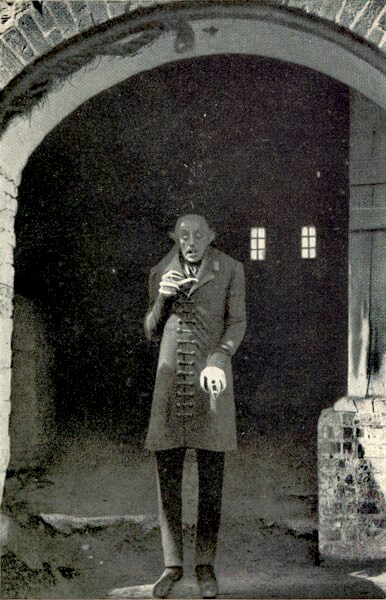
Famous scene from the 1922 film “Nosferatu”. The shadow is scarier than the actual monster (see below) because your imagination fills in the details.

Saw the movie House of Dracula on TV the other night.  It’s a 1945 Universal Monsters flick that contains three of their most popular monsters: Dracula (duh) the Wolf-Man, and Frankenstein’s monster.  It was fairly well-done for what it was.  John Carradine is great as Dracula.  Also, the film features the stereotypical hunch-backed assistant to the mad scientist, but for a change the character is female, and fairly attractive apart from the hunch-back. It’s an unusual role, and the actress, Jane Adams, does a pretty good job.

But what was especially notable about the movie was that it falls into the awful horror movie pitfall of trying to explain the source of the horror scientifically.  So, it turns out that Dracula has a blood disease, and that the Wolf-Man can be cured by brain surgery and some kind of weird fungus that the aforementioned scientist grows in his castle.

Folly!  I’ve blogged about this before: horror movies should not rationalize or explain the horror in any way.  When they do, it becomes less frightening.  They make this mistake all the time in horror movies.  It’s much better when the scientifically-inclined are skeptics and shown to be wrong, and the monster is an inexplicable violation of the laws of nature.   The intelligent, scientific  types being wrong is how you know you’re in trouble.

If you try to explain everything, it is less scary.  This applies not only to trying to give explanations for the monster’s origin or condition or whatever, but to every element in any scary story.  Just give people a few hints of the monster, and  let them piece together the rest, that’s what I say.

See what I mean?


I tried to read the first book of the Hunger Games series awhile back, and although I thought it was well-written and had a good setting, it was hard for me to get into it because it was fairly predictable.  I’m sure that’s partially because it was written for a younger audience, but I think it also is a just a little too cliche filled.  I’m not saying it’s bad.  It’s a decent book, but I pretty much knew where it was going from a very early point.  This is a problem I have with a lot of dystopian fiction–it all seems cut from the same cloth.

You know, I had an idea for a dystopian movie once.  It would be set at an undefined place and time, in a country where a totalitarian, fascist government had taken over.  The main character would be some kind of violent goon for the government who went around suppressing all dissenters.  And the whole film would present him as the hero–he’d be played by a “leading man”, the camera angles would present him heroically–the whole film would seemingly approve of the dystopian society.  Then, at the end, there would be some kind of title card or something telling the audience that this was a propaganda film approved by the fictional government, perhaps even detailing some of the techniques involved.

The point of this would be to pull the rug out from under the audience; see how many of them would have found themselves being subtly seduced into rooting for the main character–and the society he represents–by the film’s technique.  The “plot twist” would actually be a test to see how much people would start to buy into something awful because of good cinematography. Then they would have to re-evaluate what they had just watched.

The trouble is, this is more of a science experiment than an entertainment movie.  The trick of the movie is that usually, in dystopian stories, the protagonist begins to question his society, and through him, the audience is told about the society’s problems. (e.g. Winston Smith in 1984, Guy Montag in Fahrenheit 451)  There would be none of that in this movie.  He’d be 100% behind the society, and looking to maintain it.  It would be kind of like 1984 from O’Brien’s perspective.

The thing about my idea–and I’m not saying it’s a good idea–is that it plays with the tropes of the dystopian genre.  Dystopian stories give the audience some character they can turn to to see the dystopia’s flaws; or at least the “tone” of the piece, or the “voice” of the narrative give it away.  Here, there are no societal outcasts or anything like that for people to turn to. (The main character takes care of that.)  I thought this up largely from noticing that every dystopian story seems to rely on the same devices, and that makes them pretty predictable.

In Hollywood, they can’t just *suspend* disbelief, they have to have it leaping out of a helicopter while being shot at.

Via J.E. Sawyer, another good example of how real life is NOT like action movies.  I remember that Cracked did a great article about this sort of thing once.  No wonder we have a “gun culture” in this country; our movies depict them as having magical powers!

It reminds me of the movie Last Action Hero.  A lot of people hated it, but personally I thought it was brilliant.  If you haven’t seen it, what happens is: Arnold Schwarzenegger plays a generic action movie hero in a movie-within-the-movie.  Then he gets magically transported into the “real” world, and is confused when all the stuff he did in the movie world doesn’t work.  Like, there’s a scene where he shoots at a car the bad guys are in, and is shocked when it doesn’t explode.

Still, that’s why people watch movies: to see stuff that doesn’t happen.

The way he announces it is priceless.  It’s too bad he never won an Academy Award for any of his outstanding performances.  (He did win an honorary one.)  He’s one of the greatest actors ever.

Everyone remembers his awesome performance in Lawrence of Arabia–as well they should–but in my opinion, his greatest performance was in a truly bizarre film called The Ruling Class.  It’s one of the weirdest movies I’ve ever seen–funny, disgusting, thought-provoking, somewhat blasphemous, and kind of campy all at once.  I can see hating it or loving it, but either way O’Toole’s performance in it is incredible. (Incidentally, Carolyn Seymour, a voice actress in many famous video games like Mass Effect and KotOR, also appears in this movie.)

Ah, well.  Nearly all his performances are great–if you’ve never seen him in anything, you really should.

I was reading about this upcoming sci-fi movie starring Tom Cruise called Oblivion.  The IMDb synopsis says:

A court martial sends a veteran soldier to a distant planet, where he is to destroy the remains of an alien race. The arrival of an unexpected traveler causes him to question what he knows about the planet, his mission, and himself.

Hmm.  That sounds a bit like the plot of what I consider the most overrated movie of all time, Avatar.  Also like Avatar, this thing seems to share a name with another, totally unrelated franchise.

Of course, people say the idea for Avatar was itself stolen from Edgar Rice Burroughs, or some British comic book, or Dances with Wolves.  I wouldn’t say “stolen”, exactly; but it’s an age-old plot.

The plot of Avatar is:

  • Guy is sent by military to deal with exotic natives to help pursue military’s interests.
  • Guy becomes sympathetic to natives.
  • Guy rebels against military, helping natives.

This is, in broad strokes, also the plot of one of my favorite movies, Lawrence of Arabia.  The difference is in how it’s done–compare the character of General Allenby in Lawrence with Colonel Hambone from Avatar.  (Okay, so that’s not his name.  But it should have been.)

This is so often the case with fiction.  Another example:

“A video game about someone who causes tremendous damage to a planet, and must then face the consequences of that action.”

This could be describing either Star Wars: Knights of the Old Republic II: The Sith Lords or Tonic Trouble.  The former I consider to be the greatest game ever made; a masterpiece of storytelling and characterization, complete with a philosophical depth more powerful than any other work of fiction I have seen.  The latter is about a purple cartoon alien who fights mutant tomatoes.  “The Devil is in the details”, as they say.

Zaphodb2002 pointed out in a comment on this post that if you just give a synopsis of the most basic points, so many great works don’t sound all that impressive.  It is, as he said, how the story is told.