It occurs to me, gentle reader, that perhaps this series has a curious structure to it. The posts are getting longer and, hopefully, building upon each other. However, this structure might make it confusing to read. Maybe it’s better to read it in reverse order, with the posts hopefully cascading to tell a larger story. Like the verses in “I Have  A Song to Sing, O!”

Or maybe not. Anyway, our journey has now brought us to the 1995 007 flick, GoldenEye.

GoldenEye is, in my opinion, the best James Bond movie. Now, my opinion could be biased by the fact that it is the first James Bond movie I ever saw. But I don’t think so. Part of the reason is that Brosnan is not my favorite Bond; not even close, and yet I still enjoy this film the most.

The key thing with all James Bond films is that they are walking a fine line. You can’t take James Bond too seriously, because, well, the whole premise is basically ridiculous. The early Connery films established a somewhat over-the-top, tongue-in-cheek tone.

Unfortunately, the 1970s happened, and this tone got carried to a new extreme during the Roger Moore era, which saw Bond films that ranged from pseudo-blaxploitation to rip-offs of Star Wars.  And that was before we even got to Octopussy and A View to a Kill. <shudder>

The Timothy Dalton era wasn’t really even an era, consisting as it did of only two films: The Living Daylights, which still has some residual silliness inherited from the Roger Moore tradition, and the serious and gritty Licence to Kill, a clear forerunner of the darker tone of the Craig era.

It’s a shame Dalton didn’t sign up for one more turn as 007 in GoldenEye, because it’s the one that finally hit that proper medium. It isn’t outright camp like the Moore films, but it has enough awareness of its genre not to try and be some sort of grim, realistic thriller.

And we should expect nothing less! Because it was made in the ’90s, and the whole point of this exercise is that the ’90s were the halcyon days of action movies. GoldenEye isn’t a great film, and I would grade it as distinctly inferior to the preceding three films I’ve reviewed in this series, but there’s no doubt in my mind it is the best Bond film, and the best that’s likely to be made for some while.

There are even some moments of social commentary, incredible as it may seem. Like when Bond goes wandering amid a wasteland of Soviet relics to meet the leader of the Janus crime syndicate, with the implication being that Bond himself is another holdover from the Cold War. The film asks: with the U.S.S.R. gone, what is even the point of an operative like 007?

The whole movie is kind of a farewell to Cold War thrillers. Large portions of it are set in Russia, with Russian villains, and Russian super-weapons, and a brief discussion of the repatriation of the Cossacks in the aftermath of World War II. It’s a meditation, to the extent that any action movie can be called a “meditation,” on what all the tropes of the spy genre would look like in the unipolar moment.

Because what was a spy to do, at The End of History? For that matter, what were these huge, military-industrial complexes with vast arsenals of experimental weapons built up over decades to do? (The answer to both, GoldenEye suggests, is “fall into the hands of terrorists and madmen.”)

But that’s another story, for another decade. In the ’90s, it was still all just fun and games, and James Bond could be counted on to save the world with his sexy sidekicks and his cool gadgets, and even the blundering, bumbling American CIA could show up for a cameo at the end.

I can’t end this review without mentioning GoldenEye‘s most enduring legacy: the spin-off video game that proved to be one of the most influential of its era, and which remains legendary in gaming circles to this day.  Do they still do video game spin-offs of movies these days? I haven’t heard about any. Games based on movies have a reputation for being awful; and yet we see that it was done successfully at least once, in that strange, gauzily-remembered decade between the fall of the Berlin Wall and Y2K. It seems the knowledge once existed, though it has subsequently been lost. Like Greek Fire.

[Update: check out my friend Pat Prescott’s response to this post. His take on the movie is very different than mine, and while I stand by my opinion, I admit he makes some good points. But then, he’s a real Bond expert, having seen all the films many times. One thing I hope to encourage with this series is for people to post their own opinions on the films I discuss.]

There I was, thinking to myself, wouldn’t it be nice to read a cyberpunk book right about now? And then, thanks to a timely retweet from the incomparable Carrie Rubin, this book came to my attention. It was like it was meant to be.

The Copernicus Coercion is a cyber thriller about two hackers, Brock and Kathryn K, who quickly find themselves drawn into an intricate conspiracy. This book hits all the cyberpunk notes: we have hackers with embedded implants that provide continuous network access, shady back-alley surgeons providing illegal cybernetic augmentation, super-powerful artificial intelligences that become eerily human, a group of gray hat hackers operating out of an old church, and most importantly, sinister plots by shadowy elites.

Naturally, I ate it up. If you like cyberpunk stories, you’re probably going to like this. And despite the requisite tech-heavy aspects of the plot, Scobie was careful to make the characters strong, too. From the interaction between the two protagonists, to minor characters like the hacker-priest at the church or even an amateur carjacker, most of the characters in the book are interesting and memorable.

If I have any complaints about the book, it’s that the ending felt a bit rushed, and the character who functions as the final antagonist isn’t as well fleshed-out as the rest of the cast. It’s not a major problem, and generally, I’m of the opinion that if the journey is enjoyable, I can forgive a flawed ending. And The Copernicus Coercion is certainly an enjoyable journey.

In another serendipitous occurrence, I happened to be reading this book at the same time as I was reading Ray Kurzweil’s The Age of Spiritual Machines. The issues Kurzweil examines in that work of ’90s futurism are explored in an entertaining way in this novel, so it makes a perfect complement. If you want a fun story that also poses some interesting questions about humanity’s relationship to technology, pick this one up.

[Audio version of this post available below.]

This is a sequel to He Needed Killing, which I reviewed here. If you enjoyed that book, you’ll like this one, too, because it’s more of the same. Once again, retired university IT professional James Crawford is hired by the provost to investigate a murder on campus.

And like He Needed Killing, the charm of the book is less about the mystery than the atmosphere and the characters. Crawford’s life in a southern college town is portrayed as pleasant, slow-paced, and filled with food and football on a regular basis. Sure, there’s a murder to be solved, but that doesn’t stop Crawford from taking time to enjoy the good things in life. Like another southern detective, he “strolls leisurely” on his way to the truth.

And it’s an enjoyable stroll, because the descriptions of campus life are so well-written and the characters so likable. (Except, of course, for the ones who really do “need killing.”)

Crawford is a great protagonist, and his style of investigation is perhaps best captured by these lines, which he says while musing out loud to his cat:

“They were figuring out all the orbits of the solar system–how the orbits of the planets and moons were impacted by gravity, but the model kept predicting the wrong orbits. The only way they could get the model to work was if there was another planet the size of Neptune where Neptune had to be. So they looked and–by damn–there was Neptune. Don’t you think that’s cool?”

Crawford makes sense of things by thinking out loud while puttering around his house. It’s not flashy like Sherlock Holmes, which leads a lot of people to underestimate his detective skills. Much to their detriment, as it turns out…

But, in all honesty, I didn’t read this book for the mystery. In fact, I figured out who the killer was pretty early on. But that did not detract from my enjoyment one bit, because what’s really fun about it is the style, the pace, and the setting.

[Audio version of this post available below.]

If you’ve followed this blog for a while, you’ve probably already heard me sing the praises of Litka’s books many times. In fact, there are a few people who, I’m delighted to say, I’ve introduced to his work and who have also become serious fans. (Litka-heads, maybe? We’re still working on what to call ourselves.)

Yet, Litka’s work is not as well-known as it should be. Sailing to Redoubt may indeed be his greatest work, although I suppose I always feel that way after reading any of his books.

Litka books have a way of transporting you instantly into another world. They are at once fantastic and simultaneously cozy. There is rarely anyone truly “evil” in a Litka book; the conflict tends to arise from misunderstandings or differing priorities than from people who are just out to be mindlessly bad.

In that regard, Litka reminds me of P.G. Wodehouse. Now, you might not instantly see the parallels with Wodehouse’s world of upper-class Edwardian silliness with Litka’s tales of sci-fi and fantasy adventure, and indeed, no one will ever get confused as to whether they are reading Litka or Wodehouse.

But, all the same… there’s a little of Bertie Wooster in our hero, Lt. Taef Lang, and the way he just can’t seem to say no to the sisters, Lessie and Sella Raah, who lead him from one madcap adventure to the next. Lessie, with her cold aloofness, calls to mind PGW’s Florence Craye, while the playful and flirtatious Sella is more like Stephanie “Stiffy” Byng. While Lt. Lang gets dragged into matters considerably more complex than, say, stealing a cow creamer, the principle is the same: a good-natured young man who repeatedly finds himself in the middle of all kinds of strange adventures.

That said, Lang, while he can be a bit reckless and at times foolish, can definitely hold his own. He’s a naval officer, after all, and has a thorough understanding of the history and geography of local islands as well as a taste for adventure acquired from reading adventure novels as a boy. All in all, he’s a man to be reckoned with, though he wears his knowledge lightly and falls easily into the role of a personal assistant to the two sisters.

And speaking of the “local islands”: as always, I’m in awe of Litka’s ability to craft an entire world with scant description. Seemingly effortlessly, he builds a setting complete with geography, climate, multiple cultures, languages, political history, and even its own series of adventure novels. Before I even knew what was happening, I was completely immersed.

There are a few typos here and there, but nothing that detracted from the story. Also, you should know this book is part of a series, and ends with many things to be resolved in the second book.

You may think, “aww, that’s just a ploy to sell books!” Except… both this book and the sequel are free. Yes, free. You can get this wonderful nautical adventure and its sequel without spending anything.

So what are you waiting for? Why are you still hanging around here? Be off with you, and go read Sailing to Redoubt!

[Audio version of this post available below.]

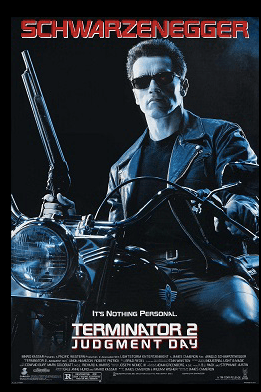
If this movie had been made a decade or two later, it would have inspired a fan backlash.

Do you doubt me? This is the film that transforms Sarah Connor from the ordinary young waitress of the original movie into a hardboiled commando, athletic and capable of handling firearms with ease. You can’t tell me that people wouldn’t complain about the change. As if that weren’t enough, now the T-800 is a good guy, fighting to protect the young John Connor. “But how did that even work?” the Comic Book Guys of the world may ask. “How does it fit with the established lore?”

But T2‘s biggest crime against the franchise is the subversion of The Terminator‘s original theme. The first film is fatalistic, with the coming nuclear war caused by Skynet understood as an inevitable outcome.

T2 says otherwise; that “there is no fate but what we make for ourselves.” It totally undercuts the original’s theme. Not to mention opening a whole new can of worms about multiple timelines, in addition to the paradoxes that are implicit in every time travel story.

All these are valid criticisms. But it doesn’t change the fact that Terminator 2 is still a really great action movie. Yes, it replaces The Terminator‘s grittiness with some pretty over-the-top and cartoonish action sequences, most notably the use of an M134 minigun as a precision non-lethal weapon to avoid casualties. Just… no. Or rather, only in the movies. Though I am come to sing T2‘s praises, I’m not going to sit here and tell you it’s believable.

But look: this was the ’90s, and the ’90s were pretty optimistic. The Cold War was over! It had been won not with guns and bombs, but with blue jeans! It was The End of History!

This might sound silly nowadays, and yet, I think, it was the attitude that made ’90s pop culture so damn infectious. Terminator 2 is lighter than both The Terminator and Terminator 3. And that, I submit, is because it was made after the renewed US-Soviet tensions of the ’80s and before the post-9/11 2000s. It captures the mood of the era, by willing to be a fun Arnold Schwarzenegger movie where the killer robot says things like “Hasta la vista, baby.”

Is The Terminator a “better” movie? I dunno, depends what you mean by “better.” In some ways, sure. But in terms of being a fun action movie that you can just enjoy and walk out of feeling like the good guys won and the bad guys lost, Terminator 2 is better.

This is why I contend that Terminator 2 is the perfect movie to encapsulate what I mean when I speak of ’90s action movies. It kicked off a style of film that would rule the decade. And moreover, it was the last decade that films like Terminator 2 could rule, exactly because fandoms had not yet organized to talk about them.

All the films I’m going to talk about in this series could not be made now, for one reason or another. And that’s partially why I want to write about them, because (you may laugh) I think these films say something about their time, and, perhaps, by way of reflection, our time as well.

But that’s only secondary. The main reason is that ’90s action movies are freaking fun, and that’s why I like watching them. James Cameron, for all his faults, sure knows how to make a good action picture. Even when he goes and makes something that’s nothing but a rip-off of Ferngully meets Dances With Wolves, the action sequences are still good. And here was Cameron at his peak, making a film with one high-speed action scene after another. I think the canal chase is my favorite part. You’ve got to love the way Arnold flips that shotgun around.

That said, let’s not forget the prelude to that sequence, when the T-1000 and the T-800 hunt John Connor through the mall. Watching it now, of course, I’m highly nostalgic. Malls are a feature of the ’90s that has since been devoured by the internet. In reality, it turned out that “Skynet” needed no nuclear missiles to take over the world; it just needed a ton of server space.

Sorry; I’m getting philosophical again. I do that sometimes when I write about movies. You’re still here, so maybe you like it, or at least are willing to tolerate it. Philosophy is a wonderful thing, and it’s delightful to find it sprinkled around the edges of our favorite movies.

But it can never be the main thing. Ultimately, movies are at their best when they show us a world we can get lost in, give us characters we can love and hate, and above all else, tell us a good story. The films I’m going to discuss all do that, and that’s why I’m revisiting them now. Come join me, won’t you? Or should I say, “Come with me if you want to live… the ’90s over again.”

Zachary Shatzer’s books never fail to make me laugh out loud. They’re absurd, over-the-top, fast-paced and hilarious, and Sorcerers Wanted is no exception.

The best way to describe it is, imagine a spoof of Harry Potter and all the Potter clones that followed it, but done with the sensibility of the movie Airplane!, only in book form. I won’t summarize the plot, because it’s too zany, and anyway, you don’t read a book like this for the plot. There’s an evil sorcerer called Pobius who has conquered Arizona, an even eviler and much cooler sorcerer named Doomsboro who has conquered Chicago, and a school to train young sorcerers to fight back against them.

This school is where our protagonist (who is unnamed, but sometimes referred to as “Mitchell” or “Doofus”) begins his journey. He’s not what you’d call a real success in life, having failed at pretty much everything he’s ever tried, but he tries to remain upbeat.

There are just too many funny lines to even count in this one. Like this, describing Doomsboro’s use of a TV game show to capture the public’s imagination:

It’s hard for most people to choose defiance against evil when they have to give up televised drama as part of the deal.

Or this, on his use of propaganda:

These papers now cranked out nothing but propaganda about Doomsboro. How strong he was, how handsome he was, how tyranny and malevolence were actually cool and benevolence was only for old fogies who can’t keep up with the times.

“Coolness” is a major theme in the book, and in fact the use of the intangible concept of being cool is used by all sides in this complex magic war. Which is critical for our protagonist, who is about as uncool as it gets.

And like an earlier Shatzer book, there’s a fictional text mentioned in this one that I desperately wish actually existed: The Cowboy Sorcerer, by Jenkins Crabston, a novel that combines Crabston’s “experience as a sorcerer and his love of movies set in the old west.”

This book so, so needs to be real.

As for Sorcerers Wanted, it’s a wonderful comic romp that had me guffawing uncontrollably. Highly recommended for when you want to just kick back and read something light.

[Audio version of this post available below.]

Note the title of this post does not include the word “review.” This isn’t a review in the typical sense. It’s long and rambling, even by my standards. But I promised Trent Lewin that I would share my thoughts on it when I finally saw it. (You can read Trent’s take here.) So, here goes.

The Book

I reviewed the book Dune here, on what was originally going to be the release date for the movie. I won’t bother rehashing everything I said there. Instead, I’ll just say that Frank Herbert went to write an article about sand dunes in Oregon, got fascinated with ecology and messianic leaders, and did a bunch of magic mushrooms. The resulting book is about what you would expect. It is interesting, multifaceted, and more than a bit bizarre. In some superficial ways, it’s just a good ol’ fashioned Sword and Planet adventure, with a hero who defeats his enemies, claims his birthright, and marries a princess… but if you’re expecting an Edgar Rice Burroughs yarn, your reaction is likely to be “WTF did I just read?”

Actually, that will probably be your reaction no matter what. It was mine, and I even (mostly) liked the book. It’s different, and I respect that. My biggest problem with the book is also a problem with the movie, so I’ll hold off on discussing that until later.

Jodorowsky’s Dune

In the early 1970s, Alejandro Jodorowsky planned to adapt the book into an epic film. The project never got off the ground, but did result in a sprawling collection of interesting storyboards and concept art, which you can see here. The artists appear to have taken the magic mushroom elements and run with them. The project spawned a documentary, which I have not seen, but which Josh Sawyer describes the ending of as follows:

“Alejandro says that in the end the actual making of the film would have ruined it, because it was absolutely perfect in his mind.”

Remember this.

Lynch’s Dune

After Jodorowsky’s attempt failed, Dino de Laurentiis bought the rights, and hired David Lynch to direct an adaptation, released in 1984. This film is a cult classic, but in my opinion, it’s a mess. The worst part is the constant voice-overs used to convey characters’ thoughts. This is in keeping with Herbert’s writing style, but it just goes to show you what worked on the page won’t work in a movie.

All that said, the film does have a unique and unsettling aesthetic, which is probably the most essential quality for any Dune adaptation. There’s no doubt Lynch had a vision, though it was a weird and probably not mass-marketable one. Not to mention that the special FX of the ’80s were just not up to creating the stuff he was trying to portray.

Villeneuve‘s Dune 

Psych! First, I have to talk about some other Villeneuve movies. This is the third one of his I’ve seen, the others being Arrival, which was pretty good, and Blade Runner 2049, which was turgid. It’s hard to make something cyberpunk that I don’t like, and yet 2049 managed to do it. So, I can’t say I was super-optimistic going into Dune.

But I watched it. I even got the “limited edition pain box” version, because, well, how could I not, with a name like that?

So what is the deal with this movie? Is it good? Is it bad? Does it do what it’s supposed to do? Come to that, what is it supposed to do?

Uh oh. It looks like we’ve run into a problem before we’ve even started. We can’t analyze Dune without understanding what a movie adaptation should be doing. So I guess more work is needed. Hold the phone, everybody!

Lean’s Dune?

Before Lynch, even before Jodorowsky, Sir David Lean was offered a chance at directing Dune, but he turned it down.

I sort of understand this, because Lean wasn’t a science fiction guy. But nevertheless, this is a tragedy of epic proportions. Because Lean was the director most qualified to direct Dune. Of course, I should stipulate that he would need his frequent collaborator, screenwriter Robert Bolt.

Lean and Bolt created one of the greatest desert epics ever made, Lawrence of Arabia. If you read my review of the Dune novel above, you know my thoughts on Lawrence‘s influence on the entire Dune universe as Herbert conceived it. It’s profound. Lawrence of Arabia is an incredible adaptation of an extremely complex book, T.E. Lawrence’s Seven Pillars of Wisdom. In fact, it’s pretty much the gold standard by which I judge all other cinematic adaptations.

It’s a completely faithful adaptation, but not in the sense that Bolt took every single thing in the book and included it in his script. That would be impossible. Rather, it’s faithful in the sense that it captures everything Lawrence records in his memoir: his initial hopes for a grand future for the Arab revolt, his own conflicted psychological turmoil, and his ultimate disillusionment at the cynical manipulation of himself and the men he led by the generals and politicians of the Great Powers. You feel all of it in the final scene as the broken Lawrence rides off to return to England, a motorcycle engine growling ominously nearby as the screen fades to black.

Ultimately, Lawrence of Arabia is about how an introverted, troubled, brilliant officer tried to accomplish something great by playing the role of a leader that deep down, he knew he never could be. And Dune, as a series, is about much the same thing. Frank Herbert said:

“The bottom line of the Dune trilogy is: beware of heroes. Much better [to] rely on your own judgment, and your own mistakes.”

“Lawrence of Arabia” was a hero. “Paul Muad’dib,” the “Kwisatz Haderach,” is a hero. But at some level, T.E. Lawrence and Paul Atreides know, more than anyone else, that it’s just a role; a story created to fit a preconceived pattern in the minds of the masses.

In a sense, Dune itself is an adaptation of Lawrence of Arabia, just in space, with psychic witches and sandworms.

On Heroes and Hero-Worship

Okay, I’m cheating now. That’s a book by Thomas Carlyle, which I have not read, although my understanding is it’s a series of essays about historical figures like Cromwell, Napoleon, etc. who rose to power. I suppose I should have picked a more creative title for this section, but what I actually want to talk about is hero-worship.

It so happens I’m reading Garibaldi’s Defence of the Roman Republic by George MacCaulay Trevelyan at the moment. It’s pretty much the definition of a hagiography, as Trevelyan makes no effort whatsoever to hide his blind adoration of Garibaldi.

Garibaldi is an interesting figure, with his own parallels to Paul Atreides. He too led a guerrilla war that battled great dynasties and inspired an impressive cult following in England with tales of his heroics. Indeed, he is one of those romantic figures of Mediterranean politics that should, I think, inform any interpretation of Dune, because Dune is heavily influenced by a powerful strain of Machiavellian political theory in its depiction of warring aristocratic houses and shifting family alliances.

Really, almost everything in Dune has some analogue in actual, if mostly forgotten history; which I suspect is why its world is one that so many people get absorbed in. It has echoes of things dimly remembered, or not even remembered, but somehow with a feeling of eminent plausibility, like having a dream that you think you’ve had before.

Villeneuve‘s Dune (For Real This Time)

Having established all that, we are now finally prepared to attack the question of whether the new Dune movie is any good or not. The answer will ride on whether or not it conveys the theme and mood of its source material.

The answer is… well, sorta.

Dune gets most of the little things right. The art direction is excellent. The acting is good. The atmosphere generally feels alien. Almost everything shown is a scene depicted in the book. Not only does it copy the things I liked about the book, but it even conveys the things I didn’t like. One of these is that I find Paul unlikable in the book, and I find him unlikable in the movies. Now, given the Herbert quote above, I think that may be deliberate. Because Paul isn’t a hero, but everybody worships him as such, you come away with the feeling that he’s a fraud. In every depiction, Leto is so much better and more interesting, and in both book and film, I feel like the story starts running out of steam at the point where he dies.

That makes the story weaker in my opinion, but I’m willing to give the movie a pass on this since I have the same problem with the book.

More significantly, though, there are places where Dune still feels like a product of the cinematic fads of the 2020s. One example is the damned washed-out lens filter. The scene that highlights this most is when Duke Leto and Gurney Halleck are looking over their newly-acquired holdings on Arrakis. Halleck tells Leto the sun is getting too high, and they can’t stay out. And sure, you can see there’s some sun, and imagine it’s probably hot.

But you don’t feel the heat. You don’t viscerally sense the sun beating down on you. In Lawrence of Arabia, you do.

This is the feeling I had throughout the movie. It’s good, it’s solid, but it’s also just not quite willing to take that extra step that propels it into timelessness. And timelessness is a very important quality for Dune.

If there’s one place where Lynch’s Dune has an advantage, it’s that the aesthetic is so weird it creates a uniquely alien vibe that really does convey the feeling that you’re in another world. I’m not saying that it’s a better film. It’s seriously not; it’s kind of a 1980s cheesefest if I’m being honest. But I am saying, Dune, more than most films, is one where a sense of aesthetics is incredibly important.

This is probably a little bit harsh on my part, I’ll admit. Every movie is of course a product of its time. Even Lawrence of Arabia, for as well as it holds up overall, has a few elements that date it as a 1960s Epic Motion Picture, like Maurice Jarre’s occasionally over-the-top soundtrack. If the problem could be reduced to a matter of lens filters, I wouldn’t complain about it. (Much.)

No, the problem here goes even deeper. And it goes right to the heart of what the core appeal of Dune is.

“Any road followed precisely to its end leads precisely nowhere.”

The universe of Dune is effectively a post-Enlightenment society. It’s not a coincidence that much of the book draws inspiration from pre-Enlightenment societies. In fact, the central idea of Dune is the rejection of rationality, from the Butlerian Jihad that destroyed Artificial Intelligences to the heavy emphasis on mind-altering drugs and visions. There is no evidence of Enlightenment concepts like “constitutional government” or “individual liberty.”

In my opinion, this is why the whole thing feels so weird and foreign. We are a society based on Reason, and on encountering a society that is not based on Reason, but on instinct, superstition, heredity and above all else, power, we feel like we have stepped into another universe altogether. (Although, if you think about it, considering the Enlightenment began in the 16th century, such societies are actually the norm, and we are the exception.)

This comes through very clearly in the book, which is one reason there are things in the book that, to be blunt, make absolutely no sense whatsoever.  They’re not supposed to. Remember: magic mushrooms.

This movie, although it has no shortage of visions, hallucinations and other weirdness, doesn’t convey that. I’m not sure exactly why. Arrival did a good job of messing with the viewer’s mind to the point that if you want to understand the plot, you have to perceive time as a Möbius strip, which is also basically the state Paul is in by the time he meets the Fremen. Yet, I never got that feeling of otherworldly eeriness that’s so integral to the Dune experience.

Actually, no. There was one scene where I did get it. The creepy chant that plays while the Sardaukar soldiers are gearing up to attack Arrakis gave me the uncanny feeling of witnessing something completely alien to my own perception of reality. I liked that scene a lot.

Otherwise, though… it was an unremarkable movie. Not bad by any means, and with some enjoyable visuals and interesting shots. It just felt hollow and meaningless, which is in a way tragic because it tried so hard to be faithful to its source material that it lacked the boldness to do something truly unusual… which, paradoxically, is exactly what made its source material good to begin with.

But recall the words of Jodorowsky paraphrased above. Perhaps there can never be a perfect Dune adaptation because the universe of Dune can only be formed in the mind of the reader. And for every reader, it compiles slightly differently, as a unique and fragile structure, and to try and preserve or share this creation is a fool’s errand.

As I think most of you know, Halloween is by far my favorite holiday. But even I can go for a good Christmas tale. So naturally, a Christmas book that brings a witch into the picture is going to get my attention.

This book tells the story of Cinnamon Mercy Claus, who unexpectedly finds herself journeying to the North Pole for the holiday season. There she meets her grandparents: Mr. and Mrs. Santa Claus themselves.

This would be a shocking enough discovery on its own, but she next learns that her grandmother is a witch and that she wants a divorce from the jolly old elf, who has been taking all her Christmas magic for granted. She angrily leaves her bewildered granddaughter in charge of handling all the arrangements for delivering toys to all the children of the world.

This is a lot to take in for Cinnamon, who is more comfortable working in the world of spreadsheets and number-crunching than of magic, but, with the help of the elves, she throws herself into the task.

The book is a lot like those made-for-TV Christmas movies that they broadcast this time of year. Which are not everyone’s cup of tea, of course, but I happen to enjoy them. Yes, they can be predictable and sometimes overly-sentimental, but hey, what are the holidays about if not the comfort of something cozy and familiar? It is true that most of the time I prefer darker varieties of fiction, but when December comes round, there’s nothing wrong with little light trifles.

And that’s exactly what this book is; a fast-paced bit of Christmas-themed fun. Read it while eating some gingerbread cookies or something, preferably by a fireplace or under some decorative lights, and you’ll surely be filled with the Yuletide spirit.

[Audio version of this review available below.]

The first thing I had to do before reading this book was try to forget everything I previously knew about James Bond. It’s not easy. Even if you’ve never seen a Bond movie, you probably have absorbed some things about him from pop culture references. I’ve seen most of the films, so I had to consciously purge all memories of Bond-related media I had seen before reading this

Because this is the first Bond book, the one that started it all, and it seemed best to try to view it through fresh eyes as much as possible. Fleming’s original character is a cold, efficient secret agent, and his mission is to defeat the communist operative Le Chiffre at baccarat in order to disgrace him in the eyes of The Party.

The first half of the book involves long and fairly complicated descriptions of baccarat, as well as some other casino games. Also, many of the terms are French, and Fleming assumes that his readers would be familiar with the language. Probably they were, because his intended audience was well-educated, not savages such as myself.

“He made a high banco at chemin-de-fer whenever he heard one offered. If he lost, he would ‘suivi‘ once and not chase it further if he lost the second time.” 

Uh… ‘kay? To be fair, some of these terms get explained later on in the book. Vesper Lynd, Bond’s assistant on this mission, serves as much as a plot device to have this stuff explained as she does a love interest.

At first, I found it a little dull, but after a while I got absorbed in the high-stakes game. Fleming did a good job building the tension and making the reader sweat right along with Bond.

And so, from the blank slate I’d consciously developed, the character of Bond as Fleming saw him starts to come into focus. It’s funny to think now that the name is so iconic that Fleming’s reason for naming him “James Bond” was because it seemed to him such an uninteresting and ordinary name.

As for his looks, Vesper compares him to Hoagy Carmichael, who I had never heard of before, although Bond himself doesn’t see it. Myself, I started picturing someone on the order of Basil Rathbone: not bad-looking, but not terribly remarkable either.

Maybe it’s because Bond evokes another iconic English hero whom Rathbone did portray: Sherlock Holmes. He surveys everything with a calm detachment, and largely avoids falling prey to emotional entanglement. Or so he tells himself. But, during the first of those signature 007 car chases, his actions betray him. Sure, he may say to himself the woman he’s racing to save means nothing to him, but he is driving 120 miles per hour at night to catch up with her kidnappers.

In the end of course, it’s not just Bond’s actions that betray him. This is a spy thriller after all, and at the end of it, Bond is even more of a heartless, misogynistic, unsentimental S.O.B. than he was at the beginning.

Okay, I lied. I didn’t actually erase all my preconceived notions about Bond before reading this. But I promise, I did my best to forget about Connery, Craig and everyone in between. Who I kept in mind was Patrick Dalzel-Job, a British intelligence officer who served under Fleming’s command during World War II, and whose memoir, From Arctic Snow to Dust of Normandy, I recently read.

Dalzel-Job is thought to have been Fleming’s inspiration for the character of Bond. Although his service seems to have been, if anything, way more exciting than Fleming’s fiction. Dalzel-Job’s memoir records no glamorous casinos, expensive meals, or fancy cars, and quite a lot of hiding out night after night on the coast of Norway, spying on the activities of the Kriegsmarine.

On the other hand, Dalzel-Job does describe reassigning himself after the war without consulting his superior officer, in order to be closer to the woman he would eventually marry. Such roguish defiance of his superiors may have been in Fleming’s mind when he was crafting his fictional spy.

Anyway, I know I’m supposed to be reviewing Casino Royale, but I really do have to recommend From Arctic Snow to Dust of Normandy to anyone who enjoys reading about history. Dalzel-Job gives a clear, well-written and extremely humble account of his heroic actions during the war. Truth is stranger than fiction, they say, and some of his real-life adventures are more breathtaking than any Bond story.

But, back to Casino Royale. The last quarter of the book makes no sense. I won’t spoil it, but in essence, a bunch of suspicious stuff is going on, and Bond is blithely ignoring it. It’s totally out of character for him based on how he behaved in the first part of the book, where he was meticulously paranoid about security measures, and proud of it. Then at the end he’s reckless about obvious threats, and the only reason for this seems to be that he needed to be to make the plot work.

I didn’t care for the ending at all, which was too bad, because I really liked the rest of it. It’s well-paced, interesting, and Bond was a good character… until he wasn’t.

To me, the book really should have ended with a fascinating conversation between Bond and his colleague, Mathis, where Bond is waxing philosophical about his profession:

“Today we are fighting communism. Okay. If I’d been alive fifty years ago, the brand of conservatism we have today would have been damn near called communism and we should have been told to go and fight that. History is moving pretty quickly these days and the heroes and villains keep on changing parts.”

Can you imagine any of the cinematic incarnations of Bond saying that? I can’t.

Even better is Mathis’s parting advice to Bond:

“Surround yourself with human beings, my dear James. They are easier to fight for than principles.”

This was my favorite chapter in the book, and really made the characters feel much more real and interesting. And then Fleming had to go and make a mess of it at the end!

Oh, well. It was still a good book and I’m glad I read it. All told, I’d say I enjoyed it more than the majority of the Bond movies I’ve seen, including the 2006 adaptation of this very story. Even if you don’t like the Bond franchise generally, it’s still worth giving the book a try if you like thrillers.

All right, that’s the end of the book review. What follows is just me going off on one of my hobbyhorses. Don’t feel like you have to read it unless you are interested in minutiae.

At one point, Bond is described as arming himself with “a very flat .25 Beretta automatic with a skeleton grip,” which he checks by removing “the clip.”

This is apparently a Beretta M418. There is an interesting behind-the-scenes story about how Bond ultimately swapped it out for his signature Walther PPK, but what I’m interested in is the use of this word “clip.” In this context, it sounds like he’s talking about a magazine, not a clip. Peter Martuneac (who, incidentally, I have to thank for recommending Casino Royale to me) has written a post about distinguishing the two. But Fleming was a navy officer, so I’m reluctant to automatically assume he was ignorant of the difference. Perhaps it’s a difference between British and American lingo? Or am I missing something, and it really is a clip? This picture of the 418 shows a pretty definite  magazine, though.

Anyway… well, if you read all this nit-picking and found it interesting, perhaps you’ll also enjoy this clip (pun intended) that I stumbled across while researching this. While it might be too big for a spy to carry discreetly, I think it’s worth noting that a few years later, a .44 magnum revolver would become an iconic cinematic weapon in its own right.

[Audio version of this review available below. This video is dedicated to the memory of all the French words I slaughtered trying to pronounce them when making it.]

The great comic novelist and book lover Noah Goats once told me, “Books lead on to books, and sometimes in strange ways. They all seem to be connected somehow.” This is a good example. After reading T.J. Brown’s excellent ghost story The Last Photograph of John Buckley, I looked to see what else he had written. And the first thing that grabbed my eye was the image you see at the right.

Well, I mean, how could I resist?

As the cover suggests, this is a raunchy, bawdy comedy. Emily Spankhammer is a young, widowed Southern Belle who runs a beaver farm. And in case you are wondering if that leads to many, many Are You Being Served?-style double-entendres, why, yes, yes it does. It is that kind of book, and I’m not ashamed to say it made me laugh.

In her quest to find love, Emily is aided by her spirit guide, a wisecracking pink unicorn named Sparkle. Despite his appearance, Sparkle is, shall we say, anything but pure or nice. As he explains to Emily, he has been forced by the Ancient Greek Gods into the role of spirit guide after his decadent hedonism indirectly led to the destruction of Atlantis.

I’m not doing it justice. Let me quote Sparkle verbatim:

“This is the realm of gods and monsters, you silly woman. They don’t have moral codes in that place. If you’d spent more time watching sword-and-sandal movies, you’d know that. This is the domain of passion, of jealousy, of revenge, blood feuds, and raging hormones.”

Sparkle and Emily’s relationship is a turbulent one. Actually, all her relationships are turbulent, whether it’s with a mechanic whose home is filled with fake owls, a circus ringmaster, or a Scottish Highlander. Are you getting a sense now of what a wild story this is?

The long and short of it is, it’s a hilarious, madcap adventure. It reminded me a little of Richard Pastore’s The Devil and the Wolf and a little of Lindy Moone’s Hyperlink From HellIt’s not a coincidence that the best comparisons I can think of are indie books. This is what makes reading indie books so rewarding: these are the kind of unusual stories that publishers are too risk-averse to take a chance on, but are an absolute delight to read.

Now, I’ll admit that some readers might not see the appeal in it. If you don’t like raunchy humor, then it isn’t for you. But if you’re in the mood for a zany, somewhat off-color, fast-paced take-off of romance novels, you should give this one a try.

[Audio version of this post available below.]