Now then, as I was saying, charisma is what wins Presidential elections.  The first debate proved this point quite conclusively; as Mitt Romney won it in the opinion of almost everyone simply because he seemed more energetic than the President did.  Naturally, I was shocked that Obama did so poorly, but nonetheless the general principle that charisma wins elections was upheld.

Obama returned to form, though, in the second debate and I think won it despite Romney’s best efforts to weird him out by stealing his material.  Obama is more likeable than Romney in general; so I really cannot think what happened in the first debate.  I still believe that Obama will win because of his charm, and leave the awkward, sometimes nervous looking former Governor wondering what happened.

Of course, in the matter of what they proposed to do things were very different.  Mitt Romney threw almost all conservative ideas out, and simply mimicked Obama to a great extent.  He talked about how rich people  do not need help; the middle class does, and spoke fondly of the need for government regulations.  In the second debate, he came out in favor of affirmative action, albeit awkwardly.  In the upcoming foreign policy debate, he will probably quote Howard Zinn approvingly.

Romney won the first debate, but in so doing he essentially promised to be super moderate–to out-Obama Obama, as it were.  Maybe Romney will just say whatever he thinks is likely to be popular at any given moment.  Or maybe there is a conscious and deliberate plan whereby Romney talks like the consummate “centrist” and then governs like a supply-side Republican.  But either way, the Etch-A-Sketch strategy worked like a charm.

In a way, I think these debates have been the culmination of what I talked about in this post.  There are two Rockefeller Republicans in these debates; one of them simply happens to be a Democrat.  There are differences in their personal style, in their manner, and in degrees of Rockefeller Republicanism, but that is what they both are campaigning as.

Obama is (usually) more charismatic, and so he gets the advantage among swing voters.  Of the remaining votes, I assume that most will be cast based on party loyalty.  The Democrats will vote for Obama and hope he will adhere more closely to their platform, even though he will still face opposition in Congress.  The Republicans will vote Romney because they want Obama out, and will vote automatically for the GOP candidate whoever he happens to be.

It bears repeating that Romney is probably not actually a Rockefeller Republican; he just plays one on TV.  He played a much more socially conservative kind of Republican in the primaries, and then relied on the public’s short attention span to affect his metamorphosis.   Most likely, he is a George W. Bush Republican: almost all of his policies suggest that he supports the same tax cuts and military interventionism that the last Republican did.  But saying that won’t win him any allies.

I think that Obama, meanwhile, would like to be more liberal on government spending, raising taxes, and so on.  He probably wants to be an FDR Democrat on the economy, but the political terrain is such that he can’t find a way to do that.  For one thing, I think he is more interested in achieving bipartisanship than FDR was.

Ultimately, I think Obama wins this on personal appeal.  Romney, outside of one fluky debate, seems rather arrogant and condescending.  Even in the debate he “won”, he seemed arrogant with the way he talked over the moderator.

Okay, I wanted to try to avoid blogging about politics this weekend, but analysis of Clint Eastwood’s Absurdist one-man play is everywhere.  I guess it’s not even that political except that it happened at the Republican convention.  As eurobrat points out, the performance, unlike everything else at the convention, was not carefully stage and crafted.  It was spontaneous.

That definitely was why it was more memorable than anything  else at the convention, but I am not sure that “memorable” means “good”.  “All publicity is good publicity”, they say, but they are wrong.  Just ask Richard Nixon.  Still, I like Eastwood, and I can sort of see what he was trying to so, but it just fell flat.  That’s okay; plays often do need adjustments after opening night.

I think he should hire Roger Guenveur Smith to perform in the next version of it.  Number one because he is very good at one-man performances, and number two because there would be something delightfully ironic about a man named Roger Smith interviewing an empty chair.

Talking of which, Michael Moore has his own take on it, in which he erroneously says “a crazy old man hijacked a national party’s most important gathering so he could literally tell the president to go do something to himself”.  But Eastwood had the imaginary President–President Harvey, if you will–telling him, Eastwood, that.  The implied swearing didn’t bother me that much, although I suppose it will horrify the religious wing of the Republican party.

But, in the end, it was my favorite part of the convention.  I have to give Eastwood credit for that much.

I know I’ve talked about this before, but it never ceases to fascinate me how the Republicans can miraculously understand and believe in Keynesian economic theory when military spending is at stake, and then forget all about it later.

By the same token, I do think it was a mistake on the administration’s part to make those cuts during a period of sluggish economic growth.  If you buy into Keynesian macro-economics, you have to admit, even if you oppose the military-industrial complex, that it is a useful economic tool.   Maybe not the best way to build an economy in the long-run, as Richard Nixon kind of alluded to in the famous “Kitchen Debate“, but even so, it certainly does work the same way as any other fiscal stimulus program.

This kind of doublethink is quite irritating, but at the same time it’s important to see what underlies it: the huge divide between Republicans and Democrats.  It is not just a matter of disagreement on economic theory, but on what the nation ought to be like and what it ought to produce.  It’s much deeper than just economics.

Do I have to turn in my liberal card if I’m not excited about this?  Yes, I think it was a stupid policy to exclude women, but frankly I don’t see why the whole thing got made into such a big deal.  It’s a place for rich people to hang out with other rich people and do, I don’t know, rich people stuff.  And play golf.

I seriously doubt that this will open new career paths for Condoleeza Rice or Darla Moore.  Rice was the Secretary of State; I’m guessing that carries more weight for networking purposes than being a member of some fancy golf club.  I bet when she was picked to be Secretary of State, her first thought wasn’t “Great!  Now maybe I can finally get into that golf club!”

Look at this list of famous people in this club.  I bet none of them got where they are by becoming members of that club.  I’m thinking their success was the cause, rather than the effect, of their membership.

It would be one thing if it were the only golf course in the world, or if the ladies they admitted were, for example, too poor to go to another location to golf.  As it is, why, surely there are adequate substitute golf clubs that Rice and Moore could go to if they wanted.  Maybe loyal reader and golfer P.M. Prescott can explain why this particular place would be so special.

I don’t actually see how discrimination really hurts anyone in this particular case, except for the discriminators.  Since the entire point of the club appears to be propagating a prestigious reputation that it has manufactured for itself, the bad P.R. for being “the place that doesn’t admit women” could get to be very damaging, as indeed it ultimately did.  I’m not defending their policy, but I don’t see that it was hurting anyone except the people who made it.

Bottom line: I think the people running Augusta National were being stupid by not admitting women.  However, I think people need to quit acting like the change in policy is some kind of giant feminist victory. It’s nothing of the kind.

Republican Vice-Presidential Candidate Paul Ryan said one of his favorite bands is Rage Against The Machine.  The band’s guitarist, Tom Morello, wrote a response to him in Rolling Stone, saying that Ryan’s beliefs are antithetical to what the band believes, and what their lyrics say.  But, Morello notes, Ryan says “he likes Rage’s sound, but not the lyrics.”

I’ve never understood that.  I don’t know much about music, so I just listen to it as background to the lyrics.  If I like the lyrics, I’ll like the song.  If I don’t, I won’t.  That doesn’t mean I don’t care at all about the music, but it’s definitely a secondary element for me.

That said, it’s easy to like music that is ideologically opposite from oneself.  I like a lot of Marty Robbins‘s songs, even though he was a hardcore conservative.  I think Warren Zevon was a conservative as well, but he’s still one of my favorite singer/songwriters ever.

Anyway, Paul Ryan says he likes RATM’s “sound”.  I’ve only heard a few songs by them, and they seem like the sort of thing he would like.  Too much random loud noise and screaming of the lyrics for my taste; makes them hard to understand.  It’s too bad, because the lyrics themselves are pretty good.  If Ryan is just in it for the “sound”, I’d have to say he’s lucky he still has his hearing.

As Morello is winding down his article, he writes:

But Rage’s music affects people in different ways. Some tune out what the band stands for and concentrate on the moshing and throwing elbows in the pit. For others, Rage has changed their minds and their lives. Many activists around the world, including organizers of the global occupy movement, were radicalized by Rage Against the Machine and work tirelessly for a more humane and just planet. Perhaps Paul Ryan was moshing when he should have been listening.

I think Morello is making a mistake here, because I suspect that most of the band’s success comes from those same “moshers”.  Morello shouldn’t insult them, even if he is understandably upset that one of them is a candidate for national office despite not listening to the band’s message.

While we’re on the subject, why are so many irrelevant details of Paul Ryan’s life making the news?  First there was the thing about his clothes, now it’s his musical tastes.  People are also excited about his hobby, bow-hunting. (Ugh!) Although at least that’s tangentially related to his policy decisions, because one of his major achievements is lowering taxes on arrow makers.

The New York Times has a bizarre fluff article about Paul Ryan’s fashion sense.  This isn’t really my area of expertise–he wears dark suits, like every other male politician–but the article does raise a lot of interesting questions about attractiveness and its relevance to politics.

I think that politicians in general are better looking now than they were before the advent of television and high-quality photographs.  You can’t go around looking like  Martin Van Buren and expect to be President anymore.

Martin Van Buren (Image via Wikipedia.)

Admittedly, not everyone in politics nowadays is pin-up material.  Actually, even people like Ryan, Obama, Palin and all the other supposedly attractive pols are just slightly above-average-looking people.  None of them would turn heads on the street.  But by the standards of the political arena, they look like movie stars.  I suspect this is because to be a major figure in politics, you usually have to be fairly old and spend a lot of time sitting around indoors.  This lifestyle isn’t conducive to getting on People magazine’s “Most Beautiful” list.

I don’t think it’s a coincidence that two consecutive Republican Vice-Presidential nominees have been relatively young and physically fit people.  They know how much looks matter in politics.  The NYT article referenced above makes it sound like only the Republicans do this, however.  Not true.  Why, the Democrats were perhaps the first beneficiaries of the attractiveness bias, in that it provided JFK the critical edge he needed in a close race against the haggard-looking Richard Nixon.

It’s not the same thing as the “charisma” that I write about so much–both Romney and Ryan are good-looking, but not at all charismatic–but it’s related.  And if you can’t get a charismatic politician to run for your side, getting a nice-looking one is probably the next best thing.

It’s been said that “Washington is Hollywood for ugly people”.  Well, now it’s coming to be Hollywood for slightly above-average looking people.  Eventually, political strategists will decide the best thing to do is put forth incredibly telegenic puppet candidates, and having the real nitty-gritty work of running the country done behind the scenes by people who look like Karl Rove or James Carville.  Or maybe that’s already going on.

A new poll has come out showing that only 49% of Americans think President Obama is Christian.  17% think he’s Muslim.  James Rainey writes:

The lingering questions about Obama’s faith likely come from people of two mind-sets. One is those who have an intense dislike of the president and find confirmation of all their fears in a fever swamp of conspiracy websites. Where a birth certificate is not accepted as proof of someone’s place of birth, forget about verifying something as intangible as a statement of faith.

The second factor driving up Obama’s “Muslim number” is doubtless the urge of some respondents to stick it in the pollsters’ ear — to commit a small act of defiance by giving an answer the voter knows is untrue. When the interloper in the Oval Office is deeply loathed, why credit him with anything, least that he is a Christian?

Rainey focuses his attention largely on 17% who think he is Muslim.  Probably this is because it really is incredible that anyone could honestly believe he is a devout Muslim, as so many of his actions are inconsistent with that faith.

What I wonder about is the people who answered “don’t know” or “other” in the poll.  Is there also a conspiracy theory that Obama is secretly Buddhist?  Actually, most of the people I’ve talked to who doubt Obama on this suspect that he’s an atheist, not a Muslim.  Not sure why those people would answer “don’t know”, though.

As for the results on Romney’s religion, I was surprised how many didn’t know it.  It’s one of the most notable facts about an otherwise fairly dull politician.

Romney may have gotten one good line in, but as I mentioned, his answer to NBC’s Brian Williams’ question on gun control was awful.  The only place I was able to find a full transcript was a Conservative website, but here it is:

Williams: As governor you signed an assault weapons ban in Massachusetts. And you said at the time, quote, ‘These guns are not made for recreation or self-defense. They are instruments of destruction with the sole purpose of hunting down and killing people.’ Do you still believe that?

Romney: Well, I actually signed a piece of legislation, as you described, that banned assault weapons in our state. It was a continuation of prior legislation. And it was backed both by the Second Amendment advocates like myself, and those that wanted to restrict gun rights, because it was a compromise. Both sides got some things improved in the laws as they existed. And I happen to think that with regards to the Aurora, Colorado disaster, we’re wise to continue the time of memorial and think of comforting the people affected. And political implications, legal implications are something which will be sorted out down the road. But I don’t happen to believe America needs new gun laws. A lot of what this young man did was clearly against the law. But the fact that it was against the law did not prevent it from happening.

Let’s break this down bit by evasive, mealy-mouthed bit, with my comments in red.

  1. “I actually signed a piece of legislation, as you described, that banned assault weapons in our state. It was a continuation of prior legislation.”  [He is basically trying to say: “it’s not my fault, it was like that when I got there.”]
  2. “And it was backed both by the Second Amendment advocates like myself, and those that wanted to restrict gun rights, because it was a compromise. Both sides got some things improved in the laws as they existed.” [It was an assault weapons ban–that means it restricted guns, period.  Don’t try to retcon everything so that you were more radically conservative.  He’s trying to appeal to the hardcore NRA members by lying to them, and what’s worse is that it’s not even a very good lie, as it makes him look like an incompetent governor.]
  3. “And I happen to think that with regards to the Aurora, Colorado disaster, we’re wise to continue the time of memorial and think of comforting the people affected. And political implications, legal implications are something which will be sorted out down the road.” [I said something similar on the day of the atrocity; I thought we should wait until more facts were known before talking about what to do to prevent it.  But now, more facts are known.  Romney is trying to dodge the question so that he doesn’t have to alienate any voters.]
  4. “But I don’t happen to believe America needs new gun laws.” [What happened to what you said in the previous sentence?  Do you want to talk about the political angle or not?  If America doesn’t need new gun laws, then tell us: what does it need?  Surely something can be done to prevent this kind of tragedy.]
  5. ” A lot of what this young man did was clearly against the law. But the fact that it was against the law did not prevent it from happening.”  [What? Yes, everyone knows mass murder is illegal, and yet it still occurs.  That’s true.  But the point is, you can make it harder for the crime to be committed.  What Romney said is a trivial generality; an attempt to dodge the question again.  And it succeeded, because Williams then moved on to another topic.] 

Stop the presses!

I know you’ll think I’m crazy, but I saw it with my own two eyes, I did!  He was being interviewed by Brian Williams of NBC, who said something like “an anonymous Romney staffer said you were planning to pick a boring white guy for VP”.  And Romney chuckled and said something like “you told me you weren’t interested.”  UPDATE: The verbatim quote from Romney was: “You told me you were not available”.  Same thing, really.

Now, it’s true that minutes earlier, Williams asked him something about a gun control law he passed as governor, and Romney answered with a barrage of weasel words and non-answers the likes of which I’ve seldom seen.  And even more pathetically, Williams totally let it go without follow-up questions.  But still, you have to give Romney credit: he made a joke that wasn’t awkward or forced, which is pretty rare for him.  And after all, “likeability” is what wins elections!

Really, it happened!  I tried to get the clip, or at least a transcript for you  at NBC’s website, but I can’t get the clip to embed, or even play correctly on my computer.  It might be here.  Or that might be an interview with Kathy Griffin.  For some reason, I was having a heck of a lot of trouble with navigating their site.

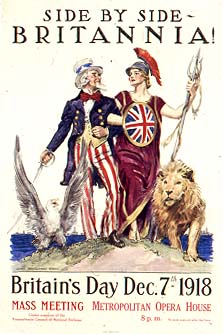
World War I propaganda poster depicting Britannia and Uncle Sam. Image via Wikipedia.

An anonymous Romney adviser has allegedly told the Daily Telegraph that Romney would improve relations with Britain because:

“We are part of an Anglo-Saxon heritage, and he feels that the special relationship is special,” the adviser said of Mr Romney, adding: “The White House didn’t fully appreciate the shared history we have”.

What a lot of people are talking about is the racial angle (pardon the pun) of this alleged quote.  One thing to keep in mind is that Obama is in fact partly English on the side of his mother, Ann Dunham.  (Dunham is an English name, for one thing.) But people are thinking this is a not-too-veiled racial attack.  I’d have to say I don’t what else the point of such quote could be, although it should be noted that the Romney campaign is saying this quote is inaccurate.  Well, if so, they should sue the Telegraph for libel.  If they don’t, it might seem like their guy actually said that, and they’re lying to cover it up.

What I really want to talk about, though, is this “special relationship” stuff.  I remember there was a big dust-up back in 2009 about the “special  relationship”, when Obama gave then-Prime Minister Gordon Brown a set of DVDs as a gift.  The Prime Minister had given him a pen-holder made from the HMS Gannet.  This upset a lot of people, but from what I can tell, Brown was treated like this by virtually everyone.  He had that anti-charismatic thing (a lot like Al Gore) that made people dislike him instinctively.  So I don’t think this means Obama doesn’t like Britain.

In practice, the “special relationship” seems to work like this: the British give us their culture–actors and actresses, authors, musicians–and we give them help whenever there’s a world war.  It’s not a bad system, all told.

Seriously, though: the “special relationship” seems to have been heavily emphasized by Winston Churchill, presumably for the purpose of convincing the U.S. to intervene in World War II.  And certainly, since America was founded people who had been British, there’s no doubt the two countries have a lot in common.  However, I don’t know that it is really that “special”.  Diplomatic relationships are usually forged and dismantled based on financial or military interests, not sentimentality.  If–Heaven forbid!–the United States’ relationship with Britain deteriorated, we would no doubt start saying “well, the whole country was founded because of a war with them, after all.”

That’s really the point: a lot of this is contrived stuff for people to argue about that ultimately doesn’t mean very much.  Example:  Romney says he’ll put a bust of Winston Churchill back in the Oval Office if elected.  Big deal.  I admire Churchill, but that really doesn’t matter very much in the scheme of things.  This is all a lot of pointless fighting over symbolism, as far as I’m concerned.