Ok, so the title may not be specific enough. Trump seems to have many problems.  But I’m not addressing his financial, social, physical, intellectual, moral or psychological problems.  Lots of people have run successful political campaigns despite having those. I’m talking about his strategic problem that’s hampering his quest for the Presidency.

Trump’s strategic problem is that he can’t adapt.  He is a one-trick pony who has used his trick to the limit of its potential and now does not know what to do on finding it no longer works.

In the primaries, Trump employed an aggressive, brash style to get attention for himself and to mock his competitors. It worked very well.  I won’t lie; I thought it was very entertaining to see him relentlessly mock the career politicians.  They had never seen anything like it, and were unprepared for it.

The problem is, people have now gotten tired of the insult-comedy routine. It was funny for a while, but eventually wears out its welcome.  Add to this that the general electorate is less receptive to such an aggressive style than Republican primary voters, and it becomes clear Trump needs a new strategy.

The standard political hack term for this is “pivoting to the general election”, which is a nice way of saying: “tell the primary voters one thing, then tell general election voters something else.”  Or lie, to put it simply.

Mitt Romney provided the textbook example of this in 2012.  He said all sorts of Conservative-sounding stuff in the Primaries, then took it all back and came out with new, more liberal policies in the General election. It all seemed strategically sound in theory, and I think most strategists would say it was very well done, except for the bit where Romney lost the election.

As you can perhaps tell, I do not like the “pivot to the general election” concept.  It seems to show contempt for voters.  It is effectively saying “Ha!  Those stupid voters will forget what we promised earlier this year, and believe the new, contradictory set of things we are promising now.”  I like candidates who seem a bit more principled.

Trump is definitely not pivoting, but he is also not standing on principle.  He is just continuing to fight and insult people.  And people are tired of it.  They want to see that he is capable of doing something else, at least once.

The funny thing is, his biggest error may also have been his greatest opportunity to do this–but he missed it.

After he started his absurd argument with the Khan family, Trump could have surprised everyone by apologizing to them profusely.  If he had done that, completely and unreservedly, people might have said “Wow!  Trump actually can admit when he’s wrong!” and it might have come out being a positive for him.

But Trump couldn’t do that. Whether because he has some personality disorder that prevents him from ever admitting he’s wrong or just because he thought “My ‘Always Attack/Never Apologize’ strategy got me this far, I won’t drop it now”, Trump failed to do the right thing because he can’t do anything other than attack people.

In general, I try not to use sports analogies when discussing politics, because sports are zero-sum games, and politics has more dimensions to it than that.  But in this case, there is a fairly apt analogy with American football.

Teams with great offenses that can “throw the ball all over the field” and score tons of points will go on record-setting streaks and look almost unbeatable playing teams with bad to mediocre pass defenses.  Then they finally have a game when the quarterback and/or receivers timing is off, or the opposing pass defense is giving them a hard time, and they have nothing else they can do.  They fall apart.

Trump is like that.  He won the primaries with an aggressive, angry style against weak opponents, but now that he is in a contest where people want to see empathy and humility, he can’t adjust and do it.

All right, so maybe I did end up analyzing his psychological problems a little, after all.  It’s kind of unavoidable.
Now then, as I was saying, charisma is what wins Presidential elections.  The first debate proved this point quite conclusively; as Mitt Romney won it in the opinion of almost everyone simply because he seemed more energetic than the President did.  Naturally, I was shocked that Obama did so poorly, but nonetheless the general principle that charisma wins elections was upheld.

Obama returned to form, though, in the second debate and I think won it despite Romney’s best efforts to weird him out by stealing his material.  Obama is more likeable than Romney in general; so I really cannot think what happened in the first debate.  I still believe that Obama will win because of his charm, and leave the awkward, sometimes nervous looking former Governor wondering what happened.

Of course, in the matter of what they proposed to do things were very different.  Mitt Romney threw almost all conservative ideas out, and simply mimicked Obama to a great extent.  He talked about how rich people  do not need help; the middle class does, and spoke fondly of the need for government regulations.  In the second debate, he came out in favor of affirmative action, albeit awkwardly.  In the upcoming foreign policy debate, he will probably quote Howard Zinn approvingly.

Romney won the first debate, but in so doing he essentially promised to be super moderate–to out-Obama Obama, as it were.  Maybe Romney will just say whatever he thinks is likely to be popular at any given moment.  Or maybe there is a conscious and deliberate plan whereby Romney talks like the consummate “centrist” and then governs like a supply-side Republican.  But either way, the Etch-A-Sketch strategy worked like a charm.

In a way, I think these debates have been the culmination of what I talked about in this post.  There are two Rockefeller Republicans in these debates; one of them simply happens to be a Democrat.  There are differences in their personal style, in their manner, and in degrees of Rockefeller Republicanism, but that is what they both are campaigning as.

Obama is (usually) more charismatic, and so he gets the advantage among swing voters.  Of the remaining votes, I assume that most will be cast based on party loyalty.  The Democrats will vote for Obama and hope he will adhere more closely to their platform, even though he will still face opposition in Congress.  The Republicans will vote Romney because they want Obama out, and will vote automatically for the GOP candidate whoever he happens to be.

It bears repeating that Romney is probably not actually a Rockefeller Republican; he just plays one on TV.  He played a much more socially conservative kind of Republican in the primaries, and then relied on the public’s short attention span to affect his metamorphosis.   Most likely, he is a George W. Bush Republican: almost all of his policies suggest that he supports the same tax cuts and military interventionism that the last Republican did.  But saying that won’t win him any allies.

I think that Obama, meanwhile, would like to be more liberal on government spending, raising taxes, and so on.  He probably wants to be an FDR Democrat on the economy, but the political terrain is such that he can’t find a way to do that.  For one thing, I think he is more interested in achieving bipartisanship than FDR was.

Ultimately, I think Obama wins this on personal appeal.  Romney, outside of one fluky debate, seems rather arrogant and condescending.  Even in the debate he “won”, he seemed arrogant with the way he talked over the moderator.

A new poll has come out showing that only 49% of Americans think President Obama is Christian.  17% think he’s Muslim.  James Rainey writes:

The lingering questions about Obama’s faith likely come from people of two mind-sets. One is those who have an intense dislike of the president and find confirmation of all their fears in a fever swamp of conspiracy websites. Where a birth certificate is not accepted as proof of someone’s place of birth, forget about verifying something as intangible as a statement of faith.

The second factor driving up Obama’s “Muslim number” is doubtless the urge of some respondents to stick it in the pollsters’ ear — to commit a small act of defiance by giving an answer the voter knows is untrue. When the interloper in the Oval Office is deeply loathed, why credit him with anything, least that he is a Christian?

Rainey focuses his attention largely on 17% who think he is Muslim.  Probably this is because it really is incredible that anyone could honestly believe he is a devout Muslim, as so many of his actions are inconsistent with that faith.

What I wonder about is the people who answered “don’t know” or “other” in the poll.  Is there also a conspiracy theory that Obama is secretly Buddhist?  Actually, most of the people I’ve talked to who doubt Obama on this suspect that he’s an atheist, not a Muslim.  Not sure why those people would answer “don’t know”, though.

As for the results on Romney’s religion, I was surprised how many didn’t know it.  It’s one of the most notable facts about an otherwise fairly dull politician.

Romney may have gotten one good line in, but as I mentioned, his answer to NBC’s Brian Williams’ question on gun control was awful.  The only place I was able to find a full transcript was a Conservative website, but here it is:

Williams: As governor you signed an assault weapons ban in Massachusetts. And you said at the time, quote, ‘These guns are not made for recreation or self-defense. They are instruments of destruction with the sole purpose of hunting down and killing people.’ Do you still believe that?

Romney: Well, I actually signed a piece of legislation, as you described, that banned assault weapons in our state. It was a continuation of prior legislation. And it was backed both by the Second Amendment advocates like myself, and those that wanted to restrict gun rights, because it was a compromise. Both sides got some things improved in the laws as they existed. And I happen to think that with regards to the Aurora, Colorado disaster, we’re wise to continue the time of memorial and think of comforting the people affected. And political implications, legal implications are something which will be sorted out down the road. But I don’t happen to believe America needs new gun laws. A lot of what this young man did was clearly against the law. But the fact that it was against the law did not prevent it from happening.

Let’s break this down bit by evasive, mealy-mouthed bit, with my comments in red.

  1. “I actually signed a piece of legislation, as you described, that banned assault weapons in our state. It was a continuation of prior legislation.”  [He is basically trying to say: “it’s not my fault, it was like that when I got there.”]
  2. “And it was backed both by the Second Amendment advocates like myself, and those that wanted to restrict gun rights, because it was a compromise. Both sides got some things improved in the laws as they existed.” [It was an assault weapons ban–that means it restricted guns, period.  Don’t try to retcon everything so that you were more radically conservative.  He’s trying to appeal to the hardcore NRA members by lying to them, and what’s worse is that it’s not even a very good lie, as it makes him look like an incompetent governor.]
  3. “And I happen to think that with regards to the Aurora, Colorado disaster, we’re wise to continue the time of memorial and think of comforting the people affected. And political implications, legal implications are something which will be sorted out down the road.” [I said something similar on the day of the atrocity; I thought we should wait until more facts were known before talking about what to do to prevent it.  But now, more facts are known.  Romney is trying to dodge the question so that he doesn’t have to alienate any voters.]
  4. “But I don’t happen to believe America needs new gun laws.” [What happened to what you said in the previous sentence?  Do you want to talk about the political angle or not?  If America doesn’t need new gun laws, then tell us: what does it need?  Surely something can be done to prevent this kind of tragedy.]
  5. ” A lot of what this young man did was clearly against the law. But the fact that it was against the law did not prevent it from happening.”  [What? Yes, everyone knows mass murder is illegal, and yet it still occurs.  That’s true.  But the point is, you can make it harder for the crime to be committed.  What Romney said is a trivial generality; an attempt to dodge the question again.  And it succeeded, because Williams then moved on to another topic.] 

Stop the presses!

I know you’ll think I’m crazy, but I saw it with my own two eyes, I did!  He was being interviewed by Brian Williams of NBC, who said something like “an anonymous Romney staffer said you were planning to pick a boring white guy for VP”.  And Romney chuckled and said something like “you told me you weren’t interested.”  UPDATE: The verbatim quote from Romney was: “You told me you were not available”.  Same thing, really.

Now, it’s true that minutes earlier, Williams asked him something about a gun control law he passed as governor, and Romney answered with a barrage of weasel words and non-answers the likes of which I’ve seldom seen.  And even more pathetically, Williams totally let it go without follow-up questions.  But still, you have to give Romney credit: he made a joke that wasn’t awkward or forced, which is pretty rare for him.  And after all, “likeability” is what wins elections!

Really, it happened!  I tried to get the clip, or at least a transcript for you  at NBC’s website, but I can’t get the clip to embed, or even play correctly on my computer.  It might be here.  Or that might be an interview with Kathy Griffin.  For some reason, I was having a heck of a lot of trouble with navigating their site.

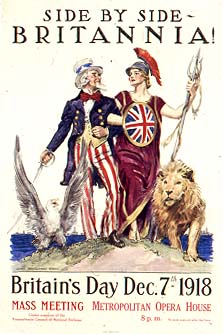
World War I propaganda poster depicting Britannia and Uncle Sam. Image via Wikipedia.

An anonymous Romney adviser has allegedly told the Daily Telegraph that Romney would improve relations with Britain because:

“We are part of an Anglo-Saxon heritage, and he feels that the special relationship is special,” the adviser said of Mr Romney, adding: “The White House didn’t fully appreciate the shared history we have”.

What a lot of people are talking about is the racial angle (pardon the pun) of this alleged quote.  One thing to keep in mind is that Obama is in fact partly English on the side of his mother, Ann Dunham.  (Dunham is an English name, for one thing.) But people are thinking this is a not-too-veiled racial attack.  I’d have to say I don’t what else the point of such quote could be, although it should be noted that the Romney campaign is saying this quote is inaccurate.  Well, if so, they should sue the Telegraph for libel.  If they don’t, it might seem like their guy actually said that, and they’re lying to cover it up.

What I really want to talk about, though, is this “special relationship” stuff.  I remember there was a big dust-up back in 2009 about the “special  relationship”, when Obama gave then-Prime Minister Gordon Brown a set of DVDs as a gift.  The Prime Minister had given him a pen-holder made from the HMS Gannet.  This upset a lot of people, but from what I can tell, Brown was treated like this by virtually everyone.  He had that anti-charismatic thing (a lot like Al Gore) that made people dislike him instinctively.  So I don’t think this means Obama doesn’t like Britain.

In practice, the “special relationship” seems to work like this: the British give us their culture–actors and actresses, authors, musicians–and we give them help whenever there’s a world war.  It’s not a bad system, all told.

Seriously, though: the “special relationship” seems to have been heavily emphasized by Winston Churchill, presumably for the purpose of convincing the U.S. to intervene in World War II.  And certainly, since America was founded people who had been British, there’s no doubt the two countries have a lot in common.  However, I don’t know that it is really that “special”.  Diplomatic relationships are usually forged and dismantled based on financial or military interests, not sentimentality.  If–Heaven forbid!–the United States’ relationship with Britain deteriorated, we would no doubt start saying “well, the whole country was founded because of a war with them, after all.”

That’s really the point: a lot of this is contrived stuff for people to argue about that ultimately doesn’t mean very much.  Example:  Romney says he’ll put a bust of Winston Churchill back in the Oval Office if elected.  Big deal.  I admire Churchill, but that really doesn’t matter very much in the scheme of things.  This is all a lot of pointless fighting over symbolism, as far as I’m concerned.

Her dress reminds me of Queen Amidala's in "Star Wars".
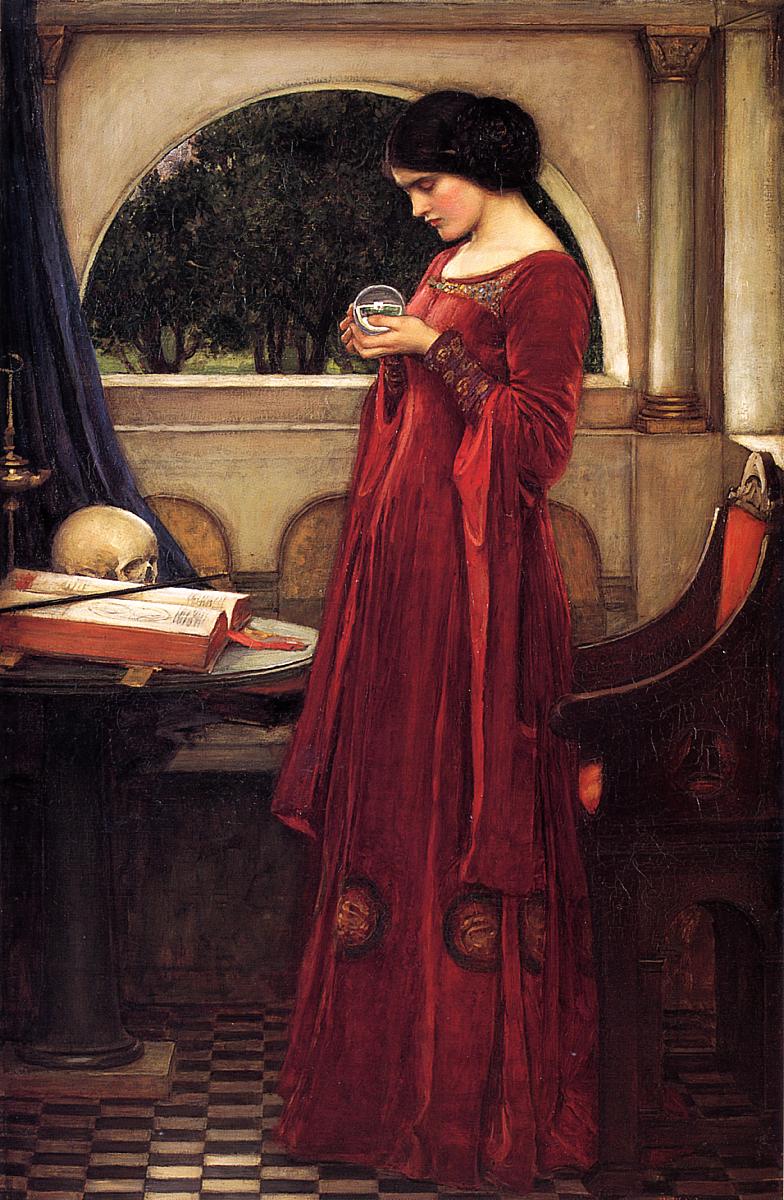
“The Crystal Ball” by John William Waterhouse. Via Wikipedia

About four years ago, the conservative site Townhall had a poll you could vote in for who you thought McCain would pick for Vice President.  Well, much like Ross Scott’s Gordon Freeman, if I see buttons I just have to push them, so I voted in the poll.  I picked somebody named Sarah Palin, who I had never even heard of, but I figured “McCain will pick a woman, but not the obvious one that everyone is bandying about, Kay Bailey Hutcheson.”

So, today, I saw that they’re conducting a similar poll for Romney.  For this one, though, they want your email address, no doubt so that they can send you ads, so I’m not going to actually vote.  Also, there are no buttons to push.  Where’s the fun in that?  Anyway, though, I scanned the list and let me officially go on record as picking Governor Susana Martinez.  Once again, I don’t know who she is.  But she is a woman, and she has a Hispanic surname, and Romney needs help with both demographics.

You know that “charisma” stuff I go on about all the time on here?  The quality that is more important than any other to winning elections?

Romney doesn’t have it.

I know, that’s not news.  But it never ceases to amaze me how singularly lacking he is in this quality.

I was listening to a snippet of some speech of his on the radio.  It bored me.  That’s a bad sign for him; if he were a half-way charismatic fellow, he’d have had me outraged.  All the charismatic people on the Republican side can make do that.  But Romney is just dull.

You don’t even have to consider the content of their speeches–and Heaven knows, too many voters probably don’t–to see the difference.  Obama sounds passionate and fired up when he speaks, whereas Romney’s voice sort of cracks whenever he tries to raise his voice to a powerful crescendo.

Sure, tons of people will vote for Romney because they hate Obama.  People are either going to vote for Obama or against him, but nobody is going to vote for Mitt Romney.  He is just hoping that enough people will hate the incumbent to vote him in.  That was the strategy for the last uncharismatic guy from Massachusetts, too.

And now there are rumors that his campaign plans to “avoid John McCain’s mistake”–to wit, make a dull pick, without any charisma, the opposite of Sarah Palin.  This is also a terrible idea, though speaking as one who hopes Romney does not get elected, it pleases me greatly.

I suspect that, in the end, Palin helped McCain’s 2008 campaign.  Yes, you read that right.  It is true that she made a fool of herself in her interviews, but what of that?   The Republican base does not believe anything in the mainstream press, and consequently explained that away as “media bias”.

You say: “but she alienated the moderates”.  No, she didn’t.  The moderates were already alienated, because they were going to vote for Obama no matter what.  No one except a die-hard Republican was going to vote for John McCain, and even they didn’t like him much.  Palin served to energize the only group which would even consider voting for John McCain.  From a purely strategic point of view, she was a good pick.  A rotten candidate, but a good pick.  Curious how that can happen.

Anyway, if the Romney people do decide to double down on dullness, I think it will signify that the people running his campaign are basically counting on a massive economic disaster to make Obama unpopular.  And I suppose that could happen.  Kind of sad, though, if your entire campaign depends on something like that.

Newt Gingrich has written an article in NewsMax about what he calls “NOT Obama Democrats”. (I am not sure why the “not” is capitalized.):

The first big signal was the 41 percent of the vote Keith Judd won in the West Virginia Democratic primary. Here was a convicted felon sitting in a Texas federal prison with a 17 1/2-year sentence for extortion. When West Virginia Democrats prefer a convicted felon to the president, they are showing they are “NOT Obama Democrats.”

This week the depth of the NOT Obama Democrats was further revealed when John Wolfe got 41 percent of the vote in the Arkansas primary. Wolfe, an attorney whose platform includes repealing Obamacare, actually won 36 counties against Obama’s 39 counties.

The same day, “uncommitted” got 42 percent in Kentucky and actually carried a majority of the counties (66 counties to 54 Obama counties).

This 42 percent is the same percentage Eugene McCarthy got against President Lyndon Johnson in New Hampshire in 1968, and at that time it was considered an earthquake to have that many Democrats repudiate their own president.

Putting that History degree to use, eh? It might be worth mentioning that McCarthy was an actual guy, and therefore somewhat more capable of sustaining his support than “uncommitted”. Obama presumably intends to continue to argue for himself, and no other Democrat is going to argue for him or her self.

I mock Gingrich, but the truth is he’s on to something here; it is an interesting development. He writes: “If the campaign continues in this direction, we may discover that the NOT Obama Democrats will evolve into Romney Democrats by Election Day.”

Doubtful. Romney is unlikely to appeal to these rural voters much more than Obama does. Yes, yes, I know my fellow Liberals are thinking it’s all motivated by “racism!”, but the fact of the matter is that Romney seems like a rich corporate elitist to these voters.I don’t think they’ll like him any more than they do Obama.

Jennifer Rubin looked at these same facts and concluded: “The reason for this, as you might imagine, is that in burnishing his credentials with the left, Obama has hurt himself in the center, even within the Democratic Party.” Yes, of course, the legendary “center”! How could I forget? She next quotes Josh Kraushaar, who gets it even more wrong:

Moderate Democratic groups and officials, meanwhile, privately fret about the party’s leftward drift and the Obama campaign’s embrace of an aggressively populist message. They’re disappointed that the administration didn’t take the lead advancing the Simpson-Bowles deficit-reduction proposal, they wish the administration’s focus was on growth over fairness, and they are frustrated with the persistent congressional gridlock. Third Way, the centrist Democratic think tank, has been generating analyses underscoring the need for Democrats to appeal to middle-of-the-road voters, to no avail. . . .

Yeah, I’m sure the farmers and rural folks in West Virginia and Arkansas are really torqued off that he didn’t do the Simpson-Bowles plan. Rural people hate populism, isn’t that so?

But, to her credit, Rubin does also make one useful observation in that same post. That is that “Romney is the least conservative candidate the GOP had to choose from.”

Is this true? Well, it’s hard to say, what with the flip-flopping and all. But he is certainly not as bombastic and bellicose as Newt Gingrich. And he was Governor of Massachusetts, a very liberal state, which demonstrates he possesses some ability to compromise; something Gingrich would never do.

Was he more liberal than Ron Paul? Difficult question. Ron Paul is extremely liberal on some issues–drugs, for example–but in step with the most reactionary of conservatives on others. It is almost an “apples to oranges” comparison, but I think on the whole, it is fair to say Romney is at least more “mainstream” and “safer” than Paul, whose supporters are often of a more radical bent, whatever their political leanings.

Romney was more liberal than Bachmann, but more conservative than Huntsman. But Huntsman barely even counts, because everyone, including him, knew he didn’t have a chance. So, that leaves only one other candidate for Romney’s “liberal Republican” credentials to be compared with: Santorum. This should be easy enough to prove. We all know Santorum was the conservative wing’s alternative to Romney. Surely, this fact alone proves Romney to be the most liberal of the possible nominees?

As a Congressman, Santorum, economically speaking, could pass for a caricature Democrat. He was for all sorts of government spending programs. As conservatives and liberals alike will attest, he may have been very conservative socially, but his fiscal behavior was entirely that of a Big-Government man.

I have often thought that Santorum would have been quite happy as a Democrat in the 1930s, ’40s or ’50s. He would have had massive government spending programs going, and social issues being more or less unacknowledged. He is, in other words, a Conservative Democrat from the pre-sexual revolution era.

So, Mitt Romney is more liberal on social issues than Santorum–not a difficult task–but more conservative on economic issues. Romney is far more likely to cut spending than Santorum was. So, which guy is more liberal? Well, that’s hard to say, isn’t it?

And we come round to where we started: what is the deal with all these Democrats not voting for the President from their own party? I suspect a lot of them are like Santorum; they want government spending programs, but don’t like Democratic policies on social issues.

It’s making me uneasy how much “social issues”–lousy term, by the way–keep coming up in this campaign. I had hoped that would stop after Santorum got out, but it hasn’t.

In my opinion, this is exactly the formula for an economic disaster: voters so busy worrying about this stuff that they forget the major economic problems the country’s facing. Even if we finally do recover from the recession, as we appear to be, it will be only to revert to the major economic problem of summer, 2008: high gas prices and stagflation. While I feel they are important, I nonetheless believe that a problem like a major stagflation epidemic dwarfs issues like government-subsidized birth control or whether gays can marry.

Although at least those actually are issues. What’s worst of all is how much attention is devoted to what Mitt Romney did 45 years ago in high-school, or what Obama had for breakfast as a kid in Indonesia.