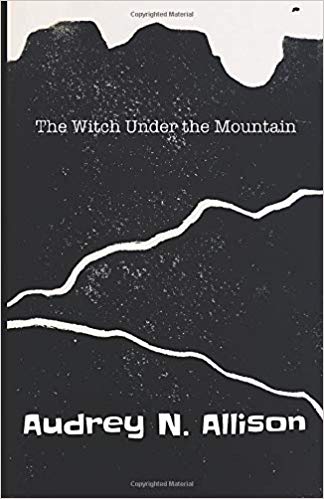
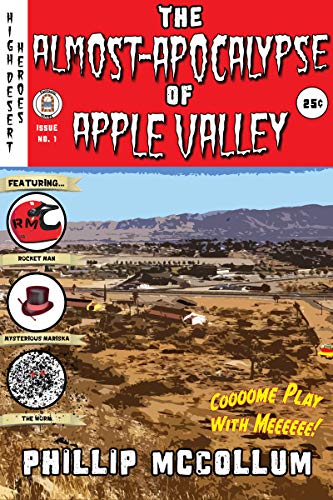
Testing the WatersThis story is a mystery; but not in the typical “whodunnit” genre; rather, it’s a mystery of what is happening in the little town of Port Athens. It’s a fishing town, and one of the fishermen, Eli P. Marin, has come back with a trident, which sets all the town on edge.

Soon, everyone in the town–all of whom have their own private interests, scandals, and skeletons in their closets, are gossiping about it. Eventually, Marin makes his announcement, and it is met with a grave response.

The writing is crisp, and I love the way the relationships between the townsfolk are portrayed. It’s even more fun once you figure you out what’s really going on. I’ll give you a hint: the characters’ names matter a great deal in this story, so pay attention to that. At first, I wondered why they all followed a certain pattern–and once I figured it out, I shook my head in amusement for not catching on sooner. It’s really neat.

Hmm, what else can I say about this story that won’t give it away? Not much, unfortunately. Maybe this: it made me think of Lovecraft’s The Shadow Over Innsmouth meets Gilbert and Sullivan’s Thespis. That’s actually a huge spoiler, but I’m gambling that it’s so obscure you’ll quickly realize it’s fastest to just read the book to figure out what I mean. And you should read this book, because it’s a quick, easy read that’s also a lot of fun.

Calmer GirlsThis is a Young Adult novel, which is not a genre I typically read. It’s probably unfair of me, but I have a stereotype in my mind of what a YA novel is, and generally speaking, they aren’t something that interests me. But this one was recommended by the great Carrie Rubin, and so I gave it a try. And I was pleasantly surprised, because whatever expectations I–rightly or wrongly–have of YA novels, this one easily surpassed them.

Part of it, perhaps, is that I have this idea in my mind of YA books being narrated in a snarky, sarcastic tone. There’s none of that in Calmer Girls–our protagonist, 16 year-old Samantha Cross, is sincere and good-hearted. All her emotions seem genuine, whether in her frequent feuds with her older sister Veronica, her love for the handsome Ben Swift, or her misery at her parents’ recent divorce and her mother’s worsening alcoholism.

A word about the divorce: one thing I liked about this book was its sensitive portrayal of how badly divorce affects the children of the split couple. The constant tension and psychological trauma it inflicts on both Samantha and Veronica is a powerful illustration of the painful consequences.

The main plot of the book is Samantha and Veronica vying for Ben’s affection. Veronica is a gregarious, extroverted young woman, used to attracting the attention of any boy she wants, and is distraught when Ben prefers her shy, younger, bookish sister.

But while he at first seems to be an ideal boyfriend, Ben is tormented by emotional scars left by his own parents. Ben and Samantha soon find themselves retreating into their love for one another, in a sweet–if decidedly not rational or mature–way, characteristic of young people leaving childhood behind, but not yet truly adults.

The prose is rich and evocative. The book reminded me of Mark Paxson’s The Irrepairable Past. That might seem like an unlikely comparison, since that novella is the story of an older man reflecting on his past, and Calmer Girls is the story of a young girl just starting out, but both books evoke a rich feeling of the melancholic beauty found in everyday life.

A running theme in the book is Samantha reading Brontë novels, and many of the chapters begin with quotes from Wuthering Heights and Jane Eyre. There’s also one scene in particular where Samantha draws a comparison to the former. I liked this a lot–it was a nice touch, without ever feeling forced or overused.

Perry did such a good job recreating what the world feels like to a teenager, it actually made me reflect back on my own teenage years. I suspect anyone reading the book will recognize a little of their own past in it. Personally, it made me think back with both nostalgia and regret to those long summer days when, having no actual responsibilities or obligations, I could nevertheless set myself to worrying obsessively about ephemeral things like whether my crushes even knew I existed. Ah, how the youthful brain makes trouble even where none exists!

The story is set in 1993, and is tinged throughout with period pop culture references, that only add to the book’s nostalgia value. Which brings to me to another point: the slang in this book is very different than what I’m used to. I’m not sure how much of this is the time period, and how much is the setting–Newfoundland, Canada–but either way, it was quite interesting. Samantha, Veronica, and their friends use a number of novel expressions which I had not seen before, which made the story that much more vibrant and authentic.

I ended up enjoying Calmer Girls far more than I expected. Don’t let any preconceived notions about YA fiction fool you–this is a fantastic read for anyone who enjoys solid literary fiction.

HarvestHarvest is a short story that packs a lot of content into few words. It tells the story of a man named Edgar, who, due to some very evil circumstances, has been given a pumpkin for a head–and that’s just the tip of the iceberg.

As Edgar is grappling with this horrible situation, a woman named Emelia and her pet approach, and she fills Edgar in on what has brought him to this state, and what can be done about it. Emelia, speaking in a pleasant, folksy twang, helps Edgar come to terms with his plight. I won’t spoil it–like I said, it’s very short, and providing more detail would give too much away. The fun of the story is in seeing how it works out, and discovering exactly what the characters are, how they came to be that way, and, most of all, what they will do next.

I absolutely adored this story. As you all know, I love scary stories, I love pumpkins, and I love the Halloween season generally. This wonderful tale captures everything that makes it special. It’s got just the perfect blend of scares, mischievousness, and fun that the holiday is all about. You can bet I’ll be re-reading it come October.

So, since it’s a seasonal tale, why am I blogging about it now, instead of waiting until autumn? Well, I happened to stumble across this author thanks to this poignant exchange with Lorinda J. Taylor* on Twitter, and frankly, this case illustrates why I think it’s especially important to support indie authors at this time, more than ever.

There are so many people all across the world who work to create art in their spare time, even after all the daily pressures life puts upon them. Even at the best of times, it’s not easy, and these are hardly the best of times. So when I find work that I like, I think it’s important that I share it. And of course, you can surely tell from the cover alone that this would be something I like. Directly upon seeing that lovely scene, I knew I had to read it, and I was not disappointed.

Harvest is a perfect short story for anyone who loves a good Halloween atmosphere. Some may prefer to read it in season, and that is surely when it will be best enjoyed–in a pumpkin patch, on a warm October’s evening, as the sun is sinking behind the trees, I should say–but true Halloween addicts such as myself can enjoy it all year round.

*For those keeping score, this is now two wonderful authors I’ve discovered thanks to Lorinda, the other being Lindy Moone. Thank you, Lorinda!

IPanama love weird westerns. Maybe this isn’t technically a western, given that Panama is at approximately the same longitude as West Virginia, but in every other respect, it fits the bill. It’s got cowboys, ghosts, witchcraft, and plenty of good old-fashioned gunfights.

Ethan Stafford and Cooper Hexum are U.S. marshals sent by President Theodore Roosevelt to investigate the disappearances of workers in the Panama Canal Zone. Ethan has a mysterious ability to see and communicate with ghosts, and Cooper–“Coop,” as he is called–is well-versed in all manner of magic and witchcraft. Roosevelt has reason to believe supernatural forces are at work, and he is soon proven right, as Ethan and Coop discover that, in addition to a plot by Spanish invaders, a demonic entity known as “El Chivato” is building up an army of his own using the souls of workers lured into the jungle.

Ethan and Coop are outfitted with considerable weaponry to fight these threats, as well as plenty of magical amulets and talismans that Coop acquires. One of my favorite early scenes was one in which Dr. Welker, who plays “Q” to Coop and Ethan’s collective 007, outfits them with all the weaponry they’ll need for their mission, including a Browning machine gun.

In the course of their mission, the pair meet a witch named Jinx, who has been captured by the Spanish, and Billy the Kid, hiding out under a different name, along with many other interesting characters. The tension builds as El Chivato’s powers grow, until our heroes confront him and his malevolent army in a final shootout, just as any good Western should conclude.

The prose is straightforward and blunt. It reminded me a bit of Hemingway, which is exactly the right style for this sort of novel. The story is well-paced and blends elements of adventure, horror, and occasional comic relief very well.

My only gripe about the book was the number of typos. Mostly minor things–missing apostrophes or glitches like “if” for “it,” etc. There were also a few formatting issues, such as character’s thoughts sometimes being unitalicized. It was nothing that ruined the book for me, but frequent enough that I noticed. To be clear, I’m very sympathetic about this, as I know from my own experience that it’s really, really hard to put out a whole novel and catch every typo. What’s great about ebooks is that it is easy to go back and correct them.

Technical issues aside, I loved the book’s atmosphere and the way Boyack balances a classic cowboy adventure, complete with likable heroes and a cruel villain, with occult demonic elements. And he ties it all together in a way that’s very satisfying. Panama is a very fun read for anyone who enjoys a good adventure story.

BBBinary Boy is a short story about a young boy named Devin, raised by two intelligent machines aboard a spaceship. All the rest of the ship’s crew, including Devin’s parents, have been killed by a virus sweeping the ship. Devin alone survived, thanks to his having been sealed away as part of his recovery from cancer.

The two machines that raise him, Ark and Rue, have vastly different personalities, but both in their way teach the young boy how to survive. He comes to view them as his parents, and to wish that he were an invincible machine, instead of a weak human.

Because of the largely disastrous outcome of the mission, Ark and Rue have opted to return the ship to earth—which Devin is dreading. When they finally near the planet, it becomes clear that Earth has fallen on… well, I’ll just say “hard times,” and leave it at that. To survive, Devin has to leave Ark and Rue behind and venture onto what is, to him, a threatening and alien world.

It’s a tight, well-written science fiction tale. All three major characters are efficiently described, and I really liked the contrast between Ark’s warm, soft personality and Rue’s pragmatic, engineering mindset.

If the book has a flaw, it’s that it ends too soon! I wanted to find out more about what Devin would do. And yes, this is book one of a series, but from reading the description of book two, I gather that it’s not a continuation of the same story. 

On the other hand, I sort of understand, because it would be challenging to continue the story given what happens to Devin in the last act. It’s full of intriguing possibilities that simultaneously beg to be explored but would be very difficult, if not downright impossible to write—at least, if it continued from Devin’s perspective.

This is a quick read that nevertheless manages to create an interesting world with strong characters. Fans of all types of sci-fi will certainly want to give it a read.

pantsIn my opinion, everyday life is one of the hardest things to write about. It is, by nature, something that is not exciting, so it takes a skilled writer to make people interested in reading about it. 

Jackson Banks is such a writer, and I Put Pants on for This? is a delightful collection of short episodes drawn from his various misadventures. By Mr. Banks’ own admission, not all of them are strictly factual—he acknowledges that he has embellished here and there, and made full use of “literary license.” But the stories feel real, because they mostly involve the sort of everyday mishaps, misunderstandings, and mix-ups that are extremely funny—when viewed with detachment, at least.

Indeed, if even a tenth of what Banks describes in here has some basis in fact, he is a man with a rare gift for being able to see the humor in the frustrating misfortunes that befall him, whether it’s endless airline delays and reroutes, camping trips gone awry, riding crowded public transportation, or one somewhat Walter Mitty-esque tale in which he convinces himself he and his wife are being kidnapped en route to a vacation resort.

Banks’ humor is light and good-natured, but like the best satire, there’s also a deeper theme which helps tie the vignettes together. What unifies most of the stories is the complexity of modern life, and many of the weird circumstances that result from it. Maybe it’s because I’ve been thinking about this lately for other reasons, but I felt Banks’ stories illustrate something that is becoming increasingly evident: the modern world is growing so interconnected and complicated that human brains almost can’t cope with it efficiently. That’s why airline travel results in lost luggage, mis-directed flights, and a general status of SNAFU—the systems are so complex they really can’t function.

The author punctuates these stories with attempts at escaping into a more simple life which inevitably go wrong—whether it’s a flooding campground, a grueling run through the desert, or an encounter with an off-kilter Kris Kringle character in Jackson, Wyoming. 

Throughout, Banks maintains a witty, engaging commentary. The real star of the book, though, is his wife. My favorite stories are the ones involving Mrs. Banks and her sarcastic commentaries on her husband’s decisions. 

Now, I do have one issue with this book, and that is that at one point he actually lumps Ohio in with New Jersey when listing terrible places to have to stay the night! Really, as a proud Buckeye, this is too much. Alongside New Jersey? Seriously?

I’m just kidding. We Ohioans can take a good-natured joke, and I Put Pants on for This? is full of them.

HyperlinkThis book

This book…

I mean to say, folks: this book!

Sorry, I’m having a bit of trouble getting started. Where exactly to begin is not obvious here. Normally I give a book’s genre, and then maybe an outline of the plot.

What genre is Hyperlink from Hell? I have no idea.

The story begins with a psychiatrist named Dr. Stapledon being given a manuscript to read, care of Dr. Albert Montclair, the former director of “The Haven”– the mental institution where she works. Montclair is now himself a patient, and the manuscript is by James “Jimmie” Canning, a now-missing former patient of Montclair’s.

Jimmie was a reality TV star with good looks, a photographic memory, and attention-deficit disorder. He is also believed to be the only patient ever to have escaped The Haven.

The only way of understanding what afflicts Dr. Montclair, he tells Dr. Stapledon, is to read Jimmie’s manuscript. “To get to me,” he tells her, “you must go through him.” Desperate to help her former mentor, Dr. Stapledon begins to read.

This book-within-the-book is indescribable. A surreal, impossible tale that begins with Jimmie’s apparent death at the hands of kidnappers, and his return to Earth as a ghostly presence, along with the kidnappers, with whom he embarks on a quest to reconcile with his ex-girlfriend, Jenny.

If that sounds weird, just wait. What follows is a madcap chase to track down Rick, the man who has stolen Jenny away from Jimmie. But that hardly does it justice. There are wacky dream sequences and mile-a-minute references to characters from famous old television shows (Referenced with amusing variations on the names: “Logan’s Heroes,” “Battleship Galaxtica,” “Milligan’s Island,” and so on.) 

Have you ever been sick with a fever, done nothing but sit around watching TV, and then fallen asleep? This is like the dreams you have when that happens. 

There are also tons of puns, sex humor, bathroom humor, and recurring conversations with “Al”—a godlike presence who toys with Jimmie and his friends while simultaneously aiding them on their quest. Oh, and there’s also an invisible, smelly dog named Louie.

Lowbrow, crude humor rarely amuses me. Jokes relating to bodily functions are usually just stupid, in my opinion. But it works for me here. It’s a mixture of crude and sophisticated comedy, similar to Monty Python. That makes it… ah, well I hate to say “palatable,” but you see what I mean.

This book is very funny. But I would not classify it as a comedy; not at all. Jimmie’s manuscript might be a comedy—a very dark, absurd, existential comedy—but remember, it’s just the book-within-the-book. Dr. Stapledon’s experience of what for lack of a better term I’ll call the “real world” is the other part of the story. And it’s not a comedy at all.

Don’t let the cover or the fact that it has tons of humor fool you: this book is not light. It goes from weird to unsettling to downright disturbing—all the more so because the darkest elements are referenced subtly at first, almost in passing, gradually setting up the conclusion when we finally learn what went down at The Haven.

I have trouble with stories that involve violence against women, children, or animals. All three are referenced in this book. Not too graphically, or for extended periods, mind you, but when these and other grim things enter the narrative, they hit you right in the gut.

Okay, so this has violence and crude humor and an incredibly confusing plot. Anything else that might alienate readers? Actually, yes: thematically, the book addresses religion frequently—it might even be the core of the story. I wouldn’t say it’s anti-religion. In fact, it might even be pro-religion, in the sense that it’s pro-faith. But nevertheless, the way the “God” figure is portrayed and certain religious motifs are used might be a turn-off to religious readers.

Oh, and of course there’s swearing. Did I even need to mention that?

Normally, this is where I say something like, “fans of [x] will like this.” I can’t say that here, because I honestly have no idea what other books to compare this to. Other reviews compare it to Terry Pratchett and Neil Gaiman, but having not read them, I don’t know how or in what way this book may be similar. The only remotely comparable book I’ve read is Richard Pastore’s The Devil and the Wolf. It was a hilarious fantasy with religious themes as well, but what makes Hyperlink different is the frenzied, sometimes almost physically exhausting pace of its weirdness.  

The closest analogue I could think of was not a book at all, but a video game: Spec Ops: The Line. I realize that sounds bizarre—how can I compare this humorous mystery novel to a military action game? Well, that’s just it: neither Spec Ops nor Hyperlink from Hell are really what they seem to be. Just as Spec Ops surprises the player by revealing that, far from being a standard military shoot-‘em-up, it’s a complex and layered examination of the psychological toll of violence, Hyperlink from Hell ultimately reveals itself to be not simply a madcap comic adventure, but a meditation on grief and coping and God and the nature of reality itself.

This book lives up to its billing as an “in(s)ane mystery” and then some. I’ve read parts of it multiple times, and there are still things that puzzle me. I discovered it thanks to Lorinda J. Taylor’s review, which I strongly suggest you read, because she does a better job analyzing certain elements than I did. 

I think everyone should buy this book and give it a try. I say that fully aware that some of you will hate it. I know I sometimes say, “This isn’t for everybody,” but that’s extra-true here. Some of you will be turned off by the crude humor. Some of you will just be like, “What the hell even is this? What does Gambrel see in this thing?” Some will make it all the way to the end and feel a bit angry, just as I did, that things didn’t resolve themselves in the way we would hope they would.

But the thing is, this book is an incredible achievement. I can’t imagine how someone could come up with and execute this idea so perfectly, and yet Moone did it. Creative people owe it to one another to be supportive, and for that reason alone, you should at least give it a try. If it seems too weird for you at first, you should probably stop, because it won’t get less weird. But if you get hooked on the ingenuity of the concept and the witty prose, as I was, you’ll feel like you’ve discovered a hidden treasure.

You know how so many forms of entertainment seem to suffer from severe copycat syndrome? That’s because the publishing industry, like many industries, tends to play it very conservative with what they decide to send to the market. Great work is rejected all the time because publishers can’t just ask Is this a good book? but instead have to ask Will it sell enough to make us a profit? And so they’re more likely to only publish books that are similar to other books that have made a profit before.

Indie publishing is changing this, but only to the extent we’re willing to reward people who take big creative risks, and Hyperlink from Hell is about as big of a creative risk as there is. The imagination and effort it must have taken to create this book is simply staggering to contemplate, and the fact that it only has eleven reviews on Amazon (all glowing, you’ll notice) is a tragedy. Yes, it’s a twisted and surreal roller-coaster that not everyone will want to take, and from which no one will emerge emotionally unscathed, but it’s also a literary masterpiece and a daring work of creative genius—yes, I said it—that deserves to be widely read and discussed.

Small PrintSmall Print is a collection of four sci-fi short stories, all premised around the ways in which advanced technology can disrupt the lives of organic life forms.

In “Data,” a skilled hacker’s curiosity gets the better of him, and he finds out more about his employer’s use of data than he would have liked. In “Juliet,” the subject of an experimental space exploration mission struggles to cope with the loneliness of space. In “Small Print,” a technician on a lunar base encounters a clerical error with severe consequences, and in “Shelley,” a young woman grapples with a mysterious trauma from her childhood.

All the stories are well-written and interesting. I liked “Juliet” the best—it ends with a surprise twist that makes an already powerful story even more poignant. “Shelley” was the weakest in my opinion—which is not to say that it was bad—but I just felt the ending was too abrupt, and the main character’s mother didn’t react to certain developments the way I would have expected her to, based on her earlier behavior.

“Data” was particularly hard-hitting, given how many big governments, corporations, and other large faceless entities have recently become fascinated by “big data,” it’s easy to imagine them abusing it just as they do in this story.

“Small Print” was probably the most complex and layered story in the collection. There’s a lot going on here, much of which I liked. I won’t spoil it, but space ghosts are a thing in this story, and you know that’s going to be a winner with me. However, there were other aspects that were a bit confusing—I had to read the story twice before I fully “got” it. Which isn’t necessarily a bad thing, but I felt like some more fleshing out would have made it better.

I think that’s true of every story in this collection, except maybe “Juliet,” which felt quite complete. They all are promising concepts, but left me wanting more. Which is a very good thing—it’s much better to have a good concept in need of more detail than a weak concept that you try to drag out. I look forward to reading more of Scobie’s work in the future.

Twisted Tales 2These stories are ideal for when you just want something quick and light. After reading some long, emotionally-charged novels, I find it’s a perfect change of pace to read one of Drayden’s weird tales. My mother told me once that in ancient Greek drama, after the heavy tragedies were over, they would close the evening out with a slapstick comedy.* That’s kind of what this is, and it works beautifully as a break after reading a serious novel.

If you read my review of Volume One in this series, all you need to know is that this is more of the same. If there’s a difference, it’s that the first volume was more sci-fi in tone, and this one is more fantasy/horror. But that’s the only difference–otherwise, these stories exhibit the same twisted sense of humor and the same bite-sized length.

Again, these stories are very short, so I won’t review them in-depth. Half the fun is realizing what the concept of the story is, as they each usually involve combining some mundane, familiar concept with something from the world of mythology or fantasy. The stylistic parallel to the comic strip The Far Side that I noted in my review of Volume One still holds.

If you read the Amazon reviews, you’ll notice some people complain about the brevity of these tales. This, in my opinion, just speaks to how tough the book market is. It may not seem like much to readers, but it takes a non-trivial amount of effort to come up with four funny stories, write them all down, proofread them, and get them published. The thing only costs 99 cents, for heaven’s sakes! 99 cents for a few good chuckles is a bargain, in my opinion.

With that said, you can get a set containing Volumes One through Six of this series, also for 99 cents, if you’re really serious about maximizing the quantity of stories you get for your money. Drayden’s stories are the perfect little treat for when you want to read something to tickle your imagination, but don’t want to commit to a whole novel.

(*My mom is a classicist. I didn’t want you thinking she was actually around in Ancient Greece. 🙂 )

I’ve let the indie book review page get out of date. The reason is largely that the format of it is so clunky. Even with the hyperlinked genre listing, it’s still awkward to navigate a long list like that. And so every time I think I should update that, my next thought is Ugh, but it’s such a chore to use; I should fix that first.

But… nothing springs to my mind as to exactly how I can make it better. What do you think? What would make that page more visually interesting than just a list you have to scroll through?