It occurs to me, gentle reader, that perhaps this series has a curious structure to it. The posts are getting longer and, hopefully, building upon each other. However, this structure might make it confusing to read. Maybe it’s better to read it in reverse order, with the posts hopefully cascading to tell a larger story. Like the verses in “I Have  A Song to Sing, O!”

Or maybe not. Anyway, our journey has now brought us to the 1995 007 flick, GoldenEye.

GoldenEye is, in my opinion, the best James Bond movie. Now, my opinion could be biased by the fact that it is the first James Bond movie I ever saw. But I don’t think so. Part of the reason is that Brosnan is not my favorite Bond; not even close, and yet I still enjoy this film the most.

The key thing with all James Bond films is that they are walking a fine line. You can’t take James Bond too seriously, because, well, the whole premise is basically ridiculous. The early Connery films established a somewhat over-the-top, tongue-in-cheek tone.

Unfortunately, the 1970s happened, and this tone got carried to a new extreme during the Roger Moore era, which saw Bond films that ranged from pseudo-blaxploitation to rip-offs of Star Wars.  And that was before we even got to Octopussy and A View to a Kill. <shudder>

The Timothy Dalton era wasn’t really even an era, consisting as it did of only two films: The Living Daylights, which still has some residual silliness inherited from the Roger Moore tradition, and the serious and gritty Licence to Kill, a clear forerunner of the darker tone of the Craig era.

It’s a shame Dalton didn’t sign up for one more turn as 007 in GoldenEye, because it’s the one that finally hit that proper medium. It isn’t outright camp like the Moore films, but it has enough awareness of its genre not to try and be some sort of grim, realistic thriller.

And we should expect nothing less! Because it was made in the ’90s, and the whole point of this exercise is that the ’90s were the halcyon days of action movies. GoldenEye isn’t a great film, and I would grade it as distinctly inferior to the preceding three films I’ve reviewed in this series, but there’s no doubt in my mind it is the best Bond film, and the best that’s likely to be made for some while.

There are even some moments of social commentary, incredible as it may seem. Like when Bond goes wandering amid a wasteland of Soviet relics to meet the leader of the Janus crime syndicate, with the implication being that Bond himself is another holdover from the Cold War. The film asks: with the U.S.S.R. gone, what is even the point of an operative like 007?

The whole movie is kind of a farewell to Cold War thrillers. Large portions of it are set in Russia, with Russian villains, and Russian super-weapons, and a brief discussion of the repatriation of the Cossacks in the aftermath of World War II. It’s a meditation, to the extent that any action movie can be called a “meditation,” on what all the tropes of the spy genre would look like in the unipolar moment.

Because what was a spy to do, at The End of History? For that matter, what were these huge, military-industrial complexes with vast arsenals of experimental weapons built up over decades to do? (The answer to both, GoldenEye suggests, is “fall into the hands of terrorists and madmen.”)

But that’s another story, for another decade. In the ’90s, it was still all just fun and games, and James Bond could be counted on to save the world with his sexy sidekicks and his cool gadgets, and even the blundering, bumbling American CIA could show up for a cameo at the end.

I can’t end this review without mentioning GoldenEye‘s most enduring legacy: the spin-off video game that proved to be one of the most influential of its era, and which remains legendary in gaming circles to this day.  Do they still do video game spin-offs of movies these days? I haven’t heard about any. Games based on movies have a reputation for being awful; and yet we see that it was done successfully at least once, in that strange, gauzily-remembered decade between the fall of the Berlin Wall and Y2K. It seems the knowledge once existed, though it has subsequently been lost. Like Greek Fire.

[Update: check out my friend Pat Prescott’s response to this post. His take on the movie is very different than mine, and while I stand by my opinion, I admit he makes some good points. But then, he’s a real Bond expert, having seen all the films many times. One thing I hope to encourage with this series is for people to post their own opinions on the films I discuss.]

There I was, thinking to myself, wouldn’t it be nice to read a cyberpunk book right about now? And then, thanks to a timely retweet from the incomparable Carrie Rubin, this book came to my attention. It was like it was meant to be.

The Copernicus Coercion is a cyber thriller about two hackers, Brock and Kathryn K, who quickly find themselves drawn into an intricate conspiracy. This book hits all the cyberpunk notes: we have hackers with embedded implants that provide continuous network access, shady back-alley surgeons providing illegal cybernetic augmentation, super-powerful artificial intelligences that become eerily human, a group of gray hat hackers operating out of an old church, and most importantly, sinister plots by shadowy elites.

Naturally, I ate it up. If you like cyberpunk stories, you’re probably going to like this. And despite the requisite tech-heavy aspects of the plot, Scobie was careful to make the characters strong, too. From the interaction between the two protagonists, to minor characters like the hacker-priest at the church or even an amateur carjacker, most of the characters in the book are interesting and memorable.

If I have any complaints about the book, it’s that the ending felt a bit rushed, and the character who functions as the final antagonist isn’t as well fleshed-out as the rest of the cast. It’s not a major problem, and generally, I’m of the opinion that if the journey is enjoyable, I can forgive a flawed ending. And The Copernicus Coercion is certainly an enjoyable journey.

In another serendipitous occurrence, I happened to be reading this book at the same time as I was reading Ray Kurzweil’s The Age of Spiritual Machines. The issues Kurzweil examines in that work of ’90s futurism are explored in an entertaining way in this novel, so it makes a perfect complement. If you want a fun story that also poses some interesting questions about humanity’s relationship to technology, pick this one up.

[Audio version of this post available below.]

Although this series is yet young, this may be the most important movie I’m going to analyze. Why? Because in addition to being an action movie, it’s about action movies. It is a meta-commentary on action movies.

It’s also a departure from Terminator 2 and Jurassic Park in that it was not a box office success. In fact, part of the reason it was not a success was because it came out right after Jurassic Park. Which, as we have established, is a great movie, so I can’t even indulge my snobbish side by complaining the masses have no taste. It’s just a bit of bad luck, that’s all.

Last Action Hero is about a young boy named Danny Madigan who loves the movies. In particularly, the Jack Slater series, about a tough cop played by Arnold Schwarzenegger. The film begins with Danny watching the climactic battle with the villain The Ripper at the end of Jack Slater III. 

Let me pause here to tell you: I was that kid. I loved Schwarzenegger movies when I was 10, MPAA ratings be damned. (My mom was thrilled about that, let me tell you…) So, I can identify with Danny, and when the projectionist at his local theater gives him a ticket for an advance screening of Jack Slater IV, he reacts the same way I would have as a ten-year-old.

But the ticket is a magical device, and transports Danny into the world of Jack Slater, where everything operates according to action movie logic: cars explode from a single bullet hit, a main character can suffer grievous physical trauma and walk away with only a scratch, all the female characters wear skimpy outfits, and Slater casually fires a round into his closet every time he enters his apartment, knowing without checking that there will be a bad guy lying in wait to ambush him.

And then, of course, there are all the Easter eggs, like when Danny and Slater enter a video store (remember those?)  and see an ad for Terminator 2: Judgment Day, starring… Sylvester Stallone. Slater’s assessment: “It’s his best performance ever.”

Eventually, when confronting the main villain, Benedict, the ticket sends Slater and Danny back into the real world, along with Benedict. Here, Slater is baffled by the rules of this strange reality. “Something’s wrong with my gun,” he mutters when it fails to blow up a car.

Benedict, however, is right at home in the real world:

Think of villains, Jack. You want Dracula? Dra-cool-la? Hang on, I’ll fetch him. Dracula? Ha! I can get King Kong! We’ll have a nightmare with Freddy Krueger, have a surprise party for Adolf Hitler! Hannibal Lecter can do the catering, and then we’ll have a christening for Rosemary’s Baby! All I have to do is snap my fingers and they’ll be here. They’re lining up to get here, and do you know why, Jack? Should I tell you why, hmm? Because here, in this world, the bad guys can win!

Benedict, you see, has been busy exploring the gritty underbelly of New York, and has learned that drugs, prostitution, and murder run rampant on the streets, with no larger-than-life heroes swooping in to save the day.

Slater does ultimately defeat Benedict, but in the process sustains wounds. Real, mortal wounds, not the fake kind he is used to getting in the movie-world.

The only way to save him, of course, is to send him back to the world of Jack Slater IV, where his fatal stomach wound just needs a quick bandage. And then, with a fourth wall breaking wink to Danny, Jack Slater rides off into the sunset.

The film is packed with references, in-jokes, parodies and meta-humor. But most of all, it’s a love letter to the movies. A love letter full of good-hearted teasing about all the ways in which action movies are silly, of course, but at its heart Last Action Hero is about why we love these movies. Because the real world is full of ugliness, and it’s pleasant to visit a world that’s not ugly and nasty, but instead ruled by hope and heroism. Yes, it’s “escapism,” and yes, it may be true that if people focused on translating the virtues of their cinematic heroes into actual, real-world actions, it might not be a place that we so urgently wished to escape.

But stories are the seeds that eventually bear fruit in deeds, and that is why heroic stories are important. Last Action Hero confesses openly that there is something silly and juvenile about the whole concept, but it doesn’t do it out of malice or with contempt. Ultimately, despite poking fun at many action movie tropes, it’s a defense of the genre.

Because the world needs heroes, just as Danny Madigan needed Jack Slater. And that fact is the central emotional core of Last Action Hero.

This is a sequel to He Needed Killing, which I reviewed here. If you enjoyed that book, you’ll like this one, too, because it’s more of the same. Once again, retired university IT professional James Crawford is hired by the provost to investigate a murder on campus.

And like He Needed Killing, the charm of the book is less about the mystery than the atmosphere and the characters. Crawford’s life in a southern college town is portrayed as pleasant, slow-paced, and filled with food and football on a regular basis. Sure, there’s a murder to be solved, but that doesn’t stop Crawford from taking time to enjoy the good things in life. Like another southern detective, he “strolls leisurely” on his way to the truth.

And it’s an enjoyable stroll, because the descriptions of campus life are so well-written and the characters so likable. (Except, of course, for the ones who really do “need killing.”)

Crawford is a great protagonist, and his style of investigation is perhaps best captured by these lines, which he says while musing out loud to his cat:

“They were figuring out all the orbits of the solar system–how the orbits of the planets and moons were impacted by gravity, but the model kept predicting the wrong orbits. The only way they could get the model to work was if there was another planet the size of Neptune where Neptune had to be. So they looked and–by damn–there was Neptune. Don’t you think that’s cool?”

Crawford makes sense of things by thinking out loud while puttering around his house. It’s not flashy like Sherlock Holmes, which leads a lot of people to underestimate his detective skills. Much to their detriment, as it turns out…

But, in all honesty, I didn’t read this book for the mystery. In fact, I figured out who the killer was pretty early on. But that did not detract from my enjoyment one bit, because what’s really fun about it is the style, the pace, and the setting.

[Audio version of this post available below.]

Jurassic Park is a movie that is so much better than it had to be. It would have been so easy to make it just an empty spectacle of a film, drawing audiences in with CGI dinosaurs and nothing else.
Make no mistake, the CGI dinosaurs are amazing. Even all these decades later, they still hold up pretty well, I think. Part of what makes it work so well is the way they’re cleverly teased out. We see what they are capable of at the beginning, but without actually seeing the dinosaurs. This creates a wonderful sense of tension and suspense.

Then we get more foreshadowing, very skillfully done, when we meet Dr. Alan Grant at a dig in Montana, where he explains to a dismissive kid just how velociraptors hunt their prey. This scene is such an economical bit of screenwriting. It communicates both something about the raptors, the primary antagonists of the film, and tells us something about Dr. Grant; namely, his disdain for children, which is a key point of disagreement in his relationship with Dr. Ellie Sattler.

And already, we see what distinguishes this film: the characters feel real. There is real love between Dr. Grant and Dr. Sattler, real affection from Hammond for his grandchildren, and real respect from Muldoon for the lethal animals he is in charge of managing.

I love Muldoon’s character. The way he murmurs “they remember,” with a mixture of fear and awe when describing the raptors’ systematic escape attempts, or his calmly delivered last words, “Clever girl.” The way he conveys that, even though he’s about to be brutally killed, he admires the sheer intelligence of the beasts.

What does it tell you that I’ve been talking about how great the characters and performances in this movie are, and I haven’t even mentioned Jeff Goldblum’s or Samuel L. Jackson’s characters yet? Like I said, everyone is great. Goldblum’s cynical mathematician has plenty of good lines, the best of which is probably “Your scientists were so preoccupied with whether or not they could, they didn’t stop to think if they should.”

Which brings me to the thematic meat of Jurassic Park. It’s your basic Frankenstein story: humanity’s attempts to play God backfire, unleashing monsters we cannot control. Actually, in a way, it’s the same theme as the previous movie I discussed in this series. But while I like the first two Terminator films, I definitely prefer Jurassic Park to both. And I think it’s largely due to the relationships between the characters. They are just so well fleshed-out, and the actors can communicate so much without even saying a word. Look at the final scene, when the survivors are flying away from the island. You know what every character is thinking just from their expressions.

This is the essential thing about Jurassic Park: it’s a monster movie with a fundamentally sweet core. The ending feels hopeful, even despite all the horror. And I don’t just mean for the human characters, either. There’s a real note of triumph in the T-Rex’s last scene in the film, as it bellows exultantly amid the wreckage of the visitors’ center. The greatest of the old beasts, literally “the king tyrant lizard,” has returned to rule, and I think every audience member cheers right along with it.

Such an upbeat time were the ’90s that even the monsters got approval from the audience! Jurassic Park is more than just a monster movie, it’s also wish-fulfillment for every kid who ever wanted to see a dinosaur for real. Yes, they are terrifying, but they are also, in the very truest sense of the word, awesome. In that moment, we are all Muldoon, feeling simultaneously the fear and the respect that these mighty creatures deserved to command.

And that is Jurassic Park‘s subtle genius: it treats dinosaurs not as mere villains for the sake of jump scares, but as if they truly were real, living, breathing creatures; great and terrible apex predators that once held dominion over the earth as surely as humans do today.

If you’ve followed this blog for a while, you’ve probably already heard me sing the praises of Litka’s books many times. In fact, there are a few people who, I’m delighted to say, I’ve introduced to his work and who have also become serious fans. (Litka-heads, maybe? We’re still working on what to call ourselves.)

Yet, Litka’s work is not as well-known as it should be. Sailing to Redoubt may indeed be his greatest work, although I suppose I always feel that way after reading any of his books.

Litka books have a way of transporting you instantly into another world. They are at once fantastic and simultaneously cozy. There is rarely anyone truly “evil” in a Litka book; the conflict tends to arise from misunderstandings or differing priorities than from people who are just out to be mindlessly bad.

In that regard, Litka reminds me of P.G. Wodehouse. Now, you might not instantly see the parallels with Wodehouse’s world of upper-class Edwardian silliness with Litka’s tales of sci-fi and fantasy adventure, and indeed, no one will ever get confused as to whether they are reading Litka or Wodehouse.

But, all the same… there’s a little of Bertie Wooster in our hero, Lt. Taef Lang, and the way he just can’t seem to say no to the sisters, Lessie and Sella Raah, who lead him from one madcap adventure to the next. Lessie, with her cold aloofness, calls to mind PGW’s Florence Craye, while the playful and flirtatious Sella is more like Stephanie “Stiffy” Byng. While Lt. Lang gets dragged into matters considerably more complex than, say, stealing a cow creamer, the principle is the same: a good-natured young man who repeatedly finds himself in the middle of all kinds of strange adventures.

That said, Lang, while he can be a bit reckless and at times foolish, can definitely hold his own. He’s a naval officer, after all, and has a thorough understanding of the history and geography of local islands as well as a taste for adventure acquired from reading adventure novels as a boy. All in all, he’s a man to be reckoned with, though he wears his knowledge lightly and falls easily into the role of a personal assistant to the two sisters.

And speaking of the “local islands”: as always, I’m in awe of Litka’s ability to craft an entire world with scant description. Seemingly effortlessly, he builds a setting complete with geography, climate, multiple cultures, languages, political history, and even its own series of adventure novels. Before I even knew what was happening, I was completely immersed.

There are a few typos here and there, but nothing that detracted from the story. Also, you should know this book is part of a series, and ends with many things to be resolved in the second book.

You may think, “aww, that’s just a ploy to sell books!” Except… both this book and the sequel are free. Yes, free. You can get this wonderful nautical adventure and its sequel without spending anything.

So what are you waiting for? Why are you still hanging around here? Be off with you, and go read Sailing to Redoubt!

[Audio version of this post available below.]

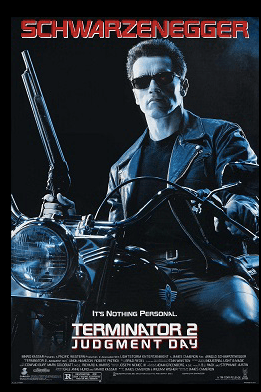
If this movie had been made a decade or two later, it would have inspired a fan backlash.

Do you doubt me? This is the film that transforms Sarah Connor from the ordinary young waitress of the original movie into a hardboiled commando, athletic and capable of handling firearms with ease. You can’t tell me that people wouldn’t complain about the change. As if that weren’t enough, now the T-800 is a good guy, fighting to protect the young John Connor. “But how did that even work?” the Comic Book Guys of the world may ask. “How does it fit with the established lore?”

But T2‘s biggest crime against the franchise is the subversion of The Terminator‘s original theme. The first film is fatalistic, with the coming nuclear war caused by Skynet understood as an inevitable outcome.

T2 says otherwise; that “there is no fate but what we make for ourselves.” It totally undercuts the original’s theme. Not to mention opening a whole new can of worms about multiple timelines, in addition to the paradoxes that are implicit in every time travel story.

All these are valid criticisms. But it doesn’t change the fact that Terminator 2 is still a really great action movie. Yes, it replaces The Terminator‘s grittiness with some pretty over-the-top and cartoonish action sequences, most notably the use of an M134 minigun as a precision non-lethal weapon to avoid casualties. Just… no. Or rather, only in the movies. Though I am come to sing T2‘s praises, I’m not going to sit here and tell you it’s believable.

But look: this was the ’90s, and the ’90s were pretty optimistic. The Cold War was over! It had been won not with guns and bombs, but with blue jeans! It was The End of History!

This might sound silly nowadays, and yet, I think, it was the attitude that made ’90s pop culture so damn infectious. Terminator 2 is lighter than both The Terminator and Terminator 3. And that, I submit, is because it was made after the renewed US-Soviet tensions of the ’80s and before the post-9/11 2000s. It captures the mood of the era, by willing to be a fun Arnold Schwarzenegger movie where the killer robot says things like “Hasta la vista, baby.”

Is The Terminator a “better” movie? I dunno, depends what you mean by “better.” In some ways, sure. But in terms of being a fun action movie that you can just enjoy and walk out of feeling like the good guys won and the bad guys lost, Terminator 2 is better.

This is why I contend that Terminator 2 is the perfect movie to encapsulate what I mean when I speak of ’90s action movies. It kicked off a style of film that would rule the decade. And moreover, it was the last decade that films like Terminator 2 could rule, exactly because fandoms had not yet organized to talk about them.

All the films I’m going to talk about in this series could not be made now, for one reason or another. And that’s partially why I want to write about them, because (you may laugh) I think these films say something about their time, and, perhaps, by way of reflection, our time as well.

But that’s only secondary. The main reason is that ’90s action movies are freaking fun, and that’s why I like watching them. James Cameron, for all his faults, sure knows how to make a good action picture. Even when he goes and makes something that’s nothing but a rip-off of Ferngully meets Dances With Wolves, the action sequences are still good. And here was Cameron at his peak, making a film with one high-speed action scene after another. I think the canal chase is my favorite part. You’ve got to love the way Arnold flips that shotgun around.

That said, let’s not forget the prelude to that sequence, when the T-1000 and the T-800 hunt John Connor through the mall. Watching it now, of course, I’m highly nostalgic. Malls are a feature of the ’90s that has since been devoured by the internet. In reality, it turned out that “Skynet” needed no nuclear missiles to take over the world; it just needed a ton of server space.

Sorry; I’m getting philosophical again. I do that sometimes when I write about movies. You’re still here, so maybe you like it, or at least are willing to tolerate it. Philosophy is a wonderful thing, and it’s delightful to find it sprinkled around the edges of our favorite movies.

But it can never be the main thing. Ultimately, movies are at their best when they show us a world we can get lost in, give us characters we can love and hate, and above all else, tell us a good story. The films I’m going to discuss all do that, and that’s why I’m revisiting them now. Come join me, won’t you? Or should I say, “Come with me if you want to live… the ’90s over again.”

Zachary Shatzer’s books never fail to make me laugh out loud. They’re absurd, over-the-top, fast-paced and hilarious, and Sorcerers Wanted is no exception.

The best way to describe it is, imagine a spoof of Harry Potter and all the Potter clones that followed it, but done with the sensibility of the movie Airplane!, only in book form. I won’t summarize the plot, because it’s too zany, and anyway, you don’t read a book like this for the plot. There’s an evil sorcerer called Pobius who has conquered Arizona, an even eviler and much cooler sorcerer named Doomsboro who has conquered Chicago, and a school to train young sorcerers to fight back against them.

This school is where our protagonist (who is unnamed, but sometimes referred to as “Mitchell” or “Doofus”) begins his journey. He’s not what you’d call a real success in life, having failed at pretty much everything he’s ever tried, but he tries to remain upbeat.

There are just too many funny lines to even count in this one. Like this, describing Doomsboro’s use of a TV game show to capture the public’s imagination:

It’s hard for most people to choose defiance against evil when they have to give up televised drama as part of the deal.

Or this, on his use of propaganda:

These papers now cranked out nothing but propaganda about Doomsboro. How strong he was, how handsome he was, how tyranny and malevolence were actually cool and benevolence was only for old fogies who can’t keep up with the times.

“Coolness” is a major theme in the book, and in fact the use of the intangible concept of being cool is used by all sides in this complex magic war. Which is critical for our protagonist, who is about as uncool as it gets.

And like an earlier Shatzer book, there’s a fictional text mentioned in this one that I desperately wish actually existed: The Cowboy Sorcerer, by Jenkins Crabston, a novel that combines Crabston’s “experience as a sorcerer and his love of movies set in the old west.”

This book so, so needs to be real.

As for Sorcerers Wanted, it’s a wonderful comic romp that had me guffawing uncontrollably. Highly recommended for when you want to just kick back and read something light.

[Audio version of this post available below.]